The Peruvian Spider Monkey is a fascinating creature, but unfortunately, it's in trouble. The species is listed as Endangered on the IUCN Red List.
Its habitat is being destroyed due to deforestation and agricultural activities. This has led to a significant decline in the population.
The Peruvian Spider Monkey is found in the tropical rainforests of Peru, specifically in the departments of Loreto and Ucayali.
Physical Characteristics
The Peruvian spider monkey is a remarkable creature, and its physical characteristics are truly unique. It weighs up to 9 kilograms (20 pounds) and has a body that's about 70 cm (28 in) long.
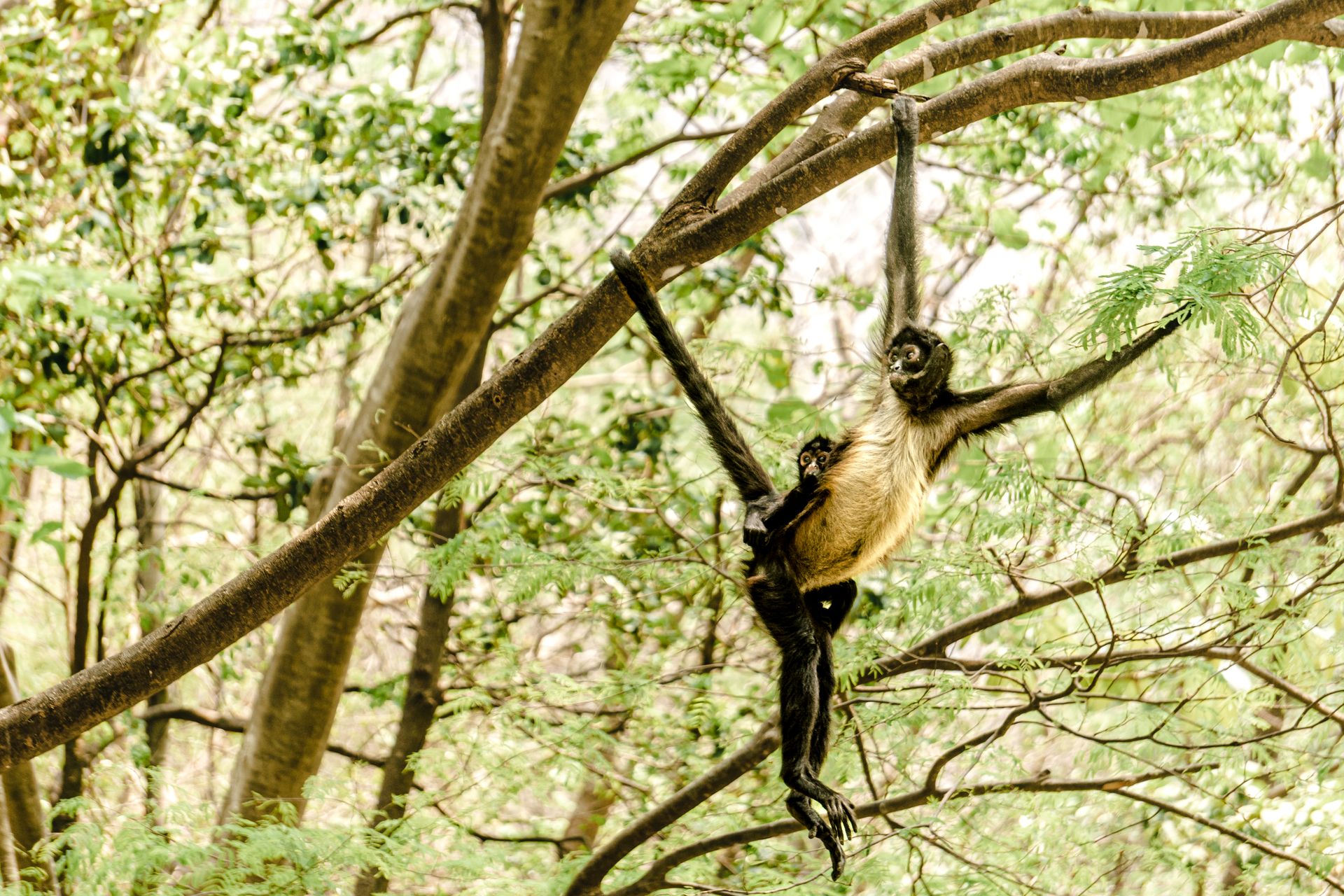
Its tail is quite impressive, measuring up to 1 m (40 in) long. This prehensile tail is a vital part of its brachiation, allowing it to swing through the trees with ease.
The Peruvian spider monkey has four elongated fingers, which are perfect for grasping onto branches. However, it has virtually no thumb, a trait that's typical for spider monkeys but unusual for other monkeys.
Its agility is unmatched, comparable only to the gibbon of Asia. This allows it to navigate the trees with incredible speed and precision.
The Peruvian spider monkey's life span is relatively long, up to 20 years. This is a testament to its adaptability and resilience in its natural habitat.
A different take: Where to See Monkeys at Silver Springs
Growth and Reproduction
The Peruvian spider monkey's reproductive period is quite flexible, spanning throughout the year, though most offspring are born at the start of the Autumn season.
The gestation period for a spider monkey is approximately 140 days, which is a relatively short time for a primate.
A pregnant female spider monkey will often leave her group to give birth and returns 2-4 months later, showing a strong instinct to care for her young.
Newborn spider monkeys are surprisingly independent, able to fend for themselves at around 10 months old.
Conservation Status
The Peruvian spider monkey is currently listed as Endangered on the IUCN Red List of Threatened Species.
Its population has declined by at least 50% over the past 45 years, with researchers suggesting that the species may effectively occupy only 28% of its entire range.
Conservation efforts are underway, but there's still much work to be done. Only 32% of the species' area of occupancy is legally protected.
A fresh viewpoint: Squirrel Monkey Species Common Characteristics
Habitat loss and degradation are major concerns, with 31-40% of the species' habitat expected to be lost by 2050. This is largely due to the expansion of agriculture and illegal mining activity.
The Amazonian bushmeat trade also poses a significant threat, with hunters targeting these monkeys for sale and consumption.
Broaden your view: Brown Spider Monkey Habitat
Similar Species
The Peruvian spider monkey has several close relatives, including the Central American spider monkey and Geoffroy's spider monkey (A. geoffroyi). These species can be distinguished by their number of chromosomes, with the Peruvian spider monkey having 34, compared to 32 in the red-faced spider monkey.
One of the closest relatives of the Peruvian spider monkey is the white-bellied spider monkey (A. belzebuth). They share many characteristics, including a prehensile tail and a thumbless hand.
Other related species include the brown spider monkey (A. hybridus) and the species' closest relative the white-bellied spider monkey (A. belzebuth). They all have a prehensile tail, a thumbless hand, and other characteristics that are found in all spider monkeys.
Here are some of the related species of the Peruvian spider monkey:
- Central American spider monkey
- Geoffroy's spider monkey (A. geoffroyi)
- Brown spider monkey (A. hybridus)
- White-bellied spider monkey (A. belzebuth)
Their Habitat
Peruvian spider monkeys live in central-northern Bolivia, north-eastern Peru, and central-western Brazil. They've even been spotted in a new area in Brazil near the Solimões River, likely due to a change in the river's path.
Their home ranges can vary in size, but typically span about 20 square kilometers or 8 square miles. This shared space is often inhabited by other spider monkeys, woolly monkeys, and howler monkeys, leading to competition for food and space.
They're adaptable and can be found in lowland forests, dry, hilly areas, and even Amazonian forests that flood during certain seasons.
Readers also liked: Costa Rican Monkeys
Their Diet
Peruvian spider monkeys eat a wide variety of foods, including leaves, berries, flowers, and fruits.
Fruits make up a big part of their diet, and they help spread seeds for many trees in the Amazon by eating and then depositing the seeds in new locations.
They also eat small animals like birds and frogs, as well as insects like termites and grubs.
In the Amazon, groups of these monkeys change their food search patterns depending on when juicy fruits are available.
If fruit is scarce, they will eat more leaves to make up for it.
For more insights, see: Cats Eat Spider Webs
Endangered Reasons
The Peruvian spider monkey is in grave danger due to hunting and habitat destruction.
Their numbers have dropped by at least 50% in the last 45 years.
Experts believe that the monkeys might only live in 28% of their original home range.
Only 32% of the areas where they live are legally protected.
Hunters target these monkeys, selling and eating them in the Amazonian bushmeat trade.
Forests in the southern part of their home are being cleared for farms, further threatening their habitat.
Mining in the southwestern Peruvian region of Madre de Dios is also harming their home.
Even in protected areas, people still illegally cut down trees and take wildlife in Peru.
Large monkeys like spider monkeys often disappear first in places with a lot of hunting and farming.
Scientists at Reserva Ecologica Taricaya are working to help by reintroducing the monkeys along the lower Madre de Dios river.
If this caught your attention, see: Monkeys from India
Interesting Facts
Spider Monkeys have a unique genitalia feature - females have long, pale genitalia, which might confuse the casual onlooker.
These primates are social animals and engage in social grooming between females and their offspring, rather than between mates.
Spider Monkeys are found in the high strata of lowland rainforests, where they need to move between areas with patchy food resources like fruits and flowers.
In the wild, you can spot Spider Monkeys by watching the canopy in lowland forests, listening for rustling leaves and long limbs, and looking upwards.
Here are some fun facts about Spider Monkeys:
- Black Spider Monkeys can only live in super healthy rainforests with lots of well-preserved resources.
- Where you find Spider Monkeys, you'll find plenty of other species, like smaller monkeys, macaws, jungle pigs (peccaries), and even jaguars!
Featured Images: pexels.com