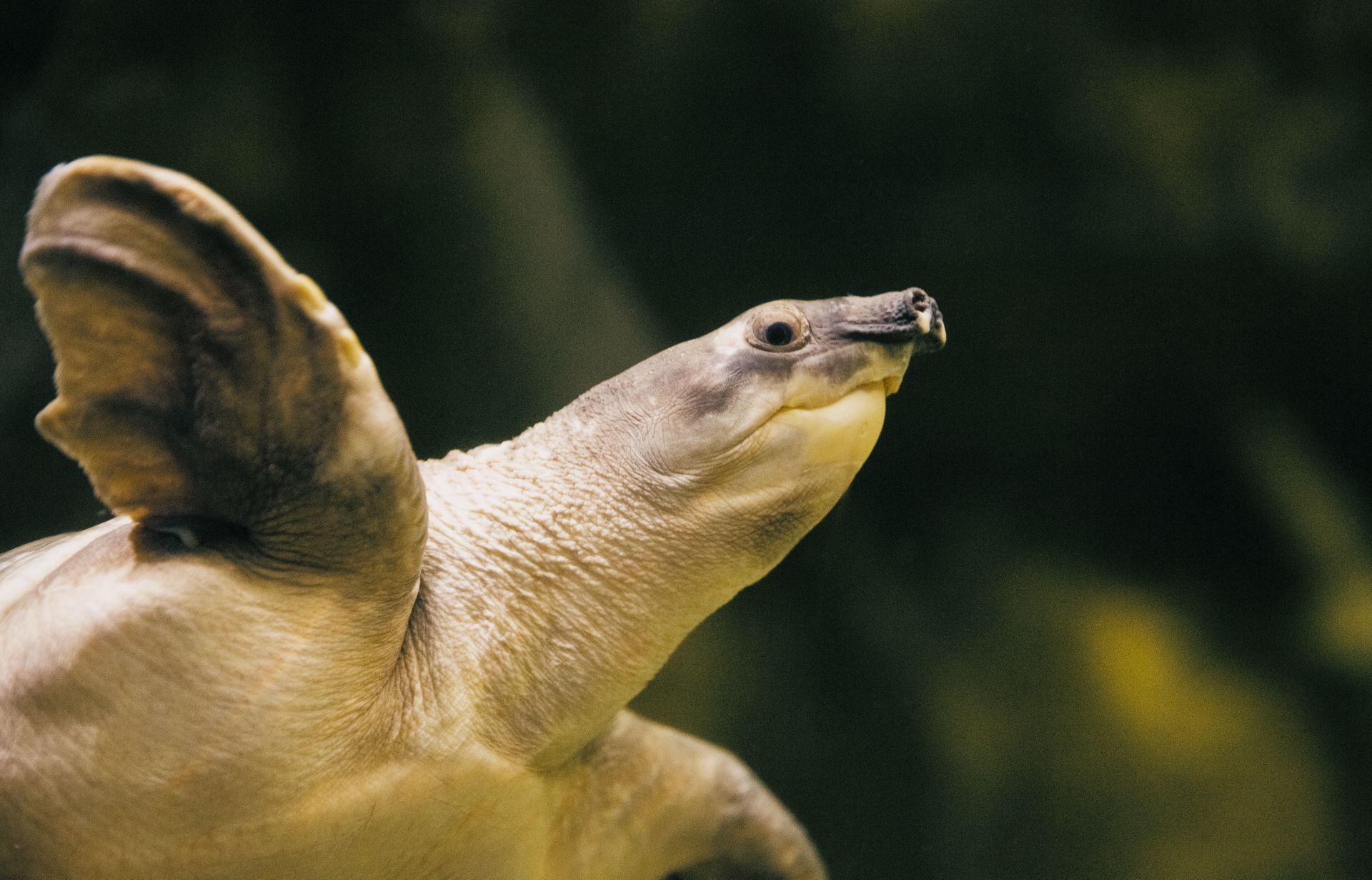
The Pelodiscus species is a group of turtles that are native to Asia and are characterized by their distinctive shell shape and size. They can grow up to 35 cm in length.
Pelodiscus species are primarily aquatic animals, living in freshwater environments such as rivers and lakes.
Pelodiscus Sinensis (Wiegmann, 1835)
Pelodiscus Sinensis (Wiegmann, 1835) is a fascinating species within the Pelodiscus genus. This species, also known as the Chinese softshell turtle, has been farmed and collected as food across Asia.
One interesting adaptation of this species is the ability to absorb oxygen through their skin and the lining of the throat when fully submerged in water. This unique ability allows them to thrive in aquatic environments.
As pets, Chinese softshell turtles have become popular in many parts of the world, including California and Italy. Their odd appearance makes them a favorite among turtle enthusiasts, despite the challenges of caring for them.
A different take: Asiatic Softshell Turtle
However, their leathery soft shells make them susceptible to infection and injuries. It's essential to keep their habitat clean to prevent shell fungal infections, which can be detrimental to their health.
If you're considering keeping a Chinese softshell turtle as a pet, be prepared for their agility in the water and their hunting prowess. They will bite and scratch if touched, so handling them requires care and caution.
Here's a quick rundown of some key characteristics of the Chinese softshell turtle:
- Species name: Pelodiscus sinensis (Wiegmann, 1835)
- Preferred habitat: Aquatic environments
- Special adaptation: Absorbs oxygen through skin and throat lining
- Challenges as pets: Leathery soft shells, requires clean habitat, can be aggressive
Habitat
To create a suitable habitat for your Pelodiscus, also known as the Chinese softshell, you'll need a large tank that can hold at least 120 gallons of water.
These turtles are messy and territorial, so a single turtle per tank is recommended to prevent aggression and infections.
A powerful water filter is essential to keep the tank clean, and a filter rated for an enclosure twice the size of your turtle's tank will do the trick.
The ideal water temperature for your Chinese softshell is between 75 and 84 °F, which can be achieved with an aquarium heater like the Hygger Titanium Aquarium Heater.
Providing a basking area is crucial for your turtle's health, as it allows them to regulate their body temperature and prevent infections.
A basking platform like the Penn Plax Above-Tank Basking Platform will give your turtle the space they need to bask and dry off.
A reptile-specific UVB light will not only keep the basking platform warm but also provide your turtle with the ultraviolet rays needed for vitamin D3 synthesis.
Don't forget to add some cool fluorescent lights to the tank, and consider using a timer to mimic the passage of day and night.
Reproduction and Conservation
They reach sexual maturity from ages 4 to 6, with a mating period that usually lasts from March to September, although it's shorter in Japan, spanning only from May to July.
Females retain sperm from males up to almost a year, during which time they will lay eggs in clutches, typically between 2 to 5 clutches a year.
Each clutch usually contains 8 to 30 eggs.
Breeding
Breeding is a vital part of a species' life cycle, and this one is no exception.
Both females and males of this species reach sexual maturity from ages 4 to 6.
Their mating period is usually between March to September. This means that during these months, they are busy finding a mate and starting their reproductive journey.
Females will retain sperm from the male up to almost a year, which is a remarkable ability that allows them to store it for a long time before fertilizing their eggs.
They will then lay the eggs in clutches, between 2 to 5 clutches a year, which is a significant number of offspring in a relatively short period.
Each clutch is usually made up of 8 to 30 eggs, which is a wide range of possibilities for the number of babies born at one time.
In Japan, however, they mate only between May and July, which is a slightly shorter mating period compared to other regions.
Endangerment
The Chinese softshell turtles are listed as a vulnerable species by the International Union for Conservation of Nature.
Their vulnerable status is largely due to the loss of habitat, which is a significant threat to their survival.
Featured Images: pexels.com


