The Northern Crested Caracara is a bird of prey that's found in the southwestern United States and northern Mexico. It's a member of the falcon family, but don't let that fool you - it's actually a scavenger that feeds on carrion and small animals.
One of the most distinctive features of the Northern Crested Caracara is its crest, which is a fleshy growth on top of its head that gives it a rather regal appearance. This crest is made of skin and feathers, and it can be raised or lowered depending on the bird's mood.
These birds are known for their intelligence and adaptability, and they've been observed using tools to get to their food. They've even been seen using rocks to crack open eggs and shells.
The Northern Crested Caracara is a medium-sized bird, with a length of about 20 inches and a wingspan of around 3 feet. They have a distinctive black crest and wings with a gray back and white underside.
Intriguing read: Yellow Headed Caracara
Biology and Behavior
The northern crested caracara is a bird of remarkable adaptability, thriving in a variety of environments.
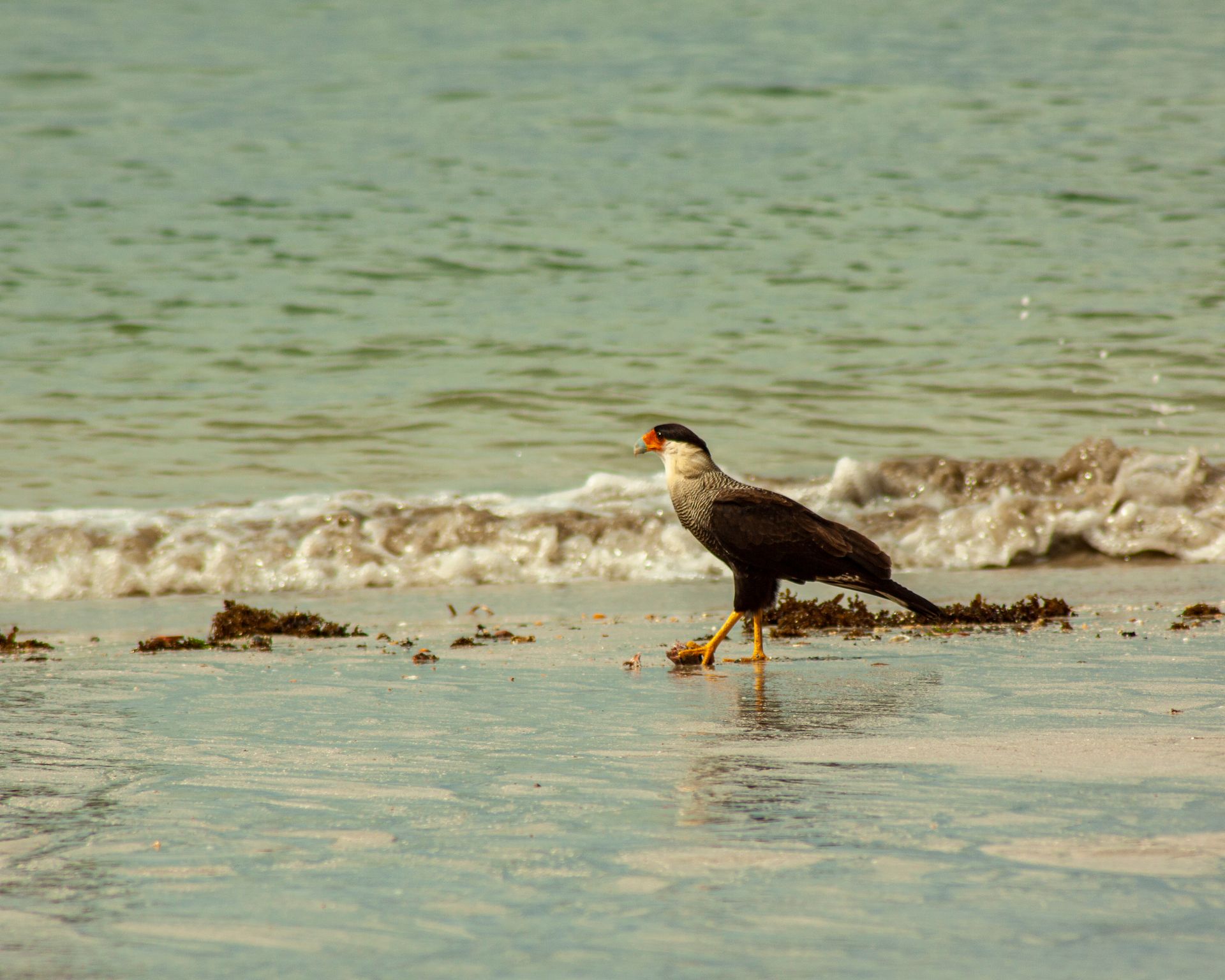
They are members of the falcon family, known for their agility and speed in the air, but they're often seen foraging on the ground, using their strong legs to walk and search for food.
Caracaras are opportunistic carnivores, eating just about anything they can find, from insects to small mammals and even carrion.
Peak breeding season occurs during the dry months from November to April, when the weather is cooler and food is more scarce.
Egg-laying typically follows the decline of precipitation in the fall, and mated pairs remain in their territory year-round, often nesting in the same tree or spot year after year.
Fledglings will often beg their parents for food, and it's not uncommon to see large groups of young caracaras gathering in specific areas, such as improved pastures in south-central Florida.
These congregation areas can be quite large, covering extensive areas of land.
In the wild, northern caracaras are known to steal food from other birds, including vultures, and will even follow trains or automobiles to scavenge for food that's been discarded.
They're also skilled hunters, catching live prey that's often immobile or injured.
Northern caracaras can usually be spotted alone, in pairs, or in small family groups, and they're known to roost in large numbers when food is abundant.
Fast Facts
The northern crested caracara is a fascinating bird with some unique characteristics. Here are some fast facts about this species:
They often jump on prey on the ground, kill them, and then carry them with their beaks. This behavior is quite different from other raptors.
Their talons and toes are flatter than those of other members of the falcon family. This allows them to walk and run along the ground more easily.
Caracaras regurgitate items they cannot digest, producing pellets that contain insect exoskeletons, animal hair, and plant matter. It's a clever way to deal with indigestible food.
Young individuals can congregate and roost in groups of up to several hundred individuals. This is a great example of social behavior in the wild.
Habitat and Distribution
The northern crested caracara is a bird of open and semi-open country, typically living in lowlands but also found in mid-elevation areas of the Northern Andes.
They prefer habitats with scattered trees, shelterbelts, and small woods, and can thrive in areas with a somewhat limited human presence. This is why you often find them in cattle ranches and other agricultural lands.
In Florida, the non-migratory population of northern crested caracaras can be found throughout the year, particularly in southern and central portions of the state. They've even adapted to living in improved pastures with non-native or exotic grasses for cattle to eat.
Habitat
Caracaras can be found in a variety of open and semi-open habitats, including lowlands and mid-elevation areas in the Northern Andes.
They typically live in areas with scattered trees, shelterbelts, and small woods, as long as there is a somewhat limited human presence.
Caracaras are most common in cattle ranches, where they can be seen foraging in pastures planted with non-native or exotic grasses for cattle to eat.
The presence of trees, especially cabbage palms, is important in these pastures, as caracaras use them as nest platforms.
In addition to cattle ranches, caracaras can also be found in other types of agricultural land, such as prairies and coastal woodlands, including mangroves.
Distribution
Caracaras can be found in a variety of habitats, including grasslands and improved pastures with non-native grasses.
The northern crested caracara is a resident in Central America and northern South America, as far south as Brazil, within suitable grassland habitat.
Caracaras are also found in the United States, specifically in Arizona, Texas, and Florida, where they are most abundant in southern and central portions of the state.
In Florida, the caracara population is non-migratory and is distinct from populations in Latin America and the western United States.
The northern caracara is a resident in Cuba, northern South America, and most of Central America and Mexico, just reaching the southernmost parts of the United States, including Florida, where it is resident but listed as threatened.
Caracaras can be found in open and semi-open country, and have been spotted as far north as San Francisco, California, and even in the upper peninsula of Michigan.
On a similar theme: Southern Crested Caracara
Identification and Variation
The northern crested caracara is a large bird, measuring 50-65 cm in length and having a wing-span of up to 130 cm.
It's worth noting that the size of the caracara can vary depending on its location, with birds from the southernmost part of its range being the largest, and those from tropical regions being the smallest.
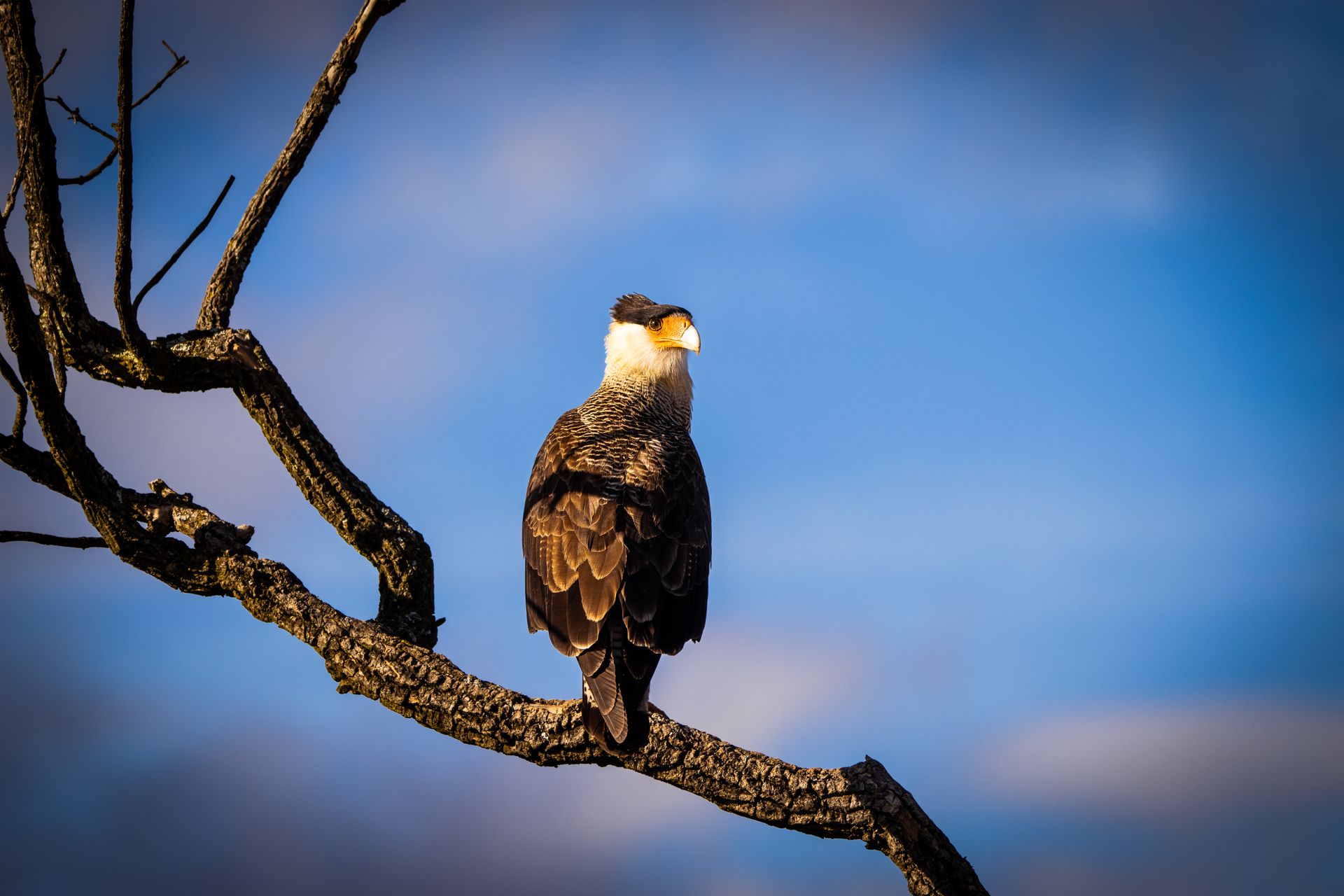
The northern crested caracara has a distinctive plumage, with a dark brownish cap, belly, and thighs, as well as a whitish-buff throat, ear-coverts, and nape.
Consider reading: Northern Crested Caracara Diet
The wings and tail-tip are also dark brownish, while the chest, neck, mantle, back, and tail are whitish-buff barred with dark brownish.
In flight, you can see a large whitish-buff patch on the outer primaries, giving the caracara a striking appearance.
The legs of the northern crested caracara are yellow, and the bill is pale bluish-horn, while the facial skin and cere can range in color from deep yellow to reddish-orange.
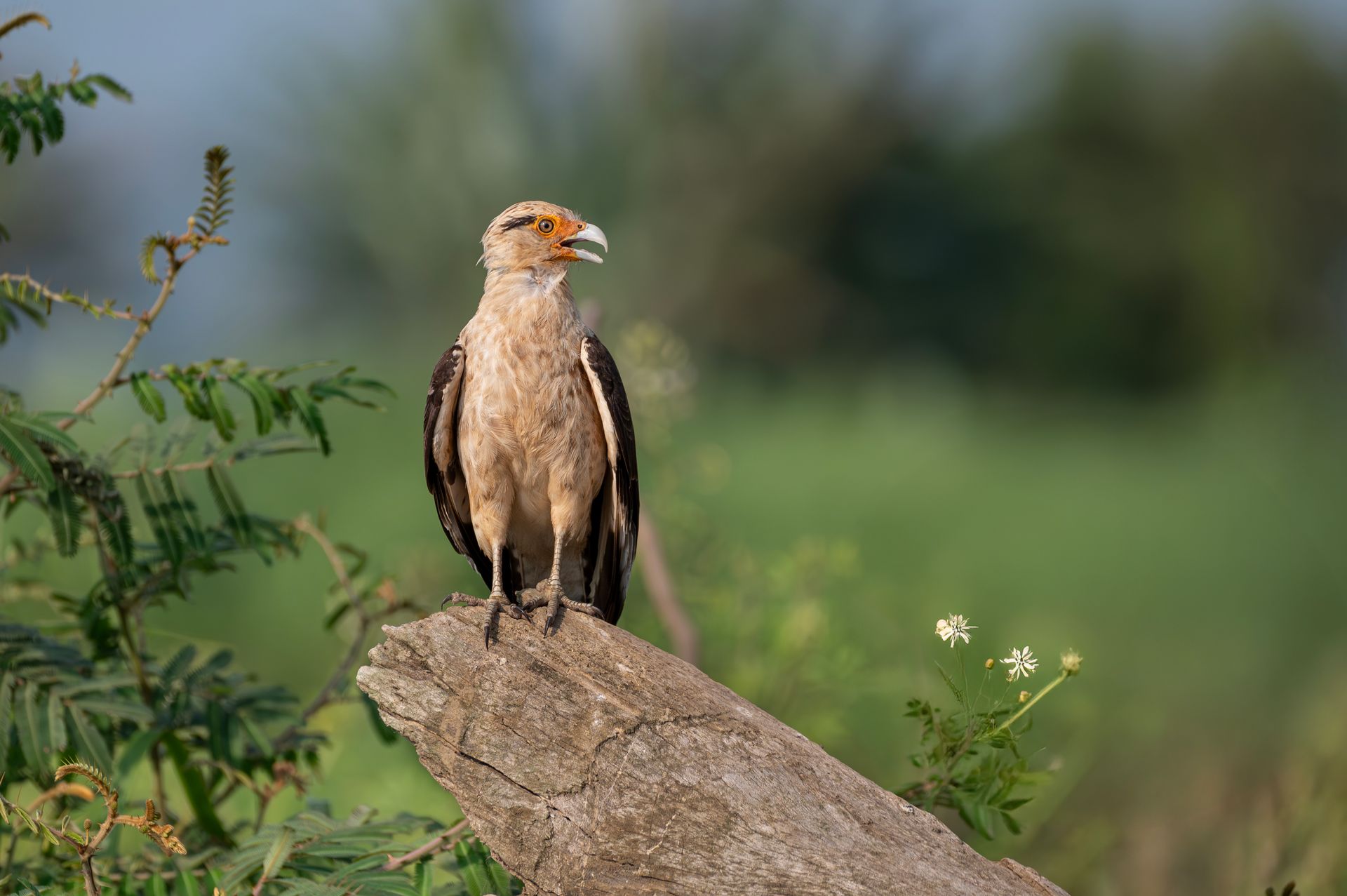
Juveniles resemble adults, but are paler, with streaking on the chest, neck, and back, and grey legs.
The northern subspecies of the crested caracara has some distinct differences in plumage compared to the southern subspecies, including a white chin, side of head, and neck, and less barring on the back and underside.
However, recent reports indicate that there is extensive hybridization where the two forms meet in the Amazonian area, and they have been lumped back into one species.
Taxonomy and Classification
The northern crested caracara's taxonomy is a bit complex. The species was formerly considered to be two separate species, with the northern subspecies being known as the Crested Caracara.
Its classification has changed over time, with recent reports indicating a large area of hybridization between the northern and southern subspecies in Amazonia. This has led to a reevaluation of the species' taxonomy.
The northern crested caracara is sometimes also included in the classification of the now extinct Guadalupe Caracara, which is no longer considered a valid classification.
Description and Appearance
The northern crested caracara is a striking bird with a distinctive appearance. It has a length of 49-58 cm (19-23 in) and a wingspan of 107-130 cm (42-51 in).
Its weight can vary greatly depending on its location, with birds in the north of its range averaging 1,117 g (2.463 lb) or more, while those in the tropics weigh less.
This bird is broad-winged and long-tailed, with long legs that it frequently uses to walk and run on the ground.
In flight, the northern crested caracara displays a very cross-shaped silhouette.
A different take: Northern Mocking Bird
Adult birds have a black body, wings, crest, and crown, with white neck, rump, and conspicuous wing patches.
The tail is white with black barring and a broad terminal band, while the breast is white with fine black barring.
Its bill is thick, grey, and hooked, and its legs are yellow.
The cere and facial skin are deep yellow to orange-red, depending on the bird's age and mood.
Sexes are similar in appearance, but immature birds have a more subdued coloration, with a buff neck and throat, and a pale breast streaked or mottled with brown.
The voice of this bird is a low rattle, which can be used to identify it in the field.
Adult northern crested caracaras can be distinguished from the similar southern caracara by their less extensive and more spotty barring to the chest, and more uniform blackish scapulars.
For another approach, see: Pure White Northern Inuit Dog
History
The northern crested caracara has a rich history in the grasslands of central and southern Florida. Early records from the 19th century show that caracaras inhabited a larger area in the state than they do today.
Historical accounts suggest that caracaras were associated with prairie-type habitats. The first specimen collected by Audubon was from Saint Augustine, which is outside of the current range.
Caracaras have persisted despite the reduction in native prairie habitat. They have adapted to living in improved pastures with non-native or exotic grasses planted for cattle to eat.
Featured Images: pexels.com