The North American cougar, also known as the mountain lion or puma, is a majestic and elusive animal. They are a type of big cat that roams the western regions of North America, from British Columbia, Canada, to the southern parts of South America.
One of the most fascinating facts about North American cougars is their incredible agility and strength. They can leap up to 45 feet in a single bound and reach speeds of up to 50 miles per hour.
North American cougars are solitary animals and have large territories, which they mark with scent to keep other cougars away. They are also skilled hunters, feeding on a variety of prey including deer, elk, and even smaller mammals like rabbits and rodents.
Their beautiful tawny or gray coats help them blend in with their surroundings, making them expert stalkers.
Physical Characteristics
The North American cougar is a majestic creature, and its physical characteristics are truly impressive. They can weigh between 115 to 220 pounds and average around 8 feet in length from nose to tail.
One of the most notable features of the cougar is its varied fur, which can range from light buff to reddish-brown or even silver-grey, with a white underbelly. Their ears and tail tip are also a darker color.
Their hind legs are larger than any other wild cat relative to their size, which allows them to jump incredibly high - up to 18 feet in a single bound.
Physical Appearance
Male cougars weigh between 115 to 220 lbs.
Their average length is around eight ft. from nose to tail, with a range of 4.9 to 9.0 ft.
Females are smaller, weighing between 64 and 141 lbs.
They average approximately 6.7 ft. in length.
Cougars that live closer to the equator are smaller than those that live further away.
The fur of the cougar is varied, from light buff to reddish-brown or even silver-grey.
Their underbelly is white, and the tip of the cat's tail and its ears are dark.
The hind legs of the cougar are larger than any other wild cat.
They can jump as high as 18 feet and horizontally up to 45 feet.
The cougar can also run up to 50 mph.
Mountain lions, also known as cougars, weigh between 110-232 pounds.
Females average about 40% the size of males.
Their coat is short and coarse, and is generally a yellow brown to gray brown color on their upper body.
Their throat and chest have white fur, while their bellies are a buff color.
This overall tawny color makes mountain lions very cryptic, allowing them to blend into their habitats.
Adolescents have paler coats than adults and are covered in dark spots on their flanks that fade after about 2.5 years.
Mountain lions have a distinctive pink nose surrounded by a dark border, accompanied by muzzle stripes.
Recommended read: Chinese Mountain Cat
Can Roar?
Cougars can't roar like other big cats. They're a bit unusual in that way.
Unlike other large cats, cougars can't make that loud, rumbling sound we often associate with roaring.
Here's an interesting read: Cats in New Zealand
Habitat and Behavior
North American cougars are generally solitary animals, only coming together with other cougars during mating. They have a strong instinct to mark their territory, which they do by leaving urine or feces in their path.
Cougars are most active during the day, typically roaming from dawn to dusk. This is when they're most likely to be seen in their natural habitat.
Cougar Behavior
Cougars are solitary animals and will avoid other cougars except during mating.
They mark their territory with urine or feces, and scratch the trunks of trees to leave their scent behind.
Cougars are primarily active during the day, from dawn to dusk.
Sightings in the US
Sightings in the US have been reported in various locations, including areas where the North American cougar was once thought to be extirpated.
California, Minnesota, Connecticut, and Illinois have all had reported cougar sightings. These sightings suggest that cougars may still exist in areas outside of their known habitats.
Discover more: Cougar Puma Concolor
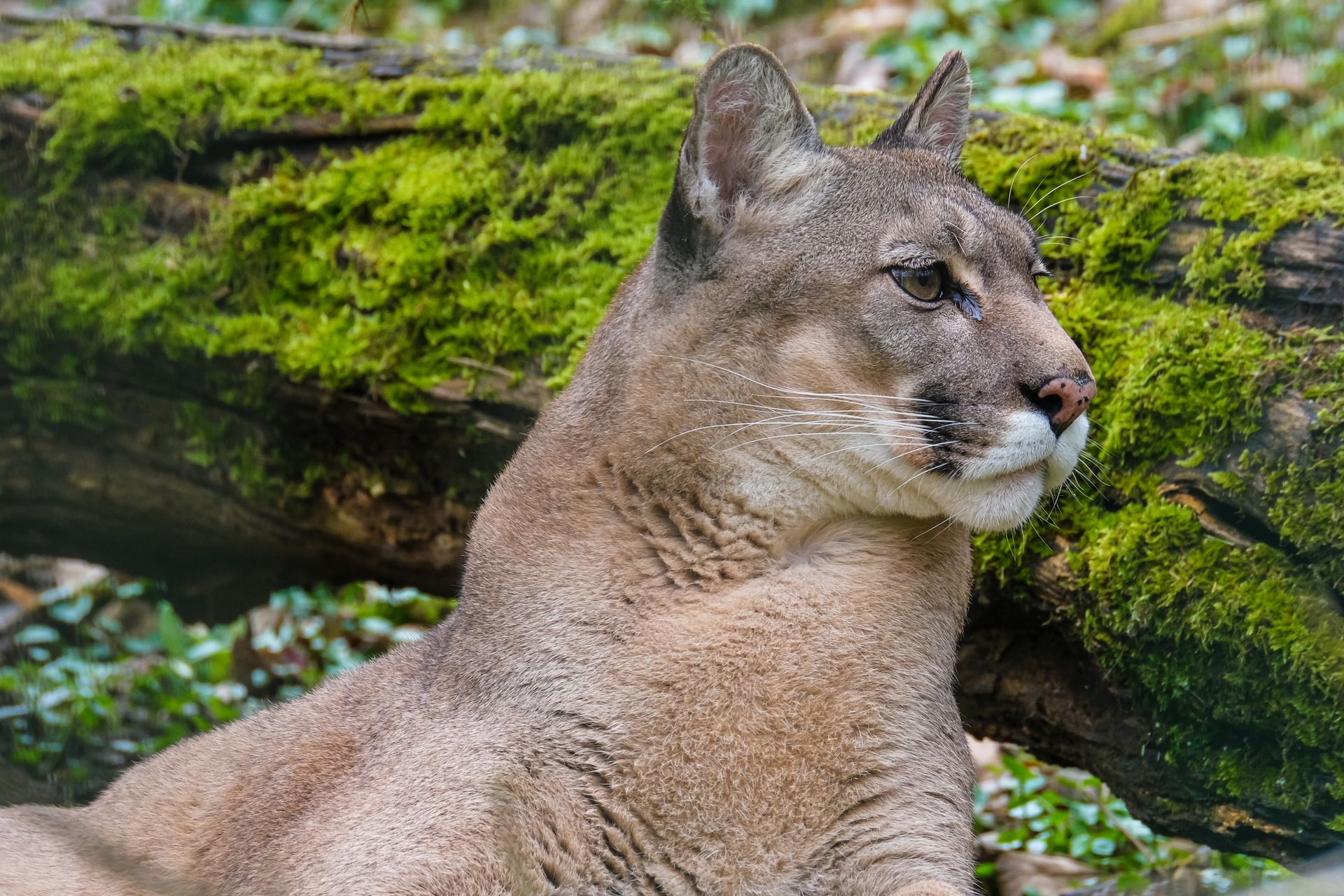
Some of these sightings have been confirmed, such as the one in Illinois in 2013, where a cougar was found on a farm and subsequently shot by a wildlife officer.
In addition to these confirmed sightings, there have been unconfirmed reports of cougar sightings in other states, including Maine and New Hampshire.
Hunting and Diet
Cougars rely heavily on sight when hunting, making them skilled and cunning predators. They can leap over 6 m (20 ft.) to catch their prey off guard.
Their diet consists mainly of deer, which make up between 60 – 80% of their meals. This preference for deer can vary depending on their location.
Cougars are known to feed on smaller animals, including rodents, sheep, cattle, horses, and insects, if necessary. They've even been known to eat domestic animals and livestock.
After killing a large animal, a cougar will typically hide the carcass and eat it over the next few days.
A fresh viewpoint: Animals Smarter than Dogs
Mating, Reproduction, Lifespan
Cougars are solitary creatures for most of their lives, only interacting to mate which can happen at any time of year.
Females give birth to a litter of 2-3 babies, called kittens or cubs, and raise them on their own.
The average litter size is three cubs and each of the babies weigh a little over a pound (500 grams).
Cougars have a 90–96 day gestation period, allowing the breeding process to continue throughout the year.
Most females will have a litter once every two to three years.
The average size of a litter is two cubs, ranging from one to six.
Cubs will leave their mother at around two years of age.
A healthy cougar in the wild can live to around 10 years of age.
In captivity, cougars can live as long as 20 years.
Readers also liked: How Big Do Akitas Get
Conservation and Threats
The north american cougar is a majestic creature, but its population is facing significant threats.
Historically, the cougar's range spanned from British Columbia, Canada, to the southern Andes.
Habitat loss and fragmentation are major contributors to the decline of the north american cougar population.
Cougars are highly territorial animals and require large areas of habitat to roam and hunt.
A lack of prey in fragmented habitats makes it difficult for cougars to survive, further exacerbating the decline of their population.
Human activities such as logging, mining, and urban development have led to widespread habitat destruction.
The north american cougar is also threatened by human-caused mortality, including poaching and vehicle collisions.
Cougars are often killed by hunters who mistake them for other animals, such as deer or elk.
Interesting Facts About
The North American cougar is a majestic creature, and there's so much to learn about it. The fourth largest cat of all wild cats, it's a force to be reckoned with.
One of the most interesting things about cougars is that they have more names than any other animal - a world record! This is likely due to the many different names used by various cultures and languages.
Cougars are not typically considered apex predators, as bears and sometimes wolves hold that title in their habitats. This is a reminder that even the largest predators have their place in the ecosystem.
Their hind legs are larger in comparison to their body size than any other wild cat, making them incredibly agile and powerful. I can only imagine the speed and agility of a cougar in the wild!
Cougars don't roar like lions do, but instead make a sound that's often compared to a human scream. It's a haunting and unforgettable sound.
Here are some key physical characteristics of cougars:
- Body type similar to a domestic cat but larger
- Hind legs larger than any other wild cat
- Can retract their claws, leaving no claw marks in their paw prints
- Cubs have blue eyes and spots on their fur
The cougar's impressive physical abilities are just as impressive as their size. They can run up to 50 mph and hold the highest jump by a mammal - a whopping 23 feet!
Geographic Distribution
The North American cougar has a vast geographic distribution, spanning across various regions in Canada, the United States, and Mexico.
They can be found in different habitats, including deserts, forests, swamps, and mountain terrain, with a preference for locations with dense vegetation.
In the western United States, Southern Florida, and western Canada, several populations of North American cougars still exist and are thriving.
Their territories can be quite extensive, with male cougars roaming from 93 to 600 miles and females roaming between 65 and 310 miles.
The Ontario Puma Foundation estimates that there are 850 cougars in Ontario, while Quebec wildlife services consider them a threatened species in the province.
There have been confirmed sightings of cougars in New Brunswick, with at least three individuals found in Fundy National Park.
In eastern North America, the critically endangered Florida panther is the only unequivocally known eastern population of cougars.
Some scientists believe that small relict populations may exist in the Appalachian Mountains and eastern Canada, with around 50 individuals possibly living in these areas.
A different take: Florida Wild Turkey
Ecology and Culture
The North American cougar plays a vital role in regulating ecosystems as a large predator. This helps prevent the overpopulation of herbivorous prey like deer, which can lead to the destruction of vegetation and biodiversity.
They usually hunt at night and travel long distances to find food, using their strong jaws and large canines to kill their prey. This hunting strategy allows them to surprise unsuspecting prey and pounce when they least expect it.
Cougars are skilled and fast, able to maneuver easily and efficiently kill their prey. They also share the same prey as the jaguar in Central or North America, depending on the abundance of deer.
In some regions, cougars have been known to prey on bear cubs and feral horses, highlighting their adaptability and position at the top of the food chain.
Ecology
The North American Cougar plays a vital role in regulating ecosystems as a large predator. Its presence prevents the overpopulation of herbivorous prey like deer, which can result in the destruction of vegetation and biodiversity.
These big cats are apex predators, which means they exist at the top of their food web and aren't considered prey by other species. They exert a top-down regulatory influence on lower trophic levels, known as a trophic cascade.
Mountain lions are skilled hunters that usually stalk their prey at night, using their strong jaws and large canines to efficiently kill their prey. They can remain hidden for hours to surprise unsuspecting prey.
The North American Cougar's diet consists of deer, elk, mountain goats, moose, and bighorn sheep, which they hunt in their territories. They also prey on bear cubs and feral horses in certain regions.
Their presence has a ripple effect on their ecosystems, influencing processes affecting aquatic species like amphibians by stabilizing stream banks. They also promote tree recruitment and allow for the regeneration of over-browsed vegetation.
In some areas, mountain lions have been known to cache their kills, providing food subsidies for species like bears and vultures. This unique behavior highlights the importance of these big cats in their ecosystems.
Recommended read: Big Hairy Armadillo
Culture

Cougars are part of the culture of many different indigenous tribes throughout South and North America. They have a special place in the traditions and stories of these communities.
Cougars also appear in Appalachian folklore, which highlights their significance in the cultural heritage of the region.
Frequently Asked Questions
Is the North American term for puma or cougar?
The North American term for puma is cougar. However, the terms are often used interchangeably, and the distinction can be unclear.
Featured Images: pexels.com