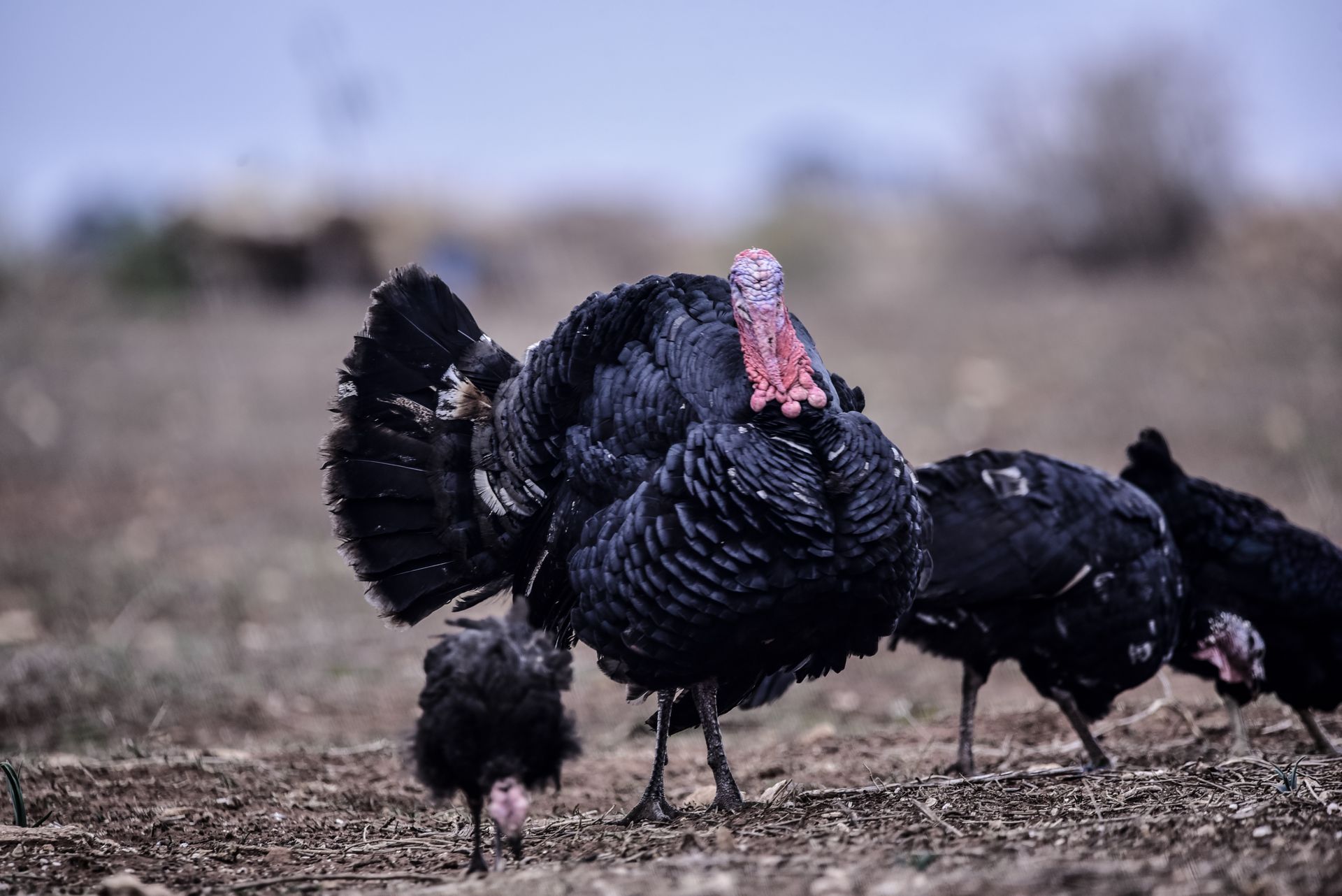
Florida's wild turkeys are a sight to behold, with their iridescent feathers and impressive courtship displays.
These birds are native to the state, with the first recorded sighting dating back to 1500.
Wild turkeys can be found in a variety of habitats, from pine flatwoods to scrub and oak hammocks.
Their omnivorous diet consists of fruits, leaves, insects, and small animals.
In Florida, wild turkeys are most active during the morning and late afternoon hours.
Wild Turkey Basics
The Florida wild turkey is a magnificent creature that's easily recognizable by its striking plumage. It features iridescent greens, browns, and reds that make them a sight to behold.
Males, also known as toms, have impressive beards and colorful wattles that make them stand out, especially during the breeding season.
What Is Osceola
The Osceola turkey is a unique subspecies of wild turkey found only in the state of Florida. It was named after Chief Osceola of the Seminole Indian Nation by ornithologist W.E.B. Scott in 1890.
This subspecies is prized by turkey hunters due to its small territory and population size, making it a challenging catch. They are considered one of the four subspecies of wild turkey, along with the Eastern, Rio Grande, and Merriam.
The Osceola turkey is found in the southern part of Florida, specifically south of State Road 70, where it can be hunted. The line of integration between the Osceola and Eastern turkey subspecies is a topic of debate, but hunting south of State Road 70 guarantees a true Osceola turkey.
The Osceola turkey is a significant part of Florida's natural heritage and cultural identity, named after a renowned Seminole leader who played a crucial role in resisting the U.S. government's attempts to remove the Seminole people from their ancestral lands.
Recommended read: What Is the State Bird of Colorado
Wild Species
The Florida wild turkey is a symbol of the great outdoors and a testament to successful conservation efforts. These magnificent creatures are easily recognizable by their striking plumage, featuring iridescent greens, browns, and reds.
There are two native sub-species present in the state of Florida: the Eastern wild turkey and the endemic Florida or Osceola wild turkey. The latter species was named after Muscogee (Creek) and later Seminole warrior Billy Powell, known as Asi-yahola (English spelling: Osceola).
The Osceola wild turkey is considered the toughest species to call in, and its gobbles don't carry as far due to the dense humidity and vegetation in Florida. Adult males weigh approximately 20 pounds, and adult females weigh 8 to 12 pounds.
Here are some key differences between the Osceola and Eastern wild turkeys:
- Dark-brown tips on tail feathers
- Mostly black wings with very small white bands
- Long legs
- Strong gobbles
- Very long spurs
- Shorter beard lengths than Easterns
Osceolas often roost in live oaks, cypress, and red pines, especially along creeks, rivers, and lakes. Natural foods for them include plant material, worms, insects, and even small amphibians.
Habitat and Behavior
Florida wild turkeys are incredibly adaptable birds, thriving in a variety of habitats from lush hardwood swamps to open pine forests. They're able to find food in diverse environments, including seeds, berries, insects, and even small reptiles.
Their omnivorous diet is vital not just for their survival but also for the health of the ecosystems they inhabit, as they help disperse seeds and maintain plant diversity. Florida wild turkeys are also intelligent and aware animals, with great eyesight and hearing that allows them to detect potential threats from a distance.
To observe these fascinating birds, it's essential to quietly approach them from afar, as they can be easily spooked by sudden movements or loud noises.
Habitat
Florida's wild turkeys are incredibly adaptable, thriving in a variety of habitats including lush hardwood swamps and open pine forests.
Their omnivorous diet plays a crucial role in their ability to find food in diverse environments, including seeds, berries, insects, and even small reptiles.
To spot these intelligent birds, quietly observe them from afar to avoid scaring them off, as they have great eyesight and hearing.
Preferred habitats for Osceola turkeys include open woodlands, forested areas, flatwoods, and swamps, with differing amounts of coverage for nesting, roosting, finding mates, and more.
A good food source is just one characteristic of their preferred habitat; they also require an environment that offers good visibility and reduces hiding places for predators to approach them.
If this caught your attention, see: Turkey Meat for Dogs
Behavior and Diet
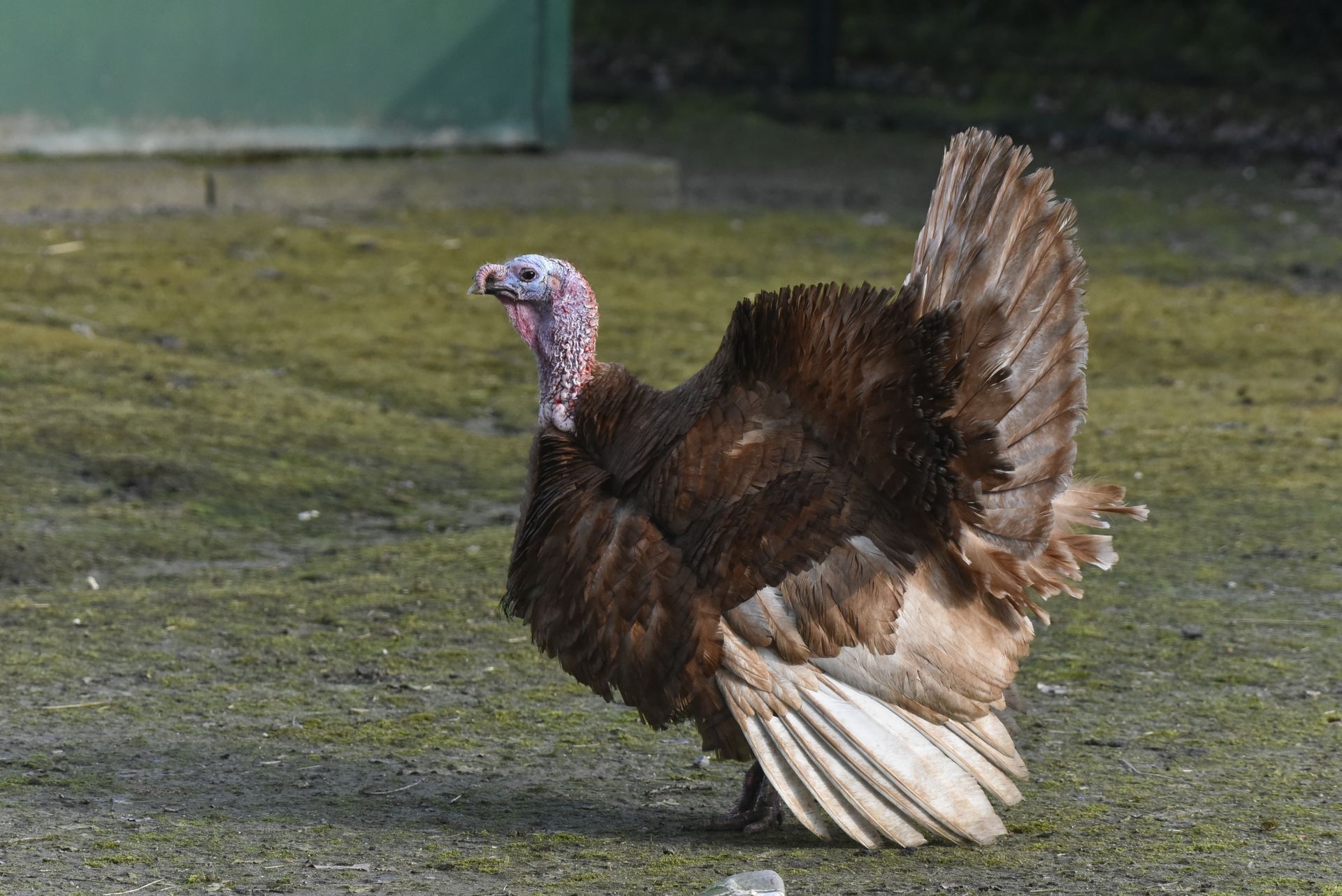
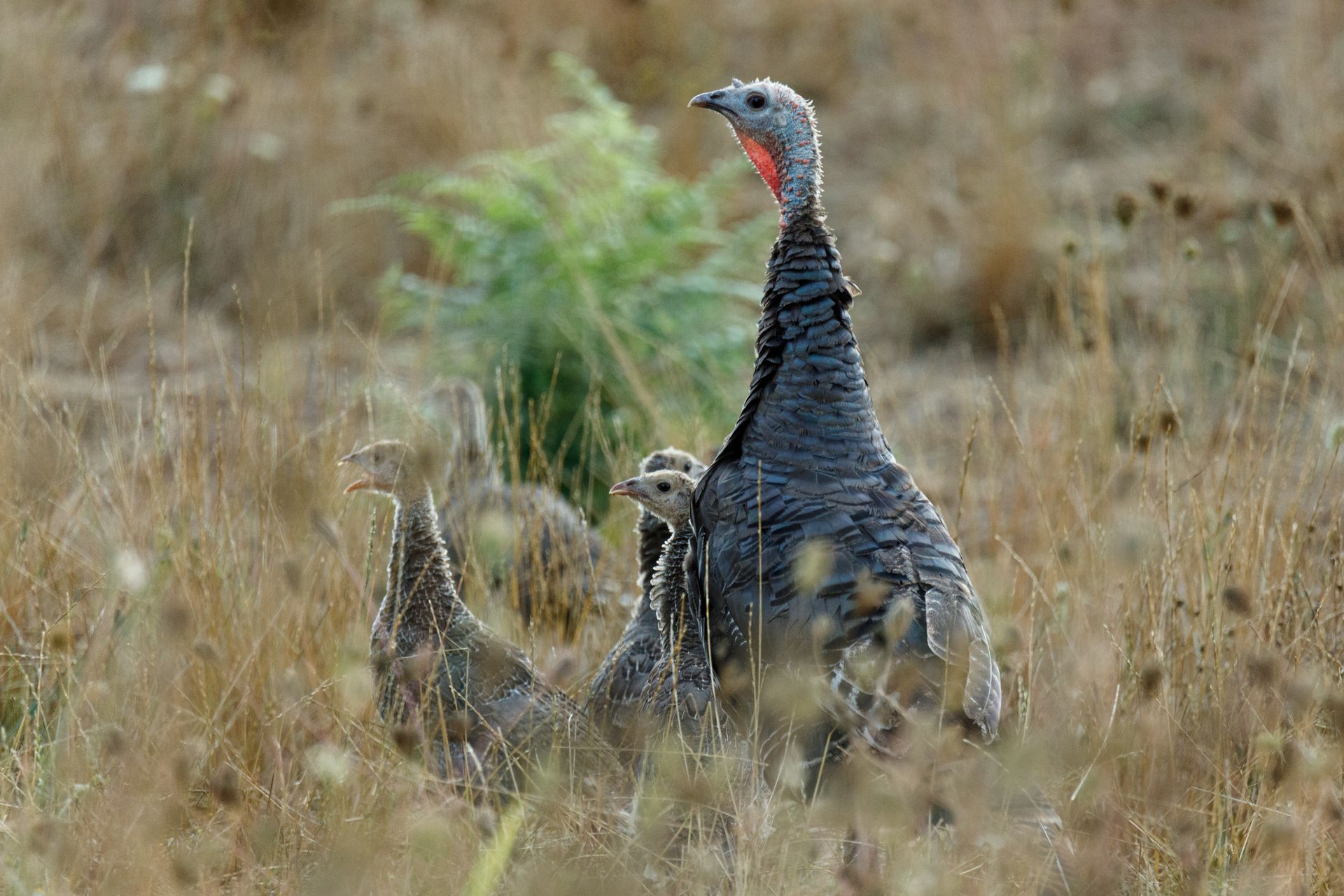
Wild turkeys are social birds that travel in medium to large flocks with a clear pecking order. They yield to larger, more dominant females or males, and flocks are usually separated by sex.
Members of the flock generally stick together, with hens and their young forming one group and toms forming their own flocks.
Turkeys make a wide range of vocalizations with different meanings and purposes. You can listen to recordings of many of their calls online to learn what those calls are communicating.
Wild turkeys have strong wings that can carry their bodies at speeds of up to 55 mph. They prefer to travel by land on their strong feet and long legs, scratching the soil as they forage through open woodlands.
As nomadic omnivores, wild turkeys can cover large areas as they follow what's "in season" and search for vegetation, fruits, nuts, seeds, and small reptiles and amphibians.
Conservation and Management
The Florida wild turkey has made a remarkable comeback thanks to dedicated conservation efforts, including sustainable hunting practices and habitat protection.
Various organizations advocate for seasonal regulations and limiting harvest quotas to ensure the long-term survival of the species.
The Federation is committed to conserving and restoring essential habitats across Florida, from the Ocklawaha River Basin to the Everglades to Gulf Conservation Area.
Through land conservation initiatives in the Ocklawaha area, FWF is actively working to restore habitats, benefiting the wild turkey population and supporting vibrant ecosystems.
Responsible wildlife management is essential to ensure future generations can continue to enjoy these magnificent birds and the unique landscapes they call home.
Human development and land conversion pose a significant threat to the Florida wild turkey, with Florida's wildlife and wild lands sharing this common threat.
Strategic conservation efforts are in place to protect Florida's wildlife, including the Osceola turkey, and wildlife habitat.
Florida has a large core base of public lands, which is unique for most eastern states, and there are strong public-land-acquisition and conservation-easement programs designed to combat development loss.
The Wild Turkey Cost-share Program, founded in 1994, plays a crucial role in improving wild turkey habitat on public lands throughout Florida, delivering over 800,000 acres of improved wildlife habitat in the last 10 years.
Landowners can take individual action to address conservation by educating themselves on land-management practices such as prescribed fires, forest industry practices, and food plot practices.
Recommended read: Wild Life Conservation
Wild Turkey Identification
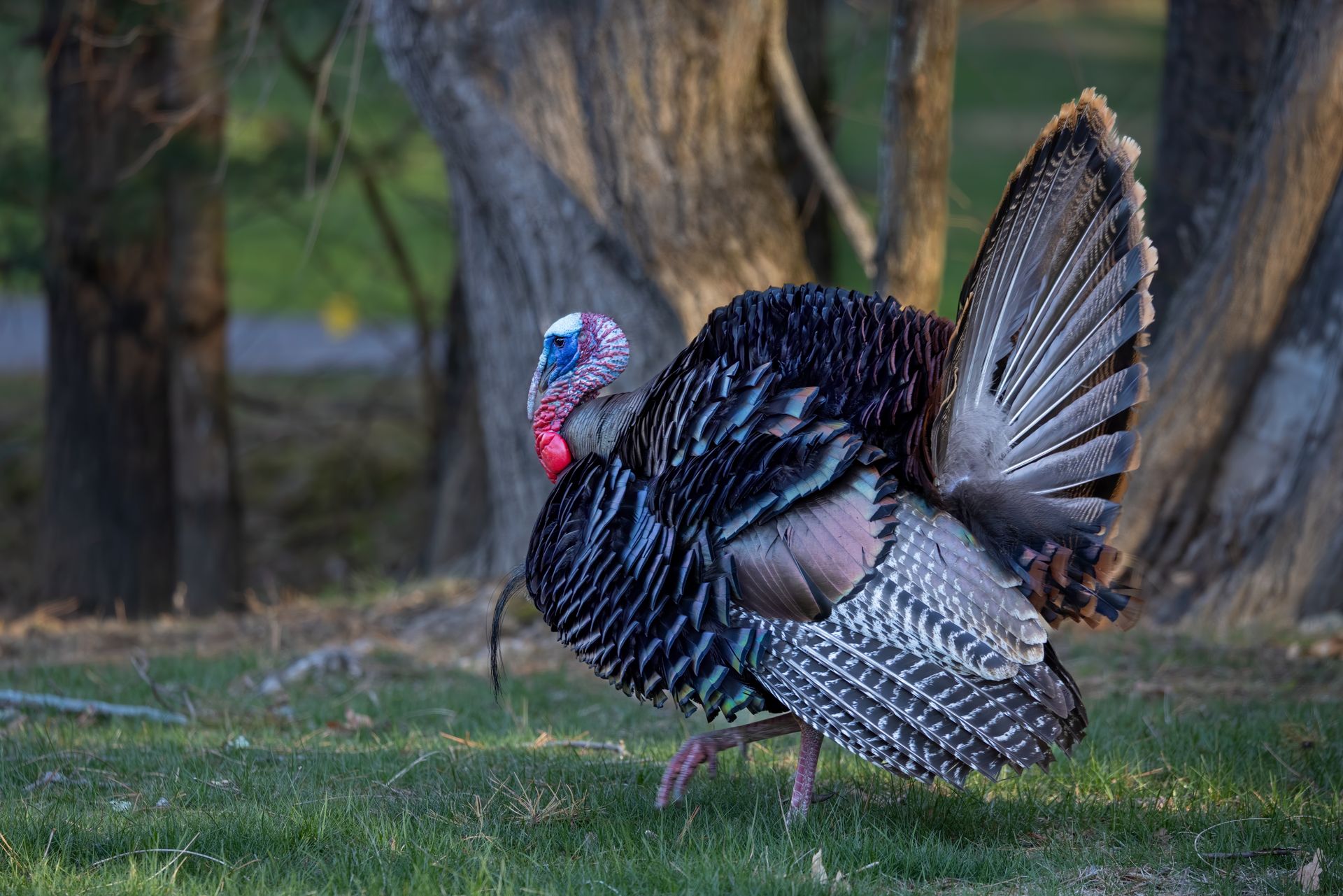
The Florida wild turkey, also known as the Osceola, is a unique subspecies that can be identified by its physical characteristics.
The Osceola wild turkey stands approximately 3.5 feet tall.
One of the key features of the Osceola is its dark coloration, with a chestnut brown and black body, and green, blue, and red iridescent feathers.
Look for the fan-shaped tail feathers, which are a distinctive feature of the Osceola.
Male turkeys have a more dramatic appearance, with a red wattle, fleshy caruncles, a long snood, and a beard.
Female turkeys are duller and more evenly brown, and may have less dramatic wattles, caruncles, and snoods.
Spurs, or long, sharp appendages, are present on the backs of male turkey legs, while those of females resemble smaller bumps.
Here are some key identification tips:
- Tallness: ~3.5 feet
- Legs and feet: Chicken-like skin and feet
- Body color: Chestnut brown and black
- Feather iridescence: Green, blue, and red
- Tail feathers: Fan-shaped
- Flight feathers: Narrow white bars
- Sex: Males have red wattle and beard, females are duller and more evenly brown
- Spurs: Males have long, sharp spurs, females have smaller bumps
Wild Turkey History and Status
The Florida wild turkey, also known as the Osceola turkey, is a symbol of the great outdoors and a testament to successful conservation efforts.
The Osceola turkey was named after Chief Osceola of the Seminole Indian Nation by ornithologist W.E.B. Scott in 1890, honoring a significant historical figure and highlighting the cultural importance of the wild turkey in Florida's natural heritage.
In Florida, two native subspecies are present: the Eastern wild turkey, found north of the peninsula and in the panhandle, and the endemic Florida or Osceola wild turkey, found only in peninsular Florida.
The Osceola's range is recognized by the NWTF as being in Dixie, Gilchrist, Alachua, Union, and Duval counties, and all counties south of them, with all birds north of these counties being Easterns.
The Osceola's overall status is positive, with a stable population and harvest rate for the last four to five years, according to Ricky Lackey, district biologist with the NWTF.
History, Status
The Osceola turkey has a rich history, and its name is a testament to the cultural importance of the wild turkey in Florida's natural heritage. It was named after Chief Osceola of the Seminole Indian Nation by ornithologist W.E.B. Scott in 1890.
Florida is the only place in the world to host Osceola turkeys, making them the most difficult of the four in the Grand Slam for most hunters to claim. Demand is high and supply is low.
The Osceola's range is limited to certain counties in Florida, with the NWTF recognizing turkeys in Dixie, Gilchrist, Alachua, Union, and Duval counties, and all counties south of them, as Osceolas. Birds north of these counties are Easterns.
The Osceola's range has not changed in the last 50 years, according to Ricky Lackey, district biologist with the NWTF.
Related reading: American Bald Eagle Range
Local Insight
The National Wild Turkey Federation has moved the line for true Osceola turkey sightings more north every year, based on demand rather than science.
Mark Clemons, a local turkey hunting guide, shared his expertise with me. He's with Everglades Adventures in Hendry County.
The original line for Osceola turkeys was set at SR70 in the 70's by Lovett Williams, the state biologist at the time.
In windy weather, a box call works best for turkey hunting, according to Mark Clemons.
A combination of two calls, like a box and a diaphragm, can sound like competing hens, which can be effective.
Mark Clemons uses all three types of calls: box, slate, and mouth call.
Using hen, jake, or strutting tom decoys depends on the hunter's goal.
Wild Turkey Photography
If you're looking to capture the beauty of Florida's wild turkeys, you're in luck - there are over 24,100 stock photos and images available to browse.
With such a vast selection, you can easily find the perfect shot to inspire your photography or simply appreciate the majesty of these birds.
You can browse through these stock photos and images or start a new search to explore more options, giving you endless opportunities to capture the perfect wild turkey photo.
Wild Turkey Surveys and Reports
The Wild Turkey Summer Survey is a great way to contribute to our understanding of these amazing birds. Every year from June 1 to Aug. 31, the FWC encourages everyone to report turkey sightings in Florida.
You can participate by submitting a report, which will help provide insight into annual nesting success, brood survival, and the distribution and abundance of wild turkeys. Last year, FWC received more than 4,000 reports of wild turkey sightings, spanning all 67 counties.
For more information or to submit a report, visit myfwc.com/hunting/turkey/brood-survey.
Wild Turkey Hunting and Scouting
To successfully hunt Osceola turkeys in south Florida, you need to be in the right habitat, which typically includes pine flatwoods and palm meadow flats.
You'll want to scout the area to find the turkeys' roost, where they sleep in tall trees like pine and oak. A roost is essentially a tree branch where turkeys perch for the night to hide from predators.
To scout, sit in a blind or behind cover to spot turkeys in the area. Once you figure out their roost, set up a natural blind or pop-up blind near the roost to prepare for the hunt. A feeder can also be set up in the area to keep the turkeys around, but be sure to place it at least 100 yards away from your blind to harvest a turkey legally.
Location Scouting
To find Osceola turkeys in south Florida, you need to be in the right habitat, specifically pine flatwoods and palm meadow flats. This is their natural environment.
Osceola turkeys in south Florida love to inhabit areas with tall trees like pine and oak, where they can roost safely. These trees provide a hiding spot from predators like bears, coyotes, and panthers.
To scout turkeys, you must go out and sit in a blind or behind some cover to hopefully find turkeys in the area. This is essentially hunting them, but without actually taking a bird.
Once you figure out where the turkeys are located, find out where their exact roost is. A roost is where turkeys go to sleep, and knowing its location can help you set up a natural blind or pop-up blind near it to prepare for the actual hunt.
You can also set up a feeder in the area to keep the turkeys around, but it must be at least 100 yards away from your hunting spot to be legal. This will help you understand their behavior and daily patterns.
Expand your knowledge: Hog Hunting with Dogs in South Carolina
Setting up a game camera pointed at the feeder can give you a time slot of when they are usually there feeding. This information can be invaluable in planning your hunt.
In south Florida, the best time to hunt turkeys is during the morning, afternoon, or evening when they are most active.
Spring Season Wrap-Up
Florida's 2021 Spring Turkey Season south of State Road 70 ended on April 11.
Hunters throughout the rest of the state had to wrap up their season by April 25.
The season bag limit on private land is two bearded turkeys.
For those without private land access or a quota permit, Green Swamp and Richloam WMAs offered daily access throughout the season.
These areas provided thousands of acres of empty woods that are home to plenty of gobblers.
Additional reading: Florida Wild Turkey Season
Osceola Range
The Osceola range is a unique and fascinating aspect of wild turkey hunting in Florida. The Osceola wild turkey (Meleagris gallopavo Osceola) is a subspecies found only in the state of Florida, with two native sub-species present: the Eastern wild turkey (Meleagris gallopavo silvestris) and the endemic Florida or Osceola wild turkey (Meleagris gallopavo osceola).
Osceolas are known for their striking appearance, with dark-brown tips on their tail feathers and mostly black wings with very small white bands. Adult males typically weigh around 20 pounds, while adult females weigh between 8 to 12 pounds.
One of the most distinctive features of the Osceola turkey is its strong gobble, which can be heard from a distance. However, the dense humidity and vegetation in Florida can reduce the distance at which gobbles can be heard, making it essential to get close to the birds.
Osceolas often roost in live oaks, cypress, and red pines, especially along creeks, rivers, and lakes. They feed on natural foods like plant material, worms, insects, and even small amphibians. Midday, gobblers seek refuge from the intense Florida heat underneath shade trees along field and pasture edges.
Here are some key characteristics of the Osceola turkey:
- Dark-brown tips on tail feathers
- Mostly black wings with very small white bands
- Adult males weigh approximately 20 pounds
- Adult females weigh 8 to 12 pounds
- Long legs
- Strong gobbles
- Very long spurs
- Shorter beard lengths than Easterns
- Considered the toughest species to call in
The longest Osceola beard length entered in the NWTF Wild Turkey Records is 19.125 inches, harvested in Lafayette, Florida, in 2008. The longest Osceola spur length entered in the NWTF Wild Turkey Records is 2.25 inches, harvested in Florida in 2014 and 1997.
Frequently Asked Questions
Can you eat Florida wild turkey?
Yes, Florida wild turkeys are edible, but it's essential to follow proper food safety guidelines and regulations before consumption
Where are the Osceola turkeys located?
The Osceola turkey is primarily found in southern Florida, with some debate surrounding the identity of birds in the northern parts of the state.
Featured Images: pexels.com