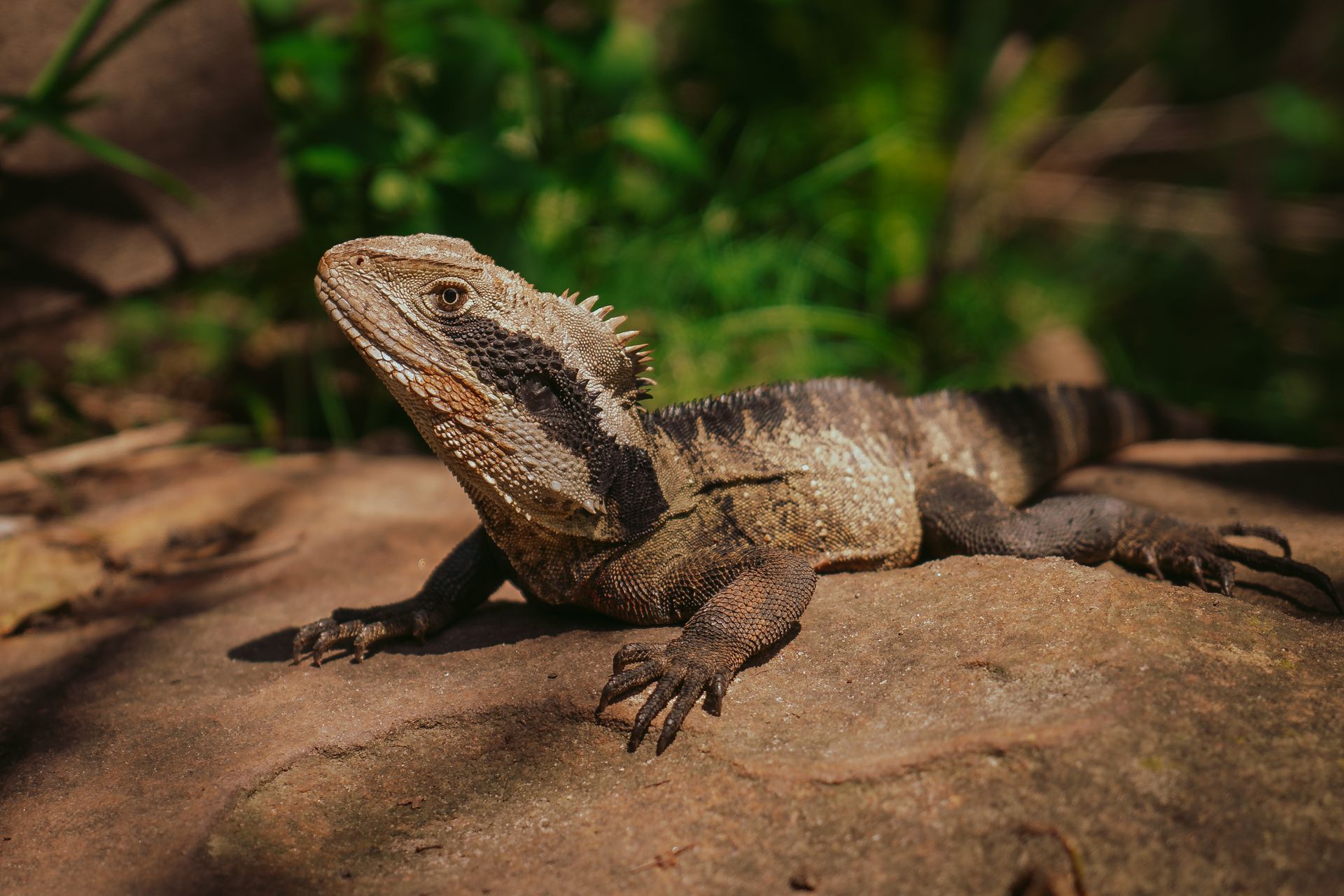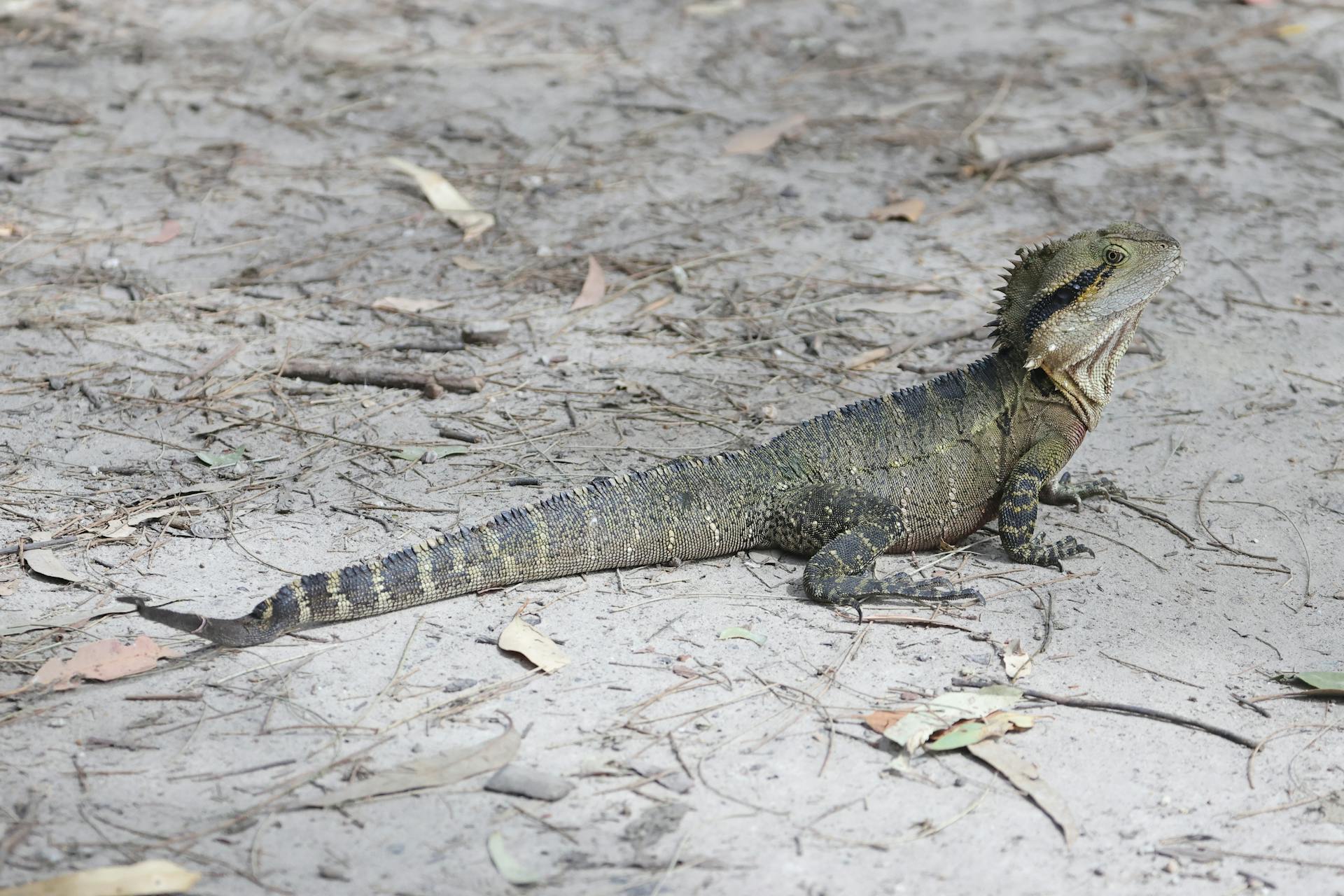
Australia is home to a diverse range of monitor lizard species, each with unique characteristics and habits.
Some of these species, such as the perentie, are found in the remote deserts and arid regions of the country.
These massive lizards can grow up to 2.1 meters in length, making them one of the largest monitor lizard species in the world.
Monitor lizards are carnivores, feeding on a variety of prey including insects, small mammals, and reptiles.
Their diet plays a crucial role in maintaining the balance of their ecosystems.
Goanna Behaviour
Goannas are surprisingly good climbers, and some species, like the Lace Monitor, are known as Tree Goannas because they spend a lot of time in trees.
They'll even climb brick walls to seek shelter in a thunderstorm, and young Lace Monitors are even more arboreal than adults.
Some species, like the Heath Monitor and Lace Monitor, will dig holes into the side of termite mounds to lay their eggs, where the termites will rebuild the nest around them, keeping them safe and at a constant temperature.
Goannas are fast runners and will sprint short distances on their hind legs to the safety of water or a tree, earning the Sand Monitor the nickname "Gould's Monitor" or "Racehorse Goanna" for its speed.
They'll also rear up on their hind legs to scare off attackers or fight, but they'll also do it to look around for threats from a higher vantage point.
Goanna Diet
Monitors eat just about anything they can catch and swallow whole.
Goannas are opportunistic feeders, which means they'll eat whatever is available. In northern Australia, they've even been known to crack open crocodile eggs for a snack.
Prey is dependent on the size of the goanna, ranging from insects to small reptiles and mammals. They'll also scavenge for carrion and are attracted to rotting meat.
Goannas have adapted to a range of environments, and their hunting methods vary accordingly. Some goannas are skilled tree-climbers, while others are expert swimmers or diggers.
Explore further: What Do Legless Lizards Eat
Goanna Reproduction
In the temperate regions, the breeding season takes place in the summer, which is the perfect time for these guys to get busy.
Male lace monitors fight each other by grappling while standing on their hind legs in the breeding season, and it's not uncommon to see up to six males vying for the attention of a receptive female.
Mating can take several hours, which is a long time to be wooing someone, but it's clear these goannas are serious about finding the right mate.
Females lay an average of eight eggs in active termite nests, either on the ground or in the trees, and they may even lay as many as 12 eggs in a single clutch.
If termite nests are in short supply, females will often fight over them or lay their eggs in burrows and hollow logs - it's a tough life, but someone's gotta do it.
The eggs overwinter to hatch 6–7 months later, which is a long wait for these little guys, but they're worth it.
Consider reading: Italian Wall Lizard Long Island
Predators
Lace monitors are close to the top of the food chain, though they have predators like dingo packs, wedge-tailed eagles, and wild boars that occasionally prey upon them.
Dingo packs, wedge-tailed eagles, and wild boars are the predators that lace monitors need to watch out for.
Lace monitors have a few natural defenses to protect themselves, but they still need to be careful around these predators.
Expand your knowledge: Spiny Tailed Lizards
Description
The lace monitor is a large and impressive creature, with some reaching up to 2 m in total length, or 76.5 cm snout-vent length.
Males reach sexual maturity when they have a snout-vent length of 41.5 cm, whereas females become sexually mature at a snout-vent length of 38.5 cm.
The tail of a lace monitor is long and slender, about 1.5 times the length of the head and body, and is cylindrical at its base but laterally compressed towards the tip.
Females are generally smaller than males, with a maximum snout-vent length of 57.5 cm.
Distribution and Habitat
In eastern Australia, you can find lace monitors roaming around, from Cape Bedford on Cape York Peninsula to south-eastern South Australia.
They're adaptable creatures, frequenting both open and closed forests, and have been known to forage over long distances - up to 3 km a day.
Lace monitors are often arboreal, meaning they spend a lot of time in trees, and they're not picky about their shelter, either - they'll happily take refuge in tree hollows, under fallen trees, or large rocks.
They're mainly active from September to May, but in cooler weather, they're pretty inactive, and you won't see them out and about.
Readers also liked: Eastern Glass Lizard Care
Threats to Monitors
Habitat loss due to land clearing for agriculture and urban space is a major threat to Australian monitors.
Monitors prey on Cane Toads, but suffer from the poison glands exuded by the toads, which has caused declines in many areas, most recently the Kimberley.
Invasive mammals and generalist predators like foxes and cats may prey on young monitors.
Habitat degradation and removal of termite mounds and other habitat features like fallen timber have a significant impact on some goanna species.
Goanna Facts
Goannas are the largest species of monitor lizards in Australia, with some species reaching lengths of up to 2 meters.
They are carnivores and feed on a variety of prey, including insects, small mammals, and even other reptiles.
Goannas are also known for their impressive speed, with some species able to run at speeds of up to 30 kilometers per hour.
Evolutionary Relationships
Varanids, also known as goannas, are more closely related to snakes than to other lizards. This is due to molecular evidence that suggests a strong connection between the two groups.
Varanids evolved during the Early Cretaceous, a time period spanning between 140-100 million years ago. Despite the lack of fossil evidence, scientists are confident in this timeline.
Varanids made their way to Australia from Asia, crossing over micro-continents that have been in existence between the two continents since the Early Cretaceous.
Uses
The Wiradjuri people had a clever approach to eating lace monitors, only consuming those that had fallen from trees to avoid a strong, unpleasant flavor associated with eating ground-dwelling monitors.
In fact, local wisdom advised against eating lace monitors that had eaten on the ground as they tasted of rotting meat.
The Tharawal people also had a unique way of collecting lace monitor eggs, gathering them in sand on riverbanks in the Nattai and Wollondilly regions.
Goanna remains have been found in middens, or ancient rubbish heaps, in what is now Sydney, providing a glimpse into the eating habits of our ancestors.
Lace monitors are now bred in captivity as exotic pets, a far cry from their wild ancestors.
Sand Monitor
Sand Monitors are voracious eaters and will eat almost anything that is smaller than them, including other lizards. They live all over Australia except the very south and south-east.
They can grow up to 160 cm and can weigh as much as 6 kg. This makes them the second largest monitor species in Australia, after the Perentie.
Their exceptionally strong legs are just made for digging. They use their sharp claws and snout to dig and forage for food.
Recommended read: Lizards of South America
Sand Monitors are diurnal species, which means that they are active during the day and sleep at night. This makes them a great choice for pet owners who want a lizard that's active during the day.
They have an extremely keen sense of smell, which they use to explore their environment. They use their long, forked tongues to sniff out food and detect any hidden prey underground.
Their favourite foods include crocodile eggs, which they love to hunt for in northern areas. They're also known to eat just about anything else they can find, making them a bit of a challenge to feed in captivity.
As pets, Sand Monitors require careful care and commitment. They need a lot of space to roam and forage, and their owners need to be prepared to provide a varied and nutritious diet.
Frequently Asked Questions
What is Australia's largest monitor lizard?
Australia's largest monitor lizard is the Perentie, characterized by its distinctive brown and cream markings, sharp teeth, and powerful legs. Learn more about this impressive Australian native.
Are Australian monitor lizards venomous?
Australian monitor lizards produce a mild venom similar to rattlesnake venom, but it has a negligible effect on humans. However, this toxin may play a role in helping them subdue small prey.
Featured Images: pexels.com