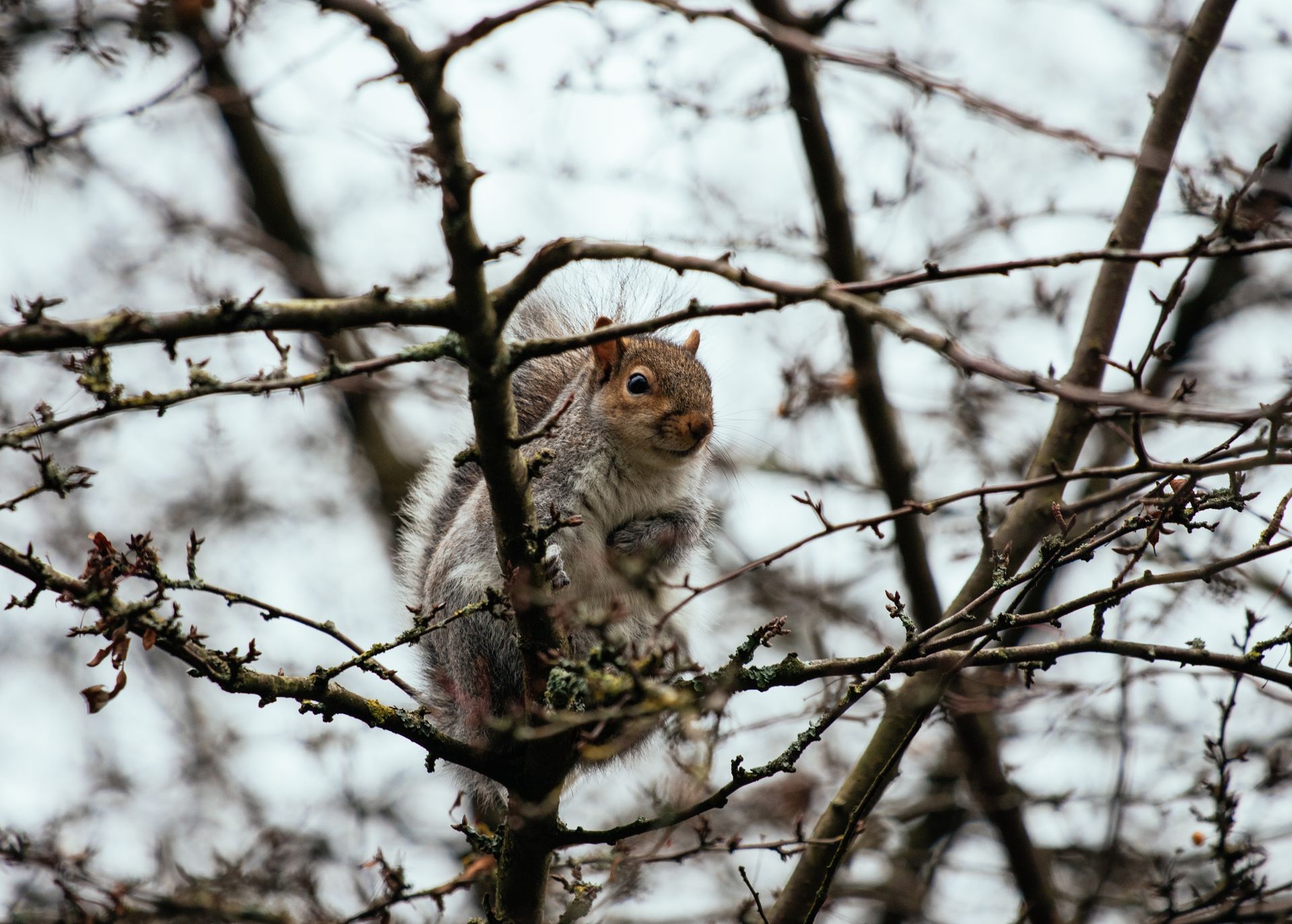
Microsciurus are small, arboreal rodents that belong to the family Sciuridae. They are found in the tropical regions of Central and South America.
Their diet consists mainly of seeds, fruits, and insects. Microsciurus have a specialized way of eating seeds, using their sharp incisors to crack them open.
These rodents are social animals and are often found in pairs or small groups. They have a complex communication system that involves a variety of vocalizations and scent markings.
Intriguing read: Africa Rodents
Classification
Classification of Microsciurus is a bit of a complex topic. Recent DNA analysis has shown that the traditional classification of the species in the genus Microsciurus is not entirely accurate. The genus may be polyphyletic, meaning it's not a natural group.
There are currently four recognized species within the genus Microsciurus: Central American dwarf squirrel, Amazon dwarf squirrel, Western dwarf squirrel, and Santander dwarf squirrel. However, a 2020 paper suggests that the genus should be split into three separate genera.
Here are the four recognized species within the genus Microsciurus:
- Central American dwarf squirrel (Microsciurus alfari)
- Amazon dwarf squirrel (Microsciurus flaviventer)
- Western dwarf squirrel (Microsciurus mimulus)
- Santander dwarf squirrel (Microsciurus santanderensis)
Taxonomy and Systematics
Taxonomy and systematics are essential in understanding the classification of living organisms. Recent DNA analysis has shown that the genus Microsciurus may be polyphyletic, meaning its classification is not entirely accurate.
The genus Microsciurus has been traditionally classified, but DNA analysis has revealed some confusion. Four species are currently recognized: the Central American dwarf squirrel, Amazon dwarf squirrel, Western dwarf squirrel, and Santander dwarf squirrel.
A 2020 paper published on the taxonomy of Sciurinae proposed splitting Microsciurus into three genera, one of which is currently unnamed. This suggests that the traditional classification may need to be revised.
The four recognized species of Microsciurus are found in different parts of Central and South America. The Central American dwarf squirrel is found in Costa Rica, Nicaragua, Panama, and northern Colombia.
Here is a list of the four recognized species of Microsciurus:
- Central American dwarf squirrel (Microsciurus alfari)
- Amazon dwarf squirrel (Microsciurus flaviventer)
- Western dwarf squirrel (Microsciurus mimulus)
- Santander dwarf squirrel (Microsciurus santanderensis)
The taxonomy of Microsciurus is complex and has been the subject of ongoing research. The 2020 paper suggests that there may be several new species that have not been described yet.
Description
Dwarf squirrels are relatively small, with a typical head-and-body length of about 15 cm (5.9 in) and a 12 cm (4.7 in) long tail.
Some species, like the Neotropical pygmy squirrel, are even smaller than that, but the Central American dwarf squirrel is not as small as its name suggests.
Their body measurements are close to that of the red squirrel and gray squirrel, with a head-and-body length about 15 cm (5.9 in) with a 12 cm (4.7 in) long tail.
The majority of their body is a dark, olive-green and brown color, while their underside can range from a yellowish grey to a tawny grey color.
Microsciurus species have gray or brown backs, and white bellies.
For another approach, see: Brown Greater Galago
Western Dwarf Squirrel
The Western Dwarf Squirrel is a small tree squirrel found in Colombia, Ecuador, and Panama. It's part of the Microsciurus genus and tribe Sciurini.
This squirrel is classified under the Kingdom Animalia, Phylum Chordata, Class Mammalia, Order Rodentia, Family Sciuridae, Genus Microsciurus, and Species M. mimulus. Its scientific name is Microsciurus mimulus, and it was first described by Thomas in 1898.
The Western Dwarf Squirrel has three recognized subspecies: M. m. mimulus, M. m. boquetensis, and M. m. isthmius. Here's a breakdown of each subspecies:
The Western Dwarf Squirrel's conservation status is listed as Least Concern by the IUCN 3.1.
Ecology
Microsciurus, the family of dwarf squirrels, are typically shy and solitary in nature. They are diurnal, but some have been observed at night by hunters, suggesting a degree of nocturnal activity.
Their small size and dull coloration make them hard to locate and catch or even observe. This is likely due to their quickness and agility.
The diet of these squirrels is most likely similar to that of common herbivores, consisting of seeds, grains, and nuts. They have been observed to eat nuts of the ivory-nut palm tree, which they inhabit.
Here's a breakdown of their known diet:
Their solitary nature and nocturnal activity make them a challenging species to study and observe.
Frequently Asked Questions
Is there a miniature squirrel?
Yes, the Central American dwarf squirrel, also known as Alfaro's pygmy squirrel, is a small, miniature tree squirrel species. It's a tiny but fascinating creature found in Central America.
Featured Images: pexels.com


