The Brown Greater Galago is a fascinating creature, and I'm excited to share some interesting facts about them.
They are nocturnal animals, meaning they are most active at night.
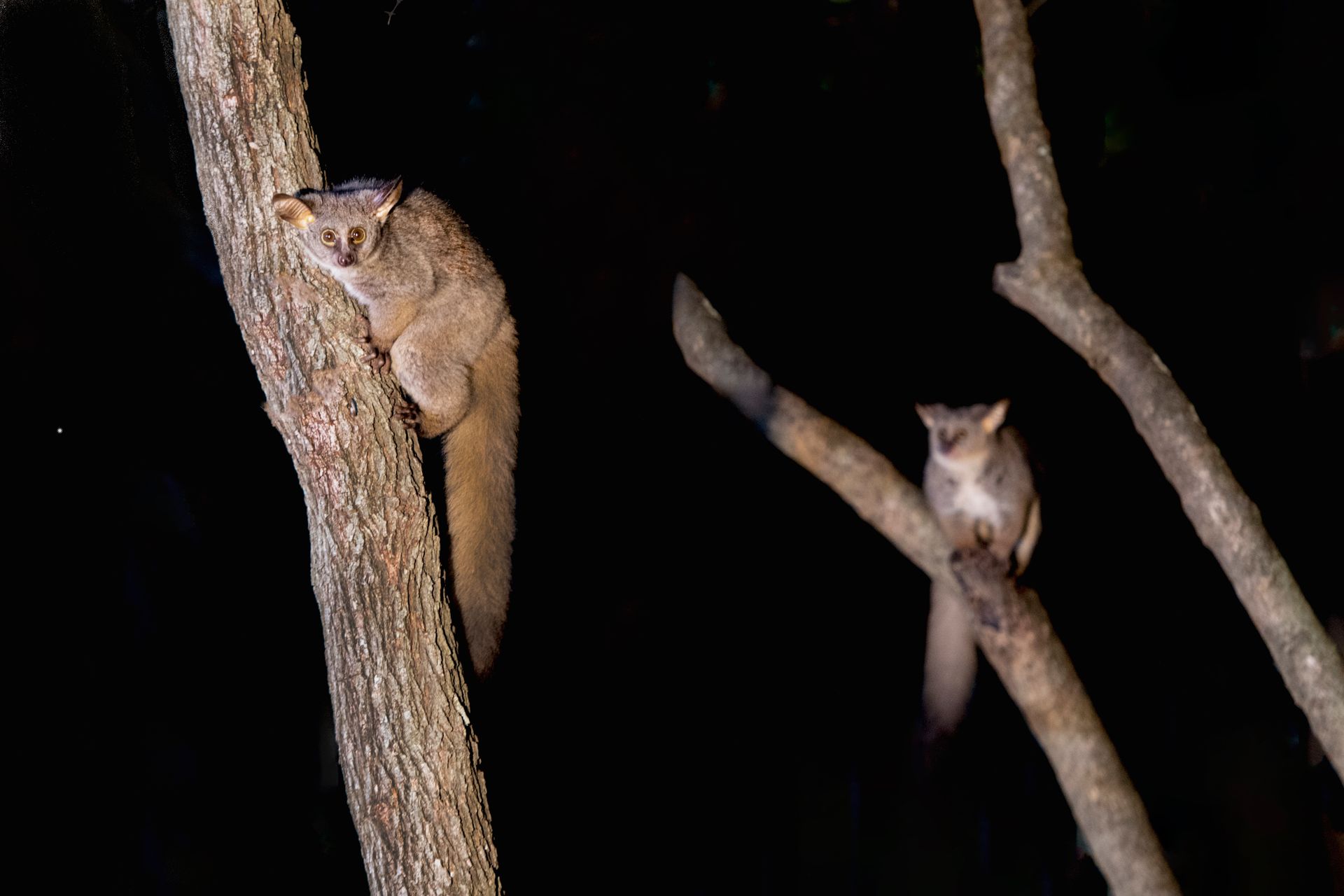
Their large eyes help them navigate in the dark.
These galagos are native to Africa, specifically in the savannas and woodlands of eastern and southern regions.
They are also known as bushbabies due to their large eyes and ears.
In the wild, Brown Greater Galagos live in groups, often with multiple females and a single male.
Physical Characteristics
The brown greater galago has a distinctive physical appearance. They have a rounded head with a short, wide snout.
Their ears are incredibly large and can be moved independently, which is quite impressive. The forward binocular eyes are relatively large, too.
They possess flat, thickened skin pads at the ends of their fingers and toes for grasping limbs. The fingers are long and toes are flattened with flattened nails.
The thick fur is highly variable in color, depending on the subspecies. O. c. crassicaudatus exhibits dorsal pelage ranging from buff to gray extending to the face, flanks and limbs.
The ventral fur is cream colored, and the tail has a darker tip. The hands and feet are darkened except on the digits.
The brown greater galago exhibits sexual size dimorphism, with males being larger than females. This is due to bimaturism, a longer period of growth in the male.
Males average 16% more body mass than females, with females weighing around 1.2 kg (2.6 lb) on average.
For your interest: Subantarctic Fur Seal
Distribution and Habitat
The Brown Greater Galago is common in Southern and East Africa, with large populations found in Angola, Tanzania, southern Kenya, and the coast of Somalia.
They live in tropical and subtropical forest, preferring riverine and coastal forest, but can also be found in woodland savannah.
The subspecies display different ranges, with O. c. crassidautus found only in the KwaZulu-Natal region.
Their habitats include a variety of wooded environments, such as dry deciduous forests, moist evergreen forests, and savanna woodlands.
These primates prefer areas with dense tree canopies that provide ample cover and food sources, like fruits, leaves, and insects.
They are arboreal, spending most of their time in trees, which helps them evade predators and navigate their environment effectively.
Their range extends from southern Kenya and Tanzania, reaching down through Zambia, Zimbabwe, and into the eastern parts of South Africa and Mozambique.
This wide distribution highlights their adaptability to different forested habitats, although they are increasingly affected by habitat loss due to deforestation and human encroachment.
Reproduction Morphology and Behavior
The brown greater galago's reproductive habits are quite fascinating.
Male galagos have very distinctive penile morphology that can be used to classify species.
During mating season, which occurs in June, the female goes into estrus for approximately 2 weeks.
She uses an advertising call to indicate her receptivity, and males approach and copulate repeatedly with her.
Mating patterns can be either monogamous or polygynous, often determined by the overlapping of host ranges and competing of males for best territories.
Females typically give birth to 2 young, sometimes 1 or 3.
The gestation period is on average 133 days.
The female typically reaches sexual maturity by 2 years of age, which is earlier than males.
After birth, the mother leaves the young to forage and returns to nourish them with nutrient-rich milk.
The juveniles typically remain with their mother until they reach close to sexual maturity.
Conservation
The brown greater galago is listed as Least Concern by the International Union for Conservation of Nature (IUCN). This is a positive sign, but it doesn't mean we should let our guard down.
Habitat fragmentation is a major issue affecting the species, with sugar cane and forestry in South Africa being a main cause. This can lead to isolated populations and make it harder for the galagos to find food and shelter.
The brown greater galago is found in well-managed protected areas, which is a good thing. However, hunting for bushmeat remains a threat to the species.
Here are some of the main threats to the brown greater galago's survival:
- Hunting for bushmeat
- Habitat fragmentation due to sugar cane and forestry in South Africa
Conservation efforts are underway to protect the brown greater galago and its habitat. These efforts include habitat protection and restoration, as well as education programs to raise awareness about the importance of these primates.
Frequently Asked Questions
Is a bushbaby a rodent?
No, a bushbaby is not a rodent, but rather a small, nocturnal primate that belongs to the galago family.
Featured Images: pexels.com