Marmota vancouverensis is a fascinating rodent species that has garnered significant attention from scientists and conservationists.
This species is classified as a member of the marmot family, Marmotini, within the squirrel family, Sciuridae.
Marmota vancouverensis is a large ground-dwelling rodent that primarily inhabits rocky outcrops and talus fields in British Columbia, Canada.
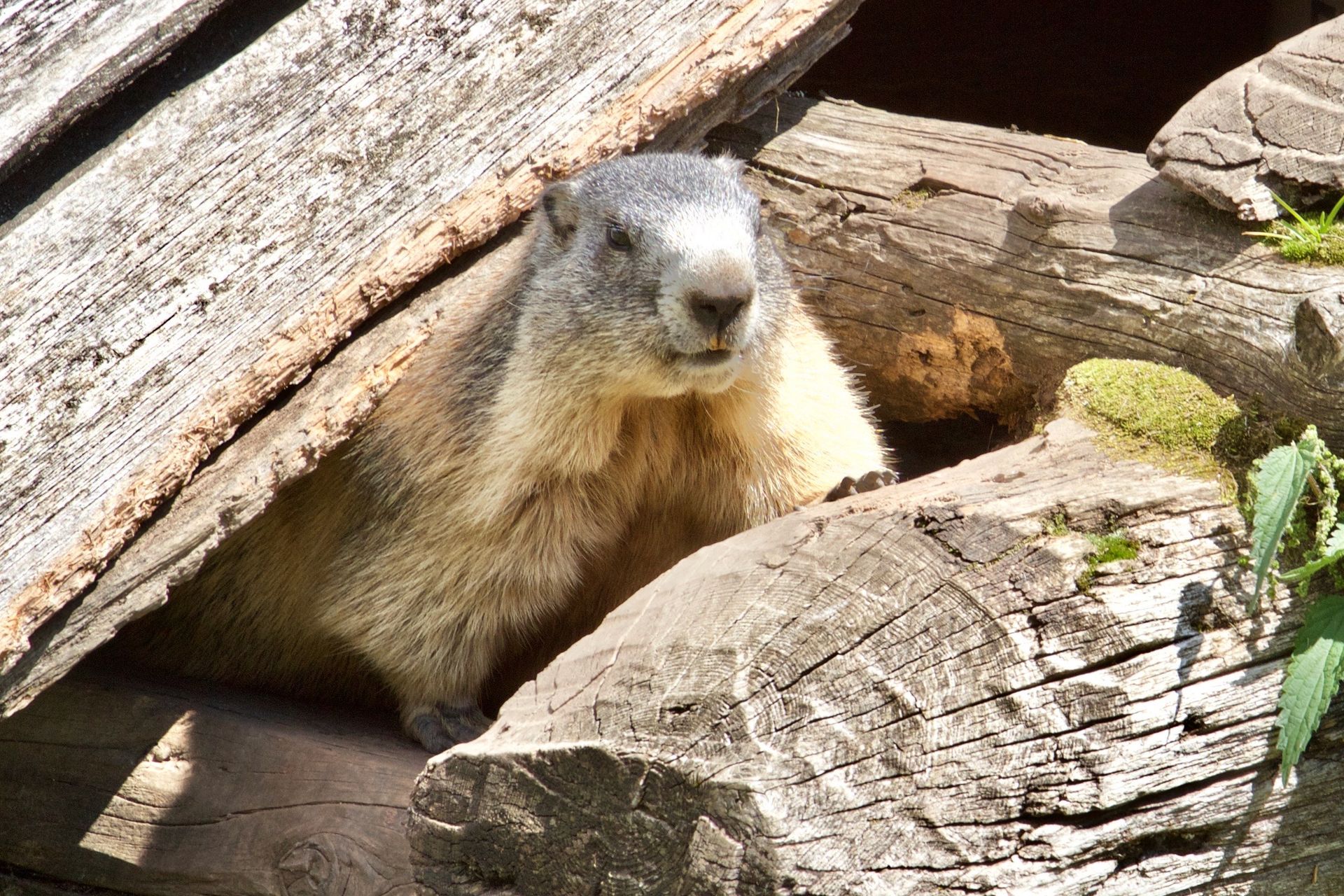
Its distinctive appearance is characterized by a stocky build, short tail, and a thick coat of fur that ranges in color from brown to gray.
Intriguing read: Marmota Flaviventris
Physical Characteristics
The Vancouver Island marmot is a unique creature, and one of its most distinctive features is its physical characteristics.
These marmots typically measure 65 to 70 centimetres from the tip of their nose to the tip of their tail.
Their chocolate brown fur and contrasting white patches set them apart from other marmot species.
Adult females can weigh anywhere from 3 to 5.5 kilograms, while males can reach weights of over 7.5 kilograms.
Marmots lose about one-third of their body mass during the six-and-a-half months they spend hibernating during winter.
Behavior and Habitat
Vancouver Island marmots live in family groups called colonies and hibernate below ground from mid-September until late April or early May. This long hibernation period allows them to survive the harsh alpine winters when food is scarce.
Their burrows are typically 30-45 cms across and range in size and purpose, with small burrows used for quick escapes and larger ones for hibernation and birthing. One excavated hibernation burrow measured five meters in length with the sleeping chamber located one meter underground.
Vancouver Island marmots are herbivores and eat over 40 different species of grasses, herbs, and wildflowers. They spend most of their time lounging on rocks and watching for predators, with only a few hours each day spent looking for food, eating, and interacting with other marmots.
Here are some key facts about Vancouver Island marmot behavior and habitat:
- They live in small patches of south and west-facing sub-alpine and alpine meadows, usually above 1000 meters.
- These meadows provide the forage they need, deep soil for digging, and large boulders to regulate their internal body temperature.
- They are highly social animals and live in colonies with one adult male, one adult female, and variable numbers of two-year-olds, yearlings, and infants.
Habitat
Vancouver Island marmots are found on south and west facing mountain ridges that are free of trees as a result of avalanches and snow accumulation during the winter months. These tree-less slopes allow for rapid snow melt in the spring, good visibility of predators, and excellent areas in which to "lounge" in order to thermoregulate.
They inhabit mine tailings and meadows created by ski runs, and are found at high elevations, from 900 to 1450 m above sea level. Lower elevations are generally unsuitable habitat due to the high amount of brush and trees, and intensely forested landscapes do not contain the forbs and grasses necessary to the diet of Vancouver Island marmots.
Vancouver Island marmots require colluvial soil structure for their burrows, which are used to escape predators, overwinter and hibernate. They need deep soil to burrow below the frost line during winter, with winter temperatures within the hibernacula maintained at at least 5 °C.
Here are some key facts about the habitat of Vancouver Island marmots:
- Habitat Regions: temperate, terrestrial
- Terrestrial Biomes: savanna or grassland, mountains
- Range elevation: 900 to 1500 m (2952.76 to 4921.26 ft)
- Average territory size: 900 m^2
Behaviour
Vancouver Island marmots live in family groups called colonies and hibernate below ground from mid-September until late April or early May. They reuse hibernacula in subsequent years, and during hibernation, their heartbeat slows to 30 or 40 beats per minute compared to 110-200 beats per minute when they're active.
Marmots spend most of their summer days lounging on rocks and watching for predators, only a few hours each day are spent looking for food, eating, and interacting with other marmots. They're more likely to be seen in early morning or late afternoon than during the heat of the day.
Vancouver Island marmots have five distinct whistles or trills used for different purposes, more than any other marmot species. They use these whistles to communicate with each other, including alarm calls to warn of predators.
Here are some common behaviors observed in Vancouver Island marmots:
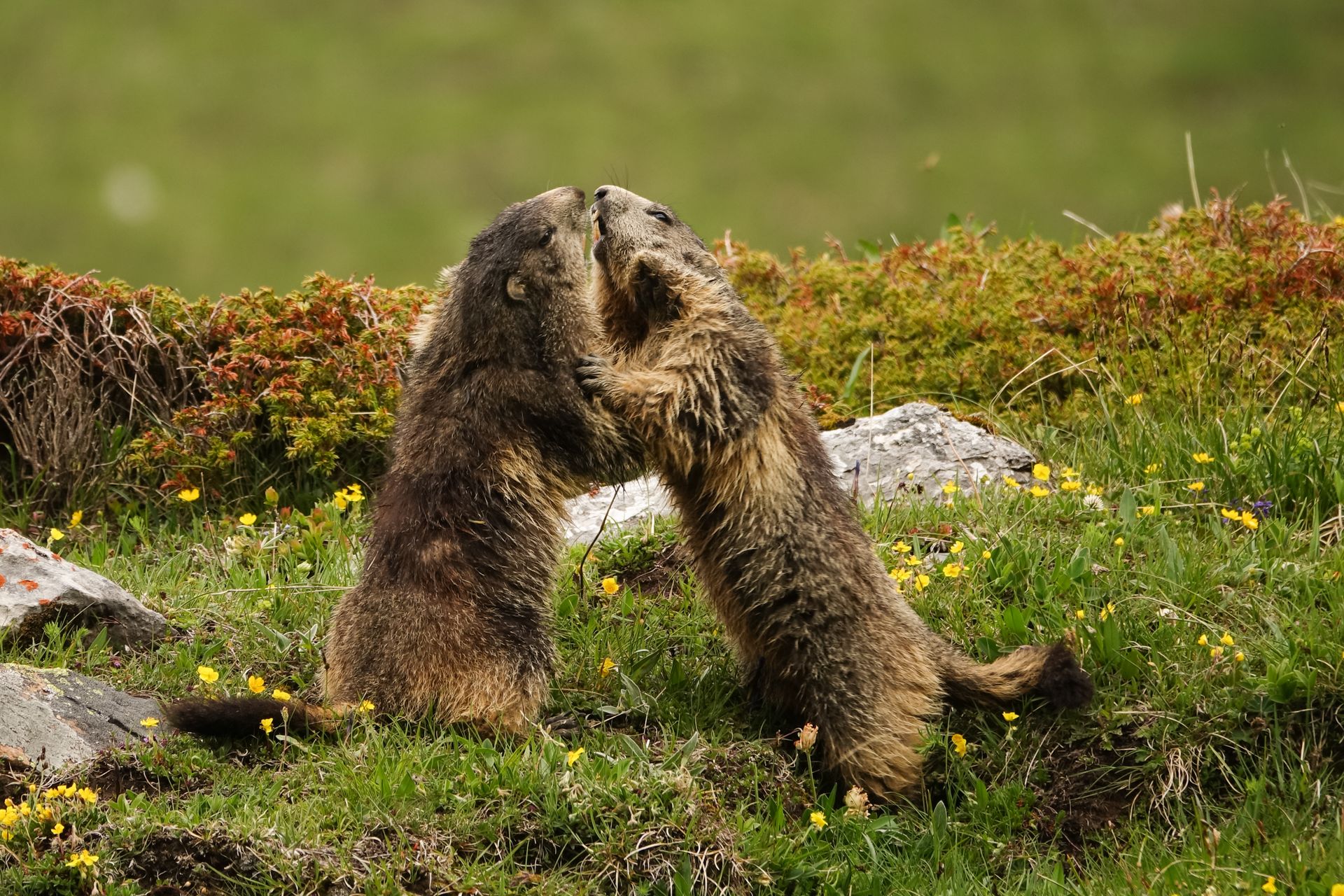
- Nose-touching ("greeting") and play-fighting ("boxing") are common behaviors
- They give piercingly loud whistles when alarmed, earning them the nickname "Whistle Pig"
Marmots live in small patches of south and west-facing sub-alpine and alpine meadows, where they find forage, deep soil for digging, and large boulders to regulate their internal body temperature.
Classification and Status
Marmota vancouverensis is classified within the animal kingdom. It belongs to the phylum Chordata and is a mammal, specifically a rodent.
Marmota vancouverensis is part of the Sciuridae family, which includes squirrels and marmots. This classification suggests a close relationship with other rodents in this family.
The species is further divided into a specific genus, Marmota, and a unique species, vancouverensis.
Scientific Classification
The scientific classification of the Vancouver Island marmot is quite fascinating. It belongs to the kingdom Animalia, which is the largest and most diverse group of organisms on Earth.
The Vancouver Island marmot is a mammal, specifically a member of the class Mammalia. This class is characterized by the presence of hair, mammary glands, and three middle ear bones.
The order Rodentia is the largest group of mammals, and the Vancouver Island marmot is a part of it. Rodents are known for their continuously growing incisors and cheek teeth.
The family Sciuridae includes squirrels and marmots, both of which are rodents. This family is known for its diverse range of species.
The tribe Marmotini is a group of ground-dwelling squirrels and marmots. They are primarily herbivores and are known for their burrowing behavior.
The genus Marmota includes ground-dwelling squirrels and marmots. The Vancouver Island marmot is the only species in this genus that is endemic to Vancouver Island.
The species vancouverensis is a unique designation for the Vancouver Island marmot.
Related Species
The Vancouver Island marmot has two close relatives, the hoary marmot and the Olympic marmot, which are identified as its closest genetic relatives.
These two mainland species are so similar to the Vancouver Island marmot that there's some debate about which one is most closely related.
Genetic analyses reveal that the differences in DNA between these species are quite small.
Physical differences between the species are more pronounced, however, and can be explained by rapid evolution in the relatively isolated island context of Vancouver Island.
Distribution and Range
M. vancouverensis lives above 1000 metres elevation in meadows that face south to west, and habitat scarceness is believed to be the primary reason for its rarity.
This species is found only on Vancouver Island, located in the south-western portion of Canada. Vancouver Island marmots, Marmota vancouverensis, are endemic to Canada. They are found only on Vancouver Island.
The population of M. vancouverensis has been declining, with an 80% to 90% decline in population between the 1980s and 2006, leaving only 32 adults remaining in the wild. However, thanks to conservation efforts, the population has begun to increase.
As of the fall of 2021, there were just over 250 wild marmots living in 25 colonies distributed between two metapopulations, and one isolated colony at Steamboat Mountain.
Here are the geographic regions and terms that describe the distribution of M. vancouverensis:
- Biogeographic Regions: nearctic
- Other Geographic Terms: island endemic
Reproduction and Lifespan
Vancouver Island marmots have a relatively short lifespan, with an average of 10 years in the wild.
They can live up to 15 years in captivity, but this is not typical of their natural habitat.
The majority of mortality occurs within the first 3 years, with most deaths happening between August and September due to predation.
Annual survival rate is around 73%, which is a significant percentage considering the harsh environment they live in.
Pups are most vulnerable during their first winter, which is a critical period for their survival.
Here's a quick summary of their lifespan:
- Average lifespan: 10 years (wild)
- Maximum age: 12-15 years (estimated)
Reproduction
Reproduction is a crucial aspect of an organism's life cycle, and it's essential to understand the process to grasp the connection between reproduction and lifespan.
In plants, reproduction can occur through seeds, which are formed after fertilization and contain the genetic material necessary for a new plant to grow.
The number of seeds produced by a plant can be influenced by factors such as soil quality, water availability, and the presence of pollinators.
In animals, reproduction involves the fusion of gametes, or sex cells, which results in the formation of a zygote that develops into a new individual.
The reproductive strategy of an animal, such as whether it's a solitary breeder or a social species, can impact its lifespan.
Some animals, like the salamander, can reproduce through a process called parthenogenesis, where an unfertilized egg develops into a new individual.
In humans, reproductive age is typically defined as the period between puberty and menopause, during which an individual is capable of reproducing.
Lifespan/Longevity
Vancouver Island marmots have a relatively short lifespan, averaging around 10 years in the wild.
Females typically live longer than males, which is a common trend in many animal species.
One-third of Vancouver Island marmots don't make it past their first year, with the majority of these deaths occurring during hibernation.
The annual survival rate of Vancouver Island marmots is a respectable 73%.
Here are some key statistics about the lifespan of Vancouver Island marmots:
- Average lifespan: 10 years (wild)
- Range lifespan: 12.1 years (captivity)
Ecosystem and Conservation
Vancouver Island marmots play a crucial role in their ecosystem as seed dispersers and pollinators. They collect various pollens and disperse consumed seeds through their feces as they amble about subalpine meadows to forage.
Their burrow systems also provide habitat for other animals, including insects and small mammals. These burrows can be extensive, a testament to the marmots' industrious nature.
Vancouver Island marmots host a variety of parasites, including ticks, fleas, and a unique tapeworm called Diandrya vancouverensis. This tapeworm is found nowhere else in the world, highlighting the importance of preserving the marmot population.
The following parasites have been found on Vancouver Island marmots:
- Ticks (Ixodes)
- Fleas (Thrassis spenceri)
- Nematode Baylisascaris laevis
- Cestode Diandrya vancouverensis
Metapopulations
A metapopulation is a group of smaller colonies that work together to keep a species healthy. These colonies are spread out within a marmot's dispersal range, allowing them to find potential mates and form new colonies.
By traveling between colonies, marmots help declining colonies to be replenished and new ones to be formed. This safeguards the species from a total collapse if one colony suffers a catastrophic event.
Just like our grandmothers told us, it's not wise to keep all your eggs in one basket, and the same principle applies to marmot colonies.
Conservation Status
The Vancouver Island Marmot is a federally protected species under the Species At Risk Act.
Canada has made a commitment to protect 30% of its lands, ocean, and freshwater by 2030, which will help protect ecosystems, restore habitats, and fight climate change.
This goal is a significant step forward in protecting Canada's at-risk animals, including the Vancouver Island Marmot.
Two of the marmot's habitats are protected under the B.C. Ecological Reserves Act and the B.C. Wildlife Act in British Columbia.
Ecosystem Roles
Vancouver Island marmots play a vital role in their ecosystem as seed dispersers and pollinators. They collect various pollens and disperse consumed seeds through their feces as they forage in subalpine meadows.
Their large burrow systems also serve as habitat for other animals, including insects and small mammals.
Marmots are hosts to several parasites, including ticks, fleas, and a unique tape worm called Diandrya vancouverensis.
This tape worm is found only on Vancouver Island marmots and is closely related to a mainland helminth.
Here's a breakdown of the ecosystem roles played by Vancouver Island marmots:
- Seed dispersers
- Pollinators
- Creates habitat
- Soil aeration
Frequently Asked Questions
Why are Vancouver Island marmots so rare?
Vancouver Island marmots are rare due to their limited habitat, which is fragmented into small patches of subalpine meadow surrounded by inhospitable forest and rocky terrain. This scarcity of suitable habitat restricts the growth of marmot colonies, making them even more vulnerable.
How many Vancouver Island marmots are left?
As of 2021, there are approximately 250 Vancouver Island marmots remaining in the wild. Learn more about conservation efforts to protect this critically endangered species.
Featured Images: pexels.com