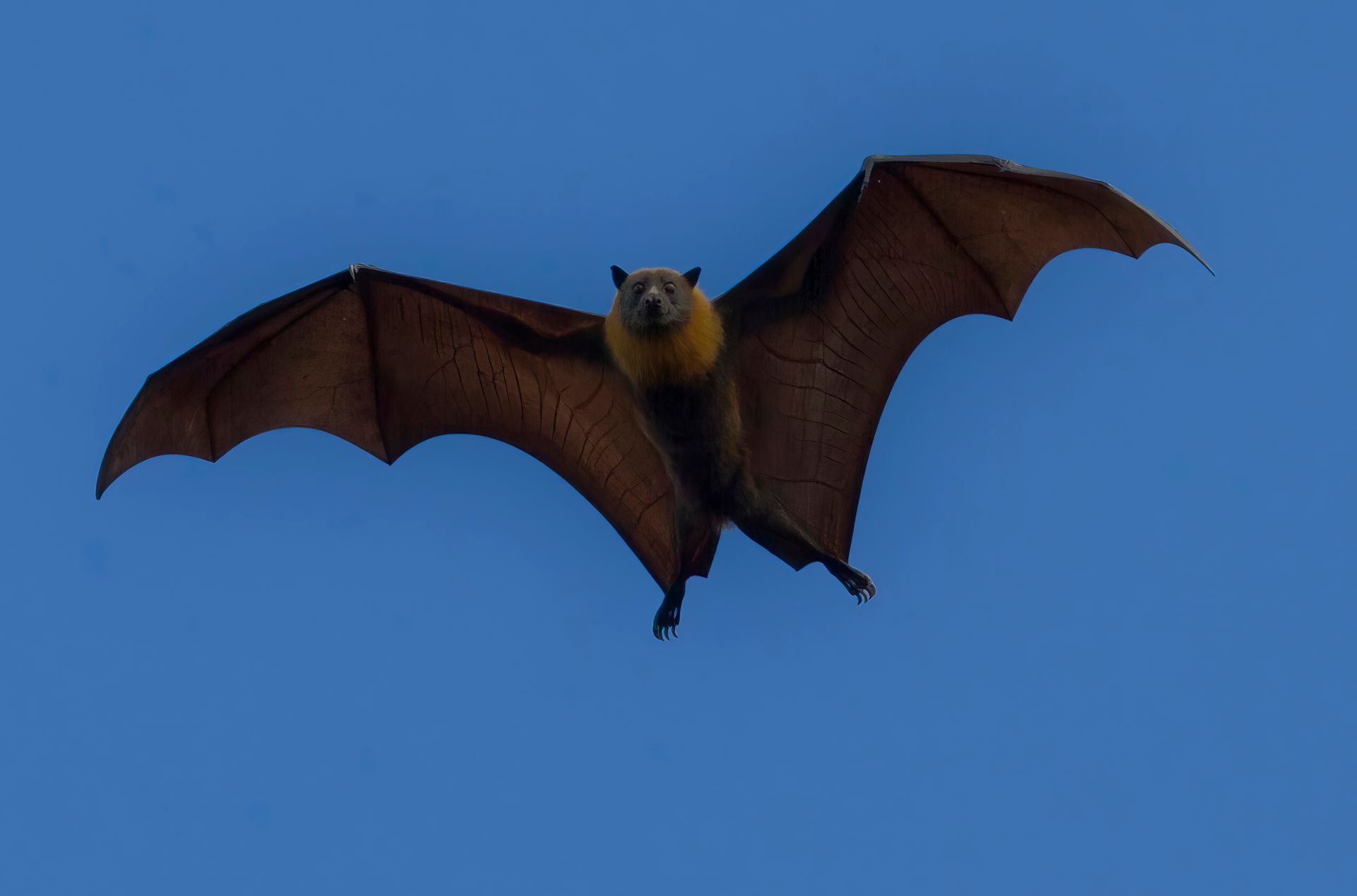
Malaysian Flying Foxes are one of the largest bat species in the world, with some individuals weighing up to 1.6 kg. They are found in the tropical rainforests of Malaysia and are known for their distinctive fox-like faces.
These bats are herbivores, feeding on nectar, fruits, and pollen, playing a vital role in pollination and seed dispersal. They can consume up to 1.3 kg of food per night, making them a crucial part of the ecosystem.
Malaysian Flying Foxes are also known for their impressive wingspans, reaching up to 1.5 meters. Their ability to fly long distances allows them to migrate and forage for food effectively.
Explore further: Are Foxes Pack Animals
Physical Characteristics
The Malaysian Flying Fox is an impressive creature, and its physical characteristics are just one of the many fascinating aspects of this animal.
It's one of the largest species of bats, with a wingspan of up to 5 ft (1.5 m) and a weight of 2.4 lb (1.2 kg). This size allows it to be quite slow in flight, but also highly maneuverable.
The fur of the males is generally longer and thicker than that of the females, which is a form of sexual dimorphism. This is a common trait among mammals, and it's interesting to note how this affects the overall appearance of the Malaysian Flying Fox.
The animal has a reddish-brown color and a covering of long, thick fur on much of its body. This fur is quite remarkable, and it's something that sets the Malaysian Flying Fox apart from other bats.
The Malaysian Flying Fox has a fox-like face, which is where it gets its common name from. This is a unique feature of the animal, and it's something that's worth noting.
Here's a breakdown of the Malaysian Flying Fox's physical characteristics:
- Kingdom: Animalia
- Phylum: Chordata
- Class: Mammalia
- Order: Chiroptera
- Family: Pteropodidae
- Genus: Pteropus
- Species: P. vampyrus
The Malaysian Flying Fox's wings are short and somewhat rounded at the tips, which allows them to fly slowly but with great maneuverability. This is a remarkable adaptation that's worth noting.
Range and Habitat
The Malaysian flying fox is found in a variety of habitats, including primary forest, mangrove forest, and coconut groves.
In certain areas, this bat prefers coastal regions, but it can also be found at elevations up to 1,370 m (4,490 ft).
Flying foxes are adaptable creatures and can be found in lowland habitats below 365 m in Malaysia.
In Borneo, they inhabit the coastal areas, but move to nearby islands to feed on fruit.
In Malaysia, flying foxes often roost in the thousands, with one colony recorded numbering around 2,000 individuals in a mangrove forest in Timor.
Colony sizes can vary greatly, with some mangrove roosts having lower numbers of resting bats compared to lowland roost sites.
In fact, colonies of 10,000–20,000 have been reported, showcasing the impressive social nature of these bats.
Mangrove forests are often used temporarily by flying foxes, who tend to prefer other habitats for roosting.
Related reading: Breeds of Dogs That Look like Foxes
Behavior and Life Cycle
Malaysian flying foxes are social creatures that fly in scattered streams, often traveling up to 50 km in one night to reach their feeding grounds.
They vocalize only upon arrival at these grounds, where they form family or feeding groups.
Flying foxes are known to circle fruit trees before landing, often taking a peculiar head-down position from which they feed.
Flowering trees play a significant role in defining territories in this species, and territorial behavior includes growling and spreading of wings.
In the event of antagonistic behavior, individuals maintain spacing through wrist/thumb sparring, bites, and loud vocalizations.
Female Malaysian flying foxes typically give birth between November and January, with some births occurring in other months in Peninsular Malaysia.
In Thailand, gestation takes place during the same period, resulting in young being born in March or early April.
Mothers usually give birth to a single young and carry them for the first few days before leaving them at the roost during foraging trips.
The young are weaned by two to three months, marking the end of their dependence on their mothers.
Broaden your view: Will Fox Attack Dogs
Biology and Ecology
The Malaysian flying fox is a fascinating creature, and its biology and ecology are just as interesting. They primarily feed on flowers, nectar, and fruit, with a preference for flowers and nectar when all three are available.
One of the unique things about these bats is their diet, which consists of a variety of fruits, including rambutan, fig, and langsat. They also eat mangoes and bananas, and have been known to consume the pulp of fruit, slicing open the rind to get to it.
The Malaysian flying fox is also a host to the Acanthocephalan intestinal parasite Moniliformis convolutus. This parasite is just one of the many interesting facts about these bats.
These bats are found in a variety of habitats, including dense mangrove forests, primary forests, and even large fruit orchards. They can live in extremely large colonies, with some groups numbering as many as 20,000 individuals.
The table below shows the various subfamilies of the Pteropodidae family, which includes the Malaysian flying fox:
These subfamilies are just one of the many interesting facts about the biology and ecology of the Malaysian flying fox.
Relationship to Humans
The large flying fox has a complex relationship with humans.
In Peninsular Malaysia, 1,756 hunting licenses were issued for the large flying fox from 2002-2006, allowing the hunting of 87,800 individuals over the four-year period.
Hunting these bats at such a high rate is unlikely to be sustainable, with a 2009 study predicting extinction of the Peninsular Malaysian population within 6-81 years.
The large flying fox is also a natural reservoir of the Nipah virus, which led to the 1998 Malaysian outbreak that was the first emergence of the disease in humans and pigs.
Researchers found that only one out of seventeen large flying foxes tested positive for Nipah virus at the time of capture.
However, this bat then became seropositive for the virus after being in quarantine for one year, suggesting that the virus can recrudesce in the large flying fox.
Expand your knowledge: Fox Hunting Hounds
Conservation Status
The large flying fox, also known as the Malaysian flying fox, is an endangered species.
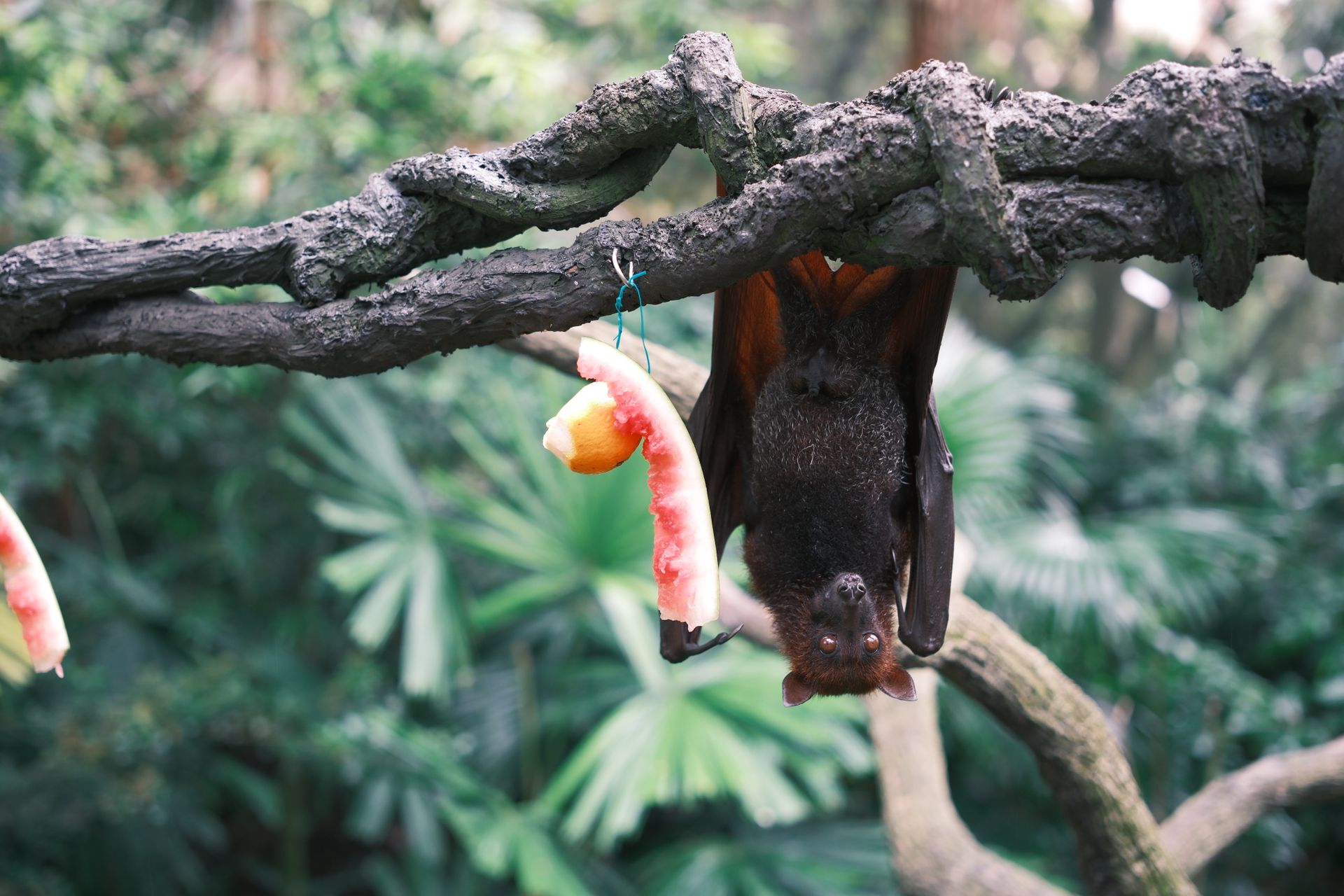
It's listed as endangered on the IUCN Red List, which is a global authority on the conservation status of species.
The species is experiencing a significant population decline due to the unsustainable harvest of bushmeat and habitat loss through deforestation.
Flying foxes are hunted for food in some areas, and the controls on hunting seem to be unenforceable.
The species is also hunted for bushmeat in Indonesia, which is contributing to its decline.
Here are some of the key threats to the large flying fox's conservation status:
- Habitat destruction through deforestation
- Sustainable harvest of bushmeat
- Hunting for food in some areas
- Unenforceable controls on hunting
- Bushmeat hunting in Indonesia
General Information
The Malaysian Flying Fox is a truly remarkable creature. It's a species of megabat endemic to Southeast Asia and is one of the largest known species of bat on earth.
This impressive creature also goes by other names, including the kalang and the greater flying fox. Its scientific name, however, is Pteropus vampyrus.
One characteristic that surprises many people is that this bat lacks the ability to echolocate like other bats. This is true for all fruit bats from the Old World.
For more insights, see: Greater Horseshoe Bat
The Malaysian Flying Fox has a great size, but fortunately, it has an entirely herbivorous diet. This is encouraging to note, as its great size could otherwise pose a threat to livestock.
The IUCN currently lists the Malaysian Flying Fox as Near Threatened on its Red List. Unfortunately, its population numbers are diminishing rapidly.
Here are some interesting facts about the Malaysian Flying Fox:
- Alternate common names: kalang, greater flying fox, Pteropus vampyrus
- Characteristics: lacks ability to echolocate, herbivorous diet
- Conservation status: Near Threatened, IUCN Red List
Featured Images: pexels.com