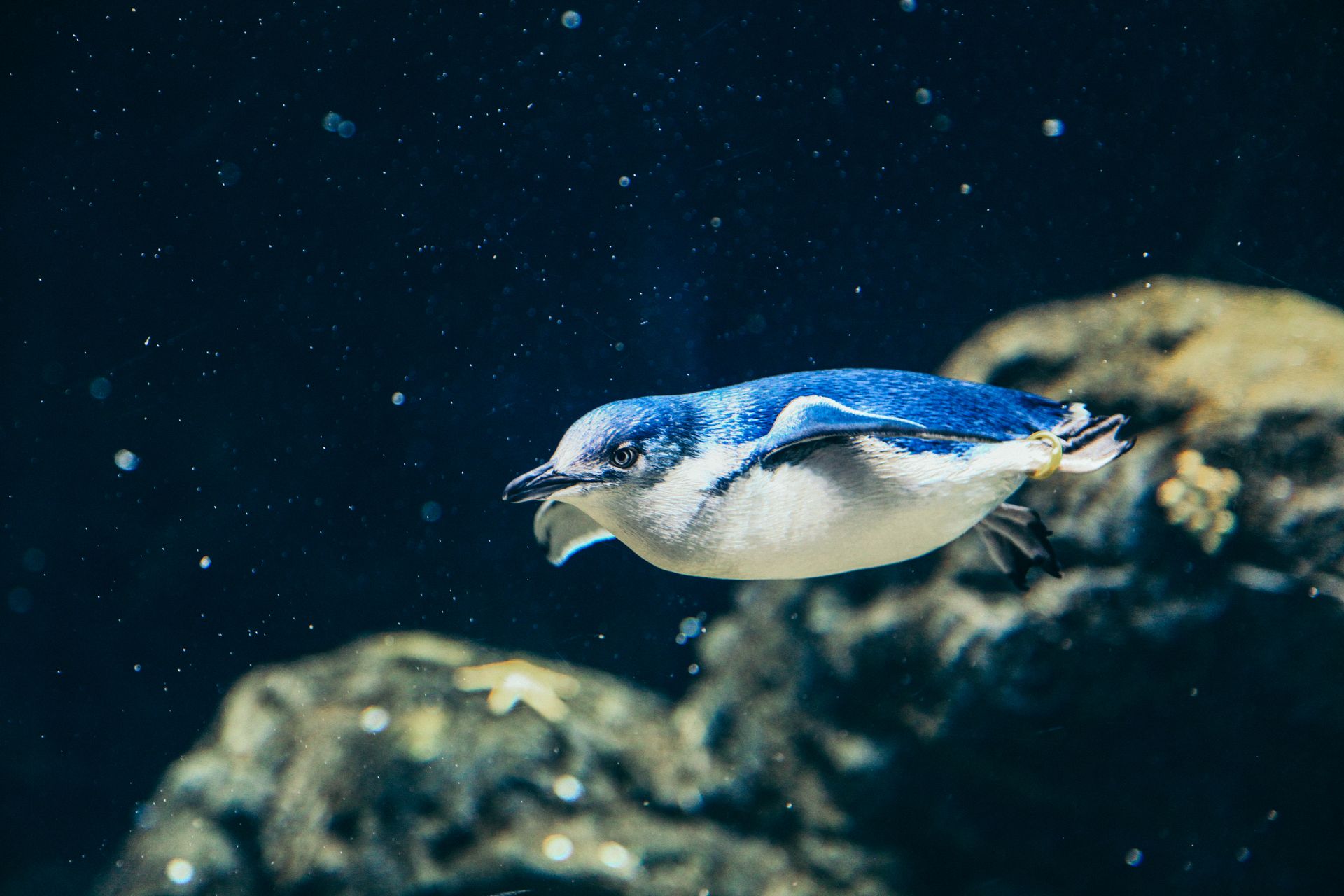
Little blue penguins are found in the coastal waters of Australia and New Zealand, where they inhabit rocky shores and islands.
They live in colonies, often with thousands of penguins, and can be found nesting in burrows, crevices, and under rocks.
These penguins are highly social creatures and can be seen interacting with each other in large groups.
They are also very noisy, making a variety of sounds to communicate with each other.
Discover more: Facts about Magellanic Penguins
Penguin Distribution and Range
The little blue penguin's world range is quite extensive, covering a vast area.
The GBIF network, OBIS, and AquaMaps all provide valuable insights into the penguin's habitat.
From these sources, we know that the little blue penguin's distribution spans across the globe, with a presence in various marine ecosystems.
World Range
Penguins can be found in the wild in various parts of the world, thanks to the efforts of organizations like the GBIF network, OBIS, and AquaMaps, which help us understand their global range and habitat.
The GBIF network, for instance, provides a wealth of information on penguin distribution, making it easier for researchers and enthusiasts alike to track their movements and habitats.
Penguins can be found in the Southern Ocean, as well as in the cold waters of the Atlantic, Pacific, and Indian Oceans.
Australia's Penguins
Australia's Penguins are a delight to watch, especially the Little Blue Penguins that call the country home. They're the smallest penguin species, weighing just under a kilo.
You can find them along the coastlines of southern Australia and New Zealand, with the largest colony on Phillip Island, where 40,000 breeding penguins reside on the Summerland Peninsula.
Little penguins are known for their unique blue and white feathers, setting them apart from other penguin species. They're also incredibly social, with most penguin couples pairing up again each breeding season.
During breeding season, which usually runs from August to February, females lay two eggs, similar in shape and size to a chicken's egg. The parents take turns incubating the eggs and caring for their chicks.
One fascinating fact about little penguins is that they're 'central place feeders', meaning they hunt for food and then return to their burrow on land to feed their chicks. They work hard to build and maintain their burrows, lining them with vegetation.
Discover more: Little Blue Penguin Nz
Penguin Breeding and Life Cycle
Little penguins spend a significant amount of time at sea, with adults out fishing for up to four weeks at a time in the Bass Strait and Port Phillip Bay.
They eat a variety of fish and other sea creatures, including young barracouta, anchovies, and squid, and can consume up to 25% of their body weight in a single day.
Before coming ashore, little penguins gather in large groups called "rafts" offshore, waiting for dusk to hide from predators like pacific gulls and sea eagles.
Breeding season for little penguins typically runs from August to February, during which time females lay two eggs that are similar in shape and size to a chicken's egg.
Both male and female penguins build and maintain their burrow, lining it with vegetation, and most couples pair up again each breeding season.
Penguin Breeding Colonies
In Australia, the little penguin is the only species that breeds on our local shores.
The breeding season for little penguins typically lasts from August to February.
During this time, females lay two eggs that are similar in shape and size to a chicken's egg.
Little penguins are central place feeders, which means they return to their burrow on land to feed their chicks after hunting for food.
Both male and female penguins build and maintain their burrow, lining it with vegetation.
Most penguin couples pair up again each breeding season, but research shows that between 18% and 50% will "divorce" if breeding doesn't produce chicks.
Penguin Life
Little penguins are seabirds that don't fly, which means they breed on land but forage for food at sea. They use their wings as flippers when swimming and deep diving in the ocean.
They can spend over four weeks at sea fishing in the Bass Strait and Port Phillip Bay. During this time, they eat a variety of fish and other sea creatures, including young barracouta, anchovies, red cod, warehou, and pilchards.
Curious to learn more? Check out: Where Are Leatherback Sea Turtles Found
They can eat about 25% of their body weight in a day, which is approximately 250g. This means they need to find plenty of food to sustain themselves.
They spend approximately 80% of their lives in the ocean, only coming to shore to maintain their burrows, breed and raise young, as well as moult their old feathers.
Penguin Behavior and Ecology
Little blue penguins spend a significant amount of time at sea, with some adults spending over four weeks out at sea fishing in the Bass Strait and Port Phillip Bay.
They eat a variety of fish and other sea creatures, including young barracouta, anchovies, red cod, and squid, which they catch while diving to average depths of 10-20 m.
Before returning to land, they often gather in groups called 'rafts' offshore, waiting for dusk to hide from predators like birds of prey.
Penguin Cam
You can observe Little Blue Penguins live on exhibit through our Penguin Cam, where they waddle, swim, and explore their surroundings.
They even have a daily feeding routine, where you can watch them eat fish during our daily feedings at 10 a.m.
Watching them eat fish during these daily feedings can give you a glimpse into their foraging behavior and social interactions.
Their daily feedings are likely to be a highlight of their social calendar, and observing them during this time can be a fascinating experience.
Feeding Behavior (Ecology)
Little blue penguins are skilled hunters that feed on small fishes, including Australian anchovies, crustaceans, and squid.
They dive to average depths of 10-20 m for an average of 24 seconds, although dives as deep as 60 m have been recorded.
To find food, they tend to remain within 25 km of the coast, but longer trips up to 75 km have been recorded.
Their diet consists of around 25% of their body weight, which is approximately 250g per day.
They can reach swim speeds of up to 6 kph, making them relatively fast swimmers.
Conservation Status
Little blue penguin populations are thought to have declined due to predation by land animals, particularly in areas where domestic animals are common.
Research has shown that this species is often killed by cars crossing coastal roads to reach their burrows.
According to the IUCN Red List, this species is classified as threatened.
The Seafood Watch List also tracks the conservation status of this species.
Domestic animals are a significant threat to little blue penguin populations, especially in areas where they are common.
In addition to predation by land animals, cars crossing coastal roads also pose a significant threat to the survival of little blue penguins.
Phillip Island and Penguin History
Phillip Island has a rich history of little penguin colonies, with 10 colonies existing before European settlement.
The construction of roads, infrastructure, and housing led to the decline of these colonies, with nine disappearing over time.
Before the 1980s, the last remaining colony on the Summerland Peninsula was also in decline.
In 1985, the Victorian Government initiated a 30-year Penguin Protection Plan to help conserve the little penguin population.
Dedicated rangers of Phillip Island Nature Parks have worked tirelessly to rehabilitate the area, including introducing a fox eradication program and replanting with native vegetation.
Today, Phillip Island Nature Parks protects and manages approximately 20% of the island, including the Summerland Peninsula.
Featured Images: pexels.com