Magellanic Penguins are highly social creatures, often living in large colonies that can number in the tens of thousands. They form long-term monogamous relationships, with some pairs staying together for over 20 years.
These penguins are incredibly vocal, using a variety of calls to communicate with each other. They're able to recognize individual voices, even in a crowded colony.
In the wild, Magellanic Penguins are found along the coasts of Argentina and Chile, where they breed and raise their young. They're well adapted to their rocky, windswept habitat, with a streamlined body and powerful flippers that allow them to dive and swim with ease.
Their diet consists mainly of fish, squid, and krill, which they catch while swimming in the cold waters of the South Atlantic.
Here's an interesting read: Magellanic Horned Owl
Physical Characteristics
Magellanic penguins are the largest members of the genus Spheniscus, with adults averaging 70 cm in length and weighing between 4 to 4.7 kg.
Their body shape is fairly typical of penguins, with a large head, short neck, and elongated body. They have webbed feet set back on their body and elongated flippers with a fused wrist joint.
For your interest: African Black Footed Penguins
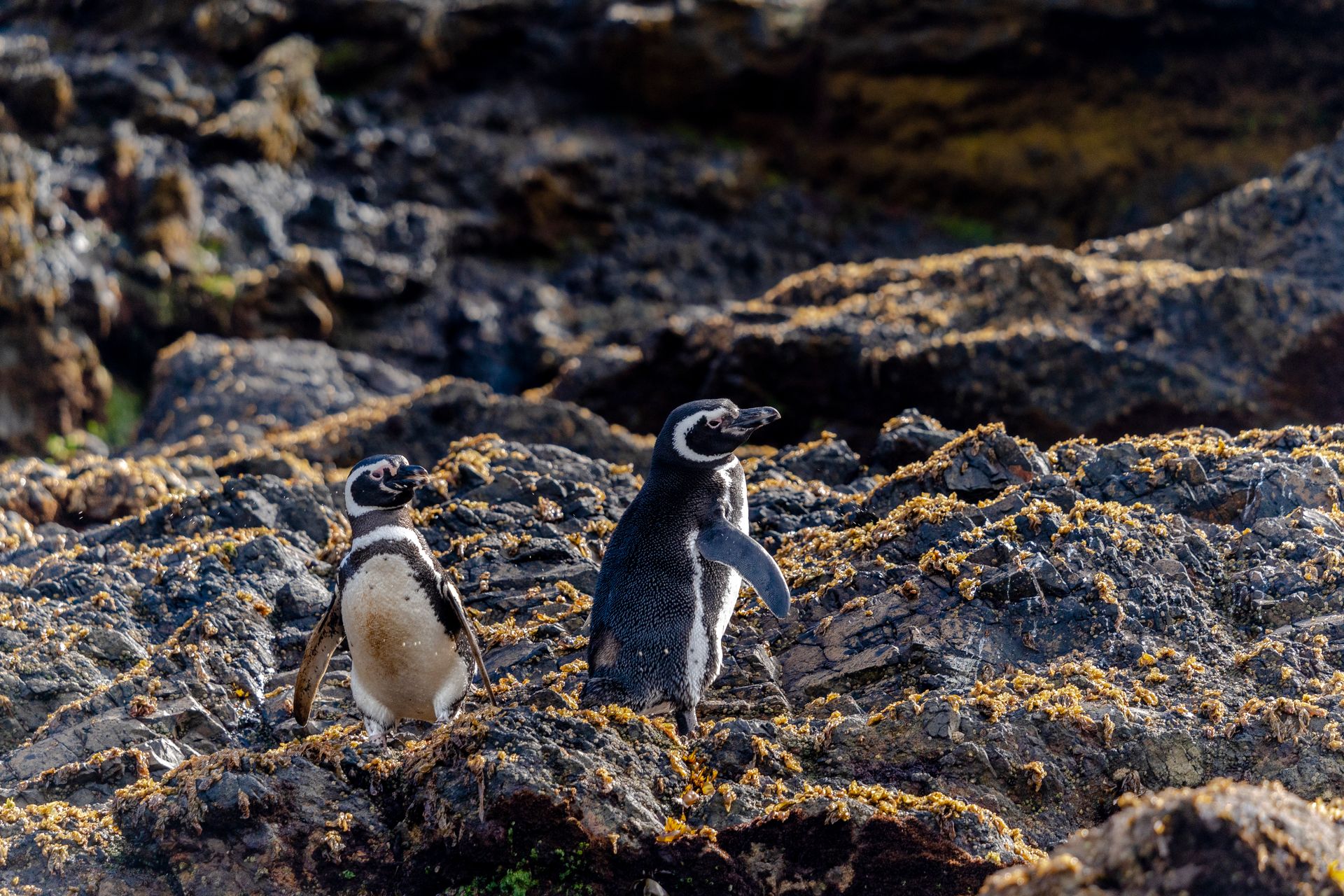
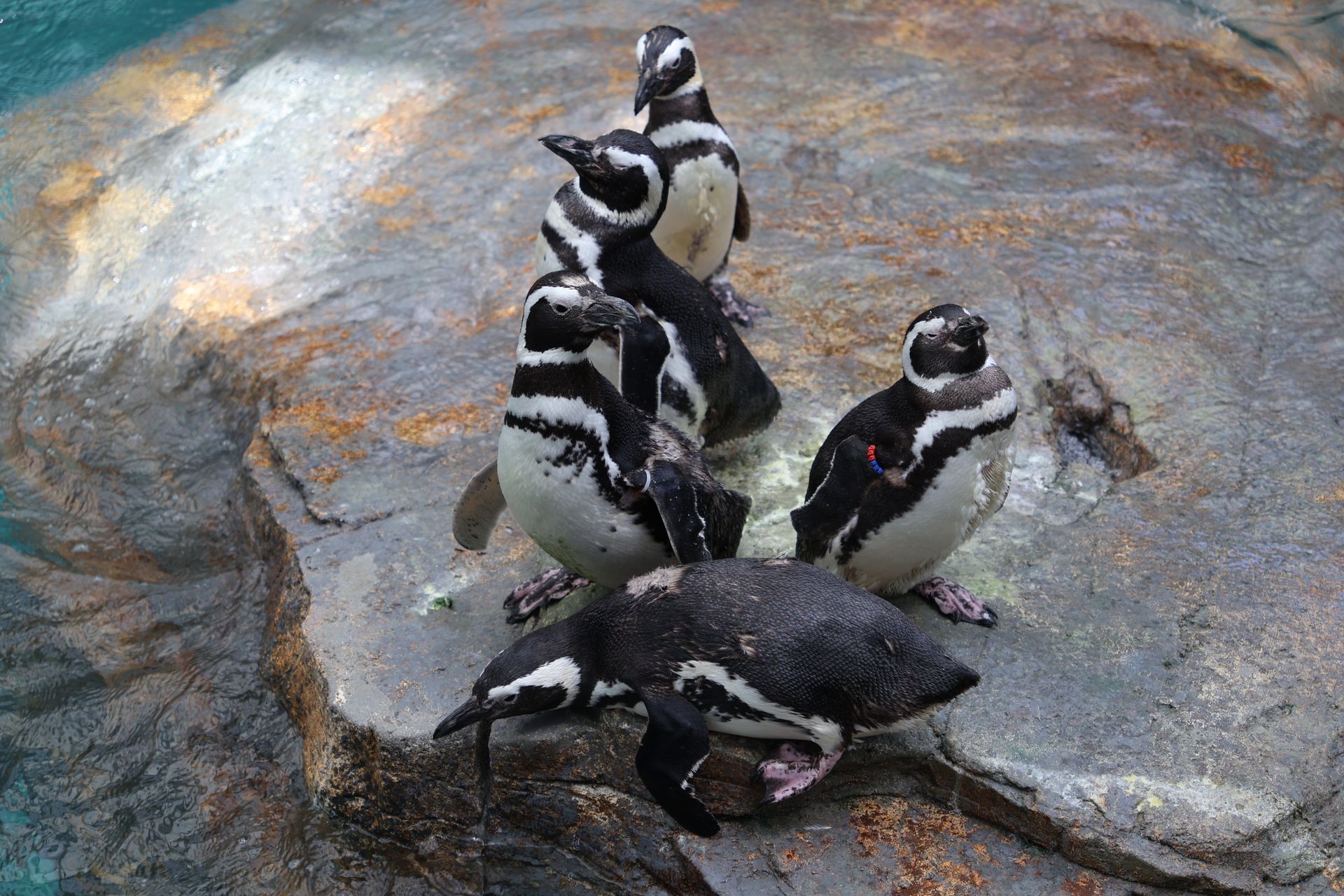
Magellanic penguins have very dense feathers, with over 452 per square centimeter. Adult penguins have scattered black spots on their breast, while juveniles have a single white band that separates their plumage coloring.
Adults and juveniles both have the typical black back and white breast and stomach of penguins. However, adults have a symmetrical white band around their mostly black face, while juveniles have only one band.
Here are some key physical characteristics of Magellanic penguins:
Males are slightly taller and heavier than females, with a mean weight of 4.7 kg compared to 4.0 kg for females.
Habitat and Distribution
Magellanic penguins can be found in a variety of habitats along the coast of South America, including coastal beaches, sandy dunes, and cliff faces.
They typically nest on shoreline grassland habitats that provide adequate vegetative cover, but are near the ocean so parents can easily forage for food.
During the non-breeding season, Magellanic penguins live a pelagic lifestyle and spend nearly all of their time off the southern coast of South America, traveling anywhere from 100 to 1,000 km offshore.
Here are some specific habitat regions and aquatic biomes where Magellanic penguins can be found:
- Temperate regions
- Terrestrial habitats
- Saltwater or marine habitats
- Pelagic biomes
- Coastal biomes
Geographic Distribution
Magellanic penguins can be found in various locations throughout South America. They breed on islands off the Chilean coast, along the coast of southern Chile, and as far south as the Falkland Islands.
During the breeding season, which takes place from September to mid-April, Magellanic penguins can be found on the coast of southern Chile, including islands off Cape Horn, and the Falkland Islands. They also breed on the South Atlantic Patagonia coast of Argentina as far north as Valdez Peninsula.
In the non-breeding season, from mid-April to September, Magellanic penguins migrate north to Peru and the coast of Brazil, although they rarely venture as far as Rio de Janeiro on the Brazilian coast.
Here's a breakdown of their geographic distribution during the different seasons:
- Breeding season (September to mid-April): Chilean coast, southern Chile, Falkland Islands, and South Atlantic Patagonia coast of Argentina.
- Non-breeding season (mid-April to September): Peru, coast of Brazil, and occasionally Rio de Janeiro.
Ecosystem Roles
Magellanic penguins play a vital role in their ecosystem as a food source for various animals. They are preyed upon by terrestrial and aquatic predators at all life stages.
As predators themselves, Magellanic penguins help keep local fish and squid populations balanced. This is an important part of maintaining a healthy ecosystem.
Their unique reproductive strategy allows them to produce offspring in multiple groups and across multiple seasons, ensuring their species can thrive in a variety of conditions.
Worth a look: Magellanic Woodpecker
Behavior and Social Structure
Magellanic penguins are social birds that live in large colonies, with some colonies having up to 200,000 individuals.
They are migratory birds that travel south to breed on the southern shores of South America and nearby oceanic islands. During the breeding season, they are significantly more terrestrial, as they nest and care for their young on sandy shores or cliff faces.
Magellanic penguins are known for their territorial behavior, with males fighting each other for nests and females fighting over choice of mates. These fights can be intense, with bill bites, massive flipper smacks, and bill duels accompanied by head and eye movement.
Their communication style is unique, with a wide range of sounds, including a moo, bleat, cackle, and two-toned bray like a donkey. Males perform ecstatic display calls in the beginning of breeding season to attract a mate and during fights with other males.
Here are some key behaviors of Magellanic penguins:
- natatorial
- diurnal
- motile
- migratory
- territorial
- colonial
Are Penguins Social?
Magellanic Penguins are indeed social creatures, often staying together in flocks as they hunt for food. They join larger colonies on land when breeding season arrives.
These colonies can number as high as 400,000 individuals, making them a bustling community. In fact, Magellanic Penguins are known to gather in huge nesting colonies during the breeding season along the coasts of the Falkland Islands, the south end of Chile, and Argentina.
Mated pairs also use tactile and visual displays to communicate with each other and strengthen their bond. To show interest in a female, the male will walk circles around a potential mate and then pat her rapidly with his flippers.
Magellanic Penguins are monogamous, returning to the same mating partner every year. The male will usually arrive a bit earlier during mating season to make sure some other opportunistic Penguin hasn’t tried to move into their burrow.
Here are some key social behaviors of Magellanic Penguins:
- Natatorial
- Diurnal
- Motile
- Migratory
- Territorial
- Colonial
By living in large colonies, Magellanic Penguins are able to take advantage of the social benefits of group living, such as increased foraging success and improved predator avoidance.
Predators and Prey
In the ocean, Magellanic penguins are preyed upon by killer whales, fur seals, sea lions, and giant fulmars. These predators can be a significant threat to adults and juveniles.
Group foraging is a common strategy used by Magellanic penguins to hunt for prey, with individuals sometimes diving to depths of 75-90 meters to capture fish, krill, and cephalopods.
On land, Magellanic penguin eggs and chicks fall prey to skuas, gulls, foxes, rats, and domestic cats. This is a major concern for colonies, as many young penguins are taken by these predators.
Red foxes, gray foxes, pampas cats, and pumas prey on older penguin chicks, juveniles, and adults while on land. This highlights the vulnerability of penguins to terrestrial predators.
Sea dwelling predators, including giant petrels, South American sea lions, and orcas, feed on fledglings, juveniles, and adults.
See what others are reading: Malayan Giant Squirrel
Conservation and Threats
Magellanic penguins are listed as near threatened on the IUCN Red List and are facing several major threats. Oil pollution, overfishing, and predation by birds and marine mammals are all significant concerns.
One of the biggest threats to Magellanic penguins is the impact of commercial fishing on their food supply. They primarily eat fish and anchovies, but these populations are being depleted due to overfishing. This is having a devastating effect on penguin colonies, particularly in the Falkland Islands where populations have declined by over 70 percent.
Other threats to Magellanic penguins include competition for food, disturbance by humans, and climate change. Climate change is causing fish populations to shift, forcing penguins to swim longer distances to find food. This is leading to reproductive failure and increased mortality rates.
Here are some of the main threats to Magellanic penguins:
- Oil pollution
- Overfishing
- Predation by birds and marine mammals
- Disturbance by humans
- Climate change
These threats are having a significant impact on Magellanic penguin populations, but conservation efforts are underway to protect these amazing birds.
Conservation
Conservation efforts are underway to protect Magellanic penguins, but more needs to be done.
The International Union for Conservation of Nature (IUCN) has listed Magellanic penguins as near threatened since 2004, with a decline of up to 10% recorded in the Falklands.
A fresh viewpoint: Wildlife Conservation Society
Protection of colonies in Chile and Argentina from commercial fishing is a key conservation effort. In Argentina's Chubut province, shipping lanes have been moved to lessen exposure to oil pollution.
Magellanic penguins are also unintentionally caught in fishing nets and die as a result. The IUCN has proposed reducing by-catch of an anchovy fishery in Argentina and monitoring the effects on a penguin population in Punta Tombo as a possible solution.
Climate change is also a major threat, causing fish populations to decline and forcing penguins to swim further to catch food. This can lead to chick mortality, as penguins are unable to feed their young.
Here are some key conservation efforts:
- Protection of colonies from commercial fishing
- Reduction of oil pollution through changed shipping lanes
- Monitoring of by-catch in anchovy fisheries
- Creation of marine parks and reserves
- International partnerships for conservation planning
Predation
Predation is a significant threat to penguin populations.
Penguin eggs and chicks are vulnerable to predation by kelp gulls, lesser grisons, and large hairy armadillos when they're on land.
On land, red foxes, gray foxes, pampas cats, and pumas prey on older penguin chicks, juveniles, and adults.
Giant petrels, South American sea lions, and orcas feed on fledglings, juveniles, and adults in the ocean.
This highlights the importance of protecting penguin colonies from land-based predators.
Penguin Biology
Magellanic penguins are incredibly social birds, often living in massive colonies that can number in the hundreds of thousands. They are known to form long-term monogamous relationships, with some couples staying together for over 20 years.
These penguins are excellent swimmers, capable of reaching speeds of up to 25 miles per hour in the water. They use their wings like flippers to propel themselves through the ocean.
Magellanic penguins are carnivores, primarily feeding on small fish, squid, and krill. They have a unique way of eating, using their beaks to filter food from the water.
In the wild, Magellanic penguins can live up to 20 years, although the average lifespan is around 15 years.
Penguin Life Cycle
Magellanic Penguins usually form life-long pairs, returning to the same breeding location annually. They reclaim last year's nest, often under bushes, in grass, among rocks, or in underground burrows.
Females arrive several days after males and after finding each other by vocalizing, the pair repairs the nest. If they don't have a mate, males advertise for one by making loud braying sounds and body displays in an elaborate courtship ritual.
One egg is laid about 37 days after mating and a second egg is usually laid one to three days later. The female incubates the eggs for the first shift of about 20 days.
How Long Do They Live?
Magellanic Penguins live an average of 25 years in the wild, which is a pretty impressive lifespan for such a small bird.
In the wild, they can live for an average of 25 to 30 years, but it's not all smooth sailing. Juvenile penguins face a high mortality rate during their first pelagic migration, which is a critical period in their lives.
Annual survival rates slowly increase as they age, but they still face many dangers, including predation, climate change, and human activities like oil spills and commercial fishing.
Here are some key facts about the lifespan of Magellanic Penguins:
- Typical lifespan: 25 to 30 years
Reproduction
Magellanic Penguins form life-long pairs, returning to the same breeding location annually. Males start arriving at the colonies in mid-September and if previously mated, reclaim last year’s nest.
The nest may be under bushes, in stands of grass, among rocks, or in underground burrows that are dug into soft soil or peat, often on cliffs facing the ocean.
Burrows slope downward and are up to 2 m (6 ft) deep ending in a nest chamber higher than the tunnel floor to allow rainwater to collect away from eggs.
Females arrive several days later and after finding each other by vocalizing, the pair repair the nest. If they do not have a mate, males advertise for one by making loud braying sounds and body displays in an elaborate courtship ritual.
One egg is laid about 37 days after mating and a second egg is usually laid one to three days later.
Adaptation
Magellanic Penguins have some amazing adaptations that help them survive and thrive in their environment. One of the most interesting adaptations is their countershading, which makes it hard for predators to spot them.
Their dark backs blend in with the dark ocean depths when viewed from above, and their light undersides blend in with the lighter surface of the ocean when viewed from below. This is a perfect example of how nature can provide the ultimate camouflage.
Their body shape is also perfectly adapted for swimming, with a streamlined tapered body that allows them to move quickly and efficiently through the water. Their wings, or flippers, function as paddles, enabling them to "fly" through the water rapidly.
If they get too hot, Magellanic Penguins can extend their flippers upward to increase the amount of surface area exposed to a breeze, helping them to cool down. This is a clever trick that they use to regulate their body temperature.
Here are some key adaptations that help Magellanic Penguins survive:
- Countershading: helps them blend in with the ocean
- Streamlined body shape: perfect for swimming
- Flipper structure: allows them to extend their flippers to cool down
- Ability to perceive blue-green colors: helps them find food
Penguin in Captivity
Magellanic penguins in captivity are often found in places like the Aquarium of the Pacific.
Some of these penguins come from captive breeding programs in California, while others were rescued from beaches in Brazil after being found stranded.
After rehabilitation, it was determined that they wouldn't survive if returned to the wild.
During breeding season, which typically lasts from March 1 to about July 1, human interactions with the penguins are minimized to help them focus on mating.
The Aquarium of the Pacific participates in the Association of Zoos and Aquariums Species Survival Program (SSP) for Magellanic penguins, which helps conserve this species.
Magellanic penguins at the Aquarium are fed herring, capelin, and squid, with their food intake increasing during breeding season and before they molt.
Penguin Speed and Abilities
Magellanic Penguins can swim at almost 25km per hour. This speed allows them to catch fish and other prey in the water.
Their swimming ability is impressive, especially when you consider they can dive to depths of up to 25 meters in search of food.
Magellanic Penguins can also be quite agile in the water, making quick turns and changes in direction with ease.
They are well adapted to their aquatic environment, with a streamlined body shape that helps them cut through the water with minimal resistance.
Featured Images: pexels.com