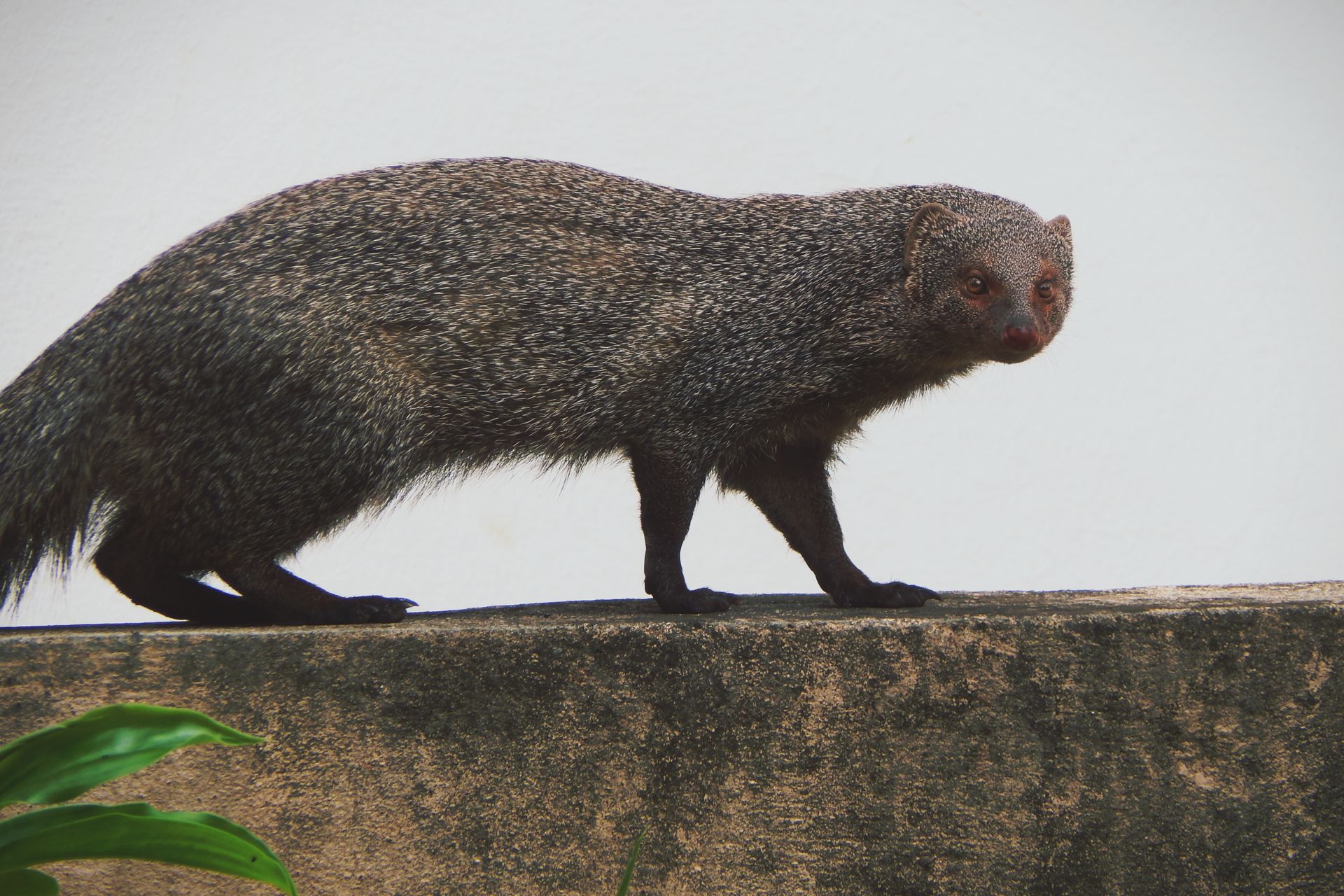
The Indian Grey Mongoose is found in a variety of habitats, including forests, grasslands, and rocky areas.
They are widely distributed across India, with a range that includes the Himalayan foothills and the Western Ghats mountain range.
Their adaptability to different environments is likely due to their ability to survive in a range of temperatures and humidity levels.
From sea level to elevations of over 2,000 meters, the Indian Grey Mongoose has been spotted in a wide range of elevations.
On a similar theme: Small Asian Mongoose
Indian Gray Mongoose
The Indian Gray Mongoose is a fascinating creature that calls the Indian subcontinent home.
They are carnivores, feeding on small mammals, birds, and reptiles, which helps to control the population of these species in their ecosystem.
These mongooses are known for their agility and speed, reaching up to 30 km/h when chasing prey.
Their thick, gray coat provides excellent camouflage in their rocky and scrubby habitats.
Indian Gray Mongooses are generally solitary animals, only coming together for mating.
Expand your knowledge: Indian Gray Mongoose
Habitat and Distribution
The Indian grey mongoose is a highly adaptable creature, able to thrive in a wide variety of habitats. They can be found in areas with thickets, cultivated fields, or broken, bushy vegetation.
One of the reasons they're able to occupy such a broad range of habitats is their ability to escape the mid-day sun by sleeping in holes in the ground or hollow trees.
They've been observed in temperate, tropical, and terrestrial habitats, and are also known to inhabit open areas, grasslands, and scrub.
Indian grey mongooses are found in a number of countries, including Saudi Arabia, Kuwait, Bahrain, Iran, Afghanistan, Pakistan, India, Nepal, Sri Lanka, and Bangladesh. They've also been spotted in Turkey and the United Arab Emirates.
Their range is quite extensive, spanning from Arabia to Nepal, and they can be found in a variety of biogeographic regions, including the Palearctic, Oriental, Neotropical, Oceanic Islands, and Mediterranean Sea regions.
Here are some of the specific habitats where Indian grey mongooses can be found:
- Grasslands
- Open areas
- Rocky patches
- Scrub
- Semi-desert
- Cultivated fields
- Areas of thickets
- Bushy vegetation
- Dry secondary forest
- Thorn forest
- Forest edges
- Near human settlement
Their ability to occupy a wide range of habitats has led to them being introduced to new areas, such as the West Indies, Hawaii, Jamaica, Cuba, and Puerto Rico, where they were brought in to control poisonous snakes and rats.
Behavior and Conservation
The Indian grey mongoose is a skilled hunter, often taking on snakes and other small mammals in its habitat. It's a testament to its adaptability and fearlessness.
In the wild, these mongooses have a unique way of dealing with venomous snakes. They can eat them whole, even after being bitten, due to their immunity to certain snake venoms.
Mongooses are generally solitary animals, only coming together during mating season. This is likely due to their need for space and resources in their habitat.
Predation
Indian gray mongooses have a unique way of dealing with predators. They retreat to burrows, crevices in rocks, or nearby rivers to escape the heat and obtain protection.
Their largest predator is the leopard (Panthera pardus). Mongooses have learned to avoid these big cats, which is crucial for their survival.
Here are some of their known predators:
- Leopards (Panthera pardus)
This information is backed by scientific research, with grants from the National Science Foundation and support from organizations like the Marisla Foundation and the Museum of Zoology.
Conservation Status
The Indian gray mongoose is listed as Least Concern on the IUCN Red List, which means it's not considered to be a threatened species. However, its population density is relatively low, with studies showing a density of 0.2 per sq. km in Ruhuna National Park.
The government of Sri Lanka has taken steps to protect the species, restricting the use of toxic agro-chemicals in farming areas around protected areas. This is a crucial measure, as the use of these chemicals is a significant threat to the species.
Here's a breakdown of the Indian gray mongoose's conservation status:
- IUCN Red List: Least Concern
- US Federal List: No special status
- CITES: Appendix III
It's worth noting that the species is protected in Sri Lanka, along with two other species of mongoose.
Diet and Spotting
The Indian Gray Mongoose is an opportunistic feeder, which means it's not picky about what it eats. It'll chow down on rodents, smaller mammals, birds, eggs, reptiles, insects, fruit, and even carrion.
They're known to be active during daylight hours, which is great news for wildlife enthusiasts. This diurnal behavior makes them easier to spot, especially in open grasslands and scrub forests.
If you're planning a Nepal adventure, consider visiting these habitats during the day for a higher chance of spotting an Indian Gray Mongoose.
Suggestion: Crab Eating Mongoose
Indian Gray Mongoose Diet
The Indian Gray Mongoose is an opportunistic feeder, which means they'll eat just about anything they can find. They primarily feed on rodents like rats and mice, but they're not picky and will also consume smaller mammals, birds, eggs, reptiles, insects, fruit, and even carrion if they come across it.
These mongooses are known to be diurnal, which means they're active during the day, and they spend most of their time on the ground. However, they're not afraid to climb trees to escape danger or find food, showing they're quite agile.
Their diet is incredibly varied, reflecting their adaptability to different environments. In fact, they'll eat just about anything they can find, from insects to fruit to carrion.
Spotting Tips for Nepal Adventure

To spot Indian Gray Mongooses in Nepal, choose the right time and location, visiting open grasslands and scrub forests during daylight hours.
These animals have sharp senses and may be easily startled by loud noises or sudden movements, so move slowly and quietly to increase your chances of a sighting.
Hiring a local wildlife guide familiar with mongoose habitats and behavior can dramatically increase your likelihood of observing these fascinating creatures up close.
By following these simple tips, you'll be well on your way to spotting Indian Gray Mongooses in their natural habitat.
Frequently Asked Questions
Are there mongooses in the United States?
Yes, mongooses are found in the United States, specifically in Hawaii, where they have established a presence on several islands. They are not native to the mainland US, but are well-established in the Hawaiian Islands.
Featured Images: pexels.com