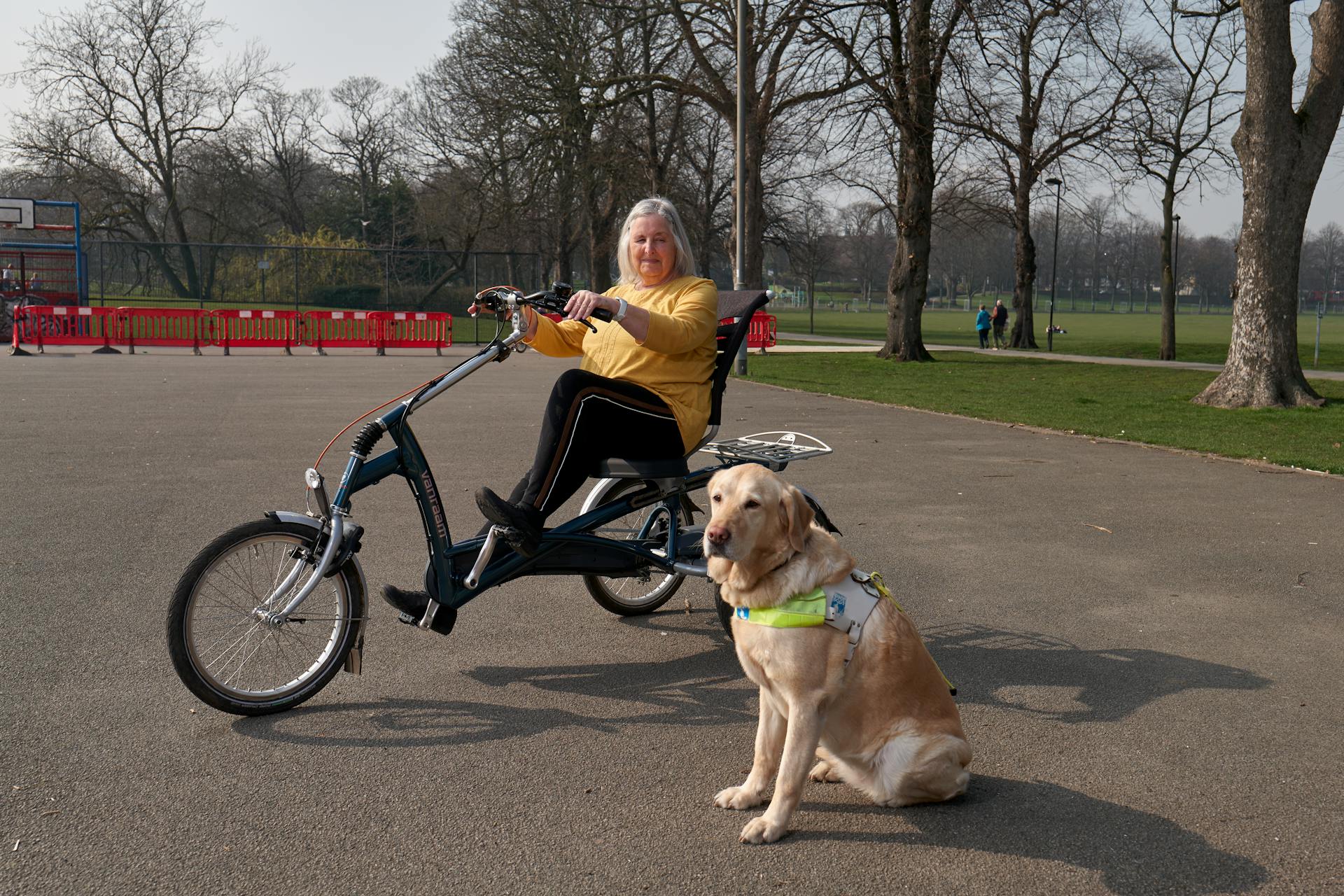
If you're a veteran or have a disability, you may be eligible for HUD assistance animals to help you live independently. These animals are trained to assist with specific tasks and can make a huge difference in your life.
The Fair Housing Act requires landlords to make reasonable accommodations for assistance animals, which means they can't deny you housing just because you have an animal. This applies to both public and private housing.
To qualify for HUD assistance animals, you'll need to provide documentation from a licensed healthcare professional stating that you need an assistance animal. This can be a doctor, therapist, or other healthcare provider who's familiar with your needs.
The type of animal that can be considered an assistance animal is not limited to dogs. Other animals, like cats, birds, and even miniature horses, can also be eligible if they're trained to perform specific tasks.
Worth a look: Hud Assistance Animal Verification Form
Service Animals and Emotional Support Animals
Service animals and emotional support animals are often confused with one another, but they serve different purposes. Service animals are trained to work or perform tasks for individuals with disabilities, and the Americans with Disabilities Act (ADA) limits these animals to dogs. However, in housing, you cannot limit assistance animals to dogs.
Emotional support animals, on the other hand, provide therapeutic emotional support for individuals with disabilities or mental health conditions. HUD defines emotional support animals as small, domesticated animals that are traditionally kept in the home for pleasure, such as dogs, cats, and small birds. Any animal that falls into this category can be considered an emotional support animal.
The key thing to remember is that the type of animal is not as important as the individual's need for the animal. HUD emphasizes that going online to get a pet registered or certified is irrelevant and does not verify an individual's need for an assistance animal. What matters is whether the individual is disabled and if the animal is necessary to assist them because of their disability.
A fresh viewpoint: Is an Emotional Support Animal an Assistance Animal
Difference Between Service Animals and Emotional Support Animals
The terms service animals and emotional support animals are often used interchangeably, but they have distinct meanings. Service animals are not relevant when it comes to housing, but emotional support animals are protected under the Fair Housing Act.
The Fair Housing Act doesn't care whether an animal is a service animal or an emotional support animal, and housing providers must consider requests for reasonable accommodations for emotional support animals. This is because emotional support animals offer comfort, stress relief, and more to people coping with mental health struggles.
Both service animals and emotional support animals fall under the definition of “assistance animals” according to HUD guidelines. This means they do work, provide assistance, perform tasks, or provide emotional support to individuals with disabilities or mental health conditions.
You might like: Animal Health Technician
Service Animal Definition
The legal definition of a service animal is an animal that has been trained to work, perform tasks, or provide assistance for a person with a disability. According to the ADA, only dogs qualify as service animals.
The ADA limits service animals to dogs, but as housing providers, you cannot limit the type of assistance animal to a dog. The ADA references can be confusing, especially with the new HUD notice that introduces a different type of animal called a support animal.
A support animal, as defined by HUD, is an animal that works, performs tasks, provides assistance, or provides therapeutic emotional support for individuals with disabilities. This definition is separate from the traditional service animal definition.
The key thing to remember is that the type of animal is not the only factor in determining whether it's a legitimate assistance animal. What matters most is whether the animal is necessary to assist someone with a disability.
Check this out: What Is an Assistance Animal
Emotional Support Animals
Emotional Support Animals (ESAs) are most commonly dogs and cats, but many types of animals can serve as wonderful companions that provide emotional support. HUD clarifies that any "small, domesticated animal that is traditionally kept in the home for pleasure rather than for commercial purposes" can be an ESA.
Expand your knowledge: Emotional Service Dogs
You can submit a request for accommodation of your ESA orally or in writing, and it can be made directly by you or by someone else on your behalf, such as a person legally residing in the unit with you or a legal guardian or authorized representative.
Landlords have to give you a "reasonable opportunity" to provide documentation regarding your ESA before rejecting your request. This means they should let you know why they believe your ESA request is insufficient and engage in a good-faith dialogue to remedy the situation.
You don't need to submit a written request or use special words like "reasonable accommodation" or "assistance animal" to request accommodation for your ESA. Just letting your landlord know you are requesting to live with your ESA and submitting your ESA letter should be sufficient.
However, HUD encourages you to specify that you are requesting "reasonable accommodation" for an Emotional Support Animal to avoid any confusion regarding your request. It's also a good idea to keep a copy of your accommodation request and any supporting documentation.
As an ESA owner, you are responsible for the well-being and safety of your ESA, as well as for any consequences that stem from your ESA's actions. This includes feeding, maintaining, providing veterinary care for, and controlling your Emotional Support Animal. You can do this on your own, with the help of family and friends, or with other third parties like volunteers or service providers.
A different take: Emotional Assistance Animals
If you're planning to get an ESA letter, please keep in mind that your state can have specific requirements. For example, in California and Arkansas, if you are seeing a therapist or doctor for the first time, they must have a relationship with you for at least 30 days before they can give you an ESA letter.
Suggestion: Assistance Animal Letter
Proper Certification for Service Animals
Certifying your pet online is not acceptable, as HUD considers those registrations irrelevant to verifying a request for a reasonable accommodation.
You can hand back online certifications to residents and inform them that they are not adequate to verify their need for an assistance animal.
The only thing that matters is if you're disabled, if you meet the definition of disability, and if that animal is necessary to assist you because of your disability.
Intriguing read: Social Security Disability Service Animal Assistance Programs
Housing and Accommodations
Landlords cannot impose breed or weight restrictions on Emotional Support Animals (ESAs), nor can they charge fees or deposits for them.
To request a reasonable accommodation for an ESA, tenants can make a request orally or in writing, and they don't need to use specific words like "reasonable accommodation" or "assistance animal." They just need to let the landlord know they're requesting to live with their ESA and submit their ESA letter.
Tenants should keep a copy of their accommodation request and any supporting documentation, as this can be helpful in case of a dispute later.
Here are some important facts to know about requesting ESA accommodations:
- Landlords must respond to ESA requests promptly, within 10 days.
- Tenants can make an ESA request before or after acquiring their ESA.
- Dogs, cats, small birds, rabbits, hamsters, gerbils, other rodents, fish, and turtles can be ESAs.
- HOAs and co-ops are subject to ESA rules, and tenants can request reasonable accommodations for their ESAs.
- Tenants are responsible for the well-being and safety of their ESAs, including feeding, maintaining, providing veterinary care, and controlling their animal.
It's worth noting that landlords cannot request sensitive details about the tenant's condition, and they cannot require healthcare professionals to use a specific form.
Air Travel and Regulations
Air travel can be intimidating, but there are laws in place to protect individuals with disabilities, including those who use service animals. The Air Carrier Access Act (ACAA) requires airlines to make reasonable accommodations for service animals.
Airlines operating flights to, from, and within the United States must comply with the ACAA. This means they must transport service animals without charging extra fees.
Service animals are protected under the law, which prohibits airlines from discriminating against individuals with disabilities. This includes those who use a service dog.
The ACAA has been in place since 1986, and it's been amended several times to ensure equal access for all passengers.
Key Information and Facts
You can submit an ESA request to your landlord orally or in writing, and it's sufficient to simply let them know you're requesting to live with your ESA and submit your ESA letter.
HUD encourages tenants to specify that they're requesting "reasonable accommodation" for an Emotional Support Animal to avoid confusion.
Tenants are responsible for the well-being and safety of their ESA, including feeding, maintaining, providing veterinary care, and controlling their Emotional Support Animal.
You can care for your ESA on your own, with the help of family and friends, or with other third parties like volunteers or service providers.
HOAs and co-ops are subject to the same Fair Housing rules as other types of housing, and a reasonable accommodation for an ESA may include a reasonable accommodation to a land use and zoning law, homeowners association rule, or a co-op rule.
12 Essential Facts for ESA Owners
As an ESA owner, it's essential to understand your rights and responsibilities. Here are some key facts to keep in mind:
Landlords can't impose breed or weight restrictions on ESAs, nor can they charge fees or deposits for them.
You can make an ESA request orally or in writing, and you can do so before or after acquiring your ESA.
The following animals can be considered ESAs: dogs, cats, small birds, rabbits, hamsters, gerbils, other rodents, fish, and turtles.
If you're a tenant, your landlord must respond to your ESA request within 10 days and engage in interactive dialogue with you about it.
Here's a quick rundown of the types of animals that can be considered ESAs:
You can use the help of third parties to care for your ESA, and you don't need to register or license your ESA to qualify it.
ESA letters can come from online health professionals, and landlords can't require healthcare professionals to use a specific form.
Key Takeaways
Landlords can't impose breed or weight restrictions on Emotional Support Animals (ESAs). They also can't charge extra fees or deposits for ESAs.

You can make an ESA request orally or in writing. This is a change from the old rules, which required a written request. It's a good idea to make a written request, though, in case you need to prove it later.
Landlords must respond to ESA requests within 10 days. This is a requirement under the new rules.
Dogs, cats, small birds, rabbits, hamsters, gerbils, other rodents, fish, and turtles can all be ESAs. This is according to the new rules.
Here are some common animals that can be ESAs:
- Dogs
- Cats
- Small birds
- Rabbits
- Hamsters
- Gerbils
- Other rodents
- Fish
- Turtles
If you're planning to get an ESA letter, you should know that your state may have specific requirements. For example, in California and Arkansas, you need to have a relationship with your healthcare professional for at least 30 days before they can give you an ESA letter.
Background and Overview
Hud assistance animals are a type of emotional support animal that provides comfort and relief to individuals with disabilities, including mental health conditions, post-traumatic stress disorder, and physical disabilities.
These animals are not just pets, but are trained to assist their owners with daily tasks and provide a sense of calm and security. Some people rely on them for emotional support, while others use them for mobility assistance.
According to the Fair Housing Act, hud assistance animals are protected under the law, which means landlords and property managers must accommodate them in housing.
7. Animal Eligibility
Service animals are typically dogs, but you can't limit assistance animals to just dogs as a housing provider.
The ADA limits service animals to dogs, but HUD has a different definition for support animals.
Any small, domesticated animal that's traditionally kept in the home for pleasure can be an ESA, such as dogs, cats, small birds, and rabbits.
Dogs and cats are the most common ESAs, but other animals like hamsters, gerbils, and fish can also qualify.
If you have a unique pet, like a monkey or a kangaroo, you'll need to provide extra documentation to prove its necessity.
Landlords must give you a "reasonable opportunity" to provide documentation for your ESA request, and they should engage in a good-faith dialogue to resolve any issues.
Discover more: Animals Dogs and Cats
Background

Background is a crucial aspect of understanding any concept or idea. The background of a particular topic can be complex and multifaceted.
The concept of background is closely tied to the idea of context, which is essential for understanding and interpreting information. Context provides a framework for making sense of data and helps to eliminate ambiguity.
Research has shown that a clear understanding of background information can improve comprehension and retention of new information. This is especially true when learning new concepts or skills.
The background of a particular topic is often composed of various elements, including history, environment, and culture. Each of these elements plays a significant role in shaping our understanding of the topic.
A good grasp of background information can also help to identify patterns and connections that might otherwise go unnoticed. This can lead to new insights and a deeper understanding of the topic.
Featured Images: pexels.com