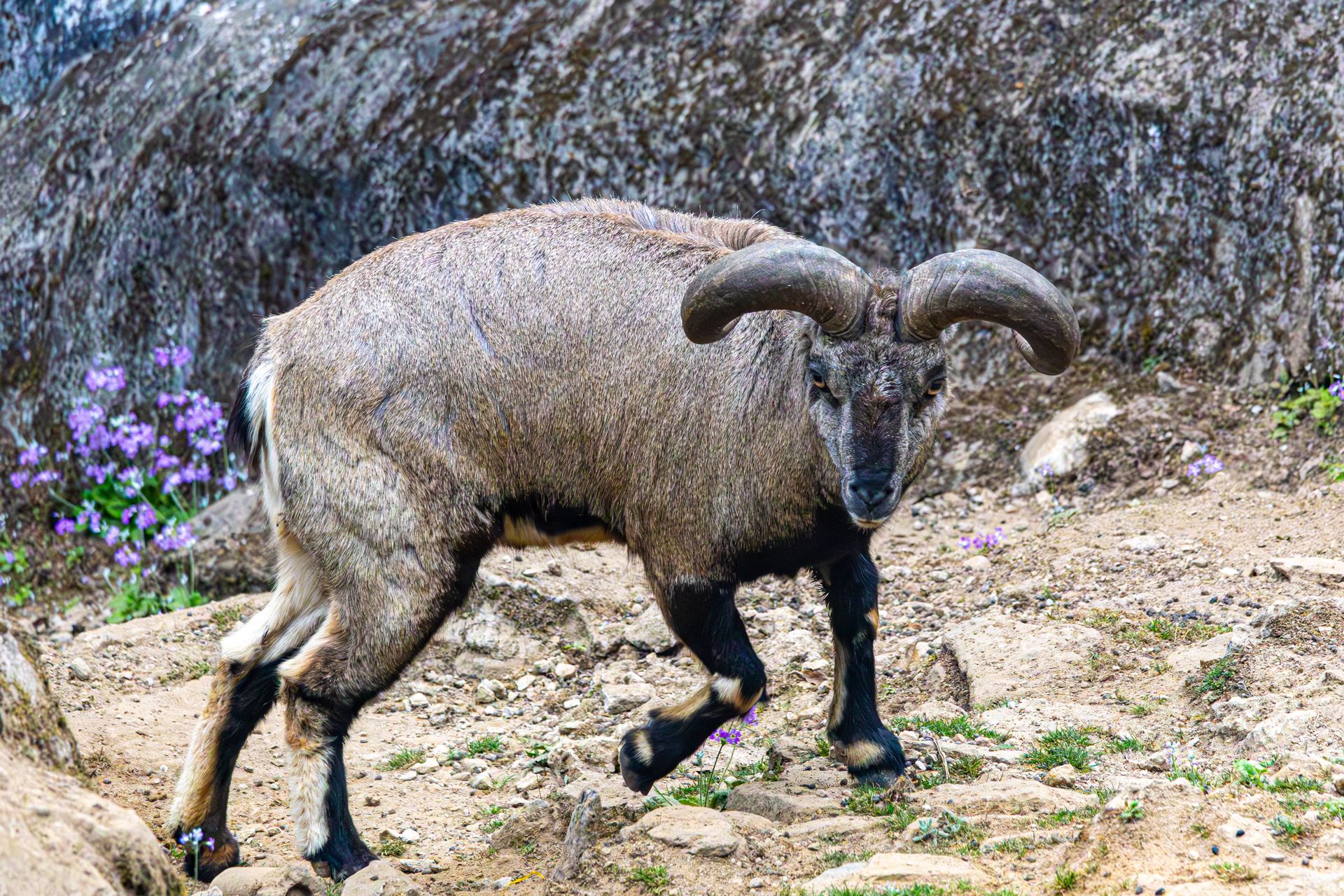
The Himalayan Blue Sheep, also known as the Bharal, is a majestic creature that calls the Himalayan Mountains home.
They inhabit the high-altitude regions of the Himalayas, typically above 3,000 meters.
Their habitat consists of steep, rocky terrain, and they're well adapted to living in these harsh conditions.
These sheep are herbivores, feeding on a variety of plants, including grasses, leaves, and twigs.
They have a unique way of communicating with each other, using a series of grunts and snorts to convey their messages.
Their social structure is complex, with males forming bachelor groups and females often living in smaller groups with their young.
Unfortunately, the Himalayan Blue Sheep is listed as Near Threatened on the IUCN Red List due to habitat loss and fragmentation.
A unique perspective: American White Ibis Habitat
Physical Characteristics
The Himalayan blue sheep is a remarkable creature, with some impressive physical characteristics. Males are significantly larger than females, weighing between 60-75 kg compared to females, who tip the scales at 35-45 kg.
Their robust bodies are adapted for navigating cliffs and rocky terrains, making them agile and fleet-footed mountaineers.
Males possess impressive crescent-shaped horns, which can grow over 50 cm in length and weigh up to 9 kg. In contrast, females have smaller, straighter horns that are significantly shorter, measuring only 10-20 cm.
Here's a comparison of the physical characteristics of male and female Himalayan blue sheep:
Their coat colors are also distinct, with males sporting a slate-blue coat with dark markings, while females have a reddish-brown coat with light markings.
Taxonomy and Evolution
The Himalayan blue sheep is a fascinating creature with a unique place in the animal kingdom. They belong to the family Bovidae and are the sole members of the genus Pseudois.
Molecular studies have shown that Himalayan blue sheep are more closely related to goats than sheep. This is a surprising finding, but it makes sense when you consider their physical and behavioral similarities to goats.
The Himalayan blue sheep are split into three subspecies: the Chinese blue sheep, the Himalayan blue sheep, and the Helan Shan blue sheep. Each of these subspecies has its own distinct characteristics, but they all share a common ancestry.
Here are the three subspecies of Himalayan blue sheep:
- Chinese blue sheep (Pseudois nayaur szechuanensis)
- Himalayan blue sheep (P. n. nayaur)
- Helan Shan blue sheep (P. n. ssp.)
Chromosomal analyses have revealed that Himalayan blue sheep likely diverged early from the ancestral stock of goats, which is why they have unique adaptations to their habitat. This has contributed to their sheep-like appearance and behavior.
Behaviour and Ecology
Himalayan blue sheep are active throughout the day, alternating between feeding and resting on the grassy mountain slopes. They're excellent at hiding, but once they're noticed, they quickly scamper up to the precipitous cliffs to freeze in place, using their camouflage to blend into the rock face.
Their diet consists mainly of grass, but during times of scarcity, they switch to browsing forbs and shrubs. This switch is likely due to the high degree of diet overlap between livestock and bharal, which can lead to resource competition and a decline in bharal density.
Population densities in Nepal range from 0.9 to 2.7 animals per km, increasing to a maximum of 10 animals in the winter as herds congregate in valleys. This is likely due to the availability of food and shelter in these areas.
Bharal are grazers, but they're also preyed upon by various predators, including snow leopards, Himalayan wolves, and leopards. A few lambs may also fall prey to foxes or eagles.
Here's a breakdown of the predators that prey on bharal:
Conservation Status
The blue sheep is categorized as "Least Concern" by the IUCN, but they still face threats from habitat degradation.
Habitat management and limiting grazing have shown positive impacts on their populations, making these conservation efforts truly commendable.
Despite their current status, blue sheep are vulnerable to diseases transmitted from domestic animals, which adds to their conservation challenges.
Spotting blue sheep in their natural habitat, like I did on my trek in Ladakh, is an unforgettable experience that highlights the importance of conservation efforts.
Worth a look: Giant Panda Habitat Loss
Relationship with Humans
The Himalayan blue sheep, also known as the bharal, have a complex relationship with humans. They are often found around Buddhist monasteries, which protect them.
However, in areas like the Spiti Valley, issues of crop damage caused by bharal have started to arise. This is a challenge for local communities and conservation efforts.
The bharal is classified as a least concern species by the IUCN Red List, and is also known as a caprid, a type of mammal found in Asia. Here are some key taxonomic identifiers for the bharal:
- Pseudois nayaur
- IUCN Red List least concern species
- Caprids
- Mammals of Asia
Relationship With Humans
In many Buddhist monasteries, the bharal is protected, but issues of crop damage have started to arise in areas like the Spiti Valley.
The bharal is considered a least concern species by the IUCN Red List.
Monasteries often protect blue sheep, which hold cultural significance in regions like Ladakh and Nepal.
However, issues like crop damage have surfaced in some areas, such as the Spiti Valley and Ladakh.
Successful conservation initiatives, like setting aside pastures in Kibber Village, have boosted blue sheep populations and facilitated snow leopard tourism.
Monasteries like Hemis Monastery, one of the largest in Ladakh, stand as living monuments to the region's profound spiritual heritage.
Are Really?
Blue Sheep are often misunderstood, but despite their name, they're not actually blue. Their coats are slate grey to pale brown, with a bluish sheen.
They're also not sheep, but rather ungulates that are more closely related to goats.
In the Himalayas, you can find Blue Sheep, also known as Bharal, roaming freely.
Distribution and Habitat
The Himalayan blue sheep is found in the high-altitude regions of the Himalayas, the Tibetan Plateau, and neighboring mountain ranges, extending into countries such as India, Nepal, Bhutan, and parts of China.
They inhabit areas with rocky, steep slopes, alpine meadows, and scrubby, high-altitude grasslands. These challenging terrains provide shelter for them in caves or craggy terrain to avoid predators.
In India, you can find them in Ladakh's Hemis National Park, Zanskar, and the Spiti Valley. Their distribution spans across high mountain ranges, primarily found in Nepal, northern India, and Pakistan.
Himalayan blue sheep are commonly found in the Annapurna and Langtang regions of Nepal, while in Pakistan, they inhabit the rugged and remote areas of the Gilgit-Baltistan region.
Rutting Behaviour
The rutting behaviour of the bharal, also known as the Himalayan blue sheep, is a fascinating phenomenon. It starts towards late November and continues until mid-January.
During this time, male bharal use multiple strategies for mating, including tending, blocking, and coursing. These strategies are crucial for securing a mate and ensuring the survival of their species.
The lambs of the bharal are born in late June and July, after a gestation period of approximately four to five months.
Here's a breakdown of the different strategies used by male bharal during the rutting season:
These strategies are essential for the survival of the bharal species, and it's a truly remarkable sight to witness in the wild.
Subspecies
The Himalayan Blue Sheep has three recognized subspecies. The Chinese Blue Sheep is a subspecies known as Pseudois nayaur szechuanensis.
The Himalayan Blue Sheep's subspecies includes the Dwarf Blue Sheep, which is now considered a variant of Pseudois nayaur.
Bharal Facts
Bharals are incredibly well-suited to their mountainous habitat, with a grey-brown coat and creamy white underbelly that helps them blend in.
Their habitat is found in the steep mountainous terrain at high altitude, specifically in the Himalayas: India, Bhutan, China, Myanmar, Nepal, and Pakistan.
Bharals are also surprisingly agile and quick, capable of climbing steep rocky mountain ridges and even going airborne when traveling between mountain peaks and passes.
Their diet consists mainly of herbs, lichens, mosses, grasses, and shrubs, which they find in their high-altitude habitat.
Bharals are quite large, reaching a height of 91cm (36 inches) and weighing up to 75kg (165lb).
Here's a summary of Bharal facts:
Hunting and Conservation
Regulations in Nepal and Pakistan ensure that hunting does not negatively impact blue sheep populations.
Hunters in both countries work with licensed guides who are familiar with the terrain and local wildlife conservation efforts.
Hunting in Nepal and Pakistan requires high-altitude trekking, often in difficult weather conditions, which adds to the thrill of the hunt.
Fees for hunting permits in Nepal and Pakistan often go toward local wildlife conservation projects.
Himalayan Blue Sheep hunting is carefully regulated to prevent over-hunting and ensure the long-term survival of the species.
Additional reading: Animal Conservation Organizations
Hunting in Nepal
Hunting in Nepal is a thrilling experience that offers a unique opportunity to explore the Himalayan wilderness. The remote mountain regions of Nepal are some of the most beautiful and rugged on earth, with dense forests, rocky ridgelines, and alpine meadows to navigate.
Hunters in Nepal typically use the spot-and-stalk approach, carefully tracking the herds as they graze and move through the landscape. This method requires patience and perseverance, as the blue sheep's natural camouflage and tendency to stay high on cliff faces make spotting them a challenge.
The altitude, weather conditions, and the sheep's wariness make for a physically demanding and rewarding hunt. Hunters need to be in top physical condition to endure the long treks and high elevations.
In Nepal, hunting blue sheep is regulated by strict conservation measures to ensure sustainable populations. Hunters typically work with licensed guides who are familiar with the terrain and local wildlife conservation efforts.
These regulations ensure that hunting does not negatively impact blue sheep populations and help preserve this iconic species for future generations.
Expand your knowledge: African Painted Dog Hunting
Ethical Conservation Hunting
Ethical conservation hunting is a vital practice that helps protect blue sheep populations. In Nepal and Pakistan, hunting is carefully regulated to prevent over-hunting.
Hunting permits in these regions often come with fees that support local wildlife conservation projects. This ensures that the revenue generated from hunting goes back into protecting the very species being hunted.
By implementing sustainable hunting practices, we can help maintain a healthy and sustainable population of blue sheep in the wild.
A unique perspective: Wild Life Conservation
Trekking and Outdoor Activities
Ladakh is a trekker's paradise, offering some of the most stunning and challenging routes in the world. From the famous Blue Sheep trek, which follows the frozen Zanskar River, to lesser-known routes like the Sham Valley or Nubra Valley treks, Ladakh's landscape offers endless possibilities for adventure and discovery.
The high-altitude passes, such as Khardung La and Chang La, offer breathtaking views of snow-capped peaks and sprawling valleys. These passes are a must-visit for any trekker.
Winter expeditions to spot the elusive Blue Sheep in the Hemis National Park are gaining popularity among wildlife photographers and conservationists alike. This is a unique opportunity to see these rare creatures in their natural habitat.
Before embarking on a trek, it's essential to understand and respect the region's customs and traditions. Visitors should dress modestly, especially when visiting monasteries or attending religious ceremonies.
The Importance of Preserving Ladakh
Ladakh's Blue Sheep is a unique and endangered species that requires careful attention to preserve.
Climate change and mass tourism are the main threats to the survival of Ladakh's Blue Sheep.
Visitors can contribute to the preservation of Ladakh's natural and cultural heritage by choosing eco-friendly accommodations and supporting local businesses.
By participating in community-led conservation efforts, visitors can help protect the fragile ecosystems that make Ladakh so special.
Ladakh's people have a long history of living in harmony with their environment, practicing sustainable agriculture, and maintaining a deep spiritual connection to the land.
Visitors are encouraged to follow the same principles, leaving no trace and respecting the region's traditions.
Ladakh is a place where the physical and spiritual worlds converge, offering travelers a journey unlike any other.
Featured Images: pexels.com