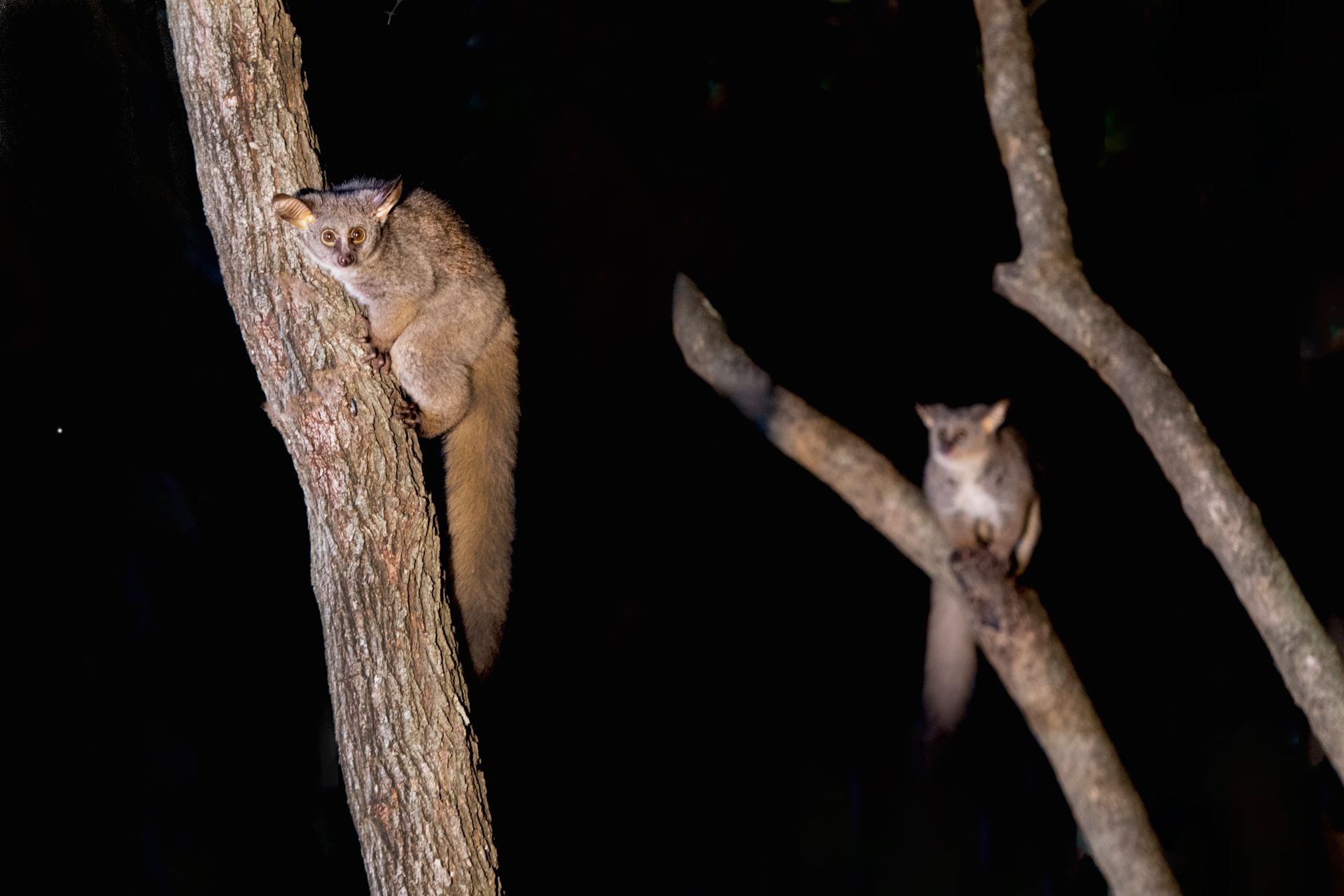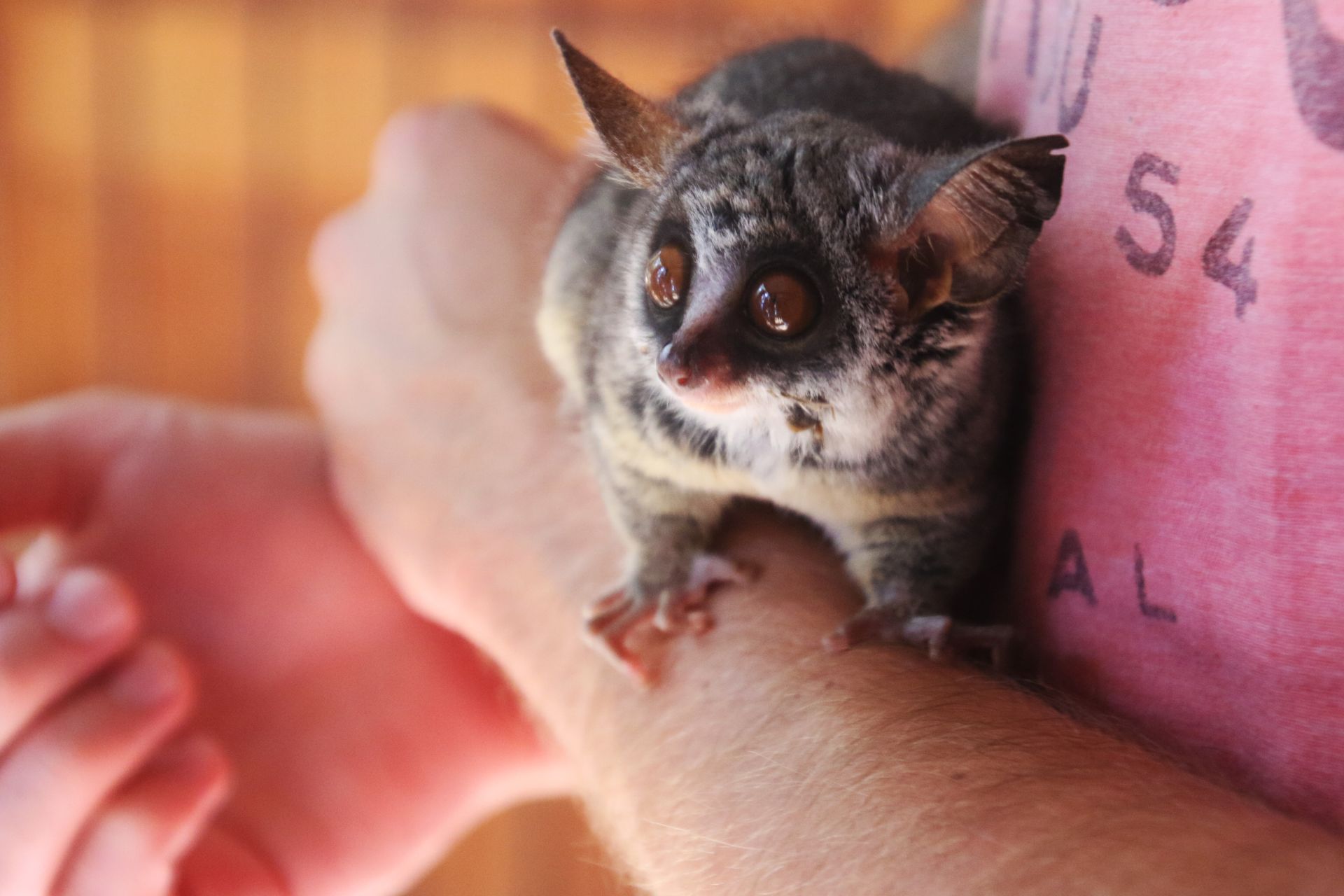
Galagos are found in a variety of habitats, including savannas, woodlands, and rocky outcrops.
These small primates are native to sub-Saharan Africa, with a wide distribution across the continent, from Senegal in the west to Ethiopia in the east.
Galagos are known for their agility and are often seen leaping between trees, using their powerful hind legs to propel themselves.
They are also skilled climbers, with flexible hands and feet that allow them to grasp branches and navigate through dense vegetation.
Classification
Galagos, like the Senegal Galago, belong to the class of mammals known as Theria, which also includes humans. This class is divided into two subclasses: Marsupialia and Placentalia.
The Senegal Galago specifically falls under the subclass Placentalia, which means it gives birth to fully formed young. This subclass is further divided into several infraclasses, but the one relevant to galagos is Boreoeutheria.
Here's a breakdown of the Senegal Galago's classification:
Subspecies
Subspecies are a crucial part of a species' classification, and in the case of the Senegal bushbaby, there are four recognized subspecies.
The subspecies of the Senegal bushbaby include Galago senegalensis senegalensis, Galago senegalensis braccatus, Galago senegalensis sotikae, and Galago senegalensis dunni.
Each of these subspecies has its own unique characteristics, but they all share the common name of Senegal bushbaby.
The different subspecies of the Senegal bushbaby are:
- Galago senegalensis senegalensis
- Galago senegalensis braccatus
- Galago senegalensis sotikae
- Galago senegalensis dunni
These subspecies are recognized by taxonomists and are an important part of understanding the diversity within the species.
Classification
Classification is a way to group living things based on their shared characteristics and evolutionary relationships. The Galago, a type of primate, falls under the subclass Theria.
The Galago is a part of the infraclass Placentalia, which means it gives birth to fully formed young. Within Placentalia, the Galago is further classified as part of the magnorder Boreoeutheria.
Here's a breakdown of the Galago's classification:
The Galago's species status can be quite complex, with several different names being used to refer to the same species. For example, the Senegal Bushbaby and Senegal Galago are two names that refer to the same species.
Consider reading: Brown Greater Galago
Type Material

Type material is a crucial part of classification.
MNHN-ZM-2007-1547 is an example of type material, which is a specific reference number assigned to a specimen.
This number is also referred to as MNHN:type:143 and MNHN "192".
Physical Characteristics
Galagos, specifically the Galago senegalensis, are quite small creatures. They typically range in length from 5 to 8 inches, excluding their tail. This compact size allows them to navigate through dense vegetation with ease.
Their size is one of the most distinctive features of these animals.
Size
When it comes to physical characteristics, size is one key aspect to consider.
The size of the animal in question is quite compact, measuring 5 to 8 in (13.2 to 20.1 cm) long, excluding tail.
Weight
Weight is a crucial aspect of physical characteristics. On average, an adult human weighs around 62 kilograms.
Body mass index (BMI) is a common way to measure weight in relation to height. A BMI of 18.5 to 24.9 is considered normal.

Excess weight can lead to various health issues. For example, a BMI of 25 or higher increases the risk of developing type 2 diabetes.
Maintaining a healthy weight requires a balance of calorie intake and expenditure. The recommended daily calorie intake varies based on age, sex, and physical activity level.
A person's weight can fluctuate due to various factors, including muscle gain or loss, water retention, and changes in body composition.
Habitat and Distribution
The Northern lesser galago, also known as galago senegalensis, can be found in a diverse range of habitats across tropical Africa.
Their broad range includes Benin, Burkina Faso, Cameroon, Central African Republic, Chad, DR Congo, Côte d’Ivoire, Eritrea, Ethiopia, Gambia, Ghana, Guinea, Guinea-Bissau, Kenya, Mali, Niger, Nigeria, Rwanda, Senegal, Sierra Leone, Somalia, Sudan, Tanzania, Togo, and Uganda.
They are at home in savanna woodland, dense to open bushland, montane forests, riverine woodland, and secondary and highly fragmented forest and woodland, including cultivated areas.
Curious to learn more? Check out: Northern Greater Galago

Areas of grassland are avoided by the Northern lesser galago.
In central Kenya, they are sympatric with the Somali lesser galago (Galago gallarum).
They may also be sympatric with southern lesser galagos (Galago moholi) in Tanzania.
The Northern lesser galago is listed on Appendix II of the Convention on International Trade in Endangered Species (CITES).
They occur in a large number of protected areas throughout their range, including Tsavo West National Park, Tsavo East National Park, Mt. Kenya National Park, and many others.
Behavior and Type
Galagos, specifically Galago senegalensis, are primarily nocturnal creatures, spending most of their time in trees and bushes.
Their active hours are from dusk until dawn, which is a significant portion of the day.
They are known to "park" their infants on a limb while foraging at night, and then retrieve them before dawn to return to their nest.
Bushbabies, as they are also known, make their nests using vegetation or repurpose abandoned bird's nests or unoccupied beehives.
Their arboreal lifestyle means they spend only 1% of their time on the ground, with 59% of their time spent within 10 meters (33 feet) of the ground in trees and bushes.
Lifespan

Research suggests that certain personality types are more likely to live longer, with introverts having a slightly longer lifespan than extroverts. On average, introverts tend to live 3-5 years longer than extroverts.
Studies have shown that individuals with a Type A personality, known for being competitive and driven, often have higher blood pressure and stress levels, which can negatively impact their lifespan. In contrast, Type B individuals tend to have lower blood pressure and stress levels, contributing to a longer lifespan.
Introverts tend to engage in healthier habits, such as regular exercise and a balanced diet, which can contribute to a longer lifespan. They also tend to get more sleep, with an average of 7-8 hours per night, compared to extroverts who often get less sleep due to their more social lifestyle.
Research has also shown that individuals with a Type A personality are more likely to engage in risk-taking behaviors, such as smoking and substance abuse, which can significantly shorten their lifespan. In contrast, Type B individuals tend to be more cautious and avoid these types of behaviors.
Overall, the data suggests that introverts and Type B individuals tend to live longer, healthier lives, while extroverts and Type A individuals may face more health risks due to their lifestyle choices.
Type Locality
Type Locality is a crucial concept in understanding the behavior and characteristics of certain species. It refers to the specific location where a species was first identified or described.
The Type Locality can be a single point or a broader region, and it's often used to establish the range and distribution of a species. For example, the Type Locality of the California Condor is Big Sur, California.
In some cases, the Type Locality is not a physical location, but rather a collection of specimens or a written description. This can make it challenging to pinpoint the exact location where a species was first observed or collected.
See what others are reading: Squirrel Monkey Species Common Characteristics
Behavior
Bushbabies are nocturnal creatures, meaning they're active at night and rest during the day. They spend most of their time in trees and bushes, with 59 percent of their time spent within 33 feet of the ground.
These little primates are expert climbers, and their agility allows them to navigate through dense foliage with ease. They make their nests out of vegetation or use existing structures like abandoned bird's nests or unoccupied beehives.
A mother bushbaby will often "park" her infant on a limb while she forages for food at night, then pick up the baby before dawn to return to their nest high in the trees. This behavior is a testament to their strong maternal instincts.
Galago Senegalensis
The Galago Senegalensis is a curious and intelligent creature, with 8 types of call.
Females of this species typically deliver one baby at a time after a 4-month gestation.
The baby clings to the mother's chest until it reaches self-sufficiency, allowing the mother to move freely.
The cry of the baby sounds like an "acute twittering" similar to a mouse's squeak.
During heat, the female accepts the male for only 5-6 days, and has a colourless shedding that excites the male.
The male copulates with the female up to three times per night, and sometimes even in the morning.
In captivity, you may hear a sweet and melancholic call, defined as the "research sexual call", when the male follows the female.
The female's temper is even more vehement towards the male during pregnancy, and she may even jump in front of him furiously.
The male exhibits stereotypical behaviours of micturition, urinating on one hand and then rubbing it against the foot of the same side.
If this caught your attention, see: Trichechus Senegalensis
Frequently Asked Questions
Are Bush Babies and galagos the same?
Yes, Bush Babies and galagos are the same, referring to small nocturnal primates native to Africa. They are also known by other names, including nagapies, which means "night monkeys" in Afrikaans.
Featured Images: pexels.com