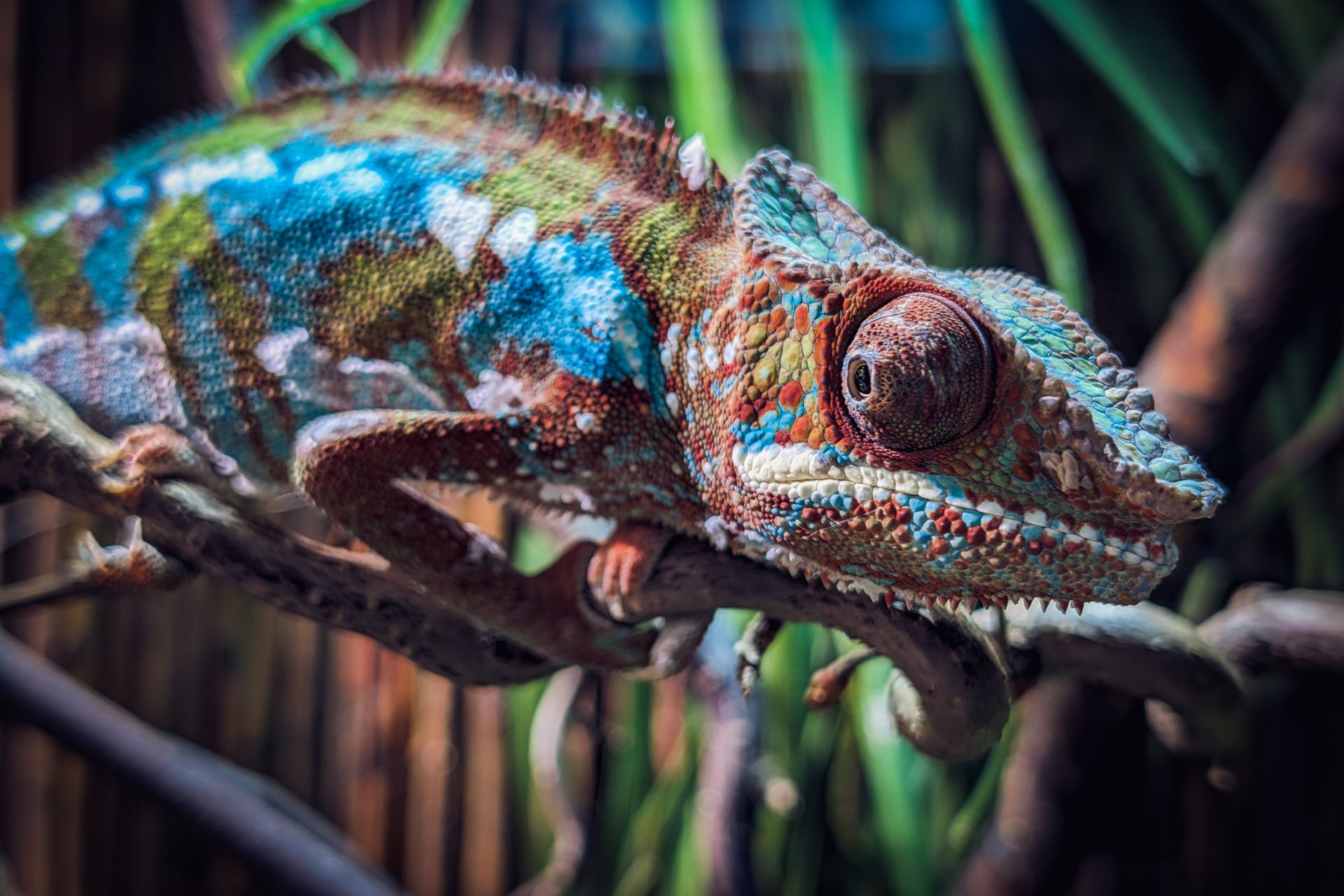
Furcifer is a genus of chameleons that are native to the island of Madagascar. They are known for their distinctive appearance, with a long, thin tail and a prehensile toe.
These chameleons are arboreal, spending most of their time in trees and using their prehensile toe to grasp branches. They have a specialized toe pad that allows them to climb and perch with ease.
Furcifer chameleons are carnivores, feeding on a diet of insects and other small invertebrates. They have a long, sticky tongue that they use to catch their prey.
In the wild, Furcifer chameleons can be found in a variety of habitats, including dry forests and rocky outcrops. They are solitary animals, only coming together to mate.
Taxonomy
The genus Furcifer contains 24 species, which is a pretty impressive number. The generic name Furcifer itself is derived from the Latin root furci- meaning "forked" and refers to the shape of the animal's feet.
The shape of a Furcifer's feet is quite unique and distinctive. This unique feature is what inspired the name of the genus.
Physical Characteristics
Furcifer pardalis is a species of chameleon that's known for its vibrant coloration. Adult males can grow up to 23 cm in length.
One of the most striking features of Furcifer pardalis is their coloration and patterning, which varies depending on their origin of location. Typically, panther chameleons from the Madagascan Island Nosy Be are blue-green, emerald-green, or have turquoise bodies.
Males from the northwest coast are usually bright pink, with a yellowish white stripe along the sides, earning them the nickname "the pink panthers." They can also be orange, red, and dark green with a vast variation in spots, stripes, and/or bands around the head and eyes.
Panther chameleons lack a vomeronasal organ, an auxiliary olfactory sense organ found in many animals, and they also do not have an outer or a middle ear.
Their specialized feet, called zygodactyl, have a tong-like appearance, allowing them to grasp and climb onto narrow branches. Each foot has two digits and three digits fused together, giving them a secure and strong grasp.
Here are some key characteristics of Furcifer pardalis:
- Sexual dimorphism: males are larger and more colorful than females
- Male coloration and patterning varies greatly, while females are more uniformly pale green or pink
- Specialized feet with zygodactyl allow for secure grasping and climbing
Habitat and Distribution
Furcifer species, such as F. verrucosus and F. oustaleti, are found in specific regions of Madagascar, with F. verrucosus confined to the extreme south and southwest of the island.
The range of F. oustaleti, on the other hand, is distributed throughout the island and is sympatric with F. verrucosus in the south and southwest.
Furcifer pardalis, also known as panther chameleons, are native to the island of Madagascar and are distributed throughout the island, but are locally abundant on the central-eastern, north-eastern, northern, and north-western coasts.
They have also been introduced to areas such as La Réunion and Mauritius.
Furcifer pardalis primarily inhabit lowland, dry deciduous forests close to thin belts of trees bordering rivers and roads.
They seem to prefer open habitats that are not overly shaded, which allows them to bask and establish territories.
Male panther chameleons have a higher range of elevation than females, most likely for territorial reasons.
Furcifer species can be found in a variety of habitats, but their specific ecological niches are not well understood.
Ecological niche models have been constructed to help differentiate between diversification models, but more research is needed to fully understand their distribution patterns.
Here's an interesting read: Eastern Gray Treefrog
Behavior and Ecosystem Roles
Furcifer chameleons are primarily solitary animals, with males having larger home ranges than females. They are known to be territorial and will defend their territory from other males.
Males will engage in displays, pursuits, and even severe injuries to protect their territory, with hostility increasing during breeding season. Female panther chameleons' behavior around other females is not well understood.
Furcifer chameleons have a significant impact on local insect and invertebrate populations, serving as a natural predator. They also support the populations of predators that prey on them, playing a vital role in maintaining the ecosystem's balance.
Here are some key behaviors exhibited by Furcifer chameleons:
- arboreal
- scansorial
- diurnal
- nomadic
- sedentary
- solitary
- territorial
Behavior
Panther chameleons are solitary animals, meaning they like to be alone, and are territorial, which means they defend a specific area from others. This is true for both males and females, regardless of age.
Males tend to have larger home ranges than females, and they can be quite aggressive when it comes to defending their territory. In fact, males will often engage in displays, pursue, and even severely injure other males that invade their space.
These chameleons are also diurnal, which means they're active during the day, and arboreal, meaning they spend most of their time in trees. They're also known to be nomadic, which suggests they don't stay in one place for too long.
Here are some key behaviors of panther chameleons:
- Arboreal
- Scansorial (although not explicitly mentioned, it's implied by their arboreal behavior)
- Diurnal
- Nomadic
- Sedentary (although not as common, they can stay in one place for a while)
- Solitary
- Territorial
Ecosystem Roles
Furcifer pardalis don't have any significant impacts on the ecosystem, but they do prey on many insects and other invertebrates, which likely affects those local populations.
Their presence also supports the populations of predators that prey on them.
Furcifer pardalis are not used very often in local cuisine.
They are, however, captured and sold within the international live pet trade, with the United States, Europe, and Asia being the major participants.
In contrast to Furcifer pardalis, other species like F. verrucosus and F. oustaleti have more complex ecological roles, with overlapping niches and different distribution patterns.
These species have been studied through ecological niche modeling, which helps understand their distribution and potential impacts on the ecosystem.
One study found that the predicted niche of F. verrucosus is mostly confined to the southern region of Madagascar, while F. oustaleti has a broader niche that covers almost all of the island.
This suggests that these species may have different ecological roles and impacts on the ecosystem.
Ep 70: Chameleons in the Classroom
Chameleons in the Classroom with Jason Mintzer is an episode that highlights the unique characteristics of these fascinating creatures. They can change color to blend in with their surroundings, which can be a valuable teaching tool for students.
Chameleons are ectothermic, meaning they regulate their body temperature using external sources, often basking in the sun to warm up. This adaptation allows them to thrive in environments with limited resources.
Jason Mintzer's experience with chameleons in the classroom demonstrates how these animals can be used to teach students about environmental science and conservation. By studying chameleons, students can learn about the importance of temperature regulation and its impact on ecosystems.
Chameleons have a specialized tongue that they use to catch prey, which can be a great teaching opportunity to discuss the concept of adaptation and its role in survival.
Conservation and Status
Furcifer pardalis is a highly sought-after species in the international pet trade due to its beautiful coloration and successful breeding in captivity.
Stricter trade quotas have been enforced, and the recent export levels are within a sustainable range, reducing the risk to this species.
The main threat to Furcifer pardalis now is the ongoing habitat loss and modification, which can have devastating effects on its population.
Living in the wild, Furcifer pardalis is adapted to its environment, which is characterized by rainforests with a closed canopy and abundant epiphytes and climbing plants.
Conservation Status
The conservation status of certain species is a pressing concern. Furcifer pardalis, a sought-after species in the pet trade, has seen a significant decrease in export levels due to stricter trade quotas.
This change has helped to reduce the risk to the species. However, ongoing habitat loss and modification remain a threat.
Some species have been transported to new regions, establishing populations outside their natural range. This has led to the creation of invasive species that can outcompete native populations.
In their natural habitats, these species are often found in rainforests, where trees form a closed canopy and precipitation is typically not limiting.
Tests of Conservatism
The niches of clade A and clade B are more similar than expected by chance when compared to each other.
In fact, the niche of clade A is more similar than expected by chance when compared to the background of clade B. This suggests that clade A and clade B share similar ecological requirements.
The niche of clade B, on the other hand, is more different than expected by chance when compared to the background of clade A. This indicates that clade A and clade B have distinct ecological niches.
Within the F. oustaleti complex, both clade C and clade D have niches that are more similar than expected by chance when compared to one another. This suggests that clade C and clade D share similar ecological requirements.
The niche overlap between clade C and clade D is higher than expected by chance alone, indicating that they have similar ecological niches.
Development and Reproduction
The development and reproduction process of Furcifer is quite fascinating. Female Furcifer pardalis gestate fertilized eggs for 2 to 3 weeks.
The young Furcifer take anywhere from 6 months to a year to hatch from their eggs. This is a relatively long incubation period compared to other species. The young take another 6 months to develop adult coloration and size, and become sexually mature.
Lifespan and Longevity
In the wild, most Furcifer panther chameleons, also known as Furcifer pardalis, survive only one or two years after maturity.
Males can live longer than females, with some living up to five years in captivity.
Females have a shorter lifespan due to the stresses of reproduction and oviposition.
Furcifer pardalis is a diurnal species, meaning it is active during the day and not at night.
Methods and Analysis
Species tree analysis was used to reconstruct the evolutionary relationships among Furcifer species. This method involved applying a strict molecular clock to certain gene partitions.
The researchers used two different calibration methods to estimate divergence times: one based on a fossil constraint and the other using a previously published molecular rate. The fossil constraint was based on the age of the genus Chamaeleo, which was estimated to be around 16.7 myr. This calibration was used to estimate the divergence times between the F. oustaleti and F. verrucosus complexes, which was estimated to be around 5.6 MYA.
The researchers also used a lognormal uncorrelated relaxed clock for the RAG1 partition, as the null hypothesis of equal evolutionary rates was rejected for this gene. This method allowed for more flexibility in estimating divergence times, especially for genes with varying rates of evolution.
Phylogenetic and Phylogeographic Analysis
The phylogenetic analysis was conducted using both mitochondrial and nuclear data, and the results were consistent with previous studies. The F. oustaleti and F. verrucosus complexes were well supported as sister clades with mitochondrial data, and as distinct nuclear clusters with both nuclear genes analyzed.
A strongly supported mitochondrial clade was considered a potential species in the analysis, and the statistic dXY was used to measure the mean number of nucleotide substitutions between potential species. The two-mitochondrial genes were linked to form a single gene tree and a Yule Process prior was placed on all gene trees.
The species tree reconstruction and divergence dating were performed using the *BEAST software, and the analysis was run for 200 million generations with trees sampled every 10,000 generations. The first 20% of sampled trees were discarded as burn-in, and the analysis was repeated with different calibration methods.
The fossil calibration Ch. andrusovi was used to estimate the age of the genus Chamaeleo, which was recovered as 16.7 myr (12.8–20.8 MYA). The divergence dates were estimated using two different calibration methods, and the results were consistent with the geologic period where divergence occurred.
The geographic distribution of individuals within clades A-D showed some sympatry between F. verrucosus and F. oustaleti in southern and southwestern Madagascar. The genetic structure in the F. oustaleti complex displayed a north–to–south pattern in Madagascar, while the F. verrucosus complex showed a southwest–to–southeast pattern.
The mitochondrial clades were geographically structured on the landscape of Madagascar, and the genetic structure in the F. oustaleti complex was consistent with the north–to–south pattern. The F. verrucosus complex showed a more complex pattern, with three mitochondrial clades and a southwest–to–southeast pattern.
The ND2 rate of 0.65% change per lineage per million years was used to estimate the divergence dates, and the results were consistent with the geologic period where divergence occurred. The maximum likelihood (raxML) tree recovered using both mitochondrial and nuclear data was congruent with the one found using mitochondrial data alone.
Methods
To analyze the data, we used a combination of statistical and machine learning methods. This allowed us to identify patterns and trends in the data that might have gone unnoticed through traditional analysis.
The data was first cleaned and preprocessed to ensure that it was in a usable format. This involved handling missing values and outliers, as well as converting the data into a suitable format for analysis.
We then applied a series of statistical tests to identify correlations and relationships between the different variables. This helped us to understand the underlying structure of the data and identify potential areas of focus.
The machine learning algorithms used were trained on a subset of the data to ensure that they were accurate and reliable. This involved tuning the parameters of the algorithms to achieve the best possible results.
The results of the analysis were then visualized using a range of techniques, including plots and charts. This made it easier to understand the findings and identify key trends and patterns.
Focal Sampling
A total of 129 individuals were included for analysis, belonging to three species of chameleons: Furcifer oustaleti, Furcifer verrucosus, and three closely related species.
The samples were collected between 1990 and 2012, with the majority of individuals collected during night surveys in the rainy season using headlamps to find roosting chameleons on vegetation.
Date, time, and location of each individual were recorded using GPS, altimeters, or topographic maps.
Voucher specimens were collected and preserved in 10% buffered formalin, later transferred to 70% ethanol.
Article and Research
Furcifer is a genus of chameleons that can be found in the island of Madagascar. They are known for their distinctive, rounded snout.
Some species of Furcifer are quite small, like the Furcifer minor, which reaches a length of about 4 inches. They have a prehensile tail that helps them grasp branches.
Their color-changing ability is one of the most fascinating features of Furcifer chameleons. They can change color in a matter of seconds to blend in with their surroundings.
Furcifer chameleons have a unique tongue, which they use to catch prey. Their tongue is long and sticky, allowing them to catch insects and other small invertebrates.
In the wild, Furcifer chameleons are found in a variety of habitats, including forests and dry scrublands. They are solitary animals and only come together to mate.
Their ability to change color is not just for camouflage, but also to communicate with other Furcifer chameleons. They can signal aggression or courtship through their color changes.
Furcifer chameleons are popular pets due to their unique appearance and behavior. However, they require specialized care and housing to thrive.
Return and Miscellaneous
Furcifer species can be found in various parts of Madagascar, including the central highlands, dry forests, and eastern regions. Some species, like the Malagasy giant chameleon, are quite large.
The distribution of Furcifer species varies, but some are found in specific regions, such as the northwest, southwest, and central parts of the island. The carpet chameleon, for example, is found in Madagascar.
Some species have specific habitats, like the dry forests in Madagascar, where the rhinoceros chameleon can be found. This species is known for its unique appearance.
The following table lists some of the Furcifer species and their distribution:
Some Furcifer species, like the lesser chameleon, are found in the central highlands of Madagascar. The distribution of these species is an important aspect of understanding their behavior and habitat.
Featured Images: pexels.com

