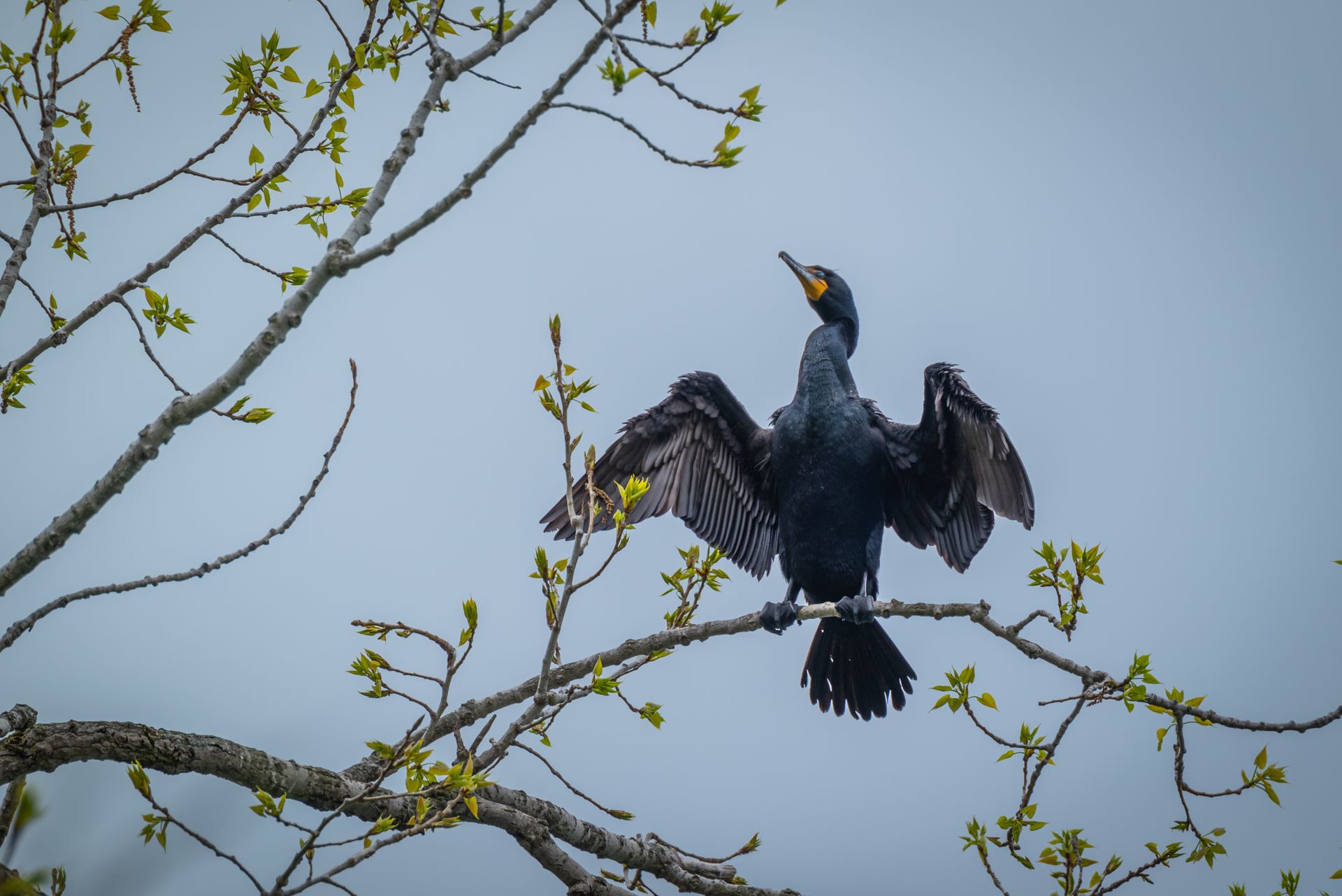
The Flightless Cormorant of the Galapagos Islands is a unique and fascinating creature.
This bird can be found only on the Galapagos Islands, a volcanic archipelago off the coast of Ecuador.
It's a relatively small bird, with adults reaching a length of about 90 cm and weighing around 2.7 kg.
The flightless cormorant has a distinctive call, described as a loud, hoarse, and guttural sound.
A fresh viewpoint: Giant Tortoise on the Galapagos Islands
Habitat and Distribution
The flightless cormorant's habitat is quite unique, found in the Galapagos Islands.
They prefer to nest on flat lava rocks, close to shore for easy access to the sea.
During a panga ride along the coast, or a snorkeling tour, you can easily spot cormorant nesting sites.
For more insights, see: Phalacrocorax Perspicillatus
Habitat
Galapagos Cormorants like to nest on flat lava rocks, close to shore for easy access to the sea. You can spot cormorant nesting sites during a panga ride along the coast, or during a snorkeling tour.
Nesting sites are typically found in areas with easy access to the sea.
Additional reading: Galapagos Green Sea Turtle
Galapagos
The Galapagos islands are home to a unique and fascinating species, the Galapagos Flightless Cormorant. There are approximately 1,000 breeding pairs, which live and nest on just 2 specific islands to the west of the archipelago.
These islands are crucial for the survival of this species, and careful trip planning is needed to find them. Visitors can enjoy watching the cormorants anytime, as they live year-round at the Galapagos islands.
The cormorant nesting season runs from May to October, which is also the prime feeding season. This is because the Humboldt current starts to arrive during this time, bringing nutrient-rich waters that attract fish and octopus, a favorite cormorant meal.
You might enjoy: Galapagos Land Iguanas
Appearance
The Flightless Cormorant's appearance is quite striking, especially when you notice their tiny wings. They're much shorter than you'd expect, and it's a bit of a shock at first sight.
Adult Flightless Cormorants have black plumage on top and dark brown underneath. Their eyes are a striking turquoise color, which really stands out.
Males are typically 35% larger than females, which is a noticeable difference.
Related reading: Flightless Bird
Diet

The Galapagos Flightless Cormorant is a unique bird with a specialized diet. They primarily feed on eel and octopus.
To catch their prey, these birds use their powerful hind legs for deep diving into the ocean. Regular dives can reach depths of 10-15 meters.
Their long necks allow them to spear their prey in rocky crevasses. This adaptation is crucial for their survival in the Galapagos Islands' coastal waters.
Behavior of
In the Galapagos Islands, the behavior of Flightless Cormorants is quite fascinating. They begin their courtship ritual by intertwining their necks and swimming around each other in a tight circle.
The male Flightless Cormorant takes on a significant role in building their home together, presenting the female with gifts such as stones, twigs, and washed-up waste to make the nest more comfortable.
An average of 3 eggs is laid per Galapagos Cormorant clutch, which the proud parents take turns incubating for 35 days.
The parents share the responsibility of protecting, feeding, and raising their chicks, which need to be looked after for over 70 days before they can fend for themselves.
In good years with abundant food supplies, the female Flightless Cormorant has been known to leave the male to handle the child-rearing duties, and in some cases, even pairs up with another male to produce another family.
Conservation Status
The flightless cormorant is listed as Vulnerable on the IUCN Red List. This classification is due to its limited range and the threats it faces.
The species' population has been estimated to be around 1,500 individuals, although this number has fluctuated over the years. A survey in 2004 reported around 1,500 individuals, while a more recent estimate in 2011 was around 1,679 individuals.
The Galapagos National Park and Marine Reserve provides a safe habitat for the flightless cormorant, and the Charles Darwin Research Station has been monitoring the species regularly. However, invasive species such as cats and rats pose a significant threat to the species.
The El Niño weather phenomenon has had a devastating impact on the flightless cormorant population in the past, causing a 50% decline in population during the 1982-83 event. This is due to the rise in sea temperatures and the subsequent depletion of nutrients in the ocean.
The Galapagos Conservation Trust and the Charles Darwin Foundation have been working to monitor the population sizes of the flightless cormorant and to develop conservation proposals. These proposals include restricting human visitation within the species' range and preventing fishing with nets in the bird's foraging range.
Conservation efforts are crucial for the survival of the flightless cormorant, and ongoing monitoring of the population is essential to track fluctuations in numbers over time.
Conservation Efforts
The flightless cormorant population has been stabilized due to conservation actions, including the control of invasive species around nesting sites, which has resulted in an increase in population.
The Charles Darwin Research Station has been monitoring the species regularly to keep track of fluctuations in numbers over time.
Conservation efforts are crucial to protect the flightless cormorant, as it's one of the world's rarest birds, with a population of around 1,500 individuals.
The Galápagos National Park and Marine Reserve has been designated as a World Heritage Site in 1978, providing a safe habitat for the species.
Annual monitoring programs and restriction on human visitation within the species range are essential conservation proposals.
The IUCN has downlisted the flightless cormorant from Endangered to Vulnerable in 2011, indicating that conservation efforts are paying off.
Here are some key conservation actions being taken:
- Control of invasive species around nesting sites
- Monitoring of populations by the Charles Darwin Research Station
- Restriction on human visitation within the species range
- Prevention of fishing with nets in the bird's foraging range
Visiting the Galapagos
To visit the Galapagos and spot a flightless cormorant, you'll need to plan carefully. There are only 1,000 breeding pairs left, and they live on just 2 specific islands to the west of the archipelago.
To increase your chances of seeing these amazing birds, consider visiting Fernandina island and/or the western coast of Isabela Island. These islands are too far afield to visit on a day tour, so you'll need to take a Galapagos Islands Cruise to reach them.
For another approach, see: Dromaius Baudinianus
The waters in the Bolivar Channel, which separates Fernandina and Isabela, are the coldest of the Galapagos archipelago, making them perfect feeding grounds for the flightless cormorant. This is because the Humboldt Current, which arrives from Antarctic waters, is rich in nutrients.
You can visit the Galapagos at any time of the year and see the flightless cormorant, as they live year-round on the islands. However, the best time to see them is during the nesting season, which runs from May to October.
Flightless Cormorant Facts
The Flightless Cormorant is the heaviest cormorant species, weighing between 2.5-5.0 kg (5.5-11.0 lb).
They have stunted wings that are only one-third the size they would need to fly. Their wings are also not waterproof, which is why you'll often see them spreading their wings in the sun to dry out after diving.
Adult Flightless Cormorants make a low, growling noise as their call. This unique sound is a great way to identify them in the wild.
The Flightless Cormorant feeds on eels, octopus, and other small marine creatures, which they reach by diving deep to the ocean floor. They use their powerful hind legs and flexible necks to spear their prey.
Their diet consists mainly of eels and octopus, which they reach by diving to depths of up to 200 meters offshore. This is impressive considering their short wings.
The adults are black on top and dark brown underneath with bright turquoise eyes. The males tend to be larger and heavier than the females.
Like all cormorants, the Flightless Cormorant has webbed feet and sturdy legs that propel it through the water. This unique body shape allows them to thrive in their aquatic environment.
The eggs are incubated for 35 days until they hatch, after which the parents take turns to feed the chicks. The male is left to care for the chick while the female starts a new breeding cycle.
Frequently Asked Questions
Can flightless cormorant swim?
Yes, flightless cormorants are excellent swimmers, using their powerful hind legs and flexible necks to catch prey underwater. They can dive and spear fish and octopus in the reefs and rocks.
Why can't flightless cormorants fly?
Flightless cormorants lost the ability to fly due to genetic changes that occurred over 2 million years, affecting their bone development and flight capabilities. This unique condition is linked to the same genetic issues that cause skeletal ciliopathies in humans.
Do Galapagos cormorants have predators?
Galapagos cormorants have few natural predators, mainly Galapagos snakes, Galapagos Hawks, and sharks. However, they also face human-related threats that are a significant concern.
Featured Images: pexels.com