The fishing cat, Prionailurus viverrinus, is a majestic and elusive creature native to the wetlands of South and Southeast Asia. It's a solitary animal, with a territory that can range from 10 to 100 square kilometers.
One of the most distinctive features of the fishing cat is its unique adaptation to aquatic life. Its broad, flat head and short, broad muzzle allow it to swim and hunt in the water with ease.
In the wild, fishing cats are primarily carnivores, feeding on fish, crustaceans, and other small aquatic animals. They have also been known to hunt birds and other small mammals on land.
Fishing cats are listed as Vulnerable on the IUCN Red List, due to habitat loss and degradation, as well as human-wildlife conflict.
Curious to learn more? Check out: Tiny Fishing
Taxonomy
The taxonomy of the fishing cat, Prionailurus viverrinus, is a complex and fascinating topic. Edward Turner Bennett proposed the species in 1833 after receiving a cat skin from India.
The genus Prionailurus was proposed by Nikolai Severtzov in 1858 for spotted wild cats native to Asia. This genus is home to several species of small cats, including the fishing cat.
Phylogenetic analysis has revealed that the fishing cat shares a common ancestor with other Prionailurus species between 3.5 and 4.5 million years ago. This is based on the analysis of nuclear DNA in tissue samples from all Felidae species.
The evolutionary radiation of the Felidae family began in Asia in the Miocene around 20-25 million years ago. This is supported by both nuclear and mitochondrial DNA analysis.
Here's a brief overview of the taxonomy of the fishing cat:
- Kingdom: Animalia
- Phylum: Chordata
- Subphylum: Vertebrata
- Class: Mammalia
- Order: Carnivora
- Family: Felidae
- Genus: Prionailurus
- Species: Prionailurus viverrinus
The Prionailurus species are estimated to have had a common ancestor between 3.5 and 4.5 million years ago. This is based on the analysis of nuclear DNA in tissue samples from all Felidae species.
Physical Characteristics
The fishing cat prionailurus viverrinus is a remarkable creature, and its physical characteristics are just as fascinating.
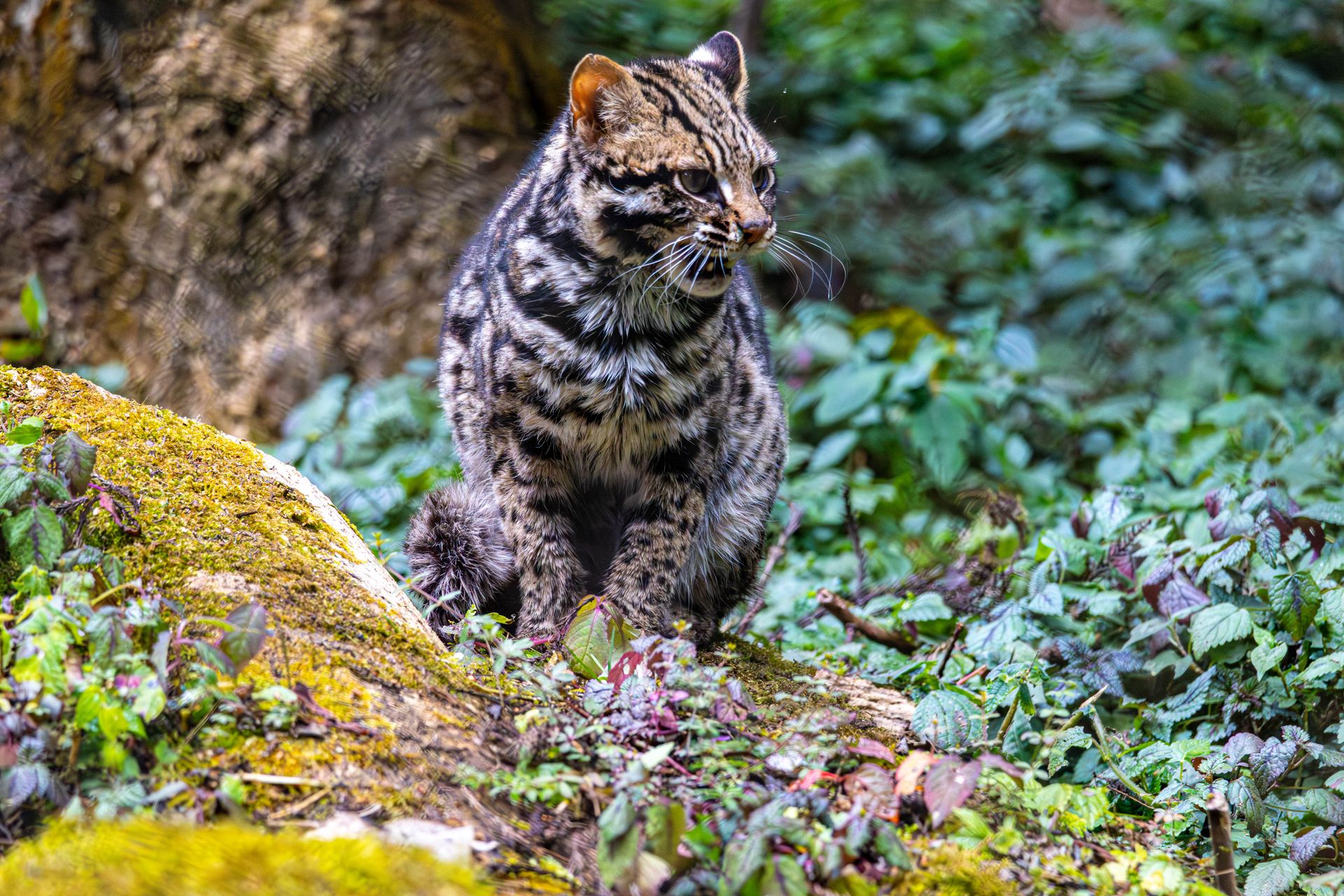
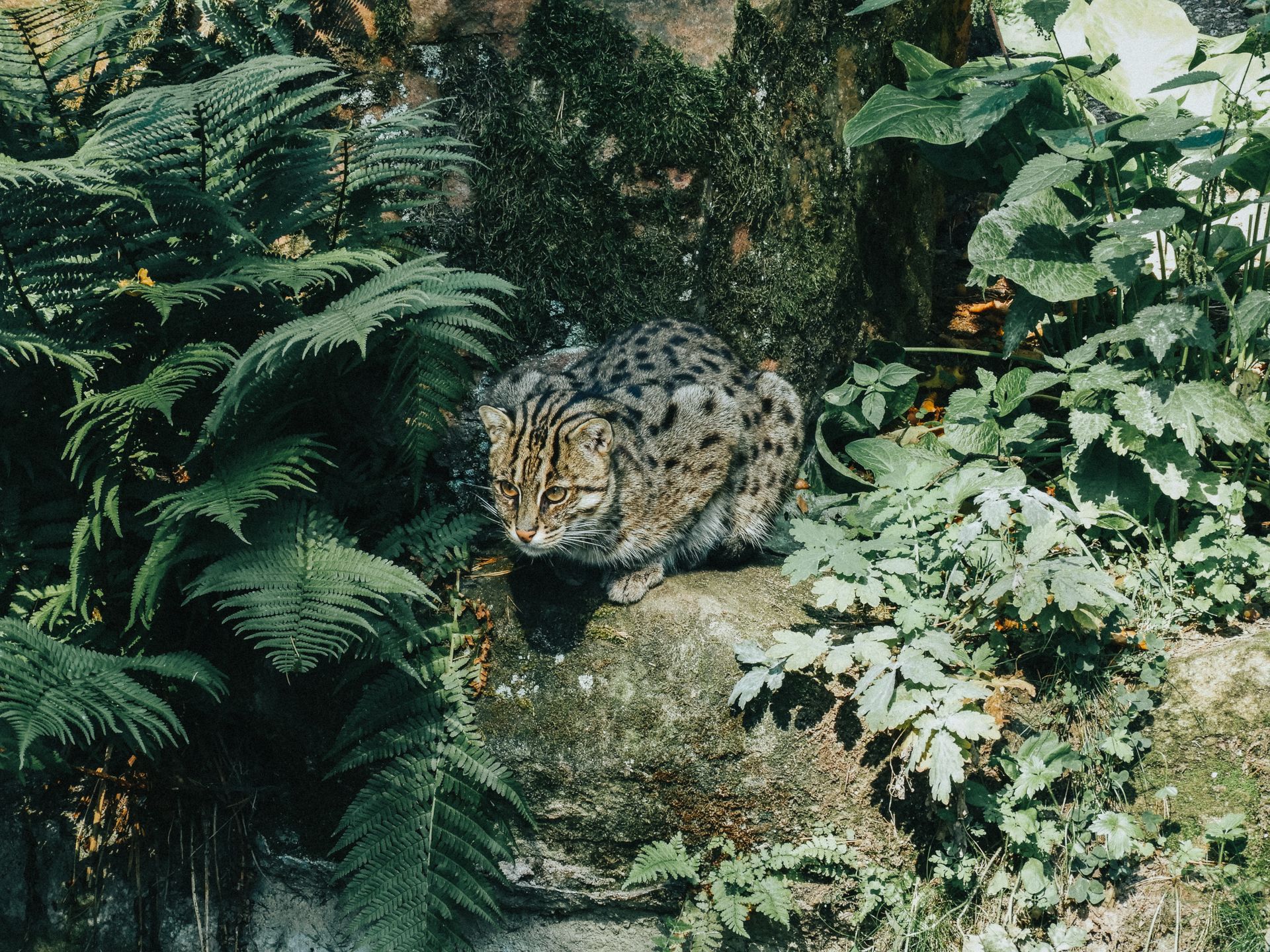
The fishing cat's fur is a deep yellowish-grey color with black lines and spots, and its background color can vary from yellowish tawny to ashy grey.
Its fur is layered, with a short, dense layer providing a water barrier and thermal insulation, while another layer of protruding long guard hairs provides its pattern and glossy sheen.
The fishing cat is stocky and muscular, with medium to short legs and a head-to-body length ranging from 57 to 78 cm.
Females weigh between 5.1 to 6.8 kg, and males weigh between 8.5 to 16 kg, showing pronounced sexual dimorphism.
The fishing cat's paws are partly webbed, and its claws are incompletely sheathed, protruding slightly when retracted.
The fishing cat's tail is short, less than half the length of its head and body, and has a few black rings at the end.
Here are the key physical characteristics of the fishing cat prionailurus viverrinus:
The fishing cat's skull is elongated, with a basal length of 123-153 mm and a post-orbital width of 27-31 mm.
Habitat and Distribution
The fishing cat prionailurus viverrinus is a fascinating creature, and understanding its habitat and distribution is crucial for conservation efforts.
Fishing cats are broadly but discontinuously distributed in South and Southeast Asia.
They predominantly inhabit densely vegetated wetlands around slow-moving bodies of water like swamps and marshes.
These areas include low-salinity bodies such as oxbow lakes, and high-salinity ones such as tidal creeks and mangrove forests.
In Pakistan's Sindh Province, the fishing cat was recorded in the Chotiari Dam area in 2012.
Fishing cats have been recorded in various protected areas in India, including Ranthambore National Park, Pilibhit, Dudhwa and Valmiki Tiger Reserves, and Sur Sarovar Bird Sanctuary.
In Sri Lanka, they have been recorded in multiple localities ranging from coastal to hilly regions.
Fishing cats can also be found in the Himalayan foothills, where they live at elevations of up to 1,500m.
Their territory can range from 16-22km², with one male's territory overlapping with several females' territories, spanning 4-6km².
Here are some specific locations where fishing cats have been recorded:
- Ranthambhore National Park, India
- Pilibhit, Dudhwa and Valmiki Tiger Reserves, India
- Sur Sarovar Bird Sanctuary, India
- Shuklaphanta, Bardia, Chitwan and Parsa National Parks, Nepal
- Koshi Tappu Wildlife Reserve, Nepal
- Chotiari Dam area, Pakistan
- Khao Sam Roi Yot National Park and Thale Noi Non-Hunting Area, Thailand
- Kulen Promtep Wildlife Sanctuary, Cambodia
- Peam Krasop Wildlife Sanctuary, Cambodia
Ecology and Behavior
The fishing cat is a fascinating creature that's adapted to life near water. It's primarily nocturnal, and can swim long distances, even underwater.
These cats are solitary animals, with adult males and females without dependent young roaming large territories. Females have been reported to range over 4 to 6 km^2, while males range over 16 to 22 km^2.
Fishing cats are expert hunters, grabbing prey from the water and sometimes diving in to catch it further from the banks. Their main prey is fish, which makes up about three-quarters of their diet.
They mark their territory using a variety of behaviors, including cheek-rubbing, head rubbing, and urine-spraying to leave scent marks. They also sharpen their claws and display flehmen behavior.
In the wild, fishing cats most likely mate during January and February, and females give birth to two or three kittens after a gestation period of 63-70 days. The kittens are able to move around by the age of one month and are weaned by six months old.
Here's a breakdown of the fishing cat's territory size:
Reproduction and Lifespan
Fishing cats most likely mate during January and February, with kittens born in March and April. Female fishing cats give birth to an average of two to three kittens, although litter size can range from one to four.
Kittens weigh around 170 grams at birth and are able to move around by the age of one month. They begin to play in water and take solid food at about two months old, but aren't fully weaned until six months old.
In captivity, fishing cats can live up to 10 years. Males have been observed helping females care for their young, although it's unclear if this behavior occurs in the wild.
Here's a summary of key reproductive features:
- Breeding interval: once yearly
- Breeding season: generally January and February
- Range number of offspring: 1 to 4
- Average number of offspring: 2
- Range gestation period: 63 to 70 days
- Range weaning age: 4 to 6 months
- Range time to independence: 10 months
- Range age at sexual or reproductive maturity (female): 8 to 10 months
- Range age at sexual or reproductive maturity (male): 8 to 10 months
Reproduction and Development
Fishing cats typically mate during January and February, but may also breed in June. They have a gestation period of 63-70 days.
Females usually give birth to an average of two to three kittens, although litter size can range from one to four. Kittens are born weighing around 170 grams.
They begin to play in water and take solid food when about two months old. This is a crucial time for their development, as they start to become more independent.
By the age of one month, kittens are able to actively move around. They reach full adult size when about eight and a half months old.
Here's a breakdown of the key reproductive features of fishing cats:
Males in captivity have been observed helping females care for and rear the young, but it's unclear whether this behavior is repeated in the wild.
Lifespan/Longevity
Fishing cats can live into their late teens in human care.
Their lifespan in the wild is unknown, but it's likely much shorter than in captivity.
In fact, zoo records indicate they may live up to 12 years in captivity, which is a pretty remarkable age for a wild animal.
Young fishing cats are born in a relatively underdeveloped state, unable to feed or care for themselves or move around independently for a while after birth.
Threats and Conservation
The fishing cat, Prionailurus viverrinus, is a vulnerable species due to various threats to its survival. Since 2016, it has been listed as a vulnerable species on the IUCN Red List, with a global population decline of around 30% between 2010 and 2015.
Destruction of wetlands is a major threat to the fishing cat's survival. Wetlands are being polluted and converted for agricultural use and human settlements, which is a significant concern in areas like coastal Andhra Pradesh. In this region, the conversion of mangrove forests to commercial aquaculture ponds is a major threat, and targeted killings of fishing cats are also prevalent.
Human-wildlife conflict is a significant issue in areas where fishing cats and humans coexist. In West Bengal's Howrah district, 27 dead fishing cats were recorded between April 2010 and May 2011. In Bangladesh, at least 30 fishing cats were killed by local people in three years between January 2010 and March 2013.
Related reading: Human Wildlife Conflict Examples
Fishing cats are also victims of poaching, with 84% of all tracked fishing cats being killed in a study in Thailand. The species is protected by national legislation in most of its range, but hunting regulations apply in some areas, and poaching remains a significant threat.
Conservation efforts are underway to protect the fishing cat and its habitat. Non-governmental organizations are working to slow habitat conversion in collaboration with local villagers, and alternative livelihood programs are being created to allow villagers to earn money without damaging natural habitats.
Here are some ways you can help protect the fishing cat:
- Be a smart consumer and avoid animal-skin products to prevent contributing to the illegal hunting of this species.
- Practice ecotourism by supporting organizations that protect wildlife and shop smart by avoiding products made from animals that could support poaching and the illegal wildlife trade.
- Support organizations like the Smithsonian's National Zoo and Conservation Biology Institute that research better ways to protect and care for this animal and other endangered species.
- Share the story of this animal with others to raise awareness about its plight and contribute to its overall protection.
In Captivity and Local Names
The fishing cat, Prionailurus viverrinus, is also known by several local names. In some parts of its range, it's referred to as the "fish cat".
In captivity, the fishing cat is listed as Endangered on the IUCN Red List.
In Captivity
In captivity, the giant panda's diet is carefully managed to mimic its natural eating habits. The bamboo they're fed is typically harvested from local farms or plantations.
In zoos, giant pandas are given a variety of bamboo species to eat, with some zoos even growing their own bamboo on site. The pandas are also given a small amount of food supplements to ensure they're getting all the necessary nutrients.
A giant panda's digestive system is specially adapted to break down the cellulose in bamboo, which is hard for many animals to digest. This unique adaptation allows the pandas to thrive on a diet that's over 99% bamboo.
In captivity, giant pandas typically live for 20-30 years, which is longer than their average lifespan in the wild. This is likely due to the improved living conditions and care they receive in zoos.
With proper care and management, giant pandas can even breed in captivity, which has helped to increase their population and reduce the risk of extinction.
For more insights, see: Golden Bamboo Lemur Wild Kratts
Local Names
In many parts of the world, the fishing cat is known by different names, reflecting its unique characteristics and habits.

In Assamese, the fishing cat is called meseka, which is likely derived from the word for "fish", mas.
In Bengali, the fishing cat is known as mach-baghrol, a name that combines "mācha" meaning "fish" and "bāgha" meaning "tiger".
In Telugu, it's called bavuru pilli, which translates to "wild cat".
In Myanmar language, the fishing cat is referred to as Kyaung-ta-nga, with "Kyaung" meaning "cat" and "ta-nga" meaning "fisherman".
In Thai, the fishing cat is literally called "fish tiger", suea pla.
Sound and Diet
The fishing cat prionailurus viverrinus is a fascinating creature, and its relationship with sound and diet is quite unique.
In the wild, fishing cats are known to be skilled hunters, and their diet consists mainly of fish and other aquatic animals.
Their ability to navigate through dense vegetation and catch prey in water is indeed impressive, and it's no surprise that they have a keen sense of hearing to detect the slightest sounds of their prey.
What Do They Sound Like?
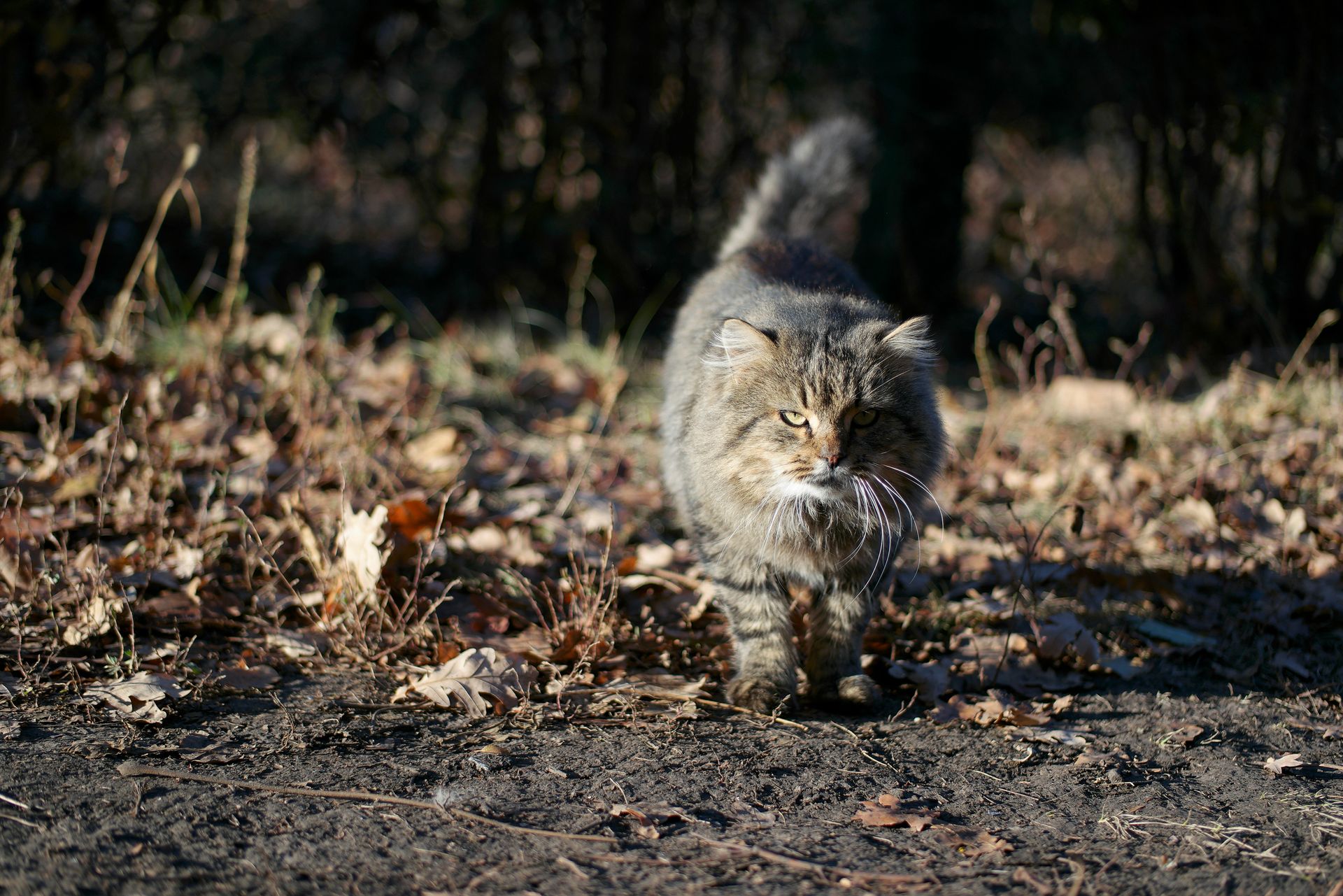
Fishing cats have a call that sounds a bit like a bark, making them easily recognizable in the wild.
Their distinctive vocalizations can be a great way to identify them, especially if you're out on a hike or nature walk and come across one.
Cat Diet
Let's dive into the fascinating world of sound and diet. I've always been curious about how certain animals adapt to their environments, and it's amazing to see how their diets reflect that.
Fishing cats are a great example of this, eating mostly fish, but also crustaceans, small mammals, amphibians, birds, and snakes.
Their diet is quite varied, and it's not uncommon for them to occasionally take small livestock too.
In the wild, sound plays a crucial role in hunting and survival, and it's interesting to see how different animals use different techniques to catch their prey.
Fishing cats, for instance, use their sharp claws and agility to catch fish, while also relying on stealth and patience to catch other prey.
Their diet is a testament to their adaptability and resourcefulness, and it's a great reminder of the importance of respecting and preserving their habitats.
On a similar theme: How to Catch the Maw in Cat Goes Fishing?
General Information
The fishing cat, Prionailurus viverrinus, is a medium-sized wild cat native to South and Southeast Asia.
They have a broad head, a short, broad muzzle, and short legs.
Fishing cats are primarily solitary animals, only coming together for mating.
Their coat is brown or grey, with a white or yellowish underbelly.
They have distinctive dark stripes on their forehead and a dark stripe running along their back.
Their eyes are yellow or green, and their ears are small and rounded.
Fishing cats are excellent swimmers and have webbed feet, which help them catch fish in water.
They are also skilled climbers, using their sharp claws to ascend trees.
Their diet consists mainly of fish, crustaceans, and small mammals.
In the wild, fishing cats can live up to 15 years, although their average lifespan is around 7-10 years.
They are listed as Endangered on the IUCN Red List due to habitat loss and human-wildlife conflict.
Frequently Asked Questions
What does the fishing cat symbolize?
The fishing cat symbolizes the health of wetlands and the balance between nature and human activities.
How many fishing cats are left in the world?
There are approximately 10,000 fishing cats remaining in the wild. Their population is threatened due to habitat destruction.
Why is it called a fishing cat?
The fishing cat is called as such because of its unique ability to catch fish, using its keen eyesight and sharp claws to scoop them up from the water's surface. Its name reflects its exceptional hunting skills, particularly in aquatic environments.
Featured Images: pexels.com