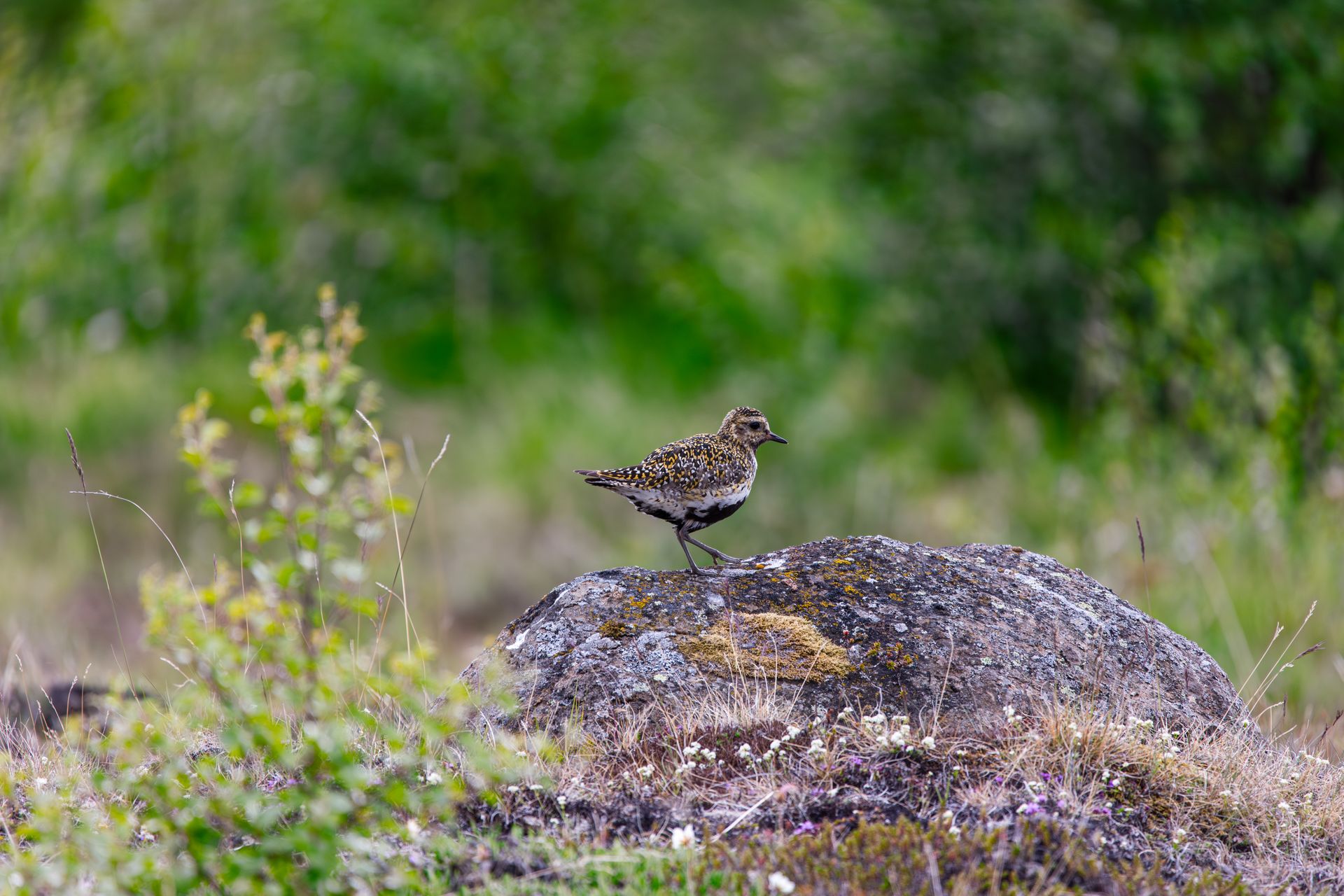
The European Golden Plover is a migratory bird that's quite the traveler. It breeds in the Arctic tundra.
These birds are known to form large flocks, often numbering in the tens of thousands. They're a sight to behold, especially during their migrations.
Their diet consists mainly of insects, earthworms, and other small invertebrates. They forage for food on the ground, using their strong, pointed bills to probe into the soil.
European Golden Plovers can be found in a variety of wetland habitats, including marshes, bogs, and coastal areas.
Physical Characteristics
The European Golden Plover is quite thickset, with its wings only being slightly longer than its tail.
In breeding plumage, the upper parts are brightly coloured black, white, and a golden yellow.
The bird stands at 26-29 cm in length.
Its wings are narrow and end in a fine point.
The underparts are black, with the black strip extending up the chest and throat and stopping just under the eye.
The Golden Plover has a weight range of 160-280 grams.
The wingspan of the Golden Plover is 67-76 cm.
In winter plumage, the chest bears a greyish breast speckled with golden yellow and brown merging with the marked brown sides.
The belly is white.
Suggestion: Charadrius Hiaticula
Distribution and Habitat
The European Golden Plover is a bird that's found in a variety of habitats, from the Arctic tundra to more temperate regions.
They tend to breed in areas with short vegetation, such as heathlands, tundra, and peaty fields, which provide them with the perfect environment to raise their young.
In the winter, they migrate to areas with more moderate climates, including the Mediterranean region and parts of northwest Africa.
These birds are often found in large flocks in open areas like agricultural plains, ploughed land, and short meadows, and can be seen ranging from lowland plains to subarctic plateaus.
They typically prefer flat terrain with moderate vegetation near wetlands, which provides them with an abundance of food and shelter.
In some cases, European Golden Plovers can be found in areas as far west as Iceland and as far east as central Siberia, and they've even been spotted in places like Canada, Gambia, and Pakistan.
A unique perspective: Short Tailed Albatross
Behavior and Conservation
The European Golden Plover's call is a monosyllabic, slightly descending, melancholic "tuu". This distinctive sound is a key part of their behavior.
Their flight action is rapid and powerful, with regular wingbeats. This impressive aerial display is a sight to behold.
In the United Kingdom, golden plover chicks rely on craneflies for feeding, while in Sweden, march flies are more important. This highlights the importance of understanding local feeding habits to support conservation efforts.
See what others are reading: Pacific Golden Plover
Behaviour and Ecology
The European golden plover's call is a monosyllabic, slightly descending, melancholic "tuu". This unique sound is a distinctive feature of the species.
Golden plover chicks rely on craneflies for feeding in the United Kingdom.
In Sweden, march flies are more important for the chicks' diet.
Conservation Status
The European Golden Plover's conservation status is a bit complicated. It's Red-listed in Ireland, which means it's of high conservation value, but globally, it's considered a species of 'Least Concern' by the IUCN Red List.
Discover more: Animal Conservation Organizations
This species has an increasing global population trend, which is a positive sign. However, its habitat is being threatened by human activities such as hydraulic works and afforestation, which can lead to the disappearance of its natural habitats.
The Golden Plover's habitat is also being modified due to the abandonment of traditional agricultural practices, which can cause disturbances during the reproduction period.
A fresh viewpoint: American White Ibis Habitat
Taxonomy
The European Golden Plover's taxonomy is a fascinating topic. Carl Linnaeus formally described the species in 1758.
Linnaeus placed the European Golden Plover in the genus Charadrius, which is where it was initially thought to belong. This was the tenth edition of his Systema Naturae.
However, the genus was later changed to Pluvialis in 1760 by Mathurin Jacques Brisson. The name Pluvialis is Latin, meaning "relating to rain".
The species name apricaria is also Latin, meaning "to bask in the sun". This is a fitting description for a bird that is often seen basking in the sun.
On a similar theme: Reticulated Giraffe Meaning
The European Golden Plover is a monotypic species, meaning that there are no recognized subspecies. This is a unique characteristic of this particular bird.
Here is a list of some of the classifications for the European Golden Plover:
- IUCN Red List: least concern species
- Genus: Pluvialis
- Books: Birds of Europe, Birds of Iceland, Birds of Scandinavia, Birds of Russia, Birds described in 1758, Animal taxa named by Carl Linnaeus
Frequently Asked Questions
What is the difference between American and European Golden-Plovers?
The American Golden-Plover is smaller and longer-legged than its European counterpart, with distinct differences in plumage and leg length. Key differences include armpit feathers and overall body shape.
Is the golden plover the fastest game bird in Europe?
Yes, the golden plover is considered the fastest European game bird, according to Guinness World Records. Its speed is a notable record in the avian world.
How fast can a golden plover fly?
The golden plover can fly at speeds of up to 60 miles per hour. Its long, pointed wings enable it to reach remarkable velocities.
Featured Images: pexels.com