The Dutch Harness Horse is a unique and versatile breed, originating from the Netherlands. They are bred for their impressive strength and agility.
Standing between 15.2 and 17 hands high, Dutch Harness Horses are known for their compact and muscular build. They typically weigh between 950 and 1,200 pounds.
Their distinctive appearance is marked by a straight or slightly convex profile and a well-defined withers. A Dutch Harness Horse's coat can be any color, but they often have a striking black or bay coat.
Characteristics
The Dutch Harness Horse is a unique breed known for its high action, which sets it apart from other warmbloods. They're often shown with a braided mane and natural tail, and when shown in-hand, they wear a white bridle without a cavesson.
Their distinctive appearance is further enhanced by their hooves, which are allowed to grow longer than those of riding horses, but are never shod with weighted shoes. Colors like black, brown, bay, and chestnut are common, but you may also see greys, true roans, and creme dilutes.
The breed's expressive head is characterized by straight lines and a warmblood type, similar to the Saddlebred. Their neck is set high, and their shoulders are long and powerful, giving them a distinctive carriage.
Their gait qualities are inherent, thanks to strict selection procedures that ensure a uniform type and motion. The trot is the true show gait, and these horses typically have a metronomic trot and ample suspension.
Related reading: Rocky Mountain Horse Gait
Physical Characteristics
The Dutch Harness Horse is a majestic sight to behold, with its expressive head that's narrow, long, and quite dry. This unique head shape is similar to the Saddlebred.
The neck is set quite high, giving the horse a regal appearance. The shoulders are long and powerful, a testament to the breed's athletic ability.
The back is long, allowing for a more open loin and a flatter croup. This unique anatomy enables the horse's front and hind legs to work independently and with great action.
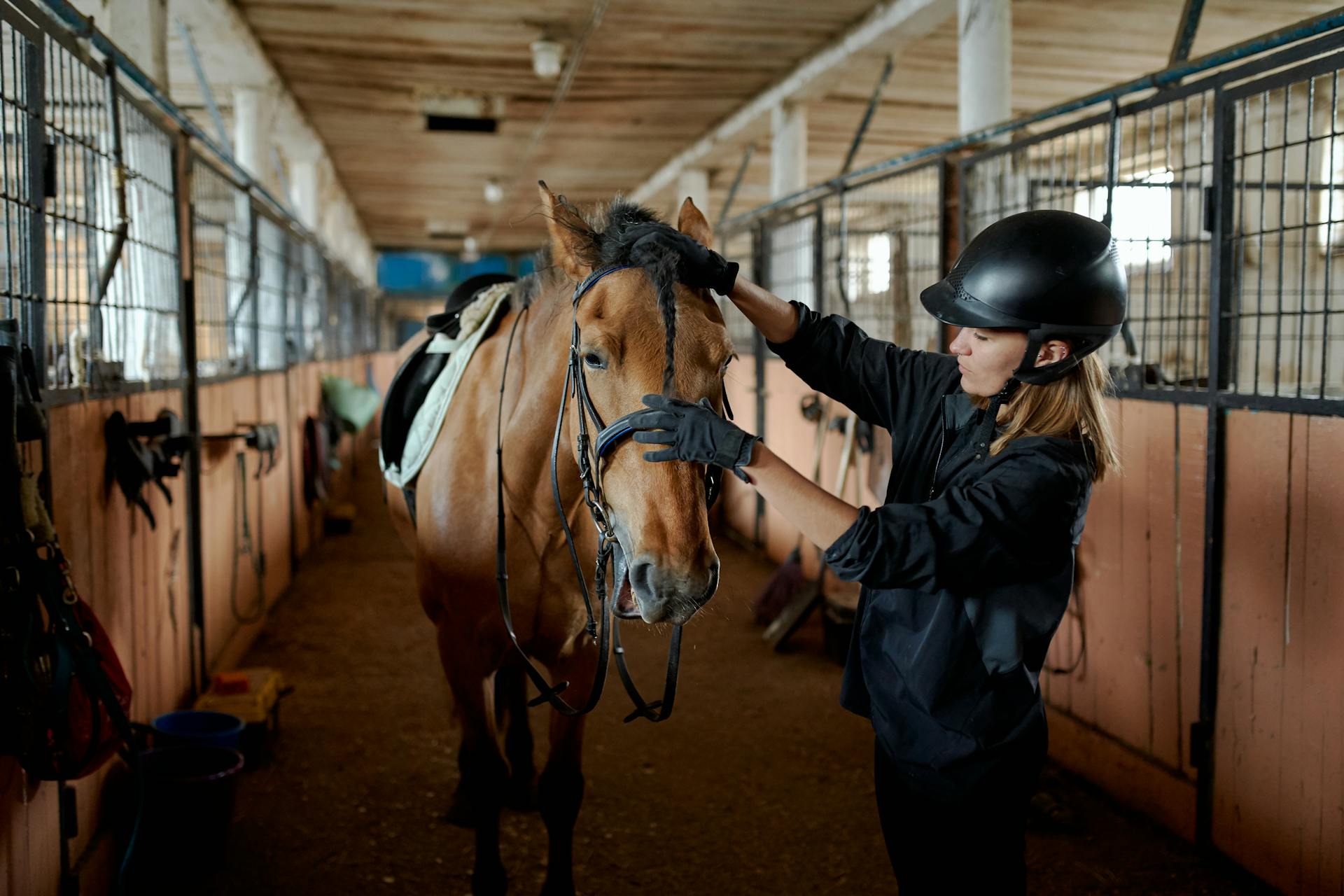
The tail is set high, adding to the horse's elegant appearance. The Dutch Harness Horse is very uniform in type, thanks to careful breeding and selection.
The carriage of the head is high, adding to the horse's overall stature. This, combined with the long back and open loin, gives the horse a distinctive appearance that's hard to ignore.
Temperament/Personality
This breed is known for being good-tempered, which makes them a great companion for families and first-time horse owners.
They're also incredibly energetic, requiring regular exercise to keep them happy and healthy.
Their willingness to work is a valuable trait, making them suitable for a variety of equestrian activities.
One of their most endearing qualities is their docile nature, which makes them relatively easy to handle and train.
Their courage is impressive, allowing them to tackle challenging tasks with confidence.
With a high natural leg action, they're built for speed and agility, making them a joy to watch in action.
Dutch Harness Horse
The Dutch Harness Horse is a breed that's known for its impressive strength and agility. They typically weigh between 1,100 and 1,400 pounds.
These horses are bred to be used for driving, and they're often used in competitions and exhibitions. Their average height is around 15 to 17 hands.
Their muscular build and strong bone structure make them well-suited for heavy loads and long distances.
See what others are reading: What Are Friesian Horses Used for
History
These horses were bred as a combination of two separate breeds: the northern Groningens and the Gelderlanders from the south. They were elegant, though heavy, carriage horses that could also work on the farm.
The Dutch have a strong tradition of breeding driving horses, which led to the development of the Royal Warmblood Horse Studbook of the Netherlands in 1969. This studbook featured a distinct section for driving horses.
The influence of the Hackney stallion Cambridge Cole significantly helped the gene pool of the Dutch Harness Horse, bringing in new characteristics and traits.
Recommended read: Leather Horse Driving Harness
Uses
Dutch Harness Horses have made their mark in combined driving, with several teams competing at the 2006 FEI World Equestrian Games.
They've also excelled in dressage, with horses like Lianca and Atuur, owned by Constance Menard and Anneke Muilwijk respectively, competing at a high level.
The breed is unique in that it has strict shoeing rules for competition, requiring shoes to be within a certain width and thickness with no pads allowed.
This ensures the breed is sound and able to trot spectacularly on its own accord.
In the United States, Dutch Harness Horses have been crossbred with Arabians to produce a more powerful horse for specific classes like half-Arabian Saddle seat-style English pleasure, fine harness, and "park" classes.
If this caught your attention, see: Horse Breed
Quick Information
The Dutch Harness Horse is a versatile breed with several nicknames, including Tuigpaard, KWPN Harness Horse, and DHH.
This breed is known for its good-tempered nature, which makes it a pleasure to work with.
A different take: What Is the Best Breed of Horse
Their energetic and willing attitude is a key characteristic that sets them apart from other breeds.
Here are some key physical traits to look out for:
The Dutch Harness Horse comes in a variety of coat colors, including black, roan, chestnut, gray, bay, pinto, and cream dilutions.
These horses typically stand between 15 and 16.2 hands high (adult) and weigh around 1050 pounds.
They are commonly used for dressage, general riding, and jumping.
Interesting Facts
The Dutch Harness Horse is a unique breed with some fascinating facts. Here are a few interesting tidbits:
The population of Dutch Harness Horses in the Netherlands is not significant, with only 40 sires and less than 2,000 breeding mares remaining.
Branding is actually illegal in the Netherlands, so instead, these horses are implanted with microchips.
In 2017, a 10-year-old white mare gave birth to a white & chestnut colt in Chesapeake, Virginia, USA.
A male Arabian/Dutch Harness horse named MD was crowned '2016 Youth of the Year' by the Arabian Horse Youth Association (AHYA), along with his owner Flora.
These horses have a rich history, and their development as a breed began in the Netherlands after World War II.
The breed was developed from the native Groningen and Gelderland horses, which were once vital to agricultural and transportation services.
Here are some of the disciplines that Dutch Harness Horses are suitable for:
- Harness
- Saddle seat
- General riding
- Dressage
Breed Information
The Dutch Harness Horse is a versatile breed originating from the Netherlands. They are known for their good-tempered and energetic nature, making them a pleasure to work with.
These horses are typically 15 to 16.2 hands high and weigh around 1050 pounds. They come in a variety of coat colors, including black, roan, chestnut, gray, bay, pinto, and cream dilutions.
Dutch Harness Horses are multi-talented and excel in various disciplines, such as dressage, general riding, and jumping. They are also used for harness driving and saddle seat riding.
Here are some of the key characteristics of the Dutch Harness Horse breed:
Their diet consists of a normal mix of hay and grains, and they are generally a healthy breed with no major health issues. The Dutch Harness Horse is a popular breed due to its excellent jumping ability, durability, and active nature.
Size and Height
The Dutch Harness Horse is a compact breed, typically standing between 14.2 and 16 hands high.
They have a short back and a strong, muscular build, which is well-suited for their work in harness.
Their height range is influenced by their purpose and the type of work they do.
In general, the Dutch Harness Horse is a sturdy and compact breed, with a strong bone structure and a well-proportioned body.
Adoption and Rescue
If you're considering adopting a Dutch Harness Horse, you're in for a treat - these horses are known for their gentle and even temperament.
Their calm nature makes them a great choice for families with children, as they are easy to handle and train.
The Dutch Harness Horse breed has a rich history, dating back to the 14th century in the Netherlands, where they were used for heavy transportation and agriculture.
They are a sturdy breed, with a strong build and a distinctive head shape.
In terms of exercise, Dutch Harness Horses require regular physical activity to maintain their health and well-being.
They are intelligent and active horses that need space to move and run freely.
Adopting a Dutch Harness Horse from a rescue organization can be a rewarding experience, as you'll be giving a loving home to a horse in need.
Rescue organizations often have a wide range of ages and experience levels, so you're sure to find a horse that suits your lifestyle.
Many rescue organizations also provide training and support to help you and your new horse adjust to each other.
Additional reading: Horse Rescue
Frequently Asked Questions
Is a Dutch Harness Horse gaited?
The Dutch Harness Horse is a gaited breed, with a focus on the trot as its primary show gait. Its trot is considered the true show gait, showcasing the breed's unique gaiting abilities.
Featured Images: pexels.com