If you're new to horse riding, you might be wondering what all the fuss is about when it comes to saddles. With so many types to choose from, it can be overwhelming to decide which one is right for you.
The most common type of saddle is the Western saddle, designed for comfort and control during long hours of riding. It features a deep seat and a high pommel, making it ideal for riders who spend a lot of time in the saddle.
For those who prefer a more agile and responsive ride, the English saddle is a great option. This saddle is designed for jumping and dressage, with a flatter seat and a more forward-cut flap.
The Endurance saddle, on the other hand, is designed for long-distance riding, with a more upright seat and a longer flatter skirt to keep the rider cool and comfortable.
See what others are reading: Horse Saddle Weigh
English
English saddles are a popular choice among horse riders, with more than 7 different types available.
The main types of English saddles include those designed for specific riding disciplines, such as jumping and dressage.
One of the most well-known types of English saddles is the jumping saddle, which is designed for high-speed jumping.
British saddles are often considered the best, with a long history of craftsmanship and attention to detail.
Western
Western saddles are designed for comfort and durability, making them perfect for long days of riding. They're built to last, with strong and durable construction that can withstand the demands of ranch work.
A key feature of Western saddles is their deep seat, which keeps riders snug and comfortable throughout the day. This design also allows for more stability, making it easier to navigate rough terrain.
The ranch saddle, in particular, is a heavy-duty Western saddle that's made for all-day riding. It's designed to enable riders to work comfortably while still providing the stability and support needed for ranch work.
Trail & Pleasure
Trail saddles are lightweight and come with a padded seat for extra comfort while riding. They're often used for trail riding and come with many tie strings to attach gear like saddle bags.
These saddles are super versatile and come in various combinations of different trees, horns, swells, seats, and skirt styles. You can choose the one that suits your riding style and needs.
A trail saddle is usually used in conjunction with a breast collar to keep the saddle aligned while going up steep hills. This helps prevent the saddle from shifting and keeps you secure in the saddle.
Discipline-Specific Saddles
You might be wondering if you need a discipline-specific saddle to do a particular type of riding. The short answer is no, but different types of saddles do have structural differences that make disciplines easier and safer.
For example, a barrel racing saddle has a deep seat and tall pommels to hold the rider in place, making it ideal for rodeo events where quick maneuvers are involved.
In contrast, a show saddle is more decorated and appearance-focused, making it perfect for the show ring where aesthetics matter.
Do I Need a Discipline-Specific?
You don't necessarily need a discipline-specific saddle, but different types do have structural differences that make disciplines easier and safer.
The English jumping saddle, for instance, features a flat seat and square cantle, allowing you to ride as one with your horse.
A flat seat is also easier to get out of, giving your horse the space it needs when jumping.
The saddle flaps are shorter on a jumping saddle, which means you can use shorter stirrups and access the side of your horse for better communication.
The Jumping Saddle is designed to push the rider slightly forward into the jumping position, with bigger flaps giving the leg more support.
However, the Hunting Saddle is made to be sat in for long periods of time, with a wide seat providing comfort for the rider.
It's not just about comfort, though - the Hunting Saddle is also designed to allow riders to jump big fences safely.
Here's an interesting read: Types of Hunting Dog
Dressage
Dressage saddles have a high cantle and a deep seat, allowing riders to fit snugly into the saddle. This design helps riders maintain better balance and posture, especially during competitions.
The seat of a dressage saddle is much deeper than other English saddles, providing a secure fit for riders. Riders who use dressage saddles regularly report improved balance and control over their horses.
Long billets on dressage saddles allow riders to attach the girth closer to the horse's elbow, giving them closer contact through the flaps. This close contact is essential for precise movements and control.
Dressage saddles often have knee and thigh blocks to provide extra grip and support for riders. These blocks can be adjusted depending on the rider's preference and the specific requirements of the event.
The trees on a dressage saddle are designed to allow for freer shoulder movement in the horse, which is a key aspect of dressage. This design feature enables horses to move more freely and naturally, making it easier for riders to execute precise movements.
Eventing
Eventing saddles are designed to give riders better control and grip while navigating various fencing, thanks to their deep seat and larger knee blocks.
The deep seat of an eventing saddle allows riders to maintain control, but still have the ability to get out of the saddle when needed.
Eventing saddles are similar to jumping saddles, but are designed more for cross country riding.
A forward cut jumping saddle is actually more similar to an eventing saddle than a show jumping saddle, with a flatter seat that allows for a light seat and maximum movement from the horse.
The flatter seat of an eventing saddle provides added security and support, allowing riders to shift balance easily.
Eventing saddles are designed to give riders maximum movement and flexibility, making them ideal for cross country riding.
Show
Show saddles are used exclusively in the show ring and are more decorated and appearance-focused.
They're adorned with silver trims and designs, making them a showstopping part of the whole ensemble.
Show saddles are not used in roping disciplines or those that feature quick maneuvers, such as trail classes or breed-specific shows.
These saddles are meant to make you and your horse stand out while providing a balanced seat for the rider.
The Show Saddle is a saddle with a high amount of detail, designed to make you stand out from the crowd.
It has very little support for the rider, with no knee or thigh rolls, but is brilliant in the show ring.
They offer a close fit and straight-cut flap, specifically designed to show off the horse's conformation.
Show saddles are generally slim lined and straight cut, making them perfect for showing off your horse's physique.
Recommended read: What to Do If You Fall off a Horse?
The Racing
The racing saddle is a lightweight and compact design that allows jockeys to move swiftly and efficiently.
For racing events, weight is a crucial factor, with strict limits in place to ensure a level playing field. Each category has its own set of rules, so keeping an eye on the racing saddle's weight is essential.
Racing saddles have a flatter seat, allowing jockeys to hover over the horse rather than sitting deep in the saddle. This design enables them to stay balanced while the horse accelerates.
The size and shape of racing saddles vary depending on the discipline, with larger flaps required for jump racing and smaller flaps for flat racing.
Roping
Roping saddles are designed specifically for roping events, such as team roping, where riders chase a calf or steer at a fast speed and dally their rope to the saddle horn once caught.
Roping saddles have a stronger tree and horn to withstand the force of a fully grown bull or cow, making them much heavier than barrel or cutting saddles. This added weight also comes from the reinforced rigging attached to the tree, providing a more secure attachment.
The horn on a roping saddle is strong enough to withstand anything that's tied to it, and the saddle typically has a roughout or suede seat to prevent the rider from sliding. This allows the rider to focus on the task at hand.
Roping saddles have stirrups that are hung more forward than on other saddles, giving riders a secure seat whether they're going fast or rapidly stopping. This feature is especially important for riders who need to chase cattle before roping.
The low cantle and slick pommel on a roping saddle allow the rider more movement and the ability to quickly dismount, which is essential for roping events.
Reining
Reining is a discipline that requires a specific type of saddle to help riders communicate with their horses through subtle cues.
The reining saddle features front-hung stirrups that allow riders to remain balanced and in control of any fast stop-start motions.
A low seat and medium height keep riders in the ideal position for maintaining control of the horse throughout the event.
Reining saddles have a lower horn and pommel with a flatter seat that does not impede the reins or any body cues.
These saddles often have accents of fancy tooling or conchos for a personal touch.
Reining saddles will have butterfly skirts or cut-out skirts, and they utilize in-skirt riggings.
Cutting
Cutting is a discipline that requires a specific type of saddle, designed to allow riders to move with their horse's quick lateral movements.
The cutting saddle has a tall, thin horn that provides an easy spot to hold onto when working cattle. This horn is meant to be grasped by only your hand, not your entire arm, and isn't built to withstand heavy work, so be careful not to break it off.
A well-balanced saddle is key for cutting riders, who need to be able to move with their horse's quick movements. This balance is achieved through a low cantle, wide swells, and a long, flat seat.
Cutting saddles typically feature skirts and fenders that are free swinging and forward hung, made of roughout leather to provide a better grip for the rider. This grip is essential for maintaining control during quick turns and changes in direction.
The cutting saddle also has a back cinch, slim stirrups, and double riggings for more connection points, which help the rider stay secure and in control.
A unique perspective: How to Get a Horse's Attention?
A Working Hunter
The Working Hunter Saddle is a relatively new design, straight cut to help accentuate the horse's shoulder. This design allows riders to showcase the horse's conformation.
The Working Hunter Saddle offers slightly more support than the show saddle due to its knee rolls. This provides additional security for riders who tend to ride in a light seat.
The saddle has a low cantle, which provides a flatter seat. This design enables riders to achieve a more stylish and performance-oriented riding position.
Riders in working hunter tend to be marked on style and performance, making the saddle very important in providing both security and showcasing the horse's conformation.
Saddle Types and Accessories
Saddle pads can be confusing to choose between different shapes and sizes.
Everything we put on our horses should have a purpose, whether it's stylistic or utility.
Saddle pads can make riding more enjoyable and functional, especially with saddlebags.
Saddle accessories like seat cushions are lifesavers for long rides and busy days.
Treeless
Treeless saddles offer a compromise between bareback riding and traditional saddles, providing a closer connection with the horse and more freedom of movement.
They are not as secure as a general-purpose saddle, so riders need to be comfortable with their position and the horse's movement.
Horses with backs that are difficult to fit saddles to can benefit from treeless saddles, which allow for a more customized fit.
Riders who feel uncomfortable in a full saddle may also find treeless saddles a more appealing option.
The Side
The side saddle is a unique design that allows women to ride with both legs on one side of the horse.
It was originally made with a two-pommel design to give women the opportunity to ride.
The right leg goes on top of the pommel, while the left leg goes in a normal position.
This design doesn't actually make the rider sit sideways, but rather keeps the body square in the saddle.
The side saddle provides excellent security for galloping and jumping, with a lot of grip to keep the rider safe.
It's a specialized saddle, but one that's been designed specifically to meet the needs of female riders.
Parts of a
Parts of a saddle can greatly impact a rider's comfort and performance. A well-designed saddle should have a sturdy tree to provide support and stability.
The tree is typically made of wood, fiberglass, or carbon fiber, and its shape and size can vary depending on the saddle type. Some saddles have a single tree, while others have a double tree for added support.
A good saddle should also have a comfortable seat, often made of leather or synthetic materials. The seat can be contoured to fit the rider's shape, reducing pressure points and discomfort.
The gullet is a crucial part of a saddle, as it allows for the horse's withers to pass through comfortably. A well-designed gullet should be wide enough to accommodate the horse's withers, but not so wide that it compromises the saddle's stability.
The pommel and cantle are the front and back parts of the saddle, respectively. They provide additional support and help to distribute the rider's weight evenly.
Types of
Did you know that a saddle distributes the weight of a rider correctly over a horse's back, giving the rider a centre of gravity that becomes one with the horse? This is especially important because having a human feel three times heavier on the horse's back without a saddle than with one.
English saddles are one type of saddle that's commonly used. Western saddles are another, and they're often used in different parts of the world. Australian saddles are also a thing, and they have their own unique characteristics.
Riding bareback can be a great way to improve your core strength, but it's not something you should do for long periods of time. Sometimes, it's a good idea to ride without stirrups too, as it can really help improve your position.
Pads & Accessories
Saddle pads can be confusing to choose between different shapes and sizes. A well-fitting saddle pad can make a big difference in your ride.
Saddlebags can make riding more enjoyable and functional. They can be used to carry tools or snacks for you and your horse.
Everything we put on our horses should have a purpose, whether it's stylistic or utility. Saddle accessories like seat cushions are lifesavers for long rides and busy days.
Keeping tools or snacks at the ready can be the difference between a great ride and a reason to turn around.
Return
As you return to the world of horseback riding, you may be thinking about the type of saddle that's right for you. Western Saddles are a popular choice, initially made for men who had to be on horseback for long periods of time.
They offer the ultimate comfort and stability, making them a great option for riders who plan to spend extended periods in the saddle.
General Purpose Saddles
General Purpose Saddles are great for riders who enjoy a bit of everything. They're suitable for lower levels of equestrian sport and can be used for both flat work and jumping.
The VSD Saddle, short for Very Slightly Dressage, is a type of General Purpose Saddle that originated in Germany. It's designed to allow riders to easily switch between disciplines by adjusting the stirrup length.
These saddles are perfect for riders who want to gain knowledge in multiple areas of equestrian sport, as they can be used in various disciplines. The General-Purpose saddle, on the other hand, is more geared towards jumping.
2. Kids
If you're buying a saddle for a child, make sure to find them a kid saddle that fits their pony comfortably.
Kids saddles are very lightweight, which is perfect for small ponies and children who are learning to ride.
These saddles are shaped to allow children more balance in the seat, which is essential for learning to ride.
All-Around
All-around saddles are designed for all-around use, which means they're perfect for riders who enjoy a variety of activities.
They have seats that aren't quite as cupped as barrel saddles but not as flat as roping saddles, which helps with security during fast-paced activities.
These saddles feature slightly more padded seats for leisure rides, making them comfortable for both you and your horse.
All-around saddles have a thicker horn than barrel or cutting saddles, yet are still slimmer than traditional roping saddles, allowing you to comfortably fit your hand around the horn if needed.
The horn should not be used to dally, as it is not built with the necessary strength, so be sure to use it wisely.
If you want a saddle that does almost everything, an all-around saddle is a great choice, but keep in mind that once you get into more specific needs, it may be better to move into a saddle built for that job.
Riding Styles and Disciplines
If you're new to horseback riding, it can be overwhelming to learn about the different riding styles and disciplines.
Western riding is often associated with the American West and is characterized by a more relaxed, laid-back style.
In contrast, English riding is more formal and emphasizes precision and control. This style is often used in competitions such as dressage and show jumping.
The type of saddle used can greatly affect the riding style, with Western saddles typically having a more substantial horn and pommel for balance and support.
Racing
Racing saddles are designed to be as light as possible, with strict weight limits in place to ensure jockeys meet their required weights.
The flatter seat of a racing saddle allows jockeys to hover over the horse, rather than sitting deep in the saddle. This design enables jockeys to glide on top of the horse, using their legs to stay balanced while the horse runs at top speed.
Racing saddles vary in size and shape depending on the type of racing, with larger flaps required for jump racing and smaller flaps for flat racing. Jump racing saddles are designed to keep the jockey's legs in place during the high-impact jumps.
Weighing in with and without tack is a crucial step for jockeys, as they must adhere to strict weight limits. The saddle itself is made from lightweight leather, designed to be as light as possible.
Racing saddles are not designed for comfort, but rather for performance, with a focus on allowing the jockey to maintain control of the horse. Seasoned riders who are used to crouching in the stirrups will find this saddle suitable for their needs.
The Hunting
The hunting saddle is designed to keep the rider firm in the seat, preventing potential accidents from big jumps. This is achieved by pushing the rider back into the saddle.
The hunting saddle is made to be sat in for long periods of time, providing comfort for the rider. Its seat is large and flat.
A hunting saddle tends to be wider to fit horses with a wider shoulder. This design feature is essential for riders who spend extended periods in the saddle.
The hunting saddle is shaped to aim the rider's weight back in the saddle and their feet forwards, allowing them to brace themselves when jumping large obstacles.
The Endurance
The Endurance Saddle is designed for long-distance horse riding, offering a comfortable and strong seat.
A thin endurance saddle is not recommended, as it can hurt both you and your horse in the long run.
Single rigging options keep the endurance saddle lightweight, allowing your horse to remain comfortable.
The Endurance Saddle has a broad and padded seat, designed for comfort during long periods of time.
Short-panel design allows the saddle to fit short-backed Arab-typed horses.
The flap is straight cut, enabling a longer and more relaxed endurance leg position.
Some Endurance Saddles have an additional gel feature to prevent aching muscles the day after.
These saddles often come with adjustable designs and various types of leather, including pure leather and synthetic materials.
Prices for Endurance Saddles can vary, but those specifically created for certain disciplines tend to be higher.
The Jumping
Jumping saddles feature a flat seat and square cantle, allowing riders to ride as one with their horse.
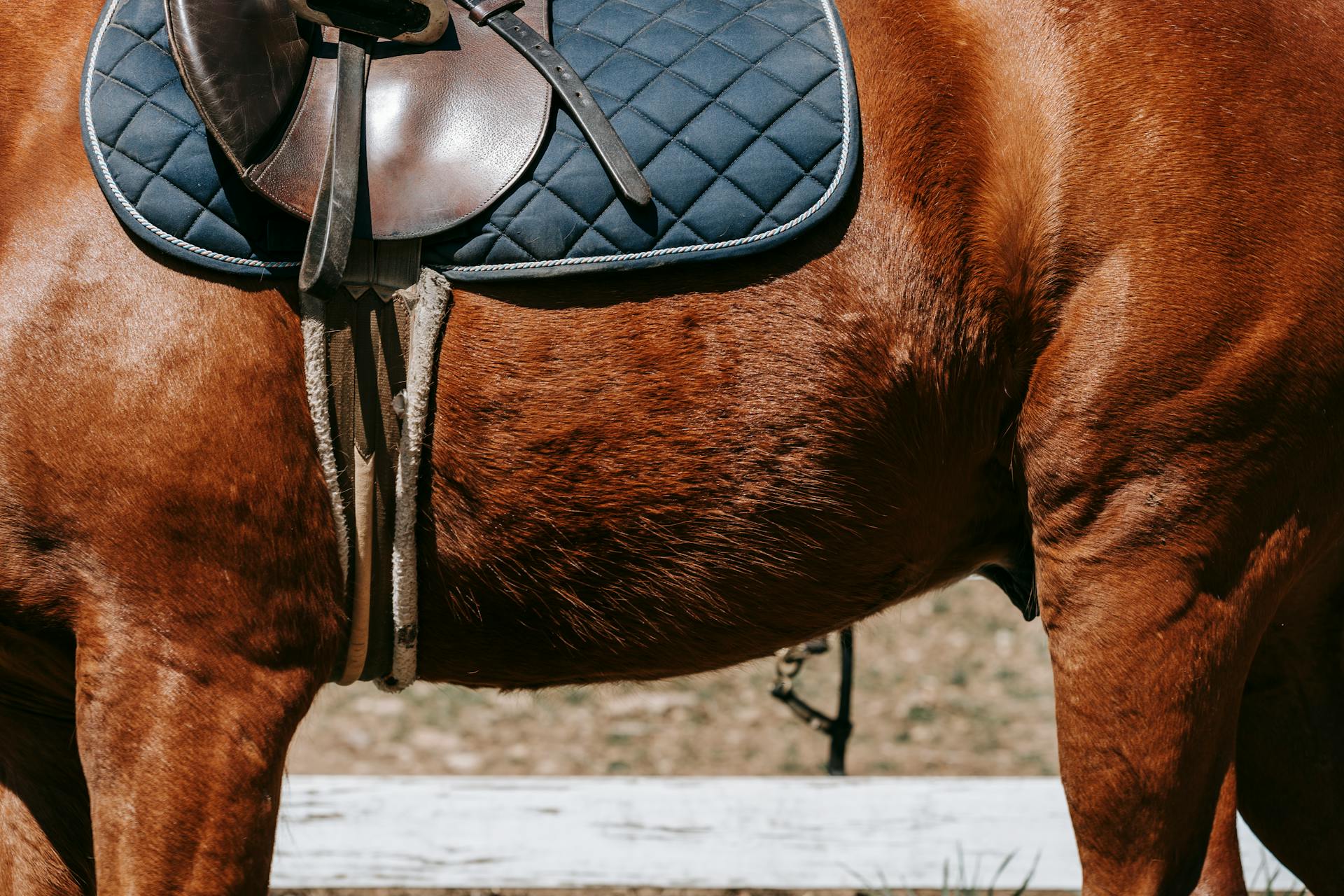
The flat seat makes it easier to get out of the saddle, giving the horse the space it needs when jumping. This design also enables riders to communicate with their horse more effectively.
Jumping saddles often have shorter flaps, which means riders can use shorter stirrups and access the side of their horse more easily. This is essential for communicating with the horse during jumps.
The flaps on jumping saddles also have knee blocks, allowing riders to grip tightly and maintain control. This feature is particularly useful for riders who prefer a more secure feel.
In some jumping saddles, the knee pads can be adjusted to suit the rider's preference, and some may even come with a thigh block for added support.
Expand your knowledge: Horses Knee
The Show
The Show is all about looking good while riding. The Show Saddle is designed to make you stand out from the crowd.
In the show ring, a close fit and straight-cut flap are crucial. The Show Saddle offers this, specifically designed to show off the horse's conformation.
Riders who use the Show Saddle often prefer its slim-lined design.
Youth
Youth riders can benefit from saddles specifically designed for their needs, which are typically lightweight and easy for them to tack up on their own.
These saddles are available in various styles, including those mentioned earlier, making it possible for young riders to excel in their chosen sport.
A youth saddle is a must-have for kids who are just starting out, as it provides a safe and comfortable riding experience that helps build their confidence and skill.
Kid saddles are designed to accommodate the unique needs of young riders, allowing them to communicate effectively with their horse while developing essential riding skills.
Saddle Materials and Impact
Synthetic saddles are the lightest option available.
They provide great alternatives for people looking for a lighter saddle, but come in fewer styles and variations.
Some brands produce synthetic saddles, which are a good option for those who want a lighter saddle.
Leather saddles, on the other hand, are more sturdy than synthetic saddles.
They offer more grip and friction, which helps to keep you secure in the saddle.
Synthetic saddles might provide more grip and friction, which helps to keep you secure in the saddle.
Frequently Asked Questions
What's the difference between a jump saddle and a GP saddle?
Jump saddles differ from general-purpose saddles in their design features, which prioritize stability, balance, and security for jumping. This unique design sets them apart for riders who compete in jumping events
What saddle is most comfortable for the horse?
The most comfortable saddle for a horse depends on its shape, riding style, and the saddle's fit, with options including endurance, trail, and well-padded Western saddles. Proper saddle fit and care, including the use of a good saddle pad, are also crucial for a comfortable ride.
Featured Images: pexels.com