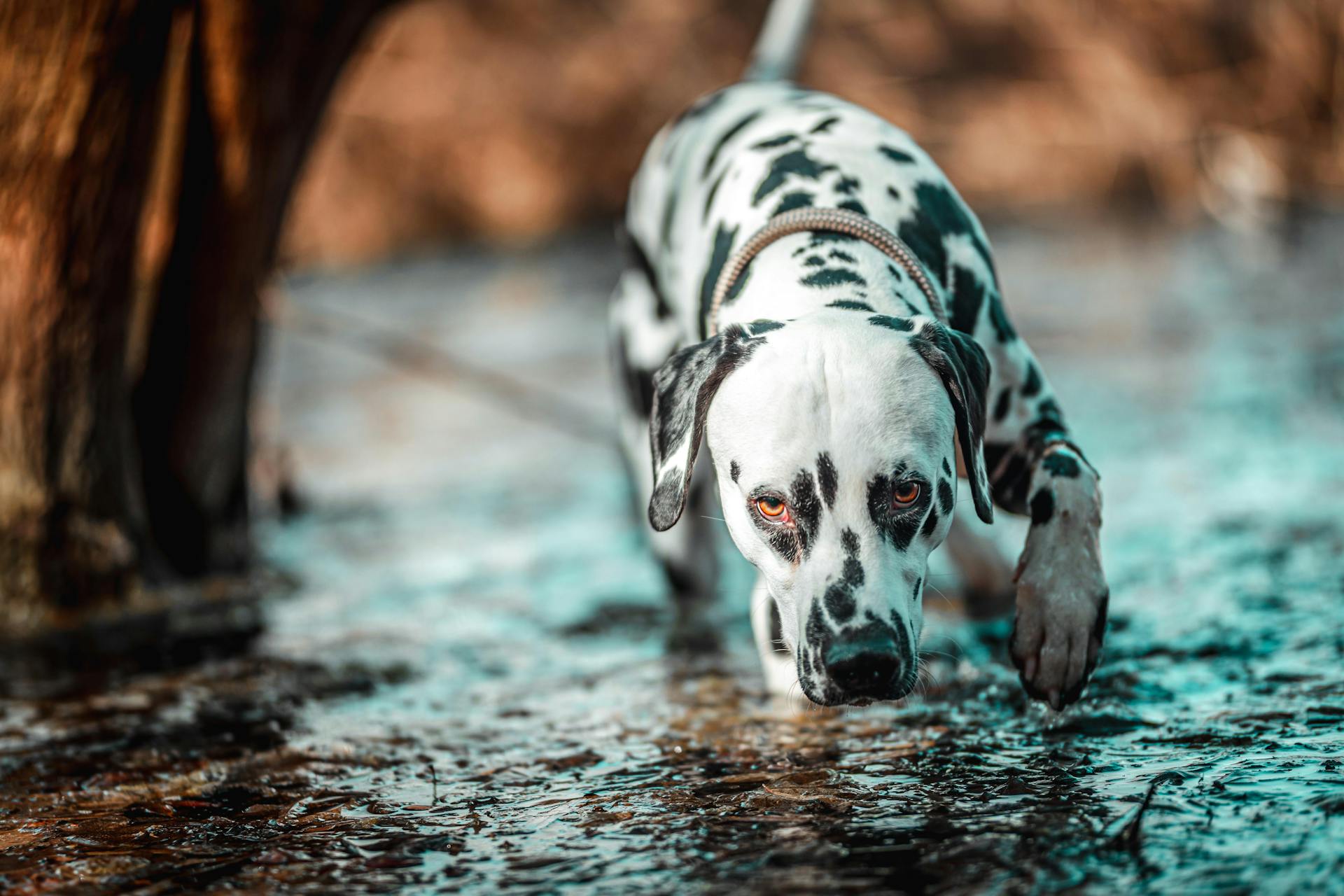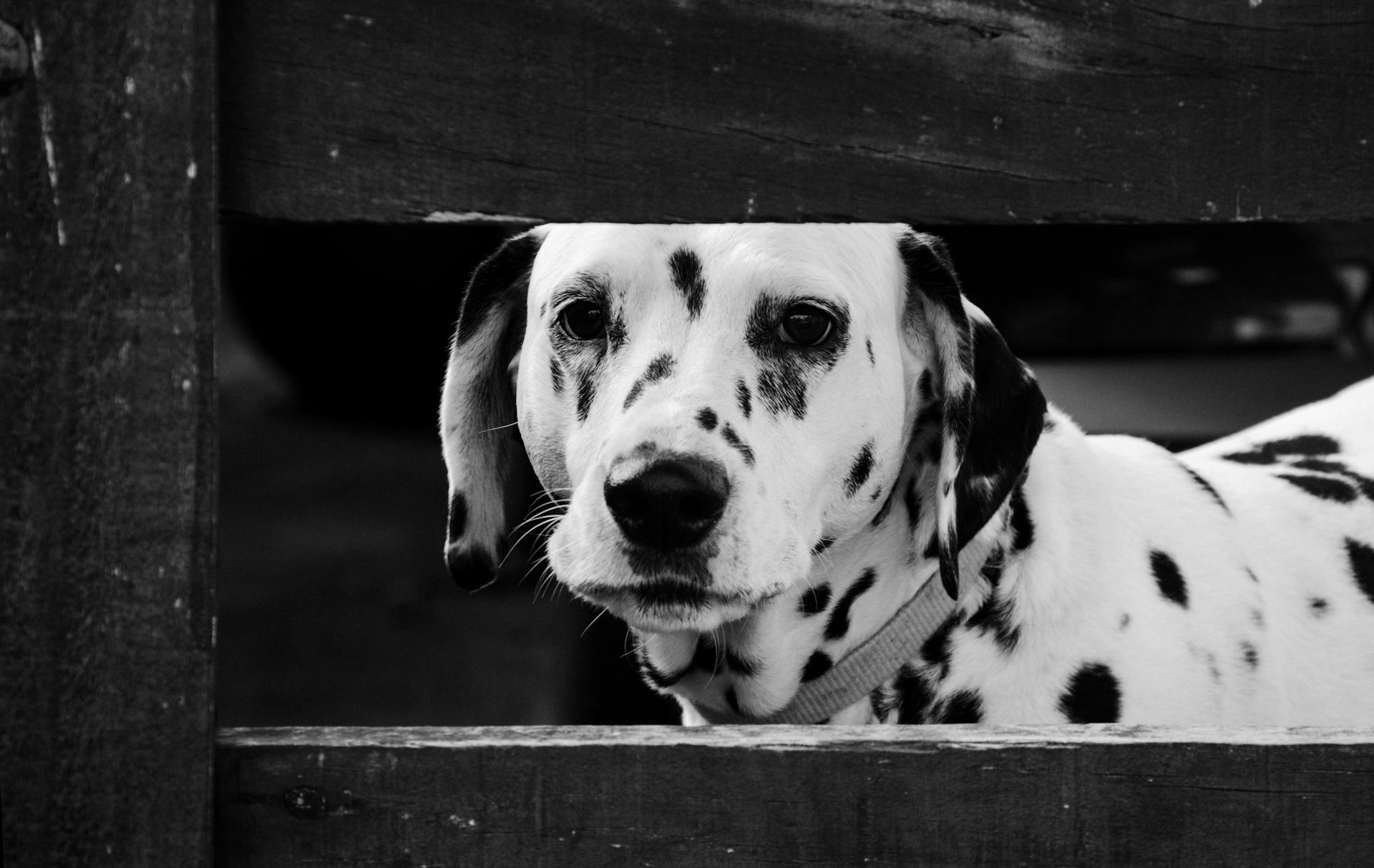
Dalmatian dogs are a unique and energetic breed that requires attention to their specific needs.
Dalmatians are prone to deafness, with about 20% of them born without any hearing in one or both ears.
They are also known for their intelligence and trainability, but their strong will can make them stubborn at times.
To keep your Dalmatian happy and healthy, regular exercise is a must, with a minimum of 30 minutes of physical activity per day recommended.
Dalmatians have a short, smooth coat that requires minimal grooming, but they do shed heavily, especially during shedding season.
With proper care and attention, Dalmatians can make wonderful companions for active families.
Take a look at this: 101 Dalmation Dog Names
Breed Characteristics
Dalmatians typically stand between 19 and 24 inches tall.
Males are generally larger than females, with a noticeable size difference.
Their weight ranges from 48 to 55 pounds, which can vary depending on individual characteristics.
Size
When considering the Dalmatian's physical presence, their size is a notable characteristic. Males and females stand between 19 and 24 inches tall.
Their weight is relatively consistent, ranging from 48 to 55 pounds. Males are generally larger than females.
Coat
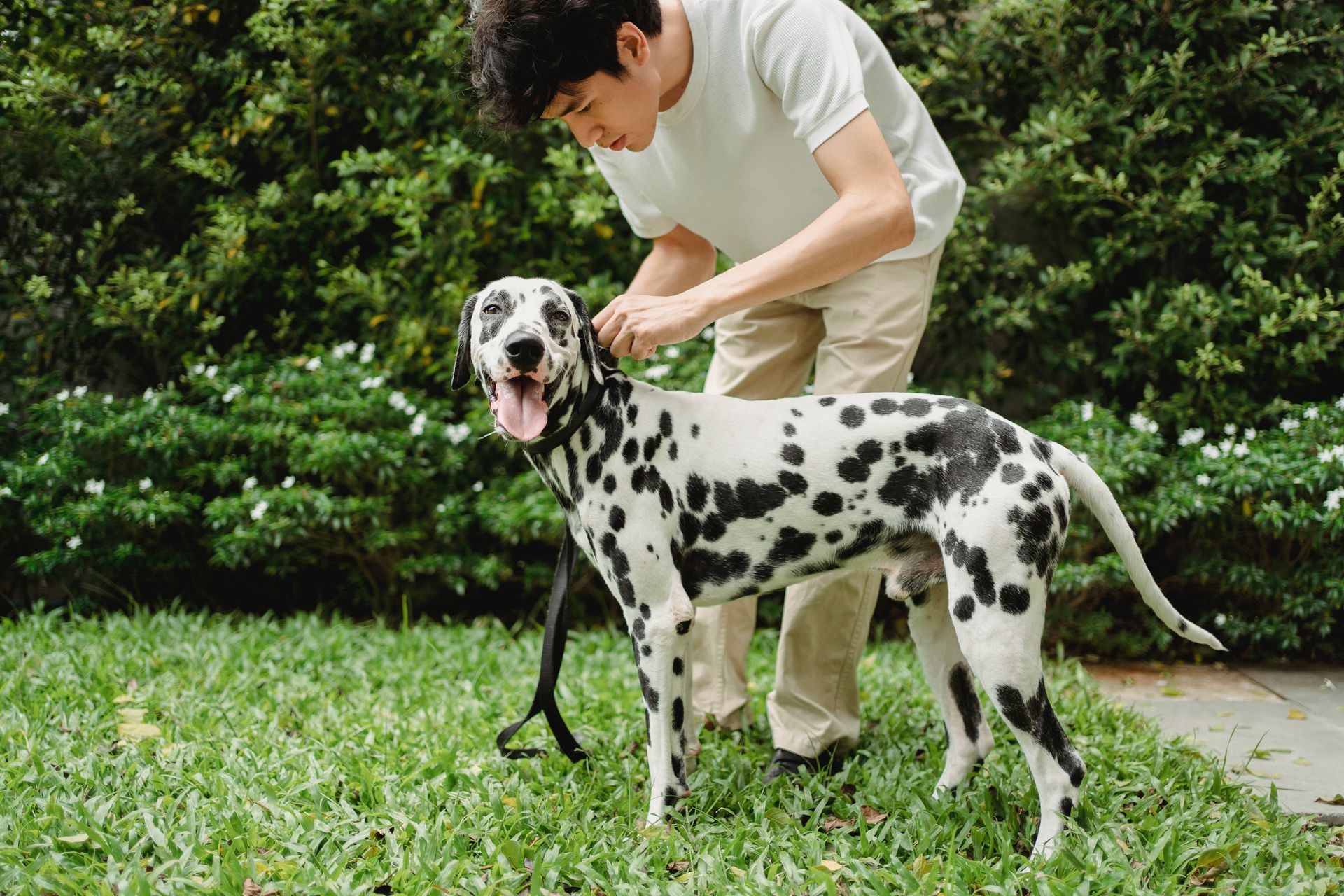
The Dalmatian's coat is truly one of a kind, with a distinctive short, satiny, and fine texture that's a joy to touch.
The base color of the coat is always pure white, providing a clean and neutral background for the spots to shine. The spots themselves are round, ranging in size from a dime to a half-dollar, and are evenly distributed over the body.
You'll often see smaller spots on the legs, head, and tail, adding to the coat's unique charm. Spotted ears are also a lovely touch, adding to the overall visual appeal of the Dalmatian.
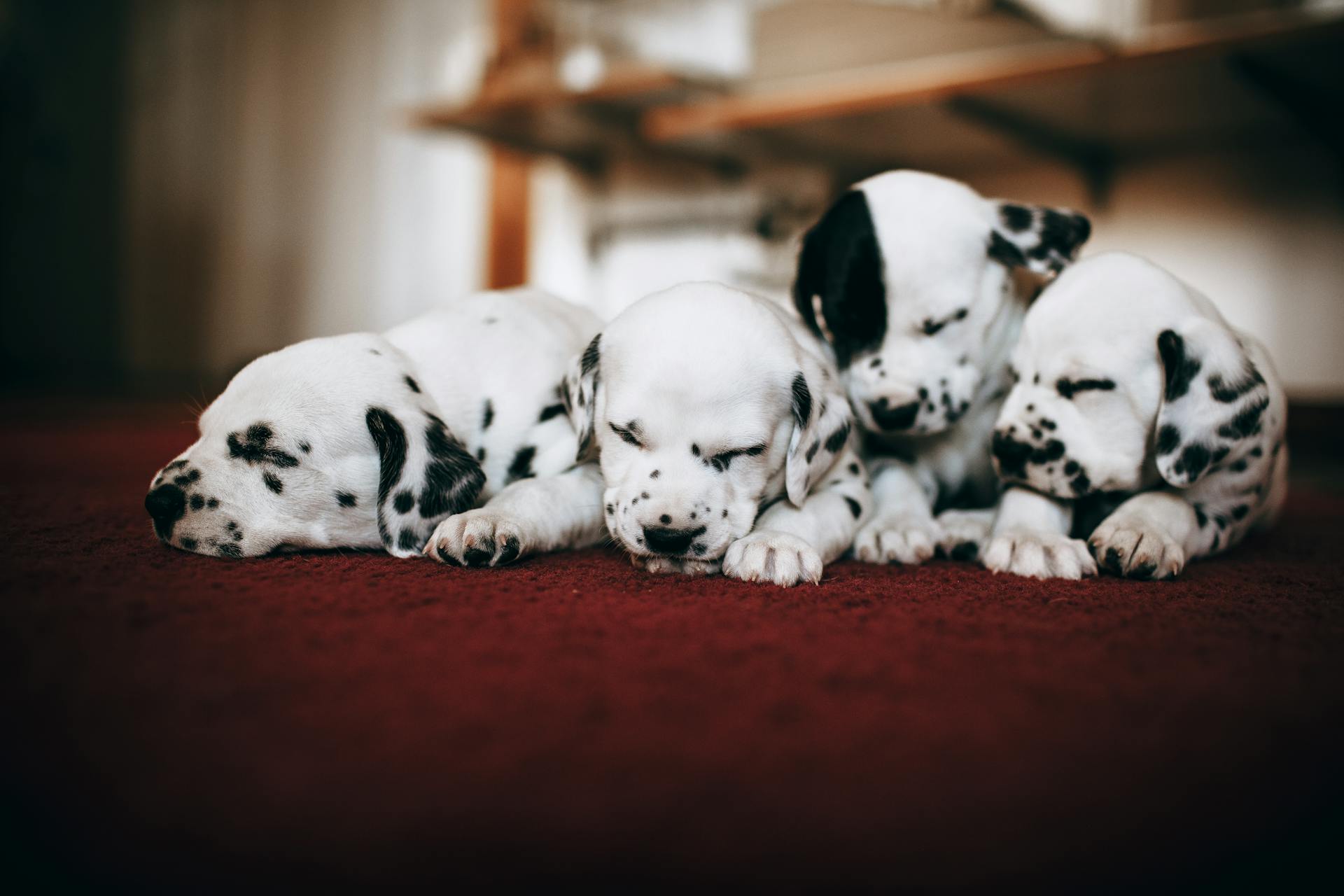
Interestingly, Dalmatian puppies are born pure white, and the spots only appear as they age. This means that you won't see any spots on a new puppy, but they'll develop as the dog grows and matures.
Dalmatians are also known for being clean dogs with little to no "doggy" odor, making them a great choice for families or people with allergies. Their coats are also dirt-repellent, which means they can get into all sorts of messy situations without getting dirty.
Suggestion: Boston Terrier Spots
Breed Standard & History
Dalmatians are distinguished by the black or brown spots on their white coats.
Their demeanor is self-possessed and alert, and they have an intelligent, curious expression.
Dals are athletic in appearance, with muscular shoulders and powerful hindquarters.
Their feet are round and compact, with thick pads and arched toes.
They are fleet and possess a remarkable endurance.
The Dalmatian has a long history that's difficult to trace, but images painted in Egyptian tombs show a spotted dog resembling the Dalmatian running alongside chariots.
The breed is named for the Dalmatia region along the Adriatic coast, where centuries-old paintings depict them.
In the 1800s, Dalmatians were used as coach dogs throughout Europe, running alongside carriages to protect the horses from packs of dogs and warn of approaching highwaymen.
When cars replaced carriages, Dalmatians began assisting horse-drawn fire engines, clearing the road so the horse-drawn engine could pass.
The breed is still connected with firehouses today, often accompanying firefighters on educational outings.
A spike in the Dal's popularity followed the 1961 film 101 Dalmatians, but many people later surrendered the breed because it was too difficult for them to manage.
This is a high-maintenance, difficult dog, and families should consider carefully before adopting or buying a Dalmatian.
Consider reading: Dog Boarding for Difficult Dogs
Exercise and Nutrition
Dalmatians are bred to run all day, every day, and need at least two hours of exercise daily, including free running.
Exercise is crucial for Dalmatians, and they'll be difficult to live with if they don't get enough physical activity. For an active owner, however, they're a total joy, always up for an outing and happy to accompany even the most extreme fitness fanatics.
To keep your Dalmatian in ideal shape, feed them high-quality dry food, divided into two meals a day, with 1.5 to 2 cups of food recommended daily. The quality of dog food matters, and a better food will nourish your dog further and reduce the amount you need to feed them.
A highly active Dalmatian will need more food than a couch potato dog, so monitor their size, age, build, metabolism, and activity level to determine the right amount of food for them.
Expand your knowledge: What to Feed Dogs When Out of Dog Food
Nutrition and Feeding
Your dog's diet needs to have the right balance of all the main nutrient groups including a constant supply of fresh water.
It's also crucial to conduct regular body condition scores to ensure your dog is in ideal shape. This will help you adjust their diet accordingly.
Feed your dog at least twice daily and in accordance with the feeding guidelines of their particular food. This will prevent overfeeding or underfeeding.
A Dalmatian's daily food intake is around 1.5 to 2 cups of high-quality dry food, divided into two meals.
The quality of dog food matters, as better food will nourish your dog further and reduce the amount you need to give them.
Keep in mind that individual dogs have different needs based on their size, age, build, metabolism, and activity level.
Additional reading: Will Shiba Inu Coin Reach 1 Cent
Exercise Needs
Dalmatians need a lot of exercise to stay happy and healthy. They require upwards of two hours of dog exercise every single day, come rain or shine.
This includes free running, which is essential for their physical and mental well-being. An under-exercised Dalmatian can be difficult to live with.
Here's an interesting read: Shiba Inu Exercise Needs
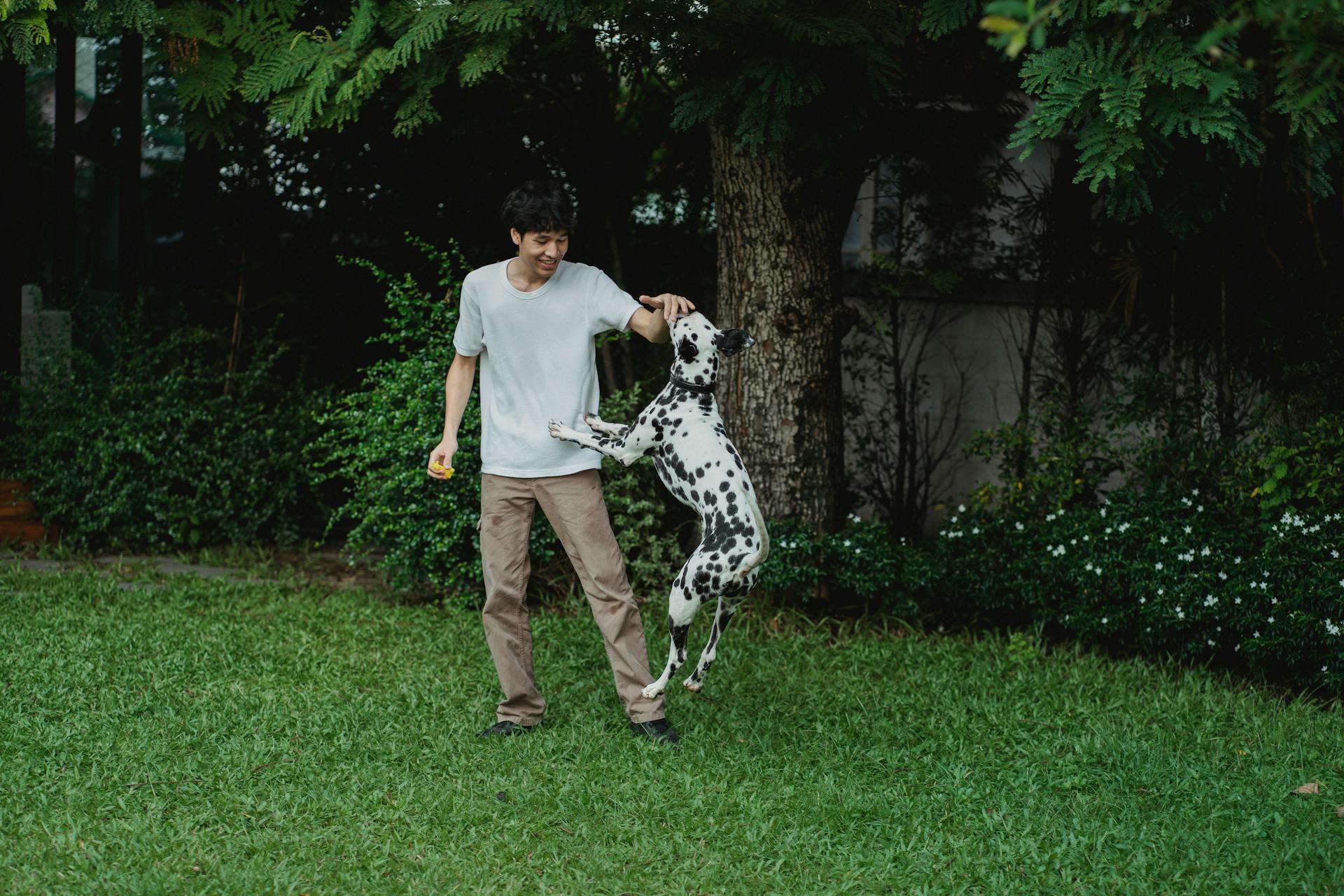
They love going for long walks, hikes, and playing outside with other dogs. This makes them perfect for active people or busy families who spend a lot of time outside.
Dalmatians can help keep people active with their exercise needs, but it's essential to consider your work schedule and lifestyle before bringing one home.
Grooming and Health
Dalmatians have short and hard hairs, making them relatively low-maintenance when it comes to grooming. A weekly grooming mitt session can help remove dead hairs and promote shine.
They do shed, however, and their hairs can be stubborn to remove from furnishings, so covers may be helpful. Regular brushing, ideally two or three days a week, can also help keep their coat clean and healthy.
A monthly bath and nail clipping can help prevent health issues, and it's essential to wash their ears about once a week with a gentle cleanser. Brushing their teeth several days a week is also crucial for their oral health.
Here are some common health issues to be aware of:
- Deafness: Approximately 17.8% of Dalmatians have some level of deafness, with 13.4% being deaf in one ear and 4.4% being deaf in both ears.
- Bladder Stones: Dalmatians are prone to urinary stones due to a genetic mutation, which can be treated surgically.
- Dilated Cardiomyopathy (DCM): This heart condition can cause symptoms such as coughing, trouble breathing, and lethargy.
- Dalmatian Bronzing Syndrome: This genetic skin condition causes pink to bronze skin discolorations, hair loss, and inflammation.
Grooming
Grooming is an essential part of keeping your Dalmatian healthy and happy. Regular brushing is a must, with two to three times a week being a good routine to keep their coat clean and healthy.
A monthly bath will help keep their coat looking its best. Don't forget to wash dirt from your Dal's ears about once a week with a dog-friendly, gentle cleanser. This will help prevent dirt and debris from building up and causing infections.
To keep your Dalmatian's toenails from cracking, clip them once a month. Brushing your Dalmatian's teeth several days a week is also important for their oral health.
If this caught your attention, see: Will Shiba Inu Coin Reach $1
Health
Dalmatians are prone to several health issues, including hypothyroidism, deafness, bladder stones, hip dysplasia, and seizures. Deafness is a common issue, with around 17.8% of Dalmatians having some degree of hearing loss.
Dalmatians are also prone to bladder stones due to a genetic mutation that causes them to secrete elevated uric acid into their blood and urine. This can lead to symptoms such as straining to urinate or blood in the urine.
Check this out: Are Dalmatian Good Guard Dogs
Dilated Cardiomyopathy (DCM) is another heart condition that can affect Dalmatians, causing symptoms such as coughing, trouble breathing, and lethargy. If you suspect your Dalmatian has a heart condition, your vet may refer you to a veterinary cardiologist for an echocardiogram.
Dalmatian Bronzing Syndrome is a genetic skin condition that causes pink to bronze skin discolorations around the nose and mouth, along with hair loss and inflammation at the hair follicle.
To minimize serious health concerns in a Dalmatian, it's essential to purchase from a reputable breeder who engages in responsible breeding practices, and to screen for common diseases and conditions.
Here are some common health issues that Dalmatians may be prone to:
- Hereditary deafness
- Urinary tract stones (Urolithiasis)
- Hip dysplasia
- Skin allergies
- Iris sphincter dysplasia
Regular exercise and a balanced diet can help prevent or manage many of these health issues. With proper care and attention, Dalmatians can live happy and healthy lives, but it's essential to be aware of these potential health concerns and take steps to prevent or manage them.
They Rarely Drool
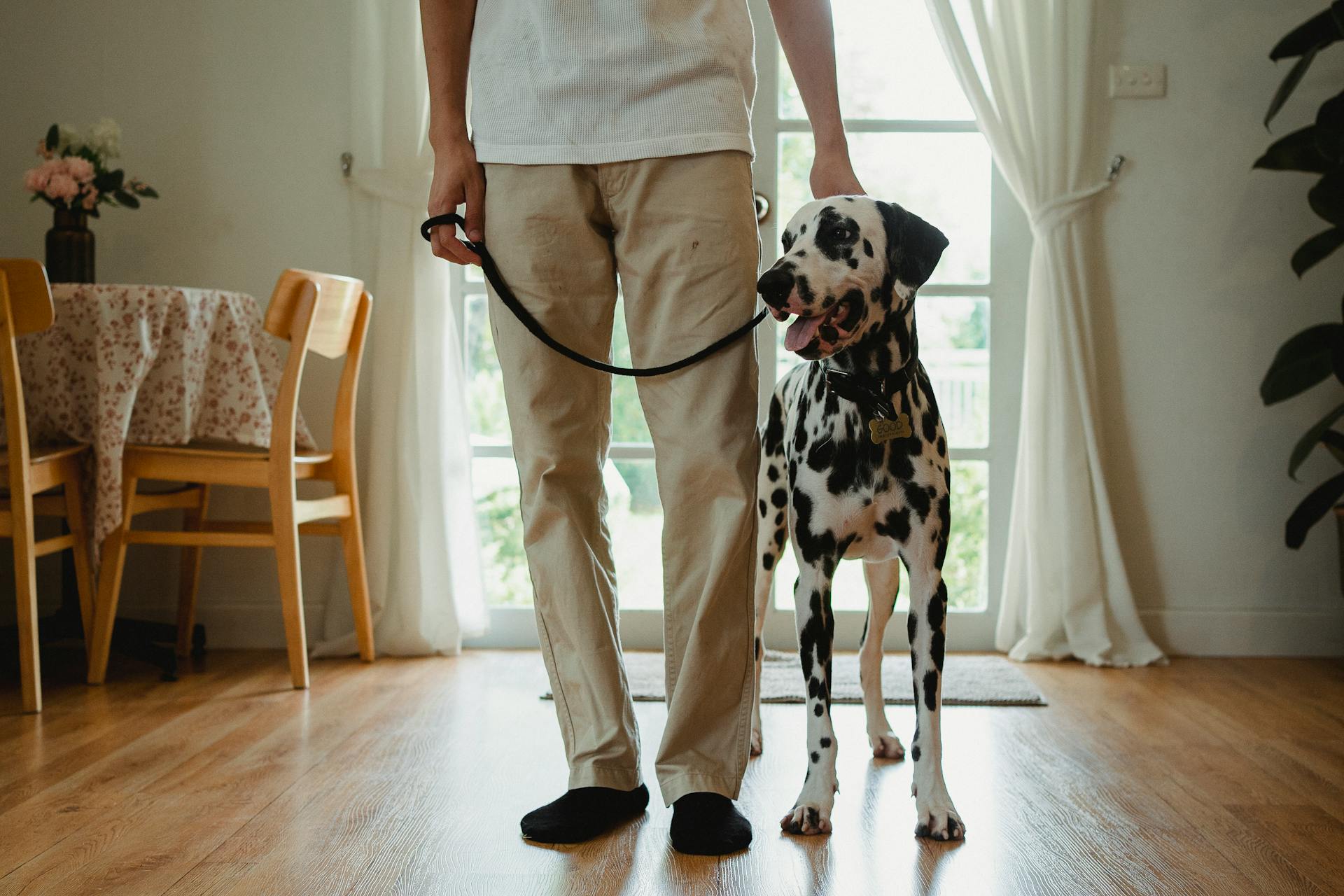
Dalmatians are a low-maintenance breed when it comes to drool. They don't drool that much, which is a relief for many owners.
One of the main reasons for this is that Dalmatians produce an expected normal amount of drool. This is usually only noticeable when they're expecting their dinner or a tasty treat.
As a result, you won't need to worry about wiping drool off their face or your clothes.
A different take: Good Dog Names for Dalmatians
Personality and Temperament
Dalmatians are born to run, with an endless capacity for exercise and a strong desire to please, making them easy to train with positive reinforcement.
They're highly alert and interested in everything around them, making them excellent watchdogs. Early socialization is crucial to ensure they grow up to be well-rounded dogs.
A Dalmatian's temperament is outgoing and curious, with a smart and friendly demeanor that makes them a great pick for families with kids. They're generally good with other pets, especially cats and other dogs.
However, they can be wary of strangers, so it's essential to teach them to be comfortable around new people, places, and things from an early age. They were bred to guard and protect animals, after all!
Dalmatians are highly energetic and need plenty of exercise to work to their full potential and use their deep energy reserves. A tired dog is a happy dog, and they'll thrive with human companionship and activities.
They're sensitive to unfair treatment, so gentle, patient, and consistent training is key to yielding the best outcomes. And, with proper socialization and training, they can be a joy to live with.
Care
Dalmatians are very active dogs that need plenty of exercise. They're built for running and can go for long distances, so it's essential to provide them with regular physical activity.
Exercise them on leash or in a secure area to prevent them from running off on their own. A Dalmatian will head cross-country if left unsupervised, and this could last for several days.
For another approach, see: How Much Exercise Does a Cavalier King Charles Spaniel Need
They thrive with human companionship and don't do well if left alone for extended periods. If you don't spend quality time with your Dalmatian, they'll pine and become unhappy.
Dalmatians need easy access to fresh water at all times. This is especially important due to their unique uric acid metabolism.
Grooming is relatively easy and doesn't take up much time. This means you can focus on other activities with your Dalmatian, like taking them for walks and training sessions.
You might enjoy: Boarding Dog for First Time
Behavior and Training
Dalmatians need plenty of early and ongoing dog socialisation to develop good behavior.
Their high energy levels make them perfect for active owners who can keep up with their needs for free-running space.
Most Dalmatians are easy to train as they enjoy working with their owners.
However, their exuberance can sometimes mean they have a short attention-span.
To ensure reliable recall, owners must work on training their Dalmatians to respond promptly to commands.
Training Dalmatians to walk on a lead and harness requires patience and consistency, but is a crucial part of their development.
If this caught your attention, see: Is Lhasa Apso Good for First Time Owners
Family and Socialization
Dalmatians can make excellent additions to active energetic families, but they may be too boisterous for younger children.
All dogs and children need to be taught to get on with each other and be safe together, and adults should supervise all interactions between them.
Dalmatians are usually great with kids, but this will be influenced by their socialization and training.
They have a natural affinity with horses and can get along with other dogs if adequately trained from a young age.
Dalmatians can get along with small animals like cats if properly introduced and trained.
To ensure a harmonious household, it's essential to teach children how to approach and touch dogs, and always supervise any interactions between dogs and young children.
Here are some key points to keep in mind:
- Supervise all interactions between dogs and young children.
- Teach children how to approach and touch dogs.
- Introduce Dalmatians to other family pets properly.
- Train Dalmatians from a young age to get along with other animals.
Rescue and Organizations
If you're considering bringing a Dalmatian into your life, it's essential to explore your options carefully. There are many wonderful Dalmatians in need of adoption and/or fostering.
If you're not sure where to start, you can contact the national Dalmatian breed club or a local breed club, and they can point you toward a rescue group in your area. They can also provide valuable guidance on what to expect when bringing a Dalmatian into your home.
Here are some reputable Dalmatian rescue groups to consider:
- Dalmatian Rescue of S. Florida
- Recycled Canines Dalmatian Rescue of Houston
- Adopt a Spot Virginia
- Dalmatian Rescue of N. Texas, Inc.
- Tennessee Dalmatian Rescue
- Dalmatian Rescue of Southern California
- Albuquerque Dalmatian Rescue
If you're looking for a reputable breeder, the Dalmatian Club of America, Inc. is a great resource to start with.
Rescue Groups
If you're considering bringing a Dalmatian into your life, it's essential to understand the responsibilities involved in owning one. Many people purchase Dalmatians without realizing the commitment required.
Dalmatians are often in need of adoption and/or fostering, and there are numerous rescue groups dedicated to helping them. If you don't see a rescue listed for your area, you can contact the national breed club or a local breed club for guidance.
A fresh viewpoint: American Kennel Club Lancashire Heeler
In the United States, there are several notable Dalmatian rescue groups. For example, Dalmatian Rescue of S. Florida, Recycled Canines Dalmatian Rescue of Houston, and Adopt a Spot Virginia are just a few organizations working tirelessly to find forever homes for these lovable dogs.
Here are some notable Dalmatian rescue groups across the country:
- Dalmatian Rescue of S. Florida
- Recycled Canines Dalmatian Rescue of Houston
- Adopt a Spot Virginia
- Dalmatian Rescue of N. Texas, Inc.
- Tennessee Dalmatian Rescue
- Dalmatian Rescue of Southern California
- Albuquerque Dalmatian Rescue
Breed Organizations
When you're looking for a reputable Dalmatian breeder, it's essential to research breed organizations that can provide you with valuable information.
Reputable breeders are committed to breeding healthy, well-socialized puppies that will make great companions. They screen their breeding stock for health problems and socialize their puppies from a young age.
Backyard breeders, on the other hand, are more interested in making a profit than in producing healthy, well-adjusted dogs. Puppies from backyard breeders are more likely to have both health and behavioral issues.
If you're interested in learning more about the Dalmatian breed, there are several breed clubs, organizations, and associations you can turn to.
Here are some reputable organizations you can check out:
- Dalmatian Club of America, Inc.
Pros and Cons
Dalmatian dogs have their fair share of pros and cons.
One of the main advantages of having a Dalmatian as a pet is their loyalty and affection towards their family. They form strong bonds with their owners and are often described as "velcro dogs" because of their tendency to stick close by.
On the other hand, Dalmatians can be high-maintenance when it comes to exercise and training. They require regular physical activity to stay happy and healthy, and consistent training to prevent behavioral issues.
Their short coats are also relatively low-maintenance, but their high energy levels mean they're not suitable for apartment living or households with small children.
The 6 Pros
Dalmatians are great alert dogs, making people feel safe with their keen sense of awareness.
They'll generally bark when strangers are nearby, alerting you to potential issues.
Dalmatians are not robust, but they're excellent at alerting you to things amiss, like animals outside or an unfamiliar car in the driveway.
Their alert nature makes them great alarm or alert dogs, providing an added sense of security.
They may also alert you to strange noises after dark, giving you peace of mind.
Their ability to alert you to potential issues makes them a great addition to any family.
A unique perspective: Medical Alert Dog Training
Cost of Dogs
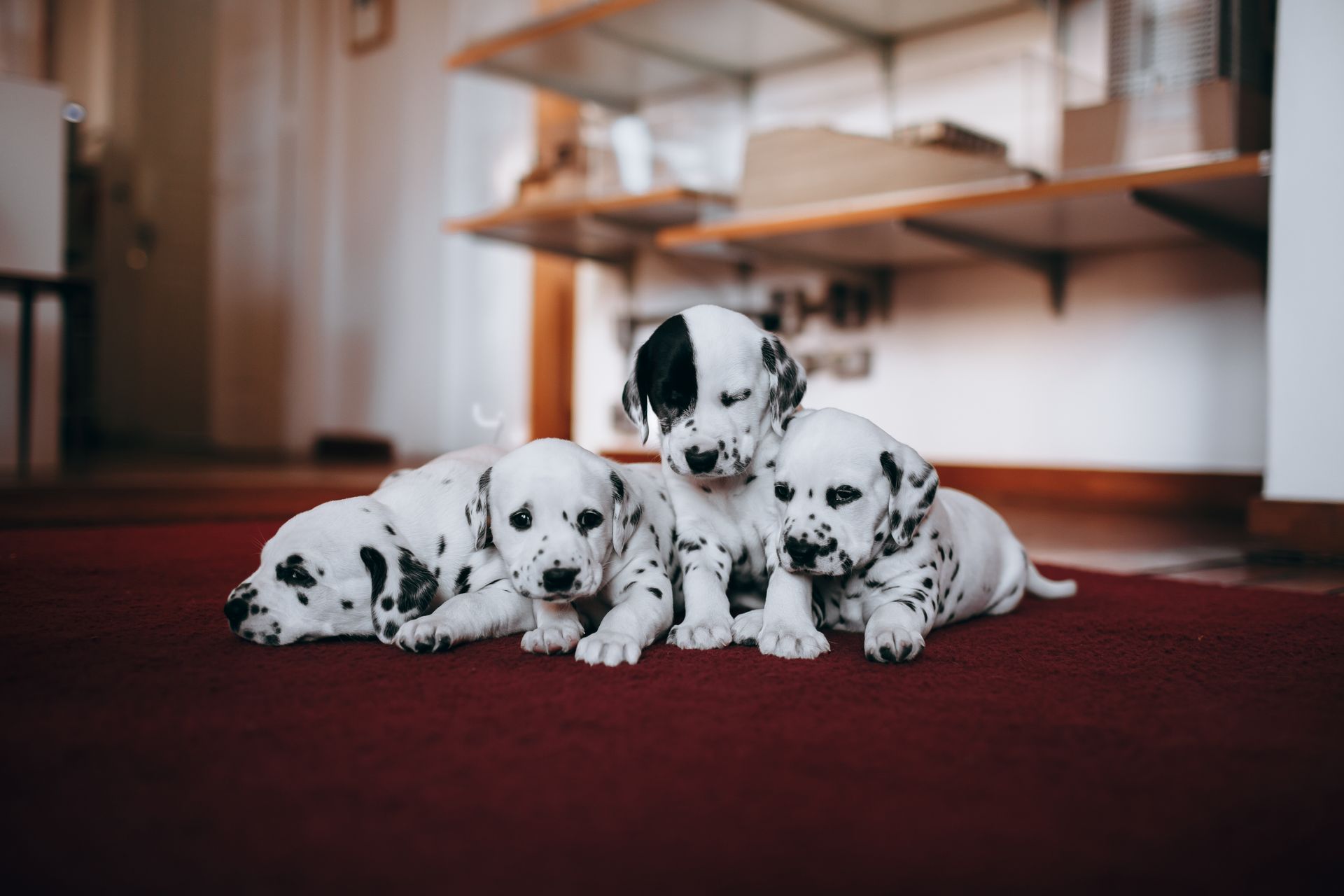
A purebred Dalmatian can cost anywhere from $800 to $2,000 or more. Some other purebred dog breeds can go for well over $1,200 on average.
Reputable breeders will often charge more than standard breeders, so be prepared for a higher price tag if you're looking for a dog from a reputable breeder.
Frequently Asked Questions
Why are Dalmatians so expensive?
The cost of a Dalmatian depends on factors like breeder reputation, pedigree, and location, with reputable breeders charging more for puppies with health guarantees and ongoing support. This higher cost reflects the breeder's investment in health testing and socialization.
Why are Dalmatians so special?
Dalmatians are special due to their unique combination of intelligence, strong hunting instincts, and distinctive markings. This blend of traits has made them excel in various roles, from hunting and herding to entertainment and companionship.
Featured Images: pexels.com