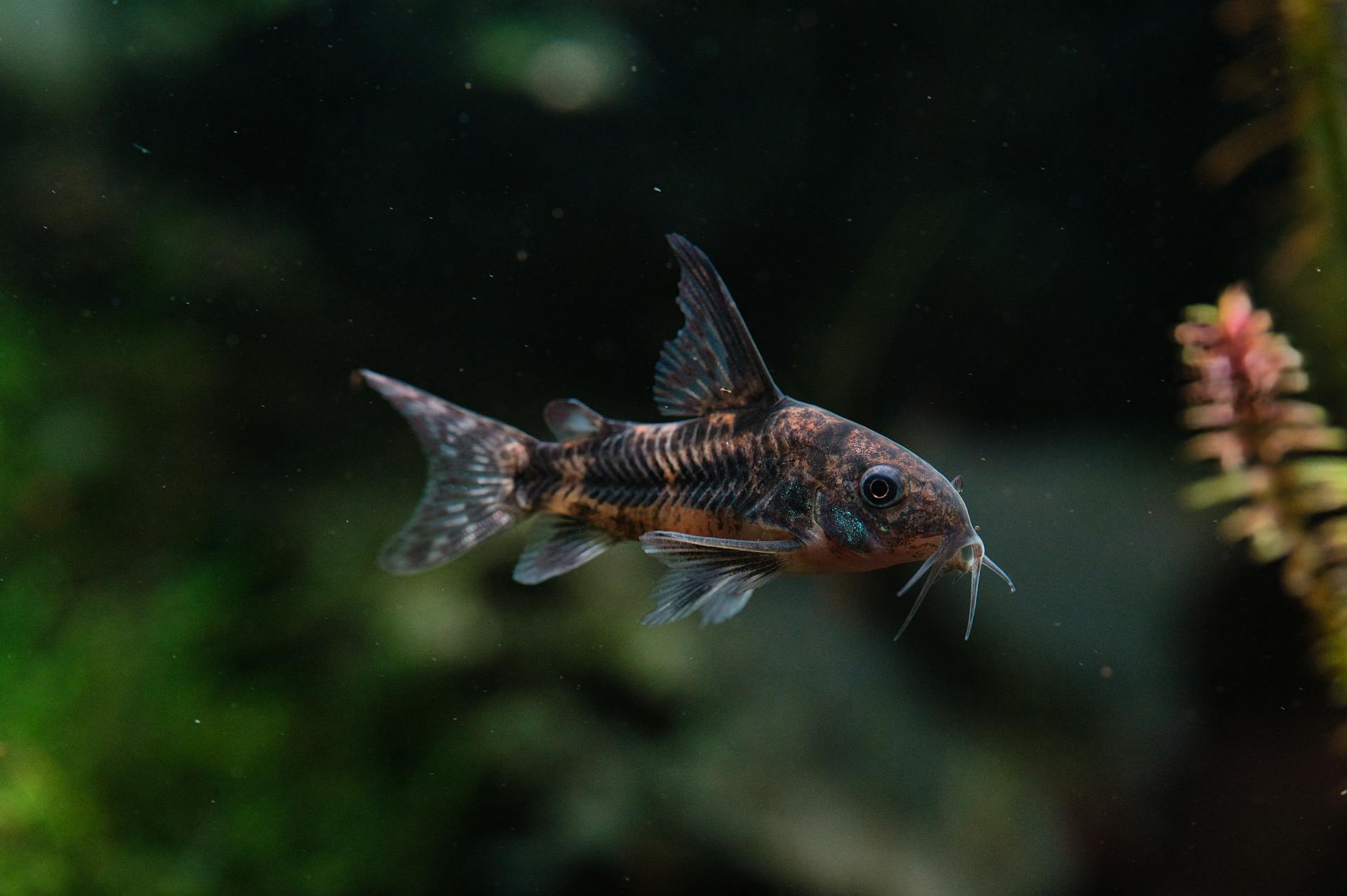
Corydoras catfish are a popular choice for aquarium hobbyists due to their small size, peaceful nature, and interesting behavior.
They thrive in schools, so it's essential to keep at least 6-8 individuals together in a well-planted tank with plenty of hiding places.
These catfish are native to the wild waters of South America, where they inhabit shallow, slow-moving streams and rivers.
Their small size, typically around 2-3 inches in length, makes them a great choice for smaller aquariums.
Tank Setup
Corydoras thrive in aquariums with a sandy substrate, as their sensitive barbels are easily damaged by rough surfaces.
A dark substrate is recommended, as these fish are sensitive to stress and prefer to seek shelter in dim environments.
Their natural habitats are often dimly lit, which helps them feel more secure.
Fine gravel with a diameter of around 3 mm (0.1 inch) can also work well, but be sure to choose a rounded edge to avoid damaging their barbels.
It's essential to monitor your tank setup to prevent Corys from getting stuck in decorations or plants with strong roots or rhizomes, such as Anubias.
A 30-gallon aquarium is best for most species, although pygmy Corys can be kept in smaller aquariums.
The ideal water temperature for Corydoras is around 25°C (77°F), although pygmy corys prefer slightly cooler temperatures between 72–78°F (22–26°C).
The general water hardness should be between 4°N dGH (71.43 ppm, 1.43 mEq) and 18°N dGH (321.43 ppm, 6.43 mEq), although a range of 8-12°N dGH (142.86 - 214.29 ppm, 2.86 - 4.29 mEq) is often ideal.
A neutral pH of 7 is recommended for Corydoras tanks, but pygmy corys can tolerate a pH of 6.4–7.5.
Make sure to provide plenty of hiding places, such as plants and hardscape, to help your Corydoras feel secure.
You might enjoy: Aquarium Plants Live Freshwater
Water Requirements
Corydoras are adaptable to a wide range of water chemistry, but ideal conditions for most captive bred species include a pH between 7.0 and 8.0.
A pH of 5.5 to 7.0 and alkalinity below 3° dKH (54ppm) is suitable for wild caught fish.
Temperature is also crucial, and most Cory cats and their relatives thrive between 74° and 80° F.
If your aquarium is kept in a room below 74°, you'll need to use an Aqueon Aquarium Heater to maintain the correct temperature.
Pristine water quality is essential to the health of Corydoras, so it's best to avoid adding them to new or neglected aquariums.
Regular water changes are also vital, and you should change 10% of the water every week or 25% every 2 weeks using an Aqueon Aquarium Water Changer or Siphon Vacuum Gravel Cleaner.
Before refilling your aquarium, make sure to treat tap water with Aqueon Water Conditioner to ensure the water is safe for your fish.
Recommended read: How to Take Care of a Chinese Fighting Fish
Diet and Nutrition
Corydoras are omnivores, which means they eat a variety of foods including both plant and animal matter.
They have a unique feeding style, designed for gathering food from the substrate, plants, or rocks. Their downward-pointing mouths make it difficult for them to eat flakes that don't sink quickly.
To provide a balanced diet, you can offer a variety of foods that sink to the bottom of the tank. Sinking wafers, mosquito larvae, and small worms are all great options.
Daphnia and brine shrimp are also excellent choices, and can be given as a treat or added to their regular diet.
Pellets, such as cichlid pellets, and chips, like Sera Wels-Chips, can also be used as part of their diet.
Here are some specific food options that are well-suited for Corydoras:
- Sinking wafers
- Mosquito larvae and small worms
- Daphnia
- Brine shrimp
- Pellets (such as cichlid pellets)
- Chips (like Sera Wels-Chips)
It's also a good idea to vary their diet daily to ensure they get a broad range of nutrients.
Tank Mates and Compatibility
Corydoras are social fish that thrive in the company of others, and they're relatively easy to pair with other peaceful species. They're a great addition to a community tank.
When choosing tank mates for Corydoras, it's essential to select species that are calm and won't harass them. Perfect tank mates include peaceful species like Angelfish, Discus, and Ram cichlids.
Some great options for Corydoras tank mates include the Adonis pleco, Yellow acara, and Marbled raphael catfish. These species are all compatible with Corydoras and can coexist peacefully.
However, there are some species that should never be kept with Corydoras. These include aggressive cichlids, Puffers, and certain other fish that may have different water requirements.
Corydoras are also known to raise a spine on their dorsal fin when they feel threatened, which can potentially harm their tank mates. To avoid this, it's crucial to choose suitable tank mates.
Here are some suitable tank mates for Corydoras:
- Adonis pleco - Acanthicus Adonis
- Yellow acara - Aequidens metae
- Marbled raphael catfish - Amblydoras hancockii
- Bristlenose catfish - Ancistrus cirrhosus
- Gold marble bristlenose catfish - Ancistrus claro
- Bushynose pleco - Ancistrus temminckii
- Bloodfin tetra - Aphyocharax anisitsi
- Green fire tetra - Aphyocharax rathbuni
- Blue cheek dwarf cichlid - Apistogramma eunotus
- Redstripe dwarf cichlid - Apistogramma hongsloi
- Altum angelfish - Pterophyllum altum
- Angelfish - Pterophyllum scalare
- Discus - Symphysodon aequifasciata alenquer
Remember to always choose tank mates that are compatible with Corydoras and to avoid species that may have different water requirements.
Sexing and Breeding
Sexing Corydoras can be a bit tricky, but males are generally smaller and less rounded than females. Males often chase females, especially during breeding season, which can be stressful for the female if it continues for too long.

To prevent this, it's a good idea to keep a ratio of 1:1 or 1:2 males to females. This will help reduce stress and increase the chances of successful breeding.
Breeding Corydoras can be a bit challenging, but it's definitely possible with the right conditions. Lowering the tank temperature to 21-22°C (69-71°F) and offering live or frozen foods can stimulate breeding.
Sexing
Sexing is a crucial step in understanding the behavior and needs of your Corydoras. Males are generally smaller and less rounded than females.
To determine the sex of your Corydoras, look for males that often chase females, especially during the breeding season. This behavior can be stressful for the female if it continues for too long, potentially leading to premature death.
A good rule of thumb is to maintain an ideal male-to-female ratio of 1:1 or, preferably, 1:2 to prevent excessive chasing.
On a similar theme: Corydoras Venezuelanus
Breeding
Sexing Corydoras can be a bit tricky, but generally, males are smaller and less rounded than females.
Males often chase females, especially during breeding season, which can be stressful for the female and potentially lead to premature death.
The ideal male-to-female ratio should be 1:1 or 1:2 to prevent this behavior.
To encourage breeding, you can lower the tank temperature to 21°C-22°C (69°F-71°F) and offer live or frozen foods like worms or small insects.
Frequent water changes can also stimulate breeding, and sometimes separating the male from the female can help.
In a breeding tank, the pH should be between 7 and 7.2.
Newborn Corydoras should be fed with newly hatched Artemia salina or microworms.
Pygmy corys love laying their eggs in dense foliage like java moss.
Corydoras can breed randomly all the time without any special effort, so be prepared for surprise eggs.
Males have a smaller and thinner profile, whereas females are rounder and larger to hold all the eggs.
To induce spawning, you can introduce cooler than normal water during water changes to imitate the rainy season.
Providing lots of cover, such as a dense mass of java fern or guppy grass, can help the catfish feel secure and breed.
Remove other species of fish to prevent them from eating the eggs.
For a higher survival rate, you can remove the eggs into a separate aquarium to raise the fry.
Habitat and Environment
Corydoras inhabit smaller streams and rivers, backwaters, oxbows, ponds, and marshy environments. The water is clear, slow-moving, and relatively shallow.
In their natural habitat, the bottom is typically made up of sand or detritus, and the shoreline often has dense plant growth, offering them cover. This dense plant growth is essential for corydoras to feel secure and hide from potential predators.
Corydoras prefer a smooth sand or gravel substrate, which helps them navigate and find food with their wispy barbels or whiskers.
Natural Habitat
Corydoras inhabit smaller streams and rivers, backwaters, oxbows, ponds, and marshy environments.
The water is clear and relatively shallow, with a smooth or sandy bottom that allows them to easily find food.
In the wild, corydoras can be found on sharp substrate, but their barbels can erode if the water quality is poor.
Their natural habitat often has dense plant growth along the shoreline, providing them with cover and protection.
Corydoras are well adapted to living in slow-moving water with a sandy or detritus bottom.
Temperature
Temperature is a crucial aspect of your cory catfish's habitat.
Most cory catfish are tropical fish and prefer water temperatures between 21 to 28 degree Celsius.
Spotted corydoras are happy with water at 21 to 24 degree Celsius.
Bronze corydoras like the water a little bit warmer, at 25 to 28 degree Celsius.
This temperature range is equivalent to 70 to 82 degrees Fahrenheit.
Care and Health
Cory catfish are social fish and do best in groups of at least five, with a minimum tank size of 60 centimeters or 24 inches long. They're bottom dwellers, so choose food that sinks to the bottom, and make sure other fish don't eat it all before they can.
To keep your cory catfish healthy, maintain a pH between 6.0 and 8.0, and adjust it gradually if you need to. A sudden change can be stressful for them. They also require stable water chemistry, so avoid sudden changes in pH, hardness, or temperature.
A fresh viewpoint: Chinese Fighting Fish Lifespan
To transport cory catfish, test the water in their current tank and replicate those conditions in their new home. This will help minimize stress and increase the chances of a successful transition. Before introducing your new cory catfish, turn off the aquarium lights, feed your existing fish, and let the temperature equalize.
Here are some ideal water parameters for cory catfish:
- pH: 7.0 to 8.0
- Alkalinity: 3° to 10° dKH (54ppm to 180ppm)
- Temperature: 74° to 80° F
Regular water changes are crucial for maintaining good health in cory catfish. Change 10% of the water every week or 25% every 2 weeks, and treat tap water with a water conditioner before refilling your aquarium.
Care
Corydoras are social fish that thrive in groups, so it's essential to keep them in a school of at least six, though 15-20 is ideal. This will provide them with enough space to swim and interact with each other.
Each Cory needs approximately 25 square centimeters (3.87 square inches) of space, so for a group of 10, you'll need a tank with a surface area of about 250 square centimeters (38.75 square inches).
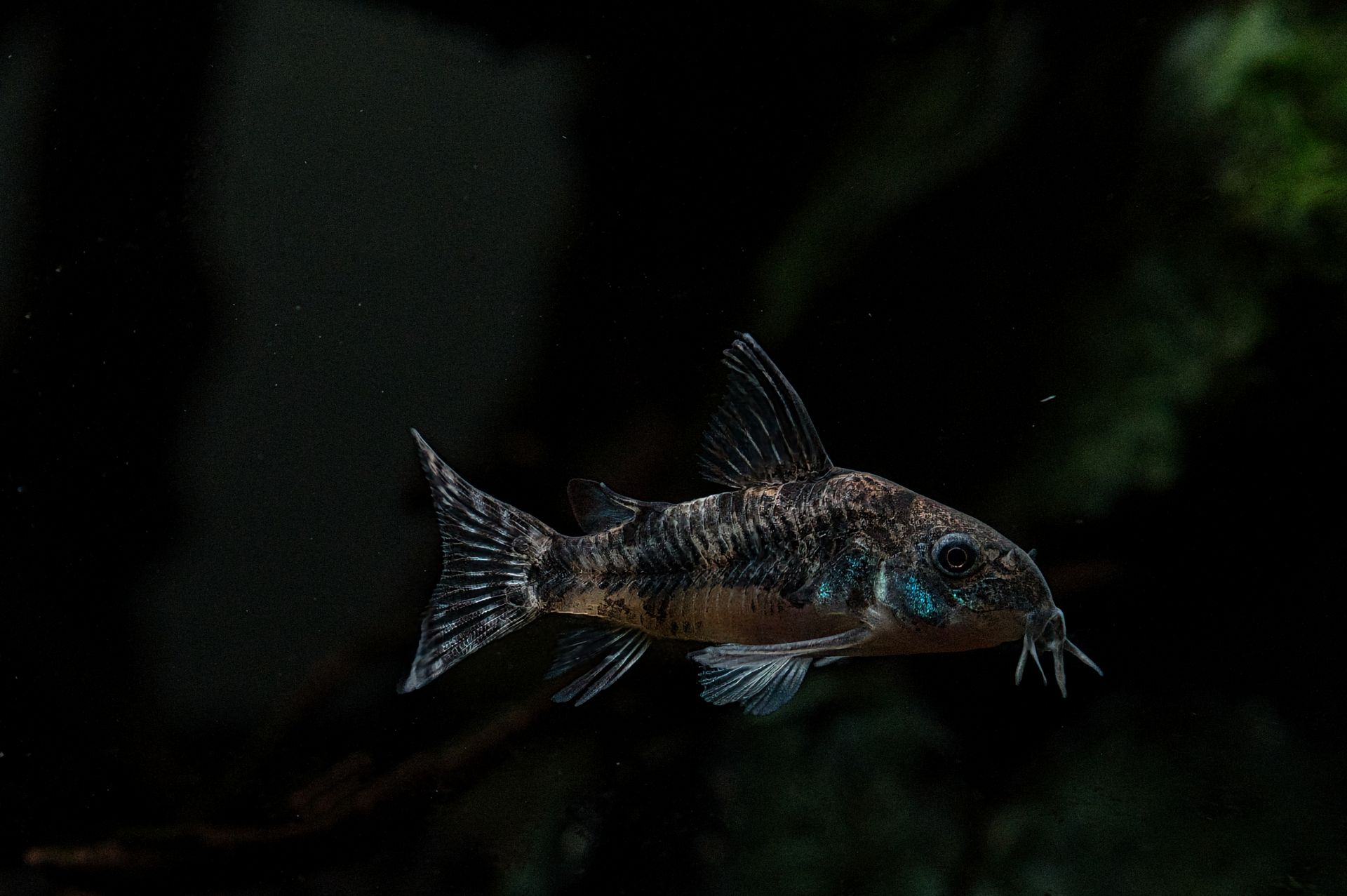
To maintain good health, Corydoras require pristine water quality, which means regular water changes. Aim to change 10% of the water every week or 25% every 2 weeks using a good filtration system and a water changer.
Corydoras are sensitive to changes in water chemistry, so it's crucial to test the water in their current tank and replicate those conditions in their new home as closely as possible. This will help minimize stress and increase the chances of a successful transition.
Before introducing new Corydoras to your tank, turn off the aquarium lights to reduce stress, and place the plastic bag containing the fish on the water's surface to allow the temperature to equalize. After 15-20 minutes, gently release your new Corys into the aquarium.
In the wild, Corydoras swim in shoals or groups, so it's essential to provide them with a suitable environment. A tank that is at least 60 centimeters (24 inches) long will give them enough room to swim and interact with each other.
To ensure the best health for your Corydoras, provide them with a varied diet that includes sinking pellets, algae wafers, and live foods such as brine shrimp, bloodworms, and daphnia.
Take a look at this: Freshwater Aquarium Plants Names
Diseases
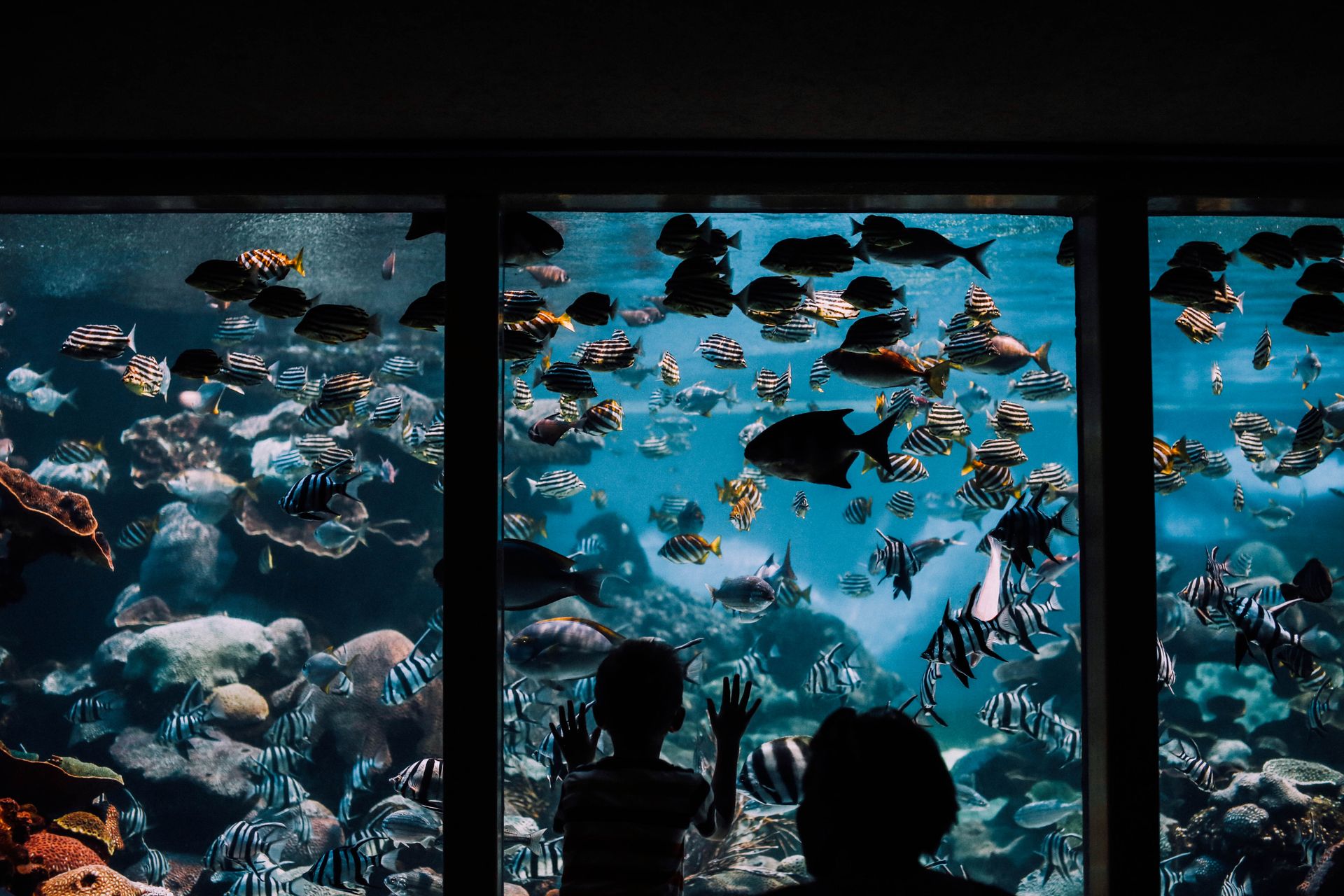
Diseases can be a major concern for aquarium owners. Fin rot is a common issue caused by bacteria that damage the fish's fins, making them look ragged.
Nitrate poisoning can be deadly if left unchecked. Fish with nitrate poisoning may stop eating, breathe faster than normal, and lie on the bottom of the tank.
Regular water changes can help prevent fin rot and nitrate poisoning. This is especially important for cory catfish, as they are sensitive to water quality.
If you notice any signs of fin rot or nitrate poisoning, take action immediately. This may involve adjusting your water change schedule or treating your aquarium with a nitrate-reducing medication.
General Information
Corydoras are a genus of South American catfish that include over 160 species.
They're relatively small, ranging from 1 to 3 inches long, and have bony plates of armor on their body for protection.
Most cory catfish prefer temperatures between 72 and 82°F, depending on the species.
Pygmy cory catfish are one of the smallest species and love to swim in the middle of the tank, not just the bottom.
In the wild, corydoras have been observed in large groups numbering from 20 to hundreds of the same species.
What Are?
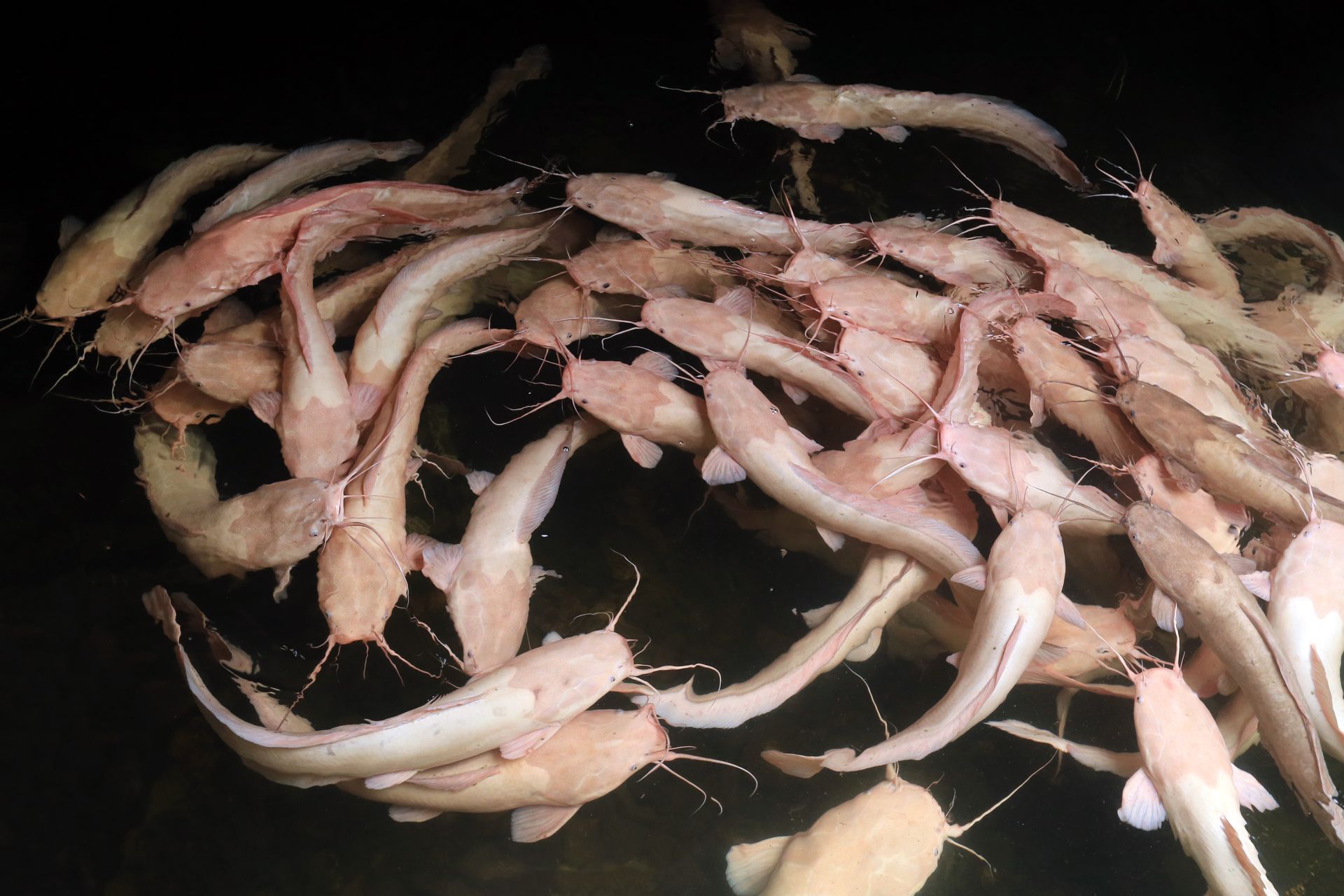
Corydoras are a genus of South American catfish, with over 160 species, and several hundred more waiting to be classified.
They're relatively small, ranging from 1 to 3 inches long in the aquarium hobby. Most cory catfish enjoy temperatures between 72 and 82°F, depending on the species.
In the wild, corydoras have been observed in large groups numbering from 20 to hundreds of the same species. They're most active in the daytime, with peak activity occurring at dawn and dusk.
Pygmy cory catfish are one of the smallest species of corydoras, and they love to swim in the middle of the tank, not just the bottom.
What Are Pygmy?
Pygmy Cory Catfish are tiny South American schooling fish that grow to a grand total of 1 inch in length.
Females are slightly rounder and longer than males.
Their silvery body with a horizontal, black stripe isn't particularly colorful, but those big, black eyes and little whiskers are hard to resist.
Pygmy corys have the unusual habit of hovering midwater by flapping their fins, almost like an underwater hummingbird.
They like to "wink" by quickly looking down and will dart up to the water surface to take the occasional gulp of air.
Characteristics and Size
Cory catfish are known as armored catfish because they have two rows of overlapping bony plates, called scutes, that run from the back of their head to the base of their tail.
These scutes are incredibly resilient, able to withstand a surprising amount of force before breaking. Scientists have tested them by trying to pierce them with needles, and were impressed by their durability.
Cory catfish also have stiff spines at the beginning of their dorsal and pectoral fins, which can be venomous in some species. These spines serve as a defense mechanism, releasing venom into the wound of any predator that tries to attack the catfish.
Cory catfish species vary in size, but none grow very large. They range from 2.5 to 12 centimeters in total length.
Characteristics
Cory catfish are known as armored catfish because they have two rows of overlapping bony plates, called scutes, that run from the back of their head to the base of their tail.
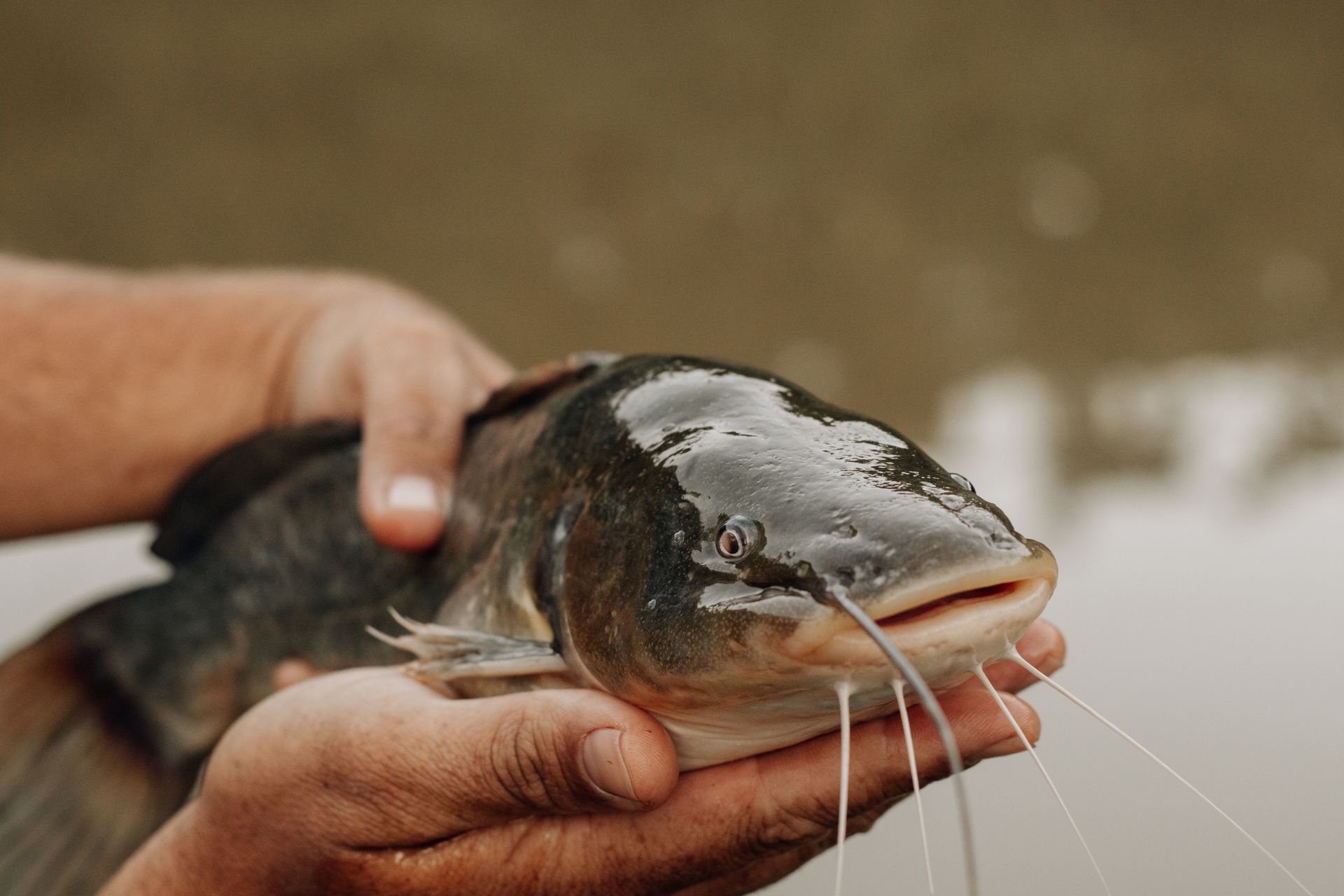
These scutes protect the cory catfish from predators, but they still allow the fish to swim easily.
Their stiff spines at the beginning of their dorsal and pectoral fins can be a defense mechanism, and in some species, these spines have venom glands.
Scientists have tested the scutes by trying to pierce them with needles, and were surprised at how much force they can stand up to.
Their armor plating is a remarkable adaptation that helps them survive in their environment.
Size
Cory catfish vary in size, but most are relatively small. They range from 2.5 to 12 centimeters in total length.
For home aquariums, you can expect most cory catfish to be less than 7 centimeters, or about 2.75 inches, in length. This is great news for smaller aquariums, as you can keep a few cory catfish without taking up too much space.
A 10-gallon aquarium may be suitable for dwarf species, but for most other varieties, a 20-gallon aquarium is recommended. This larger tank will give your cory catfish plenty of room to swim and feel safe.
To create a sense of community, it's a good idea to keep a group of six corydoras or more. This will allow them to shoal together and feel comfortable in their environment.
Behavior
Cory catfish are a bit unusual because they can breathe air. They'll dash from the bottom of the aquarium up to the surface to take a gulp of air.
Cory catfish can get oxygen from the water through their gills, but they swallow air to help keep them down under the water.
In the wild, going up to the surface to get air increases the risk of being eaten by a predator. Some cory catfish species will lessen this risk by breathing air as a group.
Cory catfish also spawn in groups, with each pair laying hundreds of eggs. The female fish will cup the eggs in her pelvic fins and then swim down to paste them on rocks and plants.
After spawning, the male and female fish swim away without protecting their eggs or providing any parental care.
Frequently Asked Questions
What are Corydoras good for?
Corydoras are expert scavengers that help maintain a clean and healthy tank environment by eating leftover food from the substrate. They're a great addition to any freshwater community aquarium.
Featured Images: pexels.com