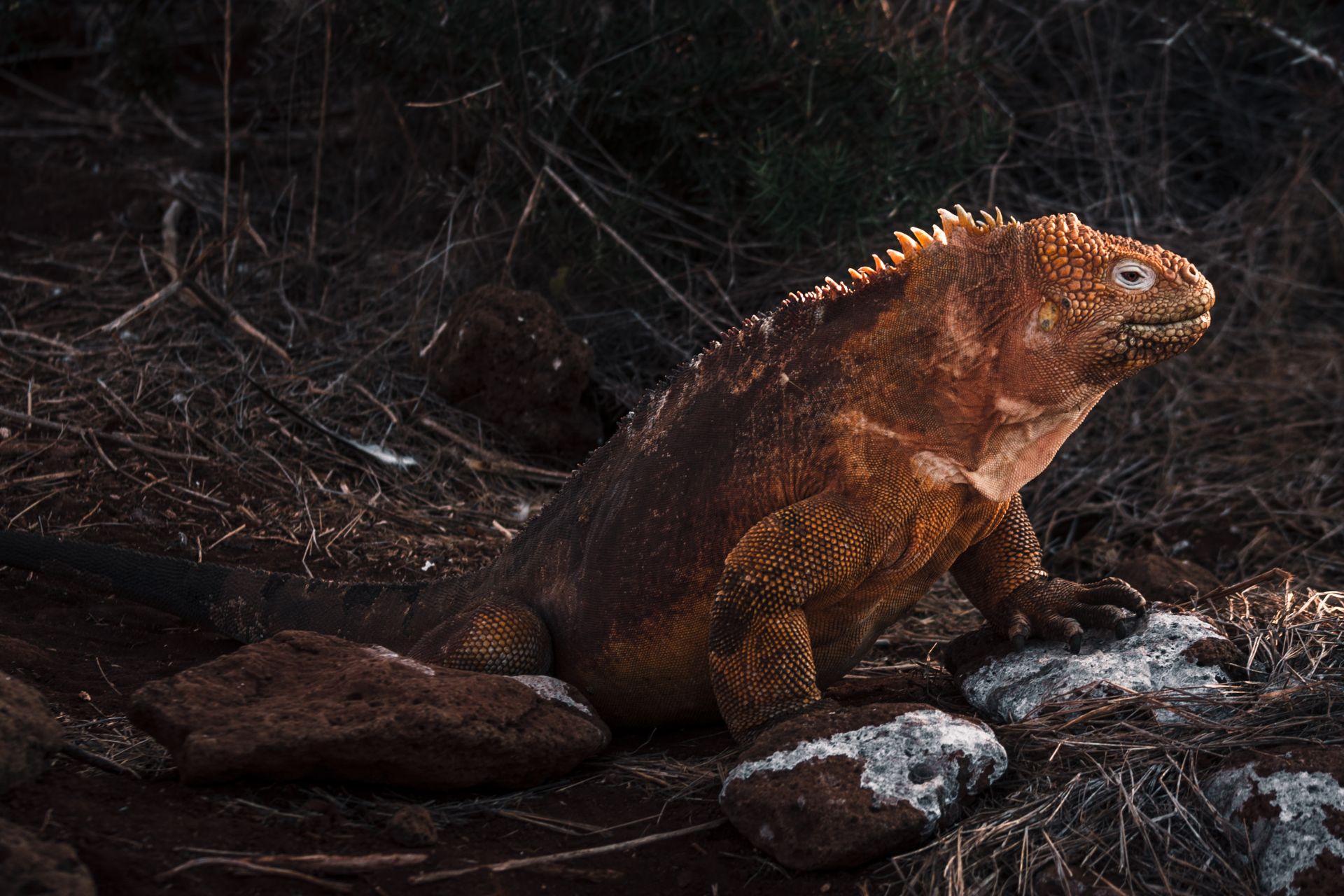
The Galapagos Land Iguana, Conolophus, is a fascinating creature that's native to the Galapagos Islands. It's a type of lizard that's been around for millions of years.
Conolophus is a relatively large lizard, with adults growing up to 4 feet in length and weighing up to 20 pounds. Their spiky scales and powerful claws make them well-adapted to their rocky, dry environment.
One of the most interesting things about Conolophus is their unique ability to survive without drinking water, getting moisture from the plants they eat. This adaptation is crucial in their arid habitat.
See what others are reading: Philippine Sailfin Lizard
Physical Characteristics
The Conolophus species, including the Galápagos land iguana and the Galápagos pink land iguana, have a range of physical characteristics that set them apart from other lizards.
The Galápagos pink land iguana (Conolophus marthae) has a distinctive pinkish head, pink and black body and legs, a black tail, and variable numbers of black, dorso-lateral stripes along the posterior part of the body.
For your interest: Giant Galapagos Tortoise
Its snout is elongated, unlike the blunt snout of the Galápagos Land Iguana (Conolophus subcristatus), and males have an adipose nuchal crest that is distinct from other land iguanas.
The holotype of Conolophus marthae weighed five kilograms, and had a snout-vent length of 47 centimeters.
The Galápagos land iguana (Conolophus subcristatus) has a low crest of spines along its back, which is not as tall as in most iguanas, giving it the name subcristatus, derived from the Latin words sub meaning "lesser" and cristatus meaning "crested".
Curious to learn more? Check out: Land Iguanas of the Galapagos Islands
Taxonomy
The Galapagos land iguana is classified as Conolophus subcristatus, a species of lizard in the family Iguanidae.
It's one of three species of the genus Conolophus, which is found in the Galapagos Islands.
Charles Darwin described the Galapagos land iguana as a species of lizard, noting its distinctive appearance and characteristics.
The Galapagos land iguana is endemic to the Galápagos Islands, specifically in the dry lowlands of Fernandina, Isabela, Santa Cruz, North Seymour, Baltra, and South Plaza Islands.
You might like: Giant Tortoise on the Galapagos Islands
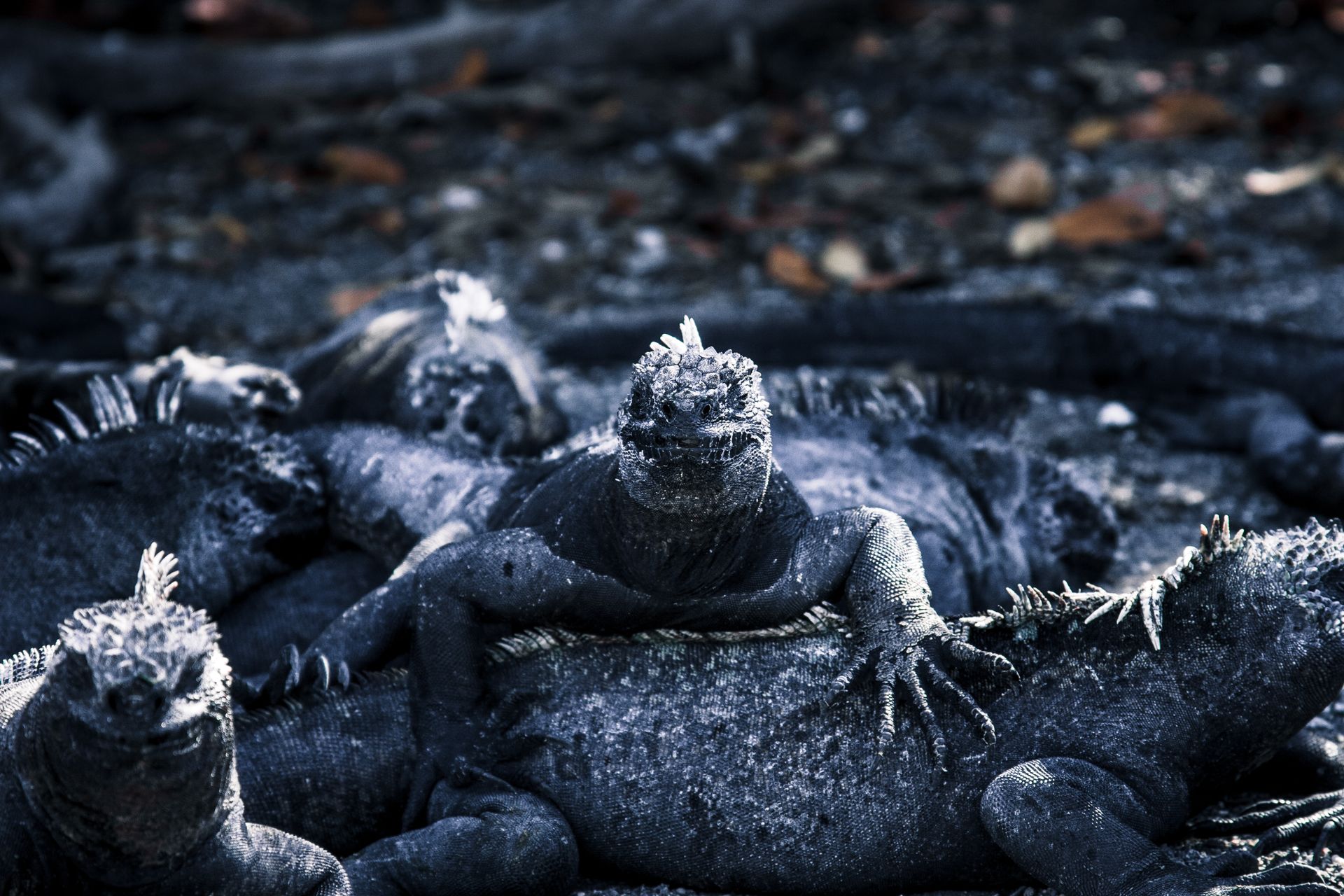
This species of lizard grows to a length of 0.9 to 1.5 m (3–5 ft) with a body weight of up to 11 kg (25 lb), depending on the island it's from.
Its unique appearance is due to its low facial angle, giving it a "singularly stupid appearance" according to Charles Darwin's observations.
Distribution and Habitat
Conolophus marthae lives in tropical dry shrub land near the caldera of Vólcan Wolf, at elevations as high as 1700 meters during the rainy season.
They migrate down the volcano to tropical dry forests during the dry season, at elevations as low as 600 meters. The animals have never been seen inside the caldera.
Vólcan Wolf is an active volcano that last erupted in May, 2015, which is an important factor in the Conolophus marthae's habitat.
The Galápagos Islands are home to the Conolophus marthae, specifically on the island of Isabela, where it can be found on a specific part of the volcano Wolf.
The total living area of the Conolophus marthae is not more than 25 km2, with a core area of less than 10 km2.
Habitat
Conolophus marthae lives in tropical dry shrub land near the caldera of Vólcan Wolf, at elevations as high as 1700 meters during the rainy season.
Their habitat is quite unique, as they migrate down the volcano to tropical dry forests during the dry season, at elevations as low as 600 meters.
They have never been seen inside the caldera, which is quite fascinating.
Distribution
Conolophus marthae, the Galapagos land iguana, has a very specific and limited distribution. It is only found on the island of Isabela.
The Galapagos Islands are home to this unique species, and it's worth noting that the islands are a group of islands that are isolated from the mainland. They are located near the equator.
The total range of C. marthae is quite small, covering an area of only 25 km2. This is a tiny fraction of the total area of the Galapagos Islands.
The Galapagos Islands are located near the equator, and they are known for their unique and endemic species.
Species and Variations
The Galapagos land iguana is a species of lizard in the family Iguanidae, and it's one of three species of the genus Conolophus.
These iguanas are endemic to the Galápagos Islands, specifically the dry lowlands of Fernandina, Isabela, Santa Cruz, North Seymour, Baltra, and South Plaza Islands.
They can grow to a length of 0.9 to 1.5 m (3–5 ft) and have a body weight of up to 11 kg (25 lb), depending on which island they're from.
The Galapagos land iguana has a distinctive appearance, with a yellowish orange underside and a brownish-red color on top.
Behavior and Ecology
The Pink Iguana is a unique creature with a distinct home range. They are found within a 25 kilometer square area, which is quite small compared to other animals.
These iguanas move from the top of the caldera of Vólcan Wolf to a lower area on the mountain during the dry season, then return to the top during the rainy season. This seasonal migration is likely due to the changing availability of food and water.
Their home range is so small that when they were first discovered, most individuals were clustered in an even smaller area of just 10.9 square kilometers.
Home Range
The Pink Iguana's home range is surprisingly small, confined to a 25 kilometer square area.
They have a unique migration pattern, moving from the top of the caldera of Vólcan Wolf to a lower area on the mountain during the dry season.
This movement is reversed during the rainy season, when they return to the top of the caldera.
The area where they were first discovered is a 10.9 square kilometer zone.
Most Pink Iguanas cluster in an even smaller area within this zone.
Predation
In the Galapagos Islands, predators play a significant role in the life cycle of the Conolophus marthae.
Feral cats and black rats are likely predators of hatchling and juvenile Conolophus marthae.
Galapagos Hawks prey on both adults and juveniles of this species.
There are no known adverse effects of Conolophus marthae on humans, so you don't have to worry about encountering them in the wild.
Conservation Status
The Pink Land Iguana, also known as Conolophus, is considered critically endangered by the IUCN Red List.
There is only one known population of about 192 individuals, which is a concerning number.
The active volcano the iguanas live on is a significant threat, as are the frequent droughts the Galapagos Islands experience.
Parasites are also a threat to the Pink Iguanas.
The Galapagos National Park has implemented feral cat control on other islands, but it's unlikely to be completely effective due to the remote location of Isabela Island and Vólcan Wolf.
Frequently Asked Questions
How many pink land iguanas are left?
There are approximately 200 pink land iguanas remaining in the wild.
Featured Images: pexels.com


