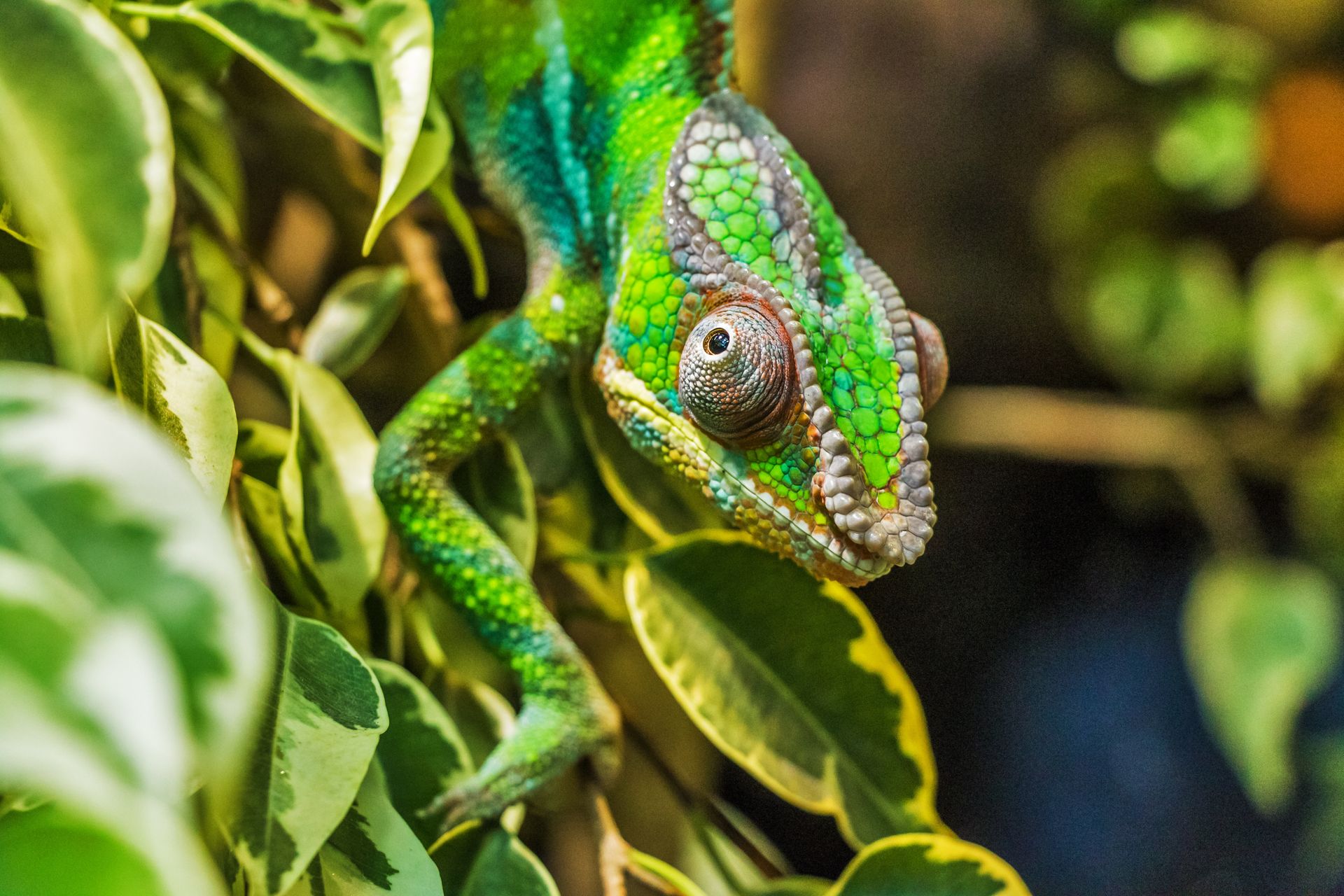
Chamaeleos are known for their remarkable ability to change color, a trait that helps them blend in with their surroundings.
This ability is made possible by specialized cells in their skin called chromatophores, which contain pigments that can be expanded or contracted to alter the color of their skin.
Chamaeleos also have a prehensile tail that they use to grasp branches and climb, a feature that's essential for their arboreal lifestyle.
In addition to their color-changing abilities, Chamaeleos are also skilled at camouflage, often remaining still for long periods to avoid detection.
Suggestion: Pseudocalotes
Physical Characteristics
Chameleons are slow-moving animals, which is quite different from their quick-witted reputation. They have independently moving eyes, allowing them to scan their surroundings without moving their whole head.
One of the most distinctive features of chameleons is their ability to change skin coloration. This helps them blend in with their environment and regulate their body temperature.
Their long, protrusible tongue is another notable feature. This is used to catch prey, and it's quite impressive to see in action.
Chameleons also have a prehensile tail, which they use as an extra limb to grasp onto branches. This is particularly useful for their arboreal lifestyle.
Males are generally bigger and more colorful than females, although there are some species where the female is larger. Male size can range from 20cm to 61cm in some species.
Here are some key physical characteristics of chameleons:
- Slow moving
- Independently moving eyes
- Ability to change skin coloration
- Long, protrusible tongue
- Prehensile tail
- Special leg adaptations for grasping vegetation
Their bodies are also ectothermic, meaning they rely on their environment to regulate their temperature. They have bilateral symmetry, which is a characteristic shared with many other reptiles.
Behavior and Habitat
Chamaeleos are mostly found in trees or bushes, but some species can be found on the ground. They inhabit a wide range of habitats, including tropical rainforests, mountain rainforests, savannas, scrublands, and even crop plantations.
Some species of Chamaeleos can be found in temperate, tropical, or terrestrial habitats. They are also found in various biomes, such as savannas or grasslands, rainforests, and scrub forests.
Chamaeleos are diurnal creatures, meaning they are active during the day and sleep throughout the night. They choose a spot to sleep where they are well hidden and blend in to avoid predators.
Here are some key behaviors of Chamaeleos:
- arboreal
- diurnal
- motile
- solitary
- territorial
Behavior
Chameleons are primarily arboreal, meaning they spend most of their time in trees or bushes. However, a few species like the Namaqua Chameleon are partially or largely terrestrial.
Males are generally more aggressive and territorial than females. They use their colorful displays to threaten other males, and may even produce sounds like hissing when feeling threatened.
Females, on the other hand, can tolerate each other in closer proximity unless they're receptive or gravid. Chameleons are slow-moving creatures that grasp foliage and branches with their zygodactylous feet and prehensile tails.
Here are some key behaviors of chameleons:
- arboreal
- scansorial
- diurnal
- motile
- sedentary
- solitary
- territorial
Chameleons are active during the day and sleep throughout the night. They choose a spot to sleep where they're well hidden and blend in, making them vulnerable to predators.
Predation
Chameleons are relatively small, so they're often at the bottom of the food chain in their ecosystems.
Their small size makes them vulnerable to predators like snakes, birds, and sometimes even monkeys.
A chameleon's most notable anti-predator adaptation is its ability to change color, which helps it blend into its environment.
For example, a chameleon on a branch can change its skin to match the branch or a leaf, making it almost invisible to predators.
This ability to camouflage itself is a crucial survival strategy for chameleons.
For more insights, see: Malagasy Giant Chameleon
Reproduction and Life Cycle
Chamaeleos are oviparous, which means they lay eggs instead of giving birth to live young.
During mating season, usually from July to September, females will change their coloring to signal they're ready to mate. This is a distinctive color change, and males will often compete for the right to mate with the female.
Females will choose the most vibrant and dominant male to mate with, and they're not monogamous - males and females will wander around to find different mates.
Here are the key reproductive features of Chamaeleos:
- Iteroparous: They can breed multiple times in a year.
- Seasonal breeding: They breed during specific times of the year.
- Gonochoric: The sexes are separate, with males and females distinct from each other.
- Oviparous: They lay eggs instead of giving birth to live young.
Lifespan/Longevity
Chamaeleons in the wild typically live between 3-8 years, with males often outliving females.
With proper care, their lifespan can be extended to around 10 years in captivity.
Males tend to live longer than females.
In the wild, their lifespan is significantly shorter than what's possible in a controlled environment.
Reproduction

Reproduction is a fascinating aspect of a chameleon's life cycle. Chameleons are oviparous, which means they lay eggs.
Females change their coloring to signal that they're ready to mate, and this color change is distinct from other reasons they might change color. This is a crucial signal for males to know when they're ready to mate.
Mating season for chameleons typically occurs during the warmer months, usually July-September. They can also mate twice a year during wet and dry seasons.
A female chameleon can lay anywhere from 10 to 70 eggs at a time, depending on the species. The eggs are incubated by the ground, which can take anywhere from a few months to 10 months.
Chameleons are not monogamous, and males and females wander around to find mates. They're actually polygynandrous, which means they're promiscuous.
Here's a summary of some key reproductive features of chameleons:
There's hardly any parental care provided to the young chameleons. The mother lays the eggs in the ground and leaves, and the babies hatch fully self-sufficient. They can even hunt for themselves from a young age.
Taxonomy
Chamaeleo is the type genus of the family Chamaeleonidae.
The genus Chamaeleo has undergone significant changes in its classification over time. Virtually all authorities now recognize it as a distinct genus, separate from others that were once included within it.
In the past, the genus Chamaeleo was broader and covered more species. It was eventually decided that the genus was too diverse and needed to be split into different genera.
The genus Chamaeleo sensu stricto now only has 14 species within it.
Explore further: Chamaeleo Chamaeleon
Conservation and Care
Chamaeleos require special care, and are generally suited to the intermediate or advanced reptile keeper.
In captivity, few exceptions exist, and most commonly seen species are members of the genus Chamaeleo.
The common, Senegal, and veiled chameleons are the most commonly found species in the pet trade, and through captive breeders.
Conservation Status
Chameleons are generally not in danger, but their habitats are. Deforestation threatens their populations, and conservation efforts are needed to protect their natural habitats.
The species in the genus Chamaeleo are not endangered, but one species, C. monachus, is listed as near threatened on the IUCN Red List.
Conservation efforts may include promoting research on their ecology and habitats, and taking measures to preserve their natural habitats.
In Captivity
Chameleons in captivity are often members of the genus Chamaeleo.
The most commonly found species in the pet trade are the common, Senegal, and veiled chameleons.
All chameleons require special care and are generally suited to the intermediate or advanced reptile keeper.
Species and Distribution
There are 14 recognized species of Chamaeleo, with some species having subspecies. The African chameleon, for example, is found in the Sahel region from Mali and Mauritania to Sudan, north to Egypt.
The distribution of Chamaeleo species varies widely, with some species found in sub-saharan Africa, while others range into northern Africa, southern Europe, and southern Asia. The veiled chameleon, for instance, is found in Yemen and Saudi Arabia.
Here's a breakdown of some of the species and their distribution:
Extant Species
There are 14 recognized species of chameleons, with subspecies identified for some of them. These species can be found in various parts of the world, including sub-Saharan Africa, northern Africa, southern Europe, and southern Asia.
Some of the most widespread species include the African chameleon, the flap-necked chameleon, and the veiled chameleon. The African chameleon, for example, can be found in the Sahel region, from Mali and Mauritania to Sudan, and north to Egypt.
Here's a list of some of the species and their common names:
- African chameleon
- Angola double-scaled chameleon
- Arabian chameleon
- Awash spurless chameleon
- Veiled chameleon
- Common chameleon
- Flap-necked chameleon
- Graceful chameleon
- Smooth chameleon
- Socotran chameleon
- Namaqua chameleon
- Nečas' flap-necked chameleon
- Senegal chameleon
- Indian chameleon
These species can be found in a variety of habitats, including scrublands, forests, and even up to 8,500 feet in elevation.
Veiled Chameleon
The veiled chameleon is a large and showy species that's native to Africa, but has been introduced to Maui as an escaped pet. They can grow up to 18-24 inches long.
These chameleons are adaptable and can thrive in various environments, from dry to wet montane regions, including areas as high as 12,000 feet elevation. They have a large casque, a bony shield on their head, and their colors can change from white to black, gray, brown, green, blue, orange, red, and yellow.
Veiled chameleons are arboreal, which means they live in trees, and they feed primarily on insects, but also on leaves, flowers, and buds. They can even take small mammals and birds due to their size.
Here's a breakdown of their reproductive habits:
Veiled chameleons can live for 4 to 8 years, and they're a target species for MISC due to their lack of natural predators on Maui and their potential to prey on native Hawaiian birds and insects.
Communication and Interaction
Chameleons primarily communicate by changing their skin pigmentation to signal their social status. They can also change color to show emotions like fear or anger, turning red or orange.
Red or orange coloration is a common indicator of fear or anger in chameleons. They may also display this coloration when they're feeling aggressive or have a higher social status.
Females show a specific coloration when they're receptive or gravid. This is an important signal for potential mates.
Chameleons have well-developed eyesight, with independently moving eyes that help them track prey.
Frequently Asked Questions
What is the common name for Chamaeleo?
The common name for Chamaeleo is the common chameleon or Mediterranean chameleon. It is a species native to the Mediterranean Basin and surrounding areas.
What is the origin of the word Chamaeleo?
The word Chamaeleo originates from Greek, derived from "khamailéōn", a compound of "khamaí" meaning "on the ground" and "léōn" meaning "lion". This Latinized form was later simplified to the English word "chameleon
What is the lifespan of a male veiled chameleon?
Male veiled chameleons typically live for about 8 years. They reach maturity at around 4-5 months, allowing for a long and healthy life with proper care.
Featured Images: pexels.com