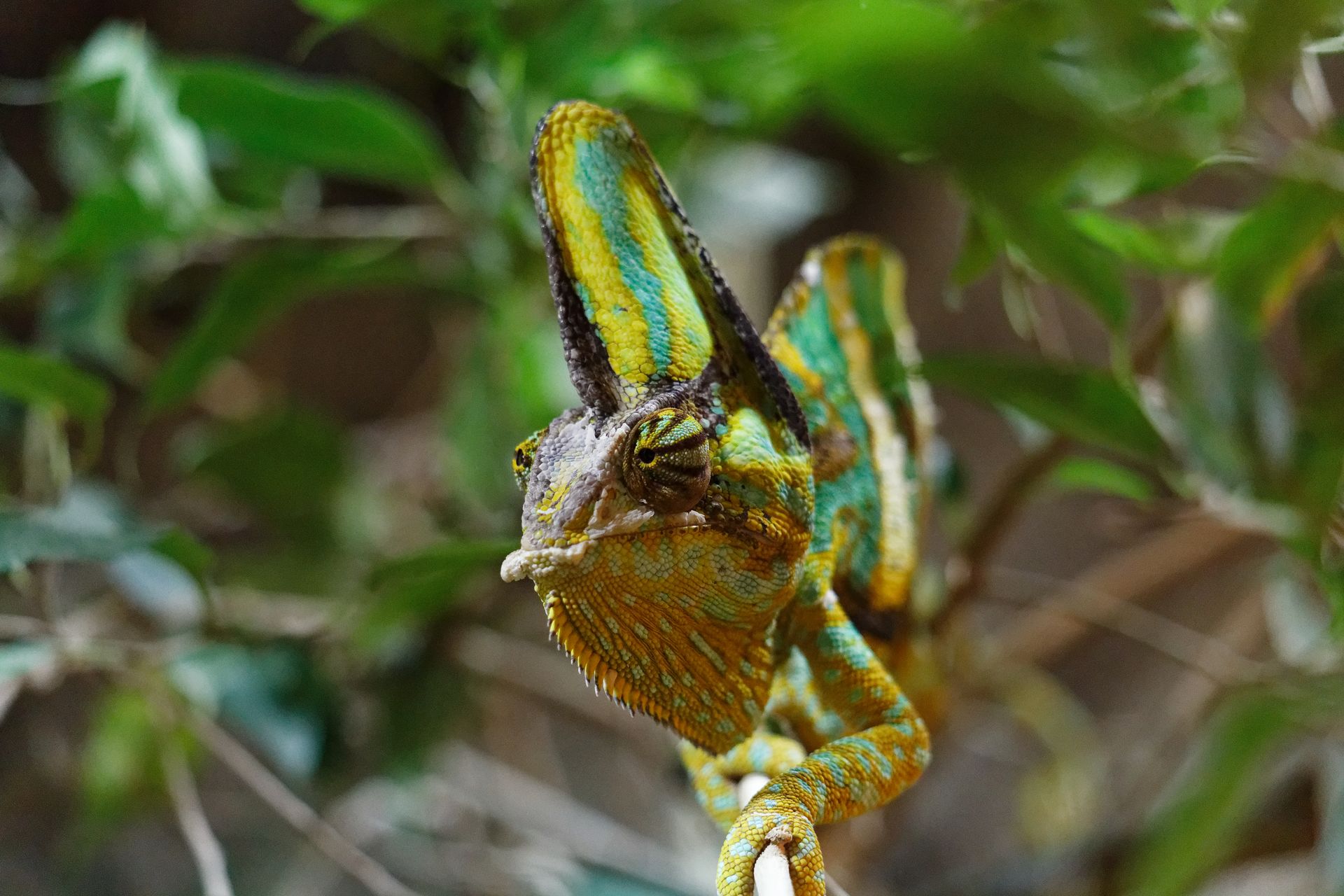
The Malagasy Giant Chameleon is a remarkable creature found only in the wilds of Madagascar. It's the largest species of chameleon, growing up to 23 inches in length.
These incredible animals have a unique appearance, with a flat, broad head and a long, slender tail.
Their color-changing ability is one of their most impressive features, allowing them to blend in seamlessly with their surroundings.
Physical Characteristics
The Malagasy giant chameleon, specifically the F. oustaleti species, is a remarkable creature. Its maximum total length, including tail, can reach up to 68.5 cm (27 in).
This makes it generally considered the world's largest species of chameleon by this measurement. However, there are some exceptions, like the Calumma parsonii and Trioceros melleri, which have been claimed to reach even greater lengths, but this remains unverified.
One of the distinctive features of F. oustaleti is its slender build. Large adult males typically weigh between 400-500 g (14-18 oz), but lower weights are common.
Curious to learn more? Check out: Common Snapping Turtle Species
Females, on the other hand, are significantly smaller and lighter than males. They typically weigh less and reach a maximum length of about 40 cm (16 in).
The head of the F. oustaleti bears a high casque with several crests, and a dorsal crest consisting of 45 or more small triangular spines, runs along the spine.
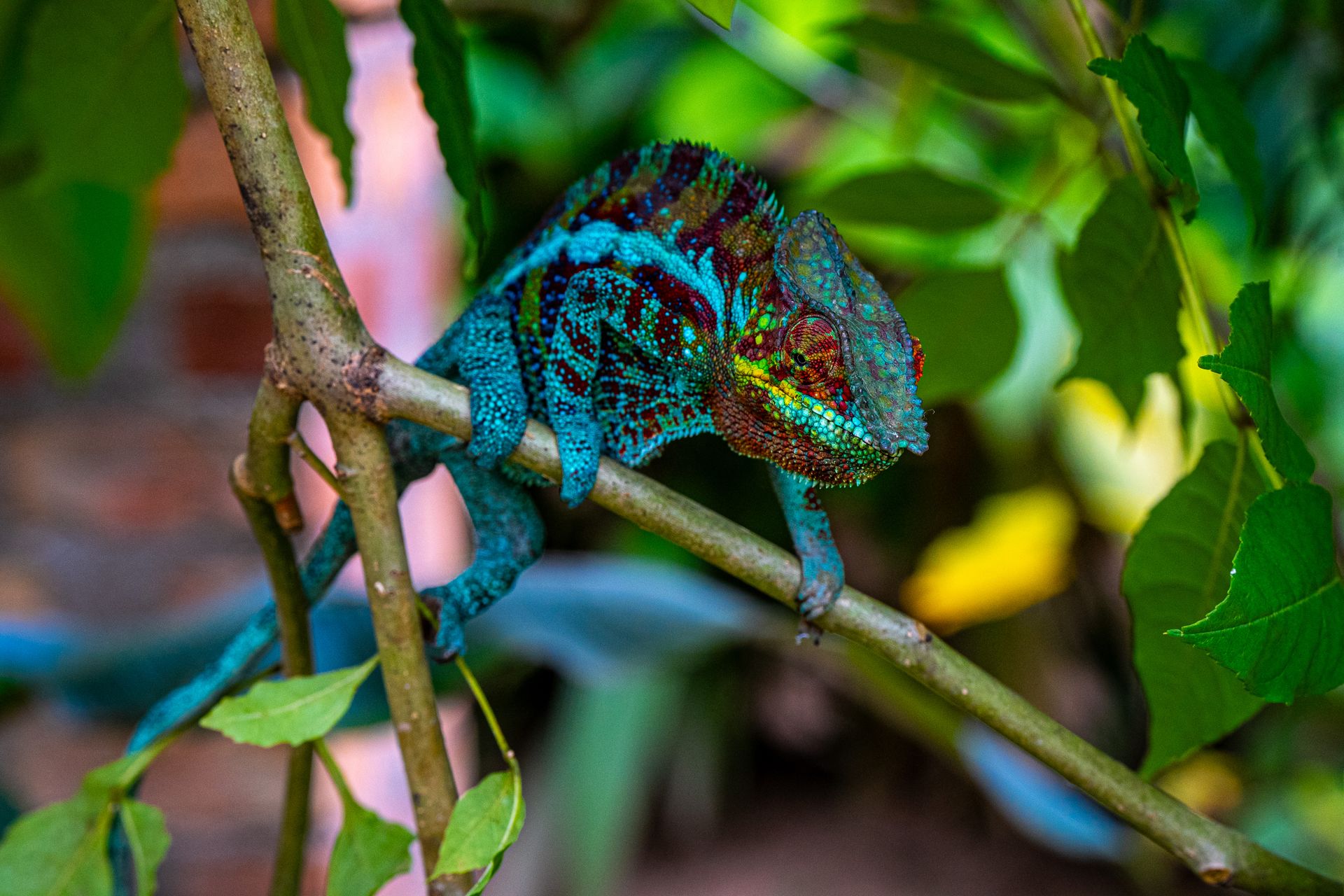
The colouring of F. oustaleti is quite variable, with males usually being largely grey or brownish, sometimes with reddish-orange feet or underparts. Females, however, are more colourful and variable, with base colours or markings in red, yellow, and green being possible, and the eyelids can sometimes be blue.
Here are some key physical characteristics of the Malagasy giant chameleon:
- Males: typically weigh between 400-500 g (14-18 oz)
- Females: typically weigh less and reach a maximum length of about 40 cm (16 in)
- Colouring: variable, with males being largely grey or brownish and females being more colourful
Classification and Distribution
The Malagasy giant chameleon is endemic to Madagascar and is found throughout the island. It's a very adaptable species, able to thrive in a wide range of habitats, from dry deciduous forests to humid evergreen forests and even urban settings.
It's worth noting that this chameleon is seldom found deep in the forest interior, but more on the edges. This is likely due to its ability to survive in a variety of environments.
The Malagasy giant chameleon is considered to be a single species, although some taxonomists have questioned whether it's a single species or a species complex due to a degree of geographic variation in colour and size.
Malagasy Giant Chameleon
The Malagasy Giant Chameleon is a large species of chameleon that's native to Madagascar. It's also found in Kenya, near Nairobi, although its current status there is unclear.
This chameleon can grow up to 68.5 cm in length, including its tail, making it the largest species of chameleon. However, its size can be contested by the Parsons chameleon, which is slightly shorter but more heavily built.
The Malagasy Giant Chameleon has a distinctive appearance, with a high casque on its head and a dorsal crest of 45 or more small triangular spines running along its spine. Its coloring is quite variable, often being grey or brown, with females being more colorful than males.
Females tend to be more colorful than males, often displaying vibrant colors.
Origin / Distribution
The Malagasy giant chameleon is endemic to Madagascar, making it a unique species found only on this island.
Its distribution is widespread, covering all parts of the island, from dry to wet sites, and at various elevations.
In fact, it's the most widespread chameleon species on the island, which is a testament to its adaptability.
Unfortunately, a localized population introduced into Kenya is likely extinct.
This species is well adapted to the warm climate of the savannah, which is why it benefits from human changes to the landscape, such as deforestation.
It's found throughout the island, but its appearance in the eastern part of Madagascar is linked to relatively high temperatures.
The Malagasy giant chameleon inhabits a very wide range of habitat types, including dry deciduous forest, humid evergreen forest, montane savanna, and even urban settings.
Broaden your view: Snake Island Brazil Snakes
Taxonomy
The Malagasy giant chameleon has a complex taxonomy, with three recognized species within its species complex.
Furcifer oustaleti is a single species that occurs in both the arid and wet regions of Madagascar, but some question whether it's a single species or a species complex due to geographic variation in color and size.
The Malagasy giant chameleon's taxonomy is not clear-cut, as some populations may represent multiple cryptic species.
The Malagasy giant chameleon has been found to have a small size, unusual coloration, and pattern in some populations, which may be a distinct feature or a characteristic of subadults.
Furcifer oustaleti is the only chameleon of Madagascar to occur in both the most arid regions and the wettest regions.
- Species complex: 3 recognized species
- Species status: Furcifer oustaleti is considered a single species, but some question its validity
Care and Management
The Malagasy giant chameleon is a relatively peaceful and quiet species, making it a great pet for experienced owners. Males do not get along with each other, and pregnant females are strictly solitary.
To keep them happy, you'll need a large terrarium, preferably a greenhouse, as they can grow quite big. In fact, a greenhouse is more suitable for their size.
The Malagasy giant chameleon is not easily excitable, but they do have a bit of a stubborn streak. Even if you're careful when handling them, they might open their mouth in a threatening way if you provoke them too much.
Curious to learn more? Check out: Malagasy Hippopotamus
Field researchers say you can put a Malagasy giant chameleon on your shoulder, and it will stay there quietly for hours. This shows just how calm and gentle they can be.
To keep your Malagasy giant chameleon healthy, you'll need to provide a varied diet. They'll eat all sorts of insects, like crickets, domestic crickets, grasshoppers, and zofas. They'll also eat young nest mice.
All insects should be sprinkled with a vitamin lime powder to ensure they're getting all the nutrients they need. This is especially important for a species that eats a wide variety of foods.
Frequently Asked Questions
How big is the Malagasy giant chameleon?
The Malagasy giant chameleon typically reaches a maximum length of 68.5 cm (27 in), including its tail. This makes it the world's largest species of chameleon by this measurement.
What is the lifespan of a Malagasy chameleon?
The Furcifer labordi chameleon's lifespan is approximately 8 months, from hatching to death. This tiny chameleon has the shortest lifespan among all four-limbed vertebrates.
Featured Images: pexels.com