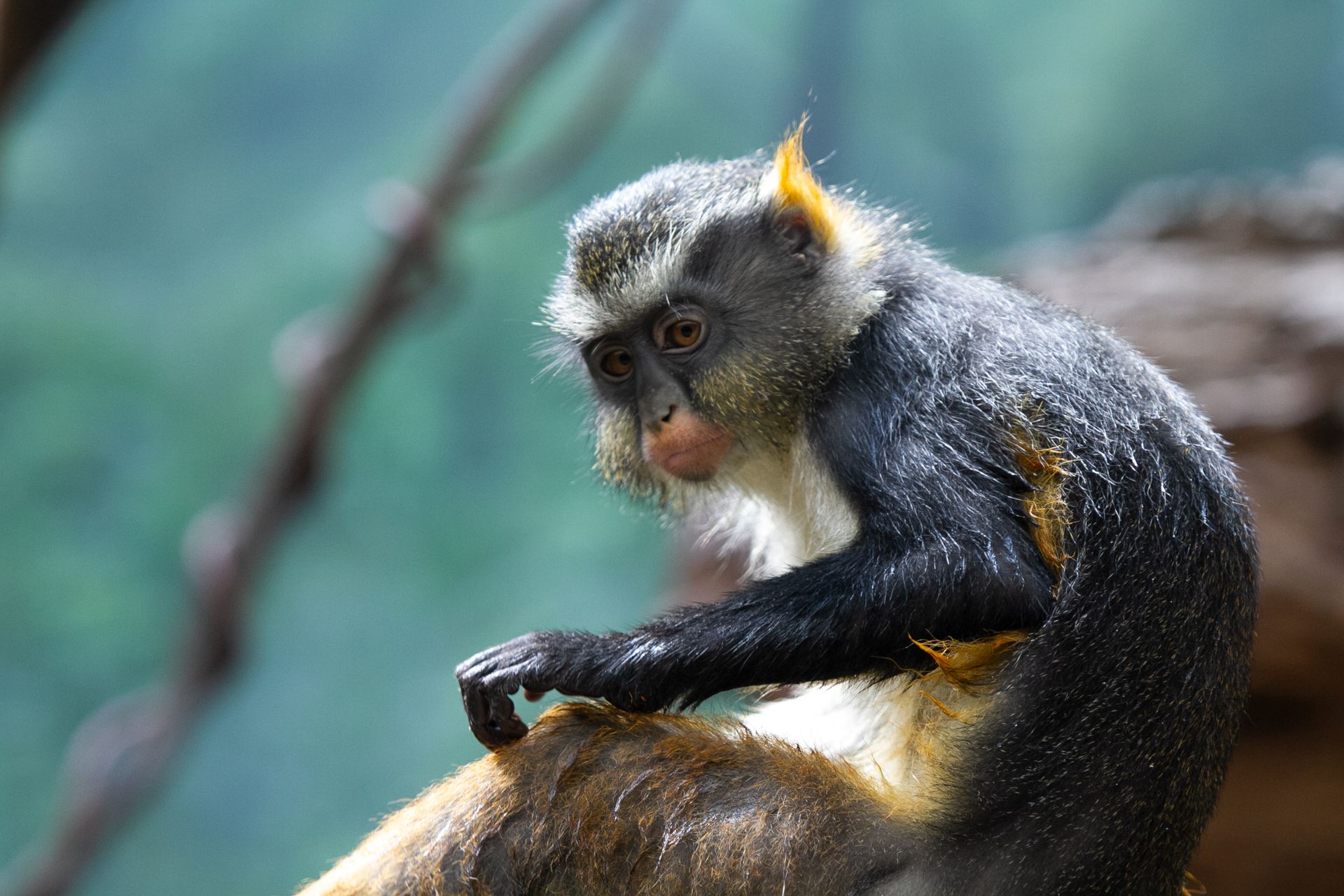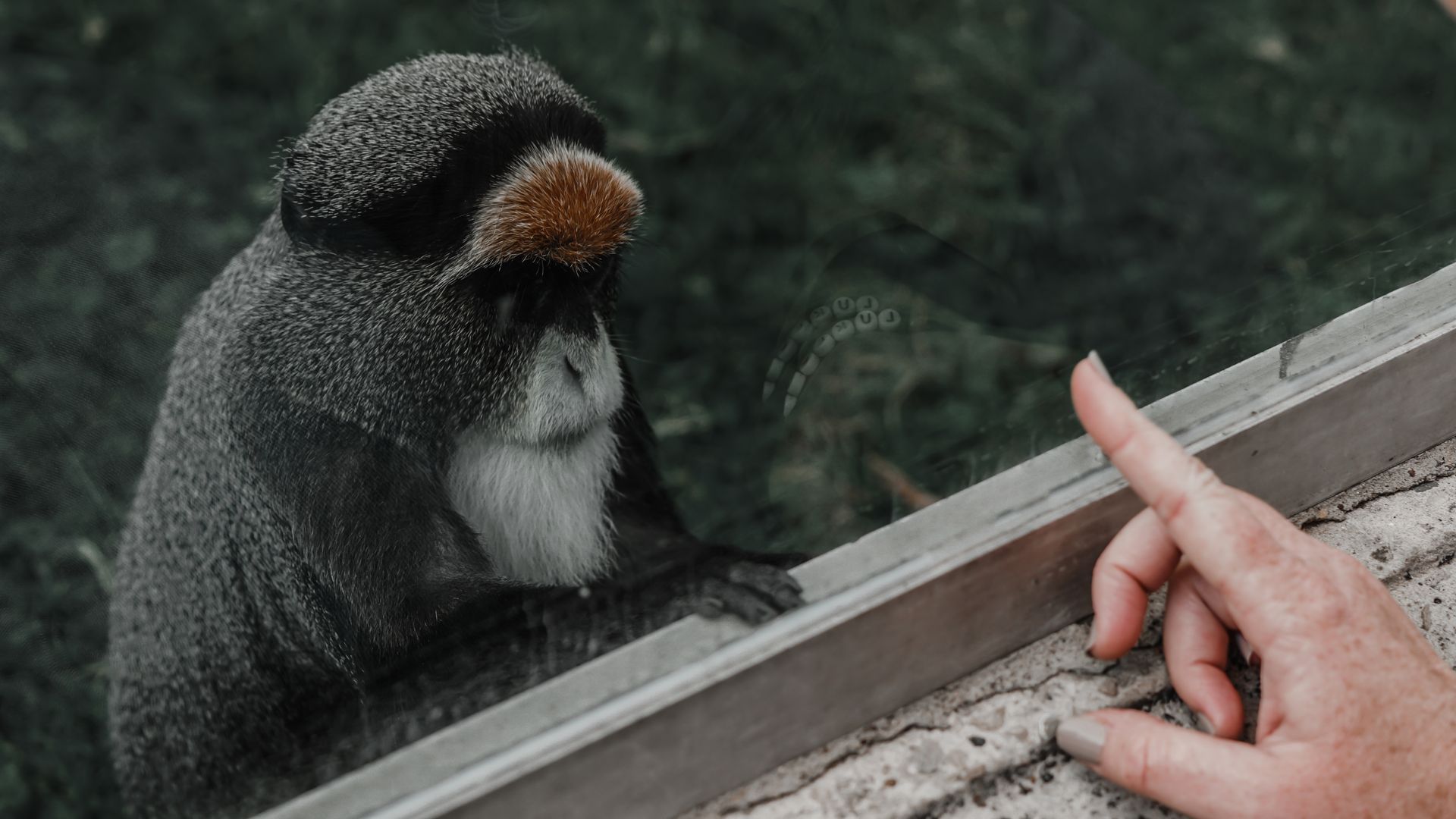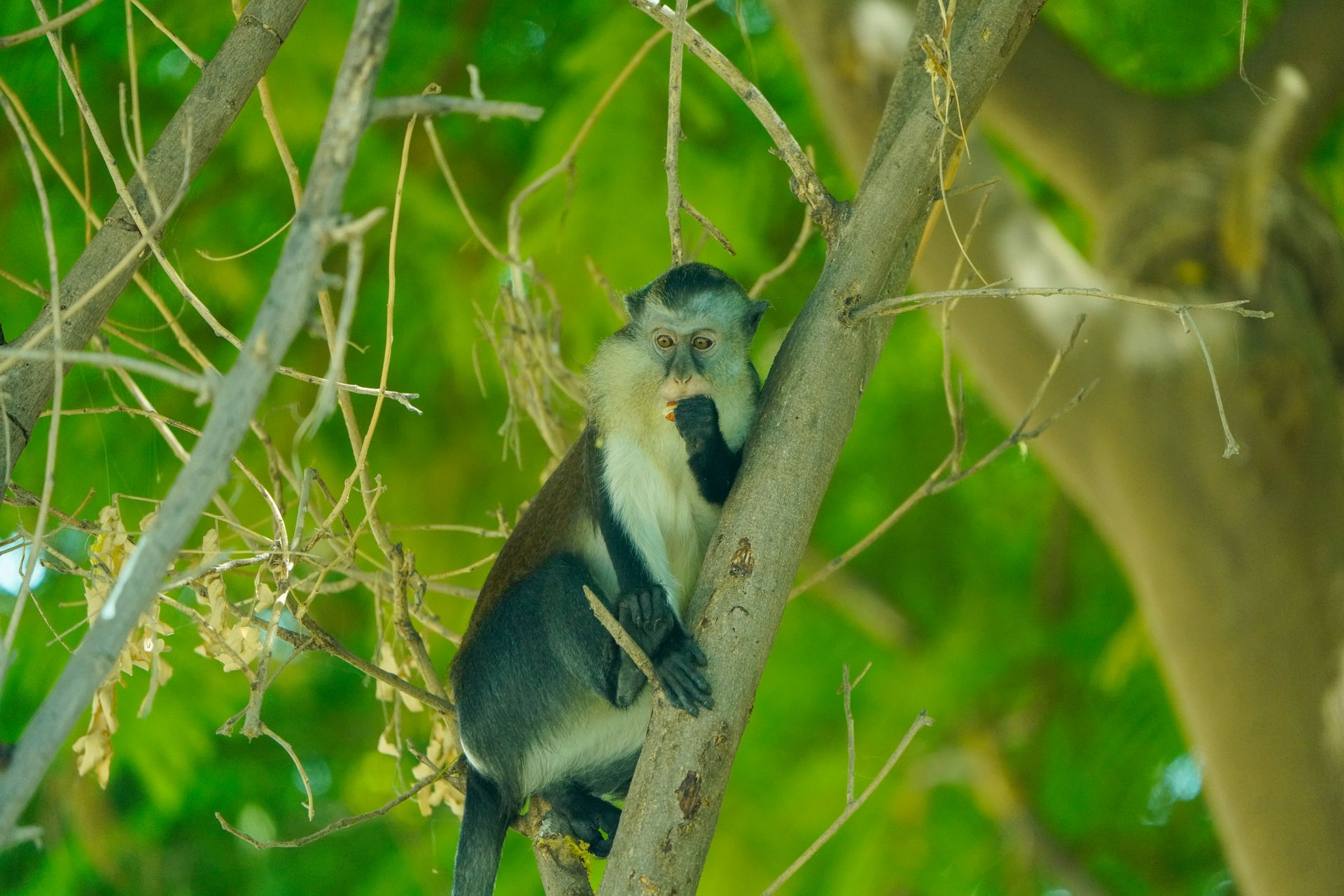
Cercopithecus Ascanius is found in a variety of habitats, including tropical rainforests and savannas.
They are primarily diurnal, spending most of their time foraging for food during the day.
Their diet consists mainly of fruits, leaves, and seeds, with some insects and small animals also consumed.
They are known to be highly social creatures, often living in large groups of up to 30 individuals.
Physical Characteristics
The red-tailed guenon, or cercopithecus ascanius, is a relatively small primate. They have long limbs and an even longer non-prehensile tail that helps with balance when traveling in the trees.
Males reach their adult size around age six, while females reach maturity earlier, between four and five years of age. This means that males and females have different growth rates.
Adult males typically weigh 8.2 pounds and are 18 inches long from the top of their head to the base of their tail. In contrast, females are noticeably smaller, weighing around 6.2 pounds and measuring 15 inches in body length.
Males and females have some physical differences beyond just size. Adult males have a black face, bluish skin around the eyes, a white spot on the nose, and white cheek fur. They also have a chestnut-colored fur on the underside of their tail, which is how they got their name.
Female red-tailed monkeys have similar markings, but with some key differences. They have a brown tail and no cheek whiskers, unlike adult males. As they mature, their markings begin to resemble those of adults.
Here are some key physical characteristics of cercopithecus ascanius:
- Endothermic (meaning they regulate their own body temperature)
- Homoiothermic (meaning they maintain a relatively constant body temperature)
- Bilateral symmetry (meaning their body parts are roughly the same on both sides)
Sexual dimorphism is also present in this species, with males being larger than females. Here are some average measurements:
Geographic Distribution and Habitat
The red-tailed monkey, also known as the black-cheeked white-nosed monkey, is native to central Africa.
Red-tailed monkeys inhabit a vast area, spanning from the Central African Republic to the Congo, with southern Sudan as the northern boundary and northern Zambia as the southern limit.
Take a look at this: Northern Greater Galago
Their home range extends east to Kenya and west to Angola, with populations found in Tanzania and the Central African Republic.
Five recognized subspecies of red-tailed monkeys exist, each with unique markings and occupying different areas within their home range.
These subspecies are generally separated by major rivers in the region.
Red-tailed monkeys are primarily tree-dwellers, with dense populations found in undisturbed Afrotropical forest.
Other populations may live in fragmented forested habitats, open woodlands, or grasslands.
In west Tanzania, groups of red-tailed monkeys occupy open valleys with some tree growth present near rivers.
Red-tailed monkeys are versatile primates, adapting to various habitats with different vegetation, rainfall, and seasonal changes.
Their geographic range extends from 23.5 degrees north to 23.5 degrees south of the equator.
Behavior and Predation
Redtail monkeys, also known as Cercopithecus ascanius, are diurnal and arboreal, meaning they're active during the day and spend most of their time in trees. They're quite agile and active, with their main hours of activity in the early morning and late evening.
These monkeys tend to live in medium-sized groups of 11 to 14 individuals, with one male and a matrilineal group of females. It's not uncommon for several groups to congregate together at food resources or in large trees during resting periods.
Redtail monkeys are social creatures and have been observed exhibiting allomothering, where other females in the group share maternal care with the infant's mother. However, this behavior can sometimes lead to the infant being harmed in a fight for possession.
Their territory size averages around 12,000 square meters, and they're known to travel approximately 1.4 kilometers each day in search of food. Redtail monkeys also have a complex social hierarchy, with dominance hierarchies playing a significant role in their behavior.
Redtail monkeys have several predators, including leopards, crowned hawk-eagles, wild cats, and humans. They may also fall victim to other predators that target small, arboreal primates in African forests, such as snakes and avian predators.
Behavior
Redtail monkeys are quite agile and active, with their main hours of activity in the early morning and late evening. They're also quite social, often found in medium-sized groups of 11 to 14 individuals.
These groups are usually made up of one male and a matrilineal group of females, which is pretty unique. It's not uncommon for several of these troops to congregate together at food resources or in large trees during resting periods.
Redtail monkeys travel approximately 1.4 km each day in search of food, which is a pretty impressive feat. They're also arboreal, meaning they spend most of their time in trees.
One interesting behavior observed in redtail monkey groups is allomothering, where other females in the group help take care of infants. However, this can sometimes lead to conflicts, and unfortunately, infants can get harmed in the process.
Males, on the other hand, tend to disperse from their home range and displace other males in different groups once they reach sexual maturity. This can lead to some pretty dramatic changes in the social dynamics of the group.
Here are some key behaviors observed in redtail monkeys:
- arboreal
- diurnal
- motile
- sedentary
- territorial
- social
- dominance hierarchies
In fact, their territory size is quite small, averaging around 12,000 m^2.
Predation
Red-tailed guenons have a few predators to worry about. Leopards are a common threat, as are crowned hawk-eagles.
These birds of prey are known to attack guenons in the wild. Humans are also a potential predator, unfortunately.
In response to predators, guenons will often try to escape, but they may also exhibit defensive behaviors like bobbing their heads and lashing their tails over their heads.
Some of the known predators of red-tailed guenons include:
- Leopards
- Crowned hawk-eagles
- Humans
Classification and Taxonomy
Classification and taxonomy are crucial in understanding the complex relationships between living organisms. Cercopithecus ascanius, the black-cheeked white-nosed monkey, belongs to the kingdom Animalia.
Within the kingdom Animalia, Cercopithecus ascanius is further classified into the phylum Chordata, which includes animals with a notochord, a dorsal nerve cord, and a post-anal tail. This phylum is characterized by a significant number of species, including chordates.
The class Mammalia is the next level of classification for Cercopithecus ascanius, a group of warm-blooded animals that give birth to live young and produce milk to feed their offspring. This class is divided into several orders, with Primates being one of the most well-known.
Here's a breakdown of the taxonomic hierarchy for Cercopithecus ascanius:
- Kingdom: Animalia
- Phylum: Chordata
- Class: Mammalia
- Order: Primates
- Family: Cercopithecidae
- Genus: Cercopithecus
- Species: Cercopithecus ascanius
Classification
Classification is the process of grouping living things into categories based on their shared characteristics. This helps us understand the relationships between different species and how they're related to one another.
There are many levels of classification, starting from the broadest categories and getting more specific from there. For example, at the top level, we have the kingdom Animalia, which includes all animals. Within this kingdom, we have the phylum Chordata, which includes animals with a backbone, such as humans and animals.
Here's a breakdown of the classification levels for the black-cheeked white-nosed monkey:
Each level of classification gets more specific, helping us understand the unique characteristics of each species. By classifying living things, we can better understand the natural world and how all the different species are connected.
A unique perspective: Squirrel Monkey Species Common Characteristics
Other Common Names
The Red-tailed Guenon has several other names, including Black-cheeked Red-tailed Monkey and Black-nosed Red-tailed Monkey.
These alternative names reflect the diversity of this species and highlight its unique characteristics.
Some of the other common names for this monkey include Katanga Red-tailed Monkey and Schmidt's Red-tailed Monkey.
The Yellow-nosed Red-tailed Monkey is also another name for this species, emphasizing its distinctive yellow-colored nose.
These various names can be found in different scientific and zoological publications, including the International Journal of Primatology.
Conservation Status
Cercopithecus ascanius, also known as the redtail monkey, is a species that's currently listed as Least Concern on the IUCN Red List. However, their future status is uncertain due to the threat of habitat loss by deforestation.
Their habitat is relatively small, and if it's lost, it could be detrimental to the species. Redtail monkeys are also threatened by predation from other animals like chimpanzees, crowned hawk-eagles, wild cats, and even humans.
Farmers often view redtail monkeys as pests and shoot them on sight, which further depletes their populations. This is a significant concern for the conservation of this species.
Here are some key conservation status facts for Cercopithecus ascanius:
- IUCN Red List: Least Concern
- US Federal List: No special status
- CITES: Appendix II
It's essential to address the threats to their habitat and populations to ensure the long-term survival of the redtail monkey.
Frequently Asked Questions
What do red tail monkeys eat?
Red-tailed monkeys primarily eat fruits, and in seasons with limited fruit availability, they also consume leaves, flowers, insects, and tree gum
Featured Images: pexels.com