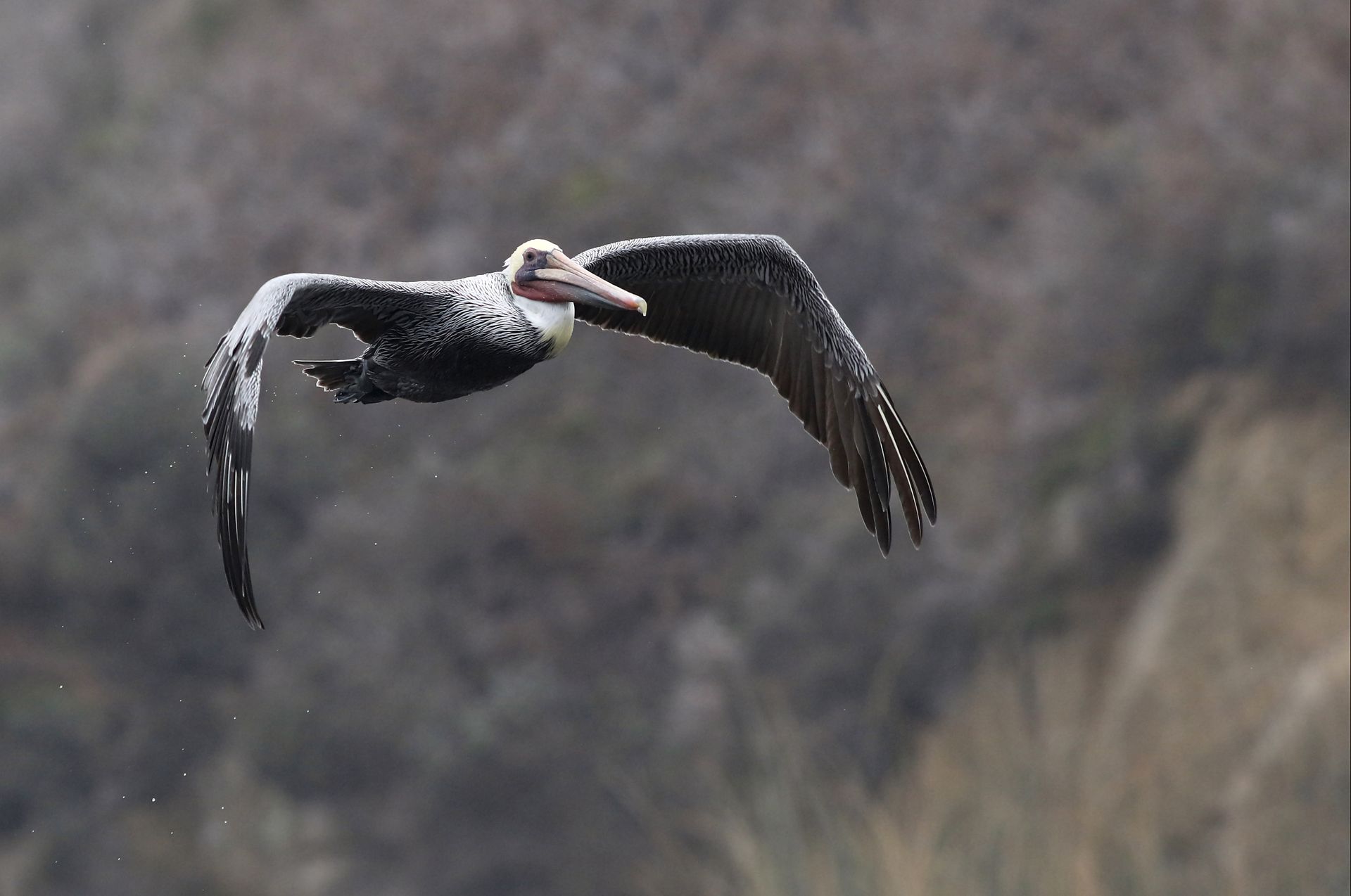
The California Brown Pelican is a majestic bird, and understanding its biology and habitat is essential to appreciating its beauty. This bird can grow up to 50 inches in length.
These birds primarily inhabit coastal areas, and their diet consists mainly of fish, squid, and crustaceans. They are skilled divers, capable of plunging into the water from heights of up to 60 feet.
Their distinctive brown and white coloring helps them blend in with their surroundings, making them expert hunters. They have a wingspan of up to 7.5 feet, which allows them to soar over the ocean with ease.
In the wild, California Brown Pelicans can live up to 20 years, although their average lifespan is around 10-15 years.
Conservation and Threats
The California brown pelican has a long and complex history of conservation and threats. In the 1970s, the species was on the brink of extinction due to the effects of DDT, which caused pelican eggshells to be too fragile to withstand incubation.
Broaden your view: American White Pelican
The banning of DDT in 1972 helped the species recover, and by 2009, the brown pelican was removed from the endangered species list. However, since then, the population has faced new threats, including overfishing of Pacific sardines, a primary food source for brown pelicans.
The lack of food has led to nesting failures and starvation among thousands of California brown pelicans. This is just one of the many environmental challenges facing the species, including coastal development, human disturbance, pollution, and fishing gear entanglement.
Here are some of the key threats facing the California brown pelican:
- Overfishing of Pacific sardines and anchovies, crucial to the pelicans’ diet
- Coastal development and human disturbance causing loss of roosting sites
- Pollution, including oil spills and plastic garbage
- Fishing gear entanglement
It's worth noting that the pelican population tends to follow the El Niño and La Niña sea surface temperature cycles, doing worse with warm El Niño conditions and better with cold La Niña conditions.
Storms May Be to Blame
Storms may be to blame for the struggles of brown pelicans in California. According to Rebecca Duerr, director of Research and veterinary science at International Bird Rescue, early spring storms can limit the bird's ability to find food.

This makes sense, especially since they've tested dead pelicans and ruled out avian flu as a possible cause. In fact, Duerr notes that even the biggest brown pelican can only grab fish about 6 feet deep, making visibility and catchability of fish an issue.
One-third to a half of the starving pelicans arriving at rescue centers were injured, highlighting the risks these birds take when they're nutritionally stressed. A desperate, hungry pelican can get into trouble, as Duerr observed after an odd weather event in 2010, when pelicans were found landing in people's yards and snatching food off of hot barbecue grills.
Here are some facts about brown pelicans and their feeding habits:
- Brown pelicans take more risks in their feeding, such as going after fishing gear, when they're nutritionally stressed.
- They're limited to grabbing fish about 6 feet deep, making visibility and catchability of fish an issue.
Threats and Status
The California brown pelican population has made significant strides in recovery, but it still faces numerous threats. Between 1985-2006, the Anacapa colony produced an average of 770 nests per year, a far cry from the 552 nesting attempts made in 1970, where only one chick survived.
One major threat is overfishing of Pacific sardines, a primary food source for brown pelicans. Since 2009, thousands of California brown pelicans have experienced nesting failures and starvation due to this food scarcity.
In addition to population decline driven by food scarcity, California brown pelicans face a multitude of other threats, including coastal development and human disturbance that causes loss of roosting sites, pollution, and fishing gear entanglement. The annual population growth rate from 1999 onward is estimated to be ~2%, but the trend line explains so little of the year-to-year variation (< 5%) in number of nest attempts that the population is best classified as stable with fluctuations.
Pelicans are also vulnerable to oil spills from offshore drilling, which reduces the waterproofing capacity of their feathers, causing them to drown. And, unfortunately, plastic garbage is a major threat, as birds often mistake plastic pieces for food and die of starvation when their stomachs become filled with garbage.
Here are some key statistics on the threats facing California brown pelicans:
- Overfishing of Pacific sardines has led to nesting failures and starvation in thousands of pelicans since 2009.
- Coastal development and human disturbance cause loss of roosting sites, pollution, and fishing gear entanglement.
- Oil spills from offshore drilling can cause pelicans to drown.
- Plastic garbage is mistaken for food, leading to starvation in pelicans.
Pelican Biology
The California brown pelican is a large waterbird with a distinctive pouched bill.
They can grow up to 50 inches in length and weigh up to 9 pounds.
These birds are known for their impressive wingspans, which can reach up to 7.5 feet.
Their distinctive brown and white feathers help them blend in with their coastal surroundings.
Morphology
The California brown pelican is a large seabird with a distinctive appearance. Its wingspan is about 2 meters.
These impressive birds have a unique way of feeding, plunging-dive from high up to catch fish. They can dive to great depths and angles, which affects their capture rate.
One of the most prominent features of the brown pelican is its long, dark bill with a large gular pouch. This pouch is expandable and acts like a fishing net, allowing the pelican to scoop up fish along with water during feeding.
The pelican's bill also has thin slits for nares along the ridges near the eyes, which allow the pressure within the sinuses to equalize. This is important for the pelican's survival.
The brown pelican's skin is also noteworthy, bearing a striking resemblance to internal bubble wrap. It's filled with scores of small air pockets that provide buoyancy, making the pelican larger in dimensions than you might expect from its weight.
Feeding Behavior
Pelicans are unique feeders because they're the only pelicans that can plunge-dive for their food.
They dive from as high as 70 feet, hitting the water with such force that it stuns their prey and gives them time to scoop it up with their bills. Their air sacs help them manage the shock from the collision.
They're capable of carrying three gallons of fish and water, which is the largest pouch of any bird in the world.
Pelicans can eat up to four pounds of fish per day, which is a lot of fish! Their diet consists of menhaden, smelt, anchovies, mackerel, sardines, and some crustaceans.
During the mating season in California, most of their diet consists of northern anchovy.
Check this out: California Kingsnake Diet
Mating and Nesting
Pelican mating and nesting habits are quite fascinating. The breeding season typically begins in March and extends through late summer.
The male pelican takes the lead in finding a suitable nesting site and performing an aerial dance to catch the eye of a potential mate. Once a female shows interest, they work together to build a nest.
The male pelican is responsible for scouting out sticks and bringing them to the nest site, while the female does most of the construction. On Santa Barbara and Anacapa Islands, brown pelicans often nest on inaccessible slopes, canyons, and high bluff tops and edges.
A normal clutch size for brown pelicans is three eggs, and both males and females share incubation duties. This shared responsibility is crucial for the success of their breeding.
Breeding success is highly dependent on the availability of their main food source: northern anchovies and Pacific sardines. If this supply rapidly declines, the parents may abandon their nest.
After hatching, the chicks are completely dependent on their parents for food and care, and they remain this way for about 3-4 weeks. During this time, the male and female pelicans take turns leaving the nest to catch fish and feed their chicks.
Worth a look: Female American Bald Eagle
Habitat and Ecology
California brown pelicans are found on the Atlantic and Pacific coasts of North and South America in nearshore and estuarine habitats. They prefer islands because of the lack of predators and human inhabitants.
They require dry land to maintain their plumage, so they seldom venture more than 30 kilometers from the coast. This allows them to stay close to their preferred nesting locations on islands.
These birds are social and often seen flying in formation or resting in large groups. They breed in colonies, which can consist of hundreds of pairs, and communicate through visual displays and vocalizations.
Habitat and Range
Brown pelicans are found on the Atlantic and Pacific coasts of North and South America in nearshore and estuarine habitats.
They require dry land to maintain their plumage, so they seldom venture more than 30 kilometers from the coast.
Their preferred nesting locations are on islands, which is why you'll find breeding colonies of California brown pelicans on the Channel Islands National Park on Anacapa and Santa Barbara Islands.
They roost on a variety of surfaces, including islands, nearshore rocks, cliffs, piers, jetties, sandy beaches, and mudflats.
Some traditional communal roosts support several thousand birds each night during the migratory period.
Ecology
Pelicans are social birds, often seen flying in formation or resting in large groups.
They breed in colonies, which can consist of hundreds of pairs, and communicate within colonies through visual displays and vocalizations.
Each bird in the V formation flies slightly above the bird in front of it, reducing wind resistance and allowing the trailing birds to take advantage of the upwash created by the wings of the bird ahead.
Birds flying in a V formation have lower heart rates compared to those flying alone, making it a highly efficient way to conserve energy.
By reducing the energy demands of flight through gliding and V-formation flying, pelicans are able to increase the distance they can travel to find food.
General Information
The Brown Pelican is a magnificent seabird found along the Pacific Coast. They can be identified by their distinctive pouched bills.
These birds are carefully monitored to record their recovery. Every year, Brown Pelican populations from over 150 sites from Washington to Baja California are surveyed.
In 2018, a total of 20682 Brown Pelicans were counted along the Pacific Coast in September. This is a testament to their successful conservation efforts.
To learn more about the survey results, you can visit the California Audubon Society's website. The next survey has been scheduled for September 12, 2020.
The health of our coastal ecosystems is closely tied to the Brown Pelican's survival. They rely on healthy fish populations for survival and reproduction.
Frequently Asked Questions
What colors are California brown pelicans?
California brown pelicans have a distinctive gray-brown and yellow coloration, with a white neck and rich reddish-brown plumage during breeding season. Immature birds have a paler gray-brown coat with a whitish belly and breast.
How can you tell if a Brown Pelican is male or female?
Brown Pelicans have similar male and female appearances, but males are slightly larger than females.
Featured Images: pexels.com