The Brahminy Blind Snake is a fascinating creature that's worth getting to know. It belongs to the family Leptotyphlopidae.
These snakes are found in Southeast Asia, specifically in countries like India, Sri Lanka, and Bangladesh. They inhabit a variety of habitats, including forests, grasslands, and even urban areas.
Brahminy Blind Snakes are relatively small, typically growing up to 20 centimeters in length. They have a slender body and a pointed snout.
Physical Description:
The Brahminy Blind Snake's physical description is quite fascinating.
These snakes are small, typically ranging from 15 cm to 25 cm (approximately 6 to 10 inches) in length, although some individuals can reach up to 35 cm (about 14 inches).
Their coloration is a key adaptation for burrowing, helping them blend into the soil and leaf litter. They have a shiny, smooth body that is typically dark brown, dark purple, or black, with lighter markings or a slightly lighter underside.
Their head is small and blunt, with tiny, vestigial eyes that are mostly covered by scales. The eyes are barely functional, and the snake relies more on vibrations and smell to navigate.
The tail is short and tapering, and the snake often burrows with its tail directed backward as it moves through soil.
Here's a summary of their physical characteristics:
- Size: 15-35 cm (6-14 inches) in length
- Coloration: Dark brown, dark purple, or black with lighter markings
- Head: Small and blunt with tiny vestigial eyes
- Tail: Short and tapering
- Scales: Smooth and shiny
Classification and Names
The brahminy blind snake has several names that are used to refer to it. One of these names is the brahminy blind snake.
It's also known as the flowerpot snake, which is a nod to its accidental introduction to various parts of the world through the plant trade. This is a clever way to describe its origins.
In some regions, the snake is referred to as the common blind snake or the island blind snake. These names are straightforward and easy to understand.
The moniker "Kurudi" is the common Malayalam term used to refer to I. braminus.
Habitat and Distribution:
The brahminy blind snake is a fascinating creature that can be found in a wide range of habitats, from urban areas to tropical forests. They are excellent burrowers and can thrive in loose soil and leaf litter.
These snakes are often found in areas with moist soil, such as garden beds, agricultural fields, and decaying leaf litter. They can also be present in urban gardens, where they have access to moist soil and decaying organic matter.
The brahminy blind snake is primarily found in lowland and foothill areas, where loose, moist soil provides ideal conditions for burrowing. They can also be found in areas with decaying wood, such as rotting logs and sawdust piles.
Here are some specific locations where the brahminy blind snake has been reported:
- India, Sri Lanka, and parts of Southeast Asia
- Uganda, DRC, Egypt, Kenya, Senegal, Benin, Togo, Nigeria, Ivory Coast, Cameroon, Zambia, Zimbabwe, Somalia, Zanzibar, Tanzania, Mozambique, South Africa, Madagascar, the Comoro Islands, Mauritius, the Mascarene Islands, and the Seychelles
- Mainland India, the Andaman Islands, the Nicobar Islands, the Lakshadweep Islands, the Maldives, Sri Lanka, Bangladesh, Myanmar, Singapore, the Malay Peninsula, Thailand, Cambodia, Vietnam, Laos, southern China, Hong Kong, Taiwan, and Japan
- Sumatra and nearby islands, Borneo, Sulawesi, the Philippines, Java, Bali, Flores, East Timor, the Kai Islands, the Aru Islands, New Guinea, New Britain, and Bougainville Island
- Papua New Guinea, Palau, Guam, Fiji, Saipan, the Hawaiian Islands, and Tahiti in French Polynesia
- The United States (California, Connecticut, Florida, Georgia, Louisiana, Massachusetts, Arizona, Hawaii, and Texas), western and southern Mexico, Guatemala, Belize, Colombia, Barbados, the Cayman Islands, the Turks and Caicos Islands, and the Okanagan in B.C., Canada
The brahminy blind snake spends most of its time buried in the ground or in rotting wood, only emerging occasionally to find mates or to forage.
Behavior and Diet
The brahminy blind snake is a unique creature with some fascinating habits. It loves to eat the eggs of ants and termites.
Its diet consists of the larvae and pupae of these insects as well. It's a specialized eater, sticking to what it knows best.
In the wild, you can find brahminy blind snakes snacking on their favorite foods, often in areas where ants and termites are abundant.
Diet and Feeding Behavior
Brahminy blindsnakes are carnivores and feed on the eggs, larvae, and pupae of ants and termites.
They have a specialized diet that consists mainly of the eggs, larvae, and pupae of ants and termites.
In the wild, they can be found in the Upper Florida Keys, Middle Florida Keys, and Lower Florida Keys, where they hunt for their prey.
Their diet is rich in protein, which is essential for their growth and development.
Brahminy blindsnakes love to eat the eggs, larvae, and pupae of ants and termites, which are abundant in their natural habitats.
This unique diet allows them to thrive in their environments, where they play an important role in controlling insect populations.
On a similar theme: Florida Snakes List
Earthworm-Snake
The Brahminy blind snake is a master of disguise, looking and acting like an earthworm, but it's actually a reptile and a true snake.
It lives a life of burrowing, spending most of its time secreted away in cramped hiding spots.
This snake is rarely seen, despite being one of the most widespread snake species in the world.
As it surfaces from the soil, it gradually reveals its length, starting at 5 centimeters, then 10 cm, and finally 15 cm.
Some Brahminy blind snakes may grow up to 20 cm long, but 15 cm is usually the upper range of their size.
Comparison and Defensive Behavior
The brahminy blind snake is a master of defense, and it's not just because of its intimidating appearance.
This snake will vibrate its tail to mimic the movements of a larger, more venomous snake, a behavior known as "startle display".
This defense mechanism is often enough to scare off potential predators, but it's not the only trick up the brahminy blind snake's sleeve.
Comparison with Other Species
When it's easy to get confused about what species you're looking at, it's worth taking a closer look. Brahminy Blindsnakes are often mistaken for earthworms due to their shiny appearance.
One key difference is that earthworms are segmented, meaning they have rings around their bodies. Brahminy Blindsnakes, on the other hand, are not segmented.
If you hold a Brahminy Blindsnake, you can see their tiny tongues sticking out of their heads. This is a dead giveaway that it's not an earthworm.
Defensive Behavior
Brahminy Blindsnakes have a unique defensive strategy. They don't bite in defense, which is a relief for anyone who's had the chance to encounter one.
If you were to uncover a Brahminy Blindsnake, it would likely try to escape by burrowing underground. This behavior is a clear attempt to get away from potential threats.
When captured, Brahminy Blindsnakes may press the pointed tip of their tail against the attacker. This is a defensive mechanism, but it's worth noting that the tail tip is harmless.
They may also release foul-smelling musk from glands located at the base of their tail. This unpleasant odor is a last resort for the snake, and it's meant to deter predators.
You might enjoy: Red Tail Boa Constrictor Snake
Conservation and Interesting Facts
The brahminy blind snake is an incredibly unique species.
One of the most interesting facts about the brahminy blind snake is that it's a fossorial snake, meaning it spends most of its time underground.
Its burrowing behavior is likely an adaptation to its environment, as the brahminy blind snake is found in areas with loose soil and sand.
These snakes are also expert navigators, able to move through tight spaces and navigate complex networks of tunnels and burrows.
Conservation Status:
The Brahminy Blind Snake is not listed as threatened or endangered, and there is currently no immediate conservation concern for the species. It's relatively abundant in areas with suitable habitat, such as moist soils and gardens.
Habitat destruction, particularly due to urbanization, deforestation, and agricultural expansion, could impact the snake's populations. This is a concern, as changes in soil composition or moisture levels may disrupt its burrowing behavior.
Preserving the snake's natural habitats, including moist soils and forest ecosystems, will help maintain healthy populations. This is a crucial step in ensuring the long-term survival of the species.
Check this out: Eastern Hognose Snake Habitat
Here are some conservation-friendly actions you can take:
- Plant native vegetation in your garden to create a suitable habitat for the Brahminy Blind Snake.
- Reduce your carbon footprint by using public transport, carpooling, or driving electric or hybrid vehicles.
- Support organizations that work to preserve and protect natural habitats.
By taking these steps, you can contribute to the conservation of the Brahminy Blind Snake and its habitats. Every small action counts, and collective efforts can make a significant difference.
Interesting Facts:
The Brahminy Blind Snake is a fascinating creature, and I'm excited to share some interesting facts about it. It's often referred to as "blind", but it has small, vestigial eyes that are practically non-functional.
These snakes rely much more on their sense of smell and vibrations to navigate, making them expert burrowers. They spend most of their lives underground, where they are rarely seen.
The Brahminy Blind Snake is non-venomous and harmless to humans, but its primary defense mechanism is its ability to hide in the soil. This is no surprise, given its fossorial life and burrowing abilities.
The Typhlopidae family, to which the Brahminy Blind Snake belongs, contains many species of burrowing snakes, all with similar traits such as small or vestigial eyes and fossorial behavior. This diversity is a testament to the adaptability of these snakes.
Related reading: List of Non Venomous Snakes
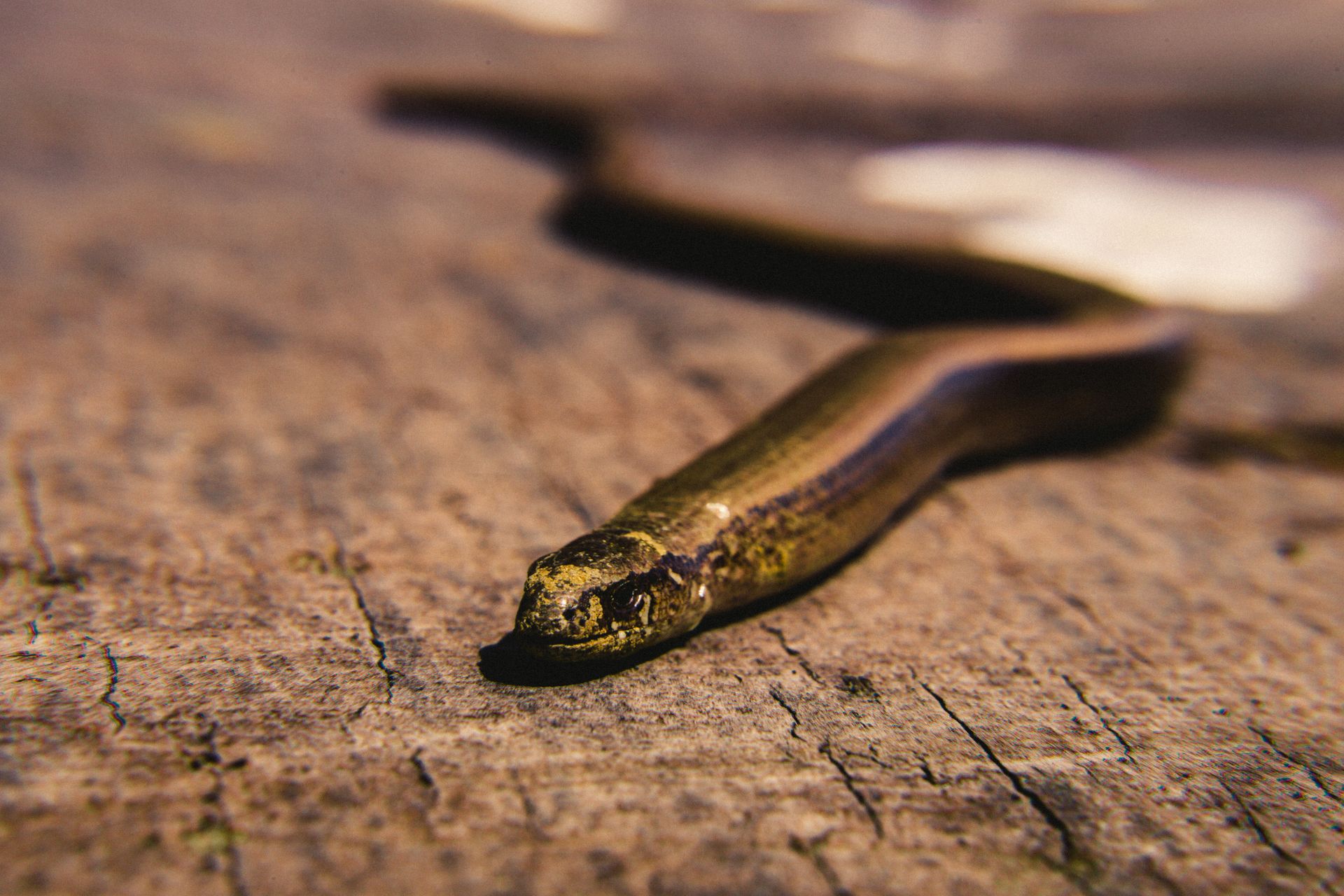
Here are some key facts about the Brahminy Blind Snake's physical characteristics:
- Typically ranges between 15 cm to 25 cm in length, with some individuals reaching up to 35 cm.
- Dark brown or black body, often with a shiny, smooth appearance and lighter ventral side.
- Small, blunt head with vestigial eyes covered by scales.
Location and Overview
The Brahminy Blind Snake is a fascinating creature that's often found in areas with loose, moist soils.
They're commonly found in gardens, forests, and agricultural areas, which is why you might stumble upon one in your backyard or a nearby field.
These snakes are burrowing, fossorial, and non-venomous, spending much of their time underground where it's cool and damp.
Related reading: Can Snakes Be Found on Every Continent
Location
The location of this place is quite unique. It's situated in a valley surrounded by mountains, making it a breathtakingly beautiful spot.
The elevation here is around 2,500 feet above sea level, which can sometimes lead to unpredictable weather conditions. This is especially true during the spring months when sudden rain showers are common.
The terrain is mostly made up of rugged hills and rocky outcroppings, which can make hiking and exploring a bit challenging. But the scenery is so stunning that it's well worth the effort.
The nearby town is a charming little place with a rich history and culture. It's a great place to visit and experience the local way of life.
The climate here is mild and temperate, with warm summers and cool winters. This makes it an ideal spot for outdoor activities like hiking and camping.
Overview:
The Brahminy Blind Snake is part of the family Typhlopidae, a group of snakes commonly referred to as blind snakes due to their underdeveloped eyes.
These snakes are burrowing, fossorial, and non-venomous, spending much of their time underground.
They are commonly found in areas with loose, moist soils, including gardens, forests, and agricultural areas.
Despite their name, they are not entirely "blind" but have very small, poorly developed eyes that offer limited vision.
Frequently Asked Questions
What to do if you find a Brahminy Blindsnake?
If you find a Brahminy Blindsnake, take clear photos and consider keeping it, as it may be of interest to scientists for identification and study. Keeping the snake may help confirm its species and contribute to conservation efforts.
How rare is a blind snake?
Some species of Blind Snakes are endangered, including the critically endangered Madagascar Blind Snake, highlighting their vulnerability. Habitat destruction and human activities pose significant threats to these rare species.
Are all Brahminy blind snakes female?
Yes, all Brahminy blind snakes are female, reproducing asexually through a unique process called parthenogenic thelytoky. This means they can produce offspring without a male, resulting in genetic clones of the mother.
Are Brahminy blind snakes good pets?
Brahminy blind snakes can make unusual and low-maintenance pets, but their care may be quite uneventful. They can thrive on a diet of live insects, making them a unique choice for reptile enthusiasts.
Is Brahminy Blindsnake poisonous?
No, Brahminy Blindsnakes are non-venomous and harmless to humans and pets. They are actually insectivores that feed on ant and termite larvae, eggs, and pupae.
Featured Images: pexels.com