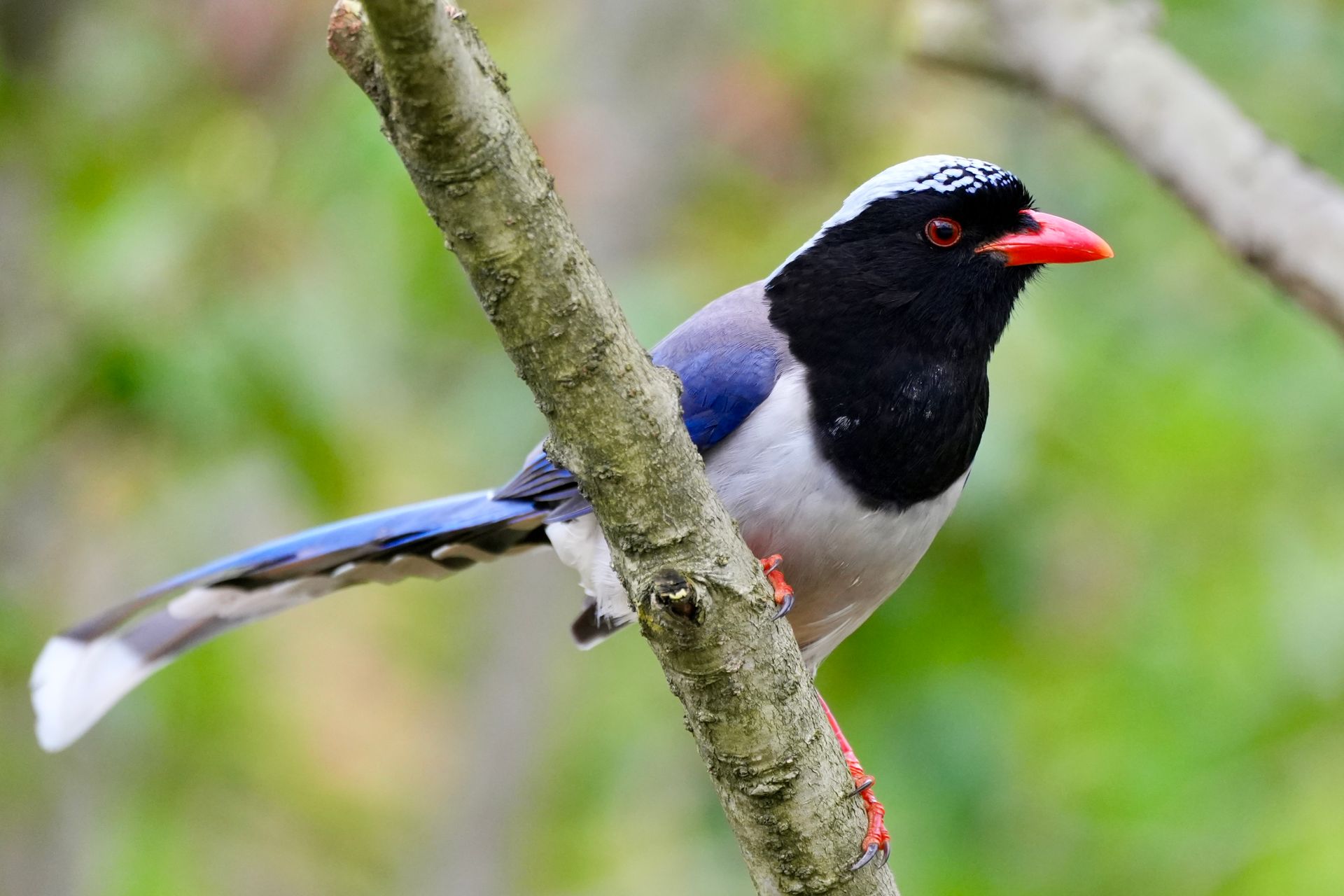
The black-billed magpie is a striking bird with a distinctive black bill and a long, flowing tail. Its sleek black and white feathers make it a common sight in western North America.
These birds are known for their intelligence, often using tools to obtain food. They've been observed using sticks to dig up grubs and other insects from tree bark.
Their social behavior is also notable, often gathering in large flocks during the winter months.
Taxonomy and Systematics
The black-billed magpie was originally described in 1823 as Corvus Hudsonius by Joseph Sabine.
The species was previously considered conspecific with the Eurasian magpie, but mtDNA studies revealed a relatively high divergence between the two species.
The generic name Pica is the Latin word for magpie, and the specific name hudsonia is in honour of the English explorer Henry Hudson.
The scientific name Pica pica was used for the species consisting of the black-billed and Eurasian magpies until it was recognized as a separate species in 2000.
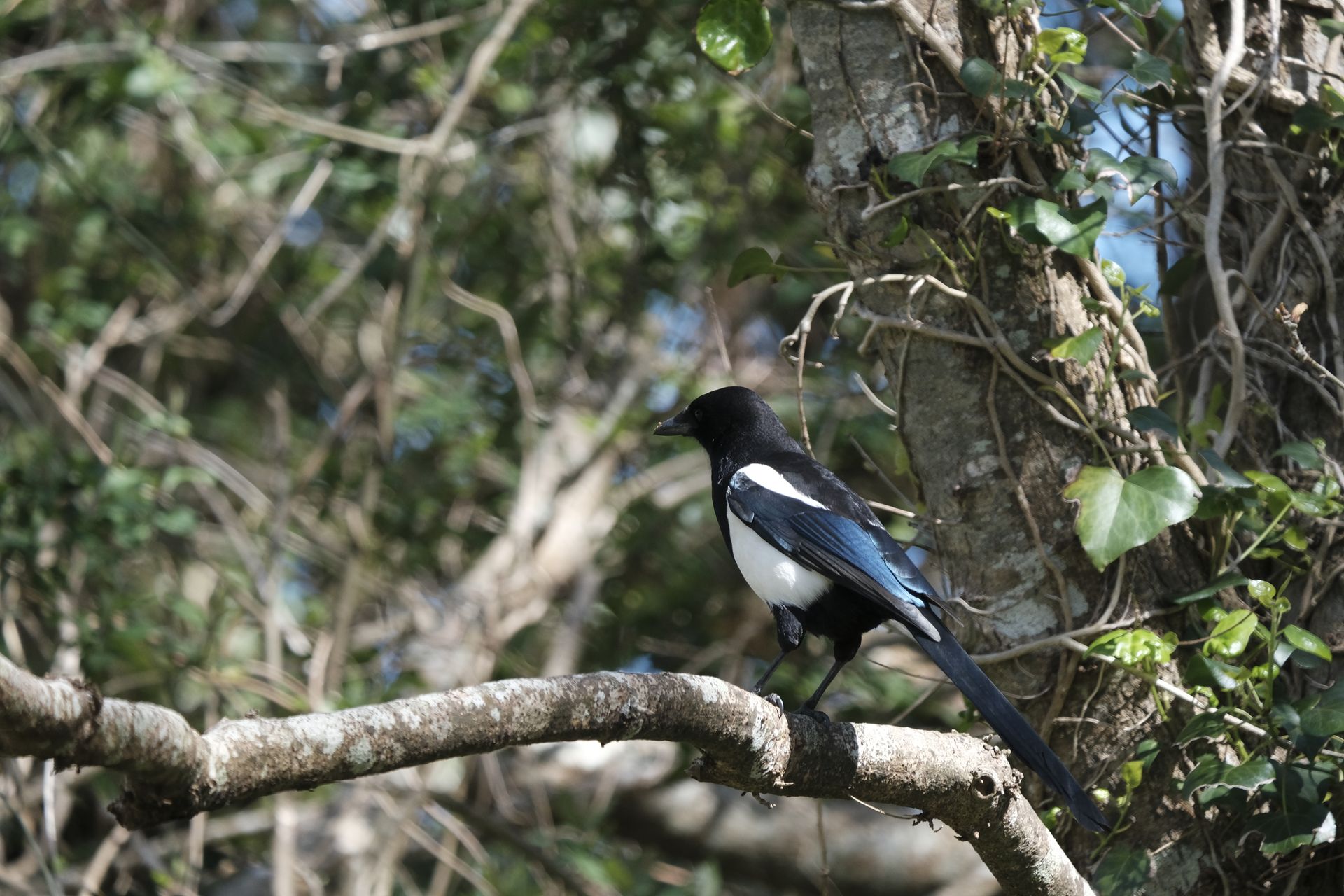
The American Ornithologists' Union recognized the black-billed magpie as a separate species, Pica hudsonia, in 2000.
Fossil evidence suggests that the ancestral North American magpie arrived in its current range around the mid-Pliocene, approximately 3–4 mya, having crossed the Bering land bridge.
The Eurasian and North American populations began to differentiate from there, with the yellow-billed magpie lineage likely splitting off soon after due to the Sierra Nevada uplift and the beginning of an ice age.
Discover more: Black American Staffordshire
Physical Characteristics
The black-billed magpie is a medium-sized bird, measuring between 45 to 60 cm in length.
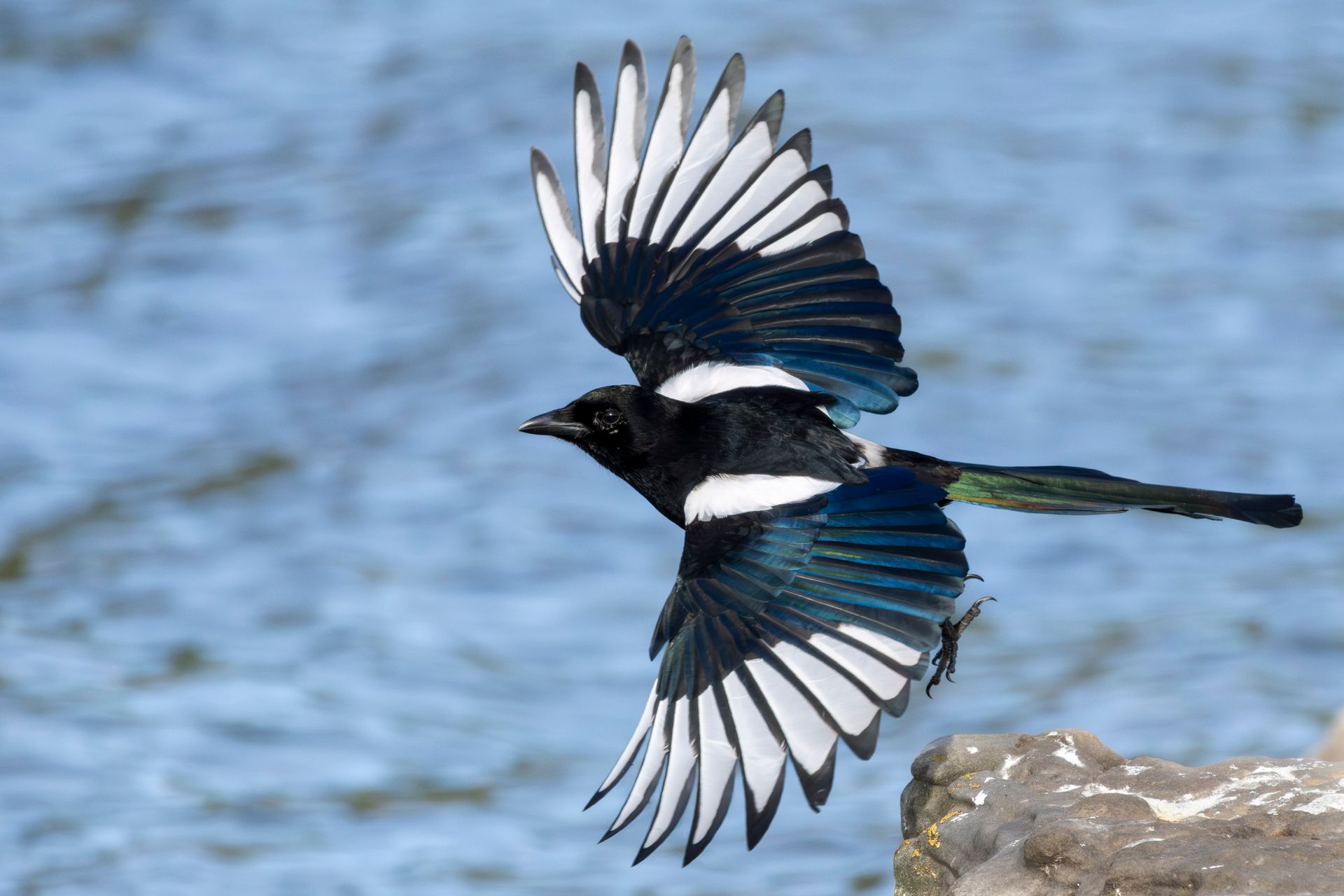
Their wingspan is quite impressive, ranging from 56 to 61 cm. This allows them to fly with a surprisingly graceful ease, despite their wings appearing too short at times.
Females are slightly smaller than males, weighing about 10% less. However, their feathers are the same color as the males.
Here are some key physical characteristics of the black-billed magpie:
- Range mass: 145 to 210 g (5.11 to 7.40 oz)
- Range length: 45 to 60 cm (17.72 to 23.62 in)
- Range wingspan: 56 to 61 cm (22.05 to 24.02 in)
Their black-billed magpie is easily distinguishable from its yellow-billed relative found in California, thanks to its distinctive black bill.
Behavior and Habitat
Black-billed Magpies are intelligent and resourceful birds that thrive in open country with large shrubs or trees for nesting. They're especially suited to areas with cottonwood or willows, streams, farmland, wetlands, and orchards.
In winter, they roost in streamside groves of trees or lowland conifers, often forming large, noisy groups of over 700 birds. They're known to be bold, but can become wary in areas where they've been harassed.
Here are some key behaviors and habitats of Black-billed Magpies:
- They live among meadows, grasslands, and sagebrush plains of the West.
- They like open areas and are not found in dense woods.
- They stay close to cover for protection from raptors.
- They're social birds that live in family flocks made up of 6 to 10 birds.
- They're diurnal, meaning they're active during the day.
- They're sedentary, meaning they stay in one place for long periods.
- They're colonial, meaning they live in large groups.
How Do They Behave?
Black-billed Magpies are intelligent and resourceful birds that form large, noisy roosts in winter, sometimes numbering over 700 birds. They are known to be bold, but in areas where they have been harassed, they become quite wary.
On the wing, Black-billed Magpies make long, sweeping flights with white flashes of their wing patches and long, trailing tails. They perch at the tops of trees, which is a means of visually establishing their territory.
In groups, males establish dominance through a stretch display: raising the bill in the air and flashing their white eyelids. They also show aggression with their wings, flickering or quivering them to display the white wing patches.
Black-billed Magpies walk with a swaggering strut and often hop before flying. They fly with slow, steady wing beats and return to the ground by alternating short wing flaps with pauses where they tuck their wings into their body.
Black-billed Magpies are social birds that live in family flocks made up of 6 to 10 birds. Outside of the breeding time, they make groups that can have several hundred birds.
In cold weather, they spend time in pine trees to get away from the wind and from predators. They are more likely to nest together when there's lots of food around.
Here are some key behaviors of Black-billed Magpies:
- Arboreal
- Flies
- Diurnal
- Motile
- Sedentary
- Social
- Colonial
Range and Habitat
Black-billed magpies are found throughout western North America, from northwestern Alaska to northern Arizona, New Mexico, and western Texas.
They live in a variety of habitats, including grasslands, woodlands, shrublands, wetlands, deserts, and savannas. They often end up at the edge of different habitats or alongside a river or lake.
These birds are perfectly comfortable around human development, particularly when easy meals are nearby. They can be spotted on the uppermost branches of trees or perched on fenceposts.
Some groups of black-billed magpies move several hundred kilometers after breeding and in the winter. They don't migrate between summer and winter locations, but do make seasonal movements.
Their nesting territories often follow stream courses, and they prefer being close to shelter belts or other forms of cover to escape predators.
Here are some of the types of habitats where black-billed magpies can be found:
- Temperate
- Terrestrial
- Savanna or grassland
- Forest
They need large shrubs or trees for nesting and are especially suited to areas with cottonwood or willows, streams, farmland, wetlands, and orchards.
Vocalizations
The black-billed magpie's vocalizations are a fascinating topic.
Their calls can be described as tweets, coos, purrs, shrills, and squawks, but the most common is an alarm call, called a chatter, that sounds like ka-ka-ka-ka, sometimes preceded with a skah-skah.
This call is very different from that of the Eurasian magpie and is similar to that of the yellow-billed magpie.
Black-billed magpies are known to be very smart birds, and one of them, living with humans, has learned to imitate human speech.
In the wild, they use two different kinds of alarm calls: a basic alarm and a staccato alarm.
Magpie Diet
Black-billed magpies are ultimate omnivores, which means they eat a wide variety of foods including both plants and animals. They'll visit platform feeders for suet, eat fruit and mealworms, and even visit trash cans if they're not secured.
In the warm months, magpies love to snack on grasshoppers and other insects, and have even been known to pick ticks off the backs of deer or livestock. They're also skilled hunters, taking down small mammals, frogs, and young birds.
If you have a magpie in your neighborhood, you'll want to keep the lid on your trash cans - they'll use them as personal feeders if given the chance. Magpies will also dig in the ground or snow to store food for later.
Here's a breakdown of what magpies typically eat:
- Primary Diet: Omnivore
- Animal Foods:
- Birds
- Mammals
- Eggs
- Carrion
- Insects
- Terrestrial non-insect arthropods
- Plant Foods:
- Seeds, grains, and nuts
- Fruit
Breeding and Nesting
Black-billed Magpies are monogamous and form long-term pair bonds, often staying with their partner for life.
They form pairs in the fall or winter within wintering flocks and nest in small, loose colonies. However, this may be more a factor of the distribution of trees for nesting rather than true colonialism.
Both sexes help build a huge nest in the branches of a deciduous tree, with the male gathering sticks for the exterior and the female forming a mud cup and lining it with grass.
The nest is used in succeeding years by many other species, such as owls, and is typically about 30 inches high and 20 inches wide.
The female lays up to 9 eggs, but the typical clutch ranges from 6-7 eggs, which she incubates for about 18 days while the male brings food.
The young leave the nest at 3-4 weeks and join with 2-8 other broods, where the parents feed their own fledglings for another 3-4 weeks.
Distribution and Conservation
The black-billed magpie has a wide range, spanning from coastal southern Alaska to the Rocky Mountain states, including New Mexico, Colorado, Utah, Wyoming, Idaho, and some bordering states. They can also be found in northern Minnesota and Iowa, with casual records in northern Wisconsin and upper Michigan.
In the United States, black-billed magpies are protected under the Migratory Bird Treaty Act, but a federal permit is not required to control them if they're causing damage to crops or livestock. State or local regulations may limit or prohibit killing these birds as well.
The black-billed magpie population is estimated to be between 500,000 and 5,000,000 adults, making it a species of least concern according to the International Union for Conservation of Nature. They are also found in Canada, where they do not appear on the list of birds protected by the Migratory Birds Convention Act, but provincial laws may apply.
Home Range
Black-billed magpies have a relatively small territory, usually about 0.3 hectares in size, which they defend during the breeding season.
Their home range is typically found in riparian areas with thickets, where they can easily find food and shelter.
In these areas, magpies are perfectly comfortable around human development, particularly when easy meals are nearby.
They often spot magpies on the uppermost branches of trees or perched on fenceposts, taking advantage of shelter belts or other forms of cover to escape predators.
In fact, magpies are known to thrive in meadows and suburbs, where they can easily find food and avoid predators.
Their adaptability to human development is likely due to the availability of easy meals, such as pet food, which makes it easy for them to survive in these areas.
Conservation Status
Black-billed magpies are rated as a species of least concern by the International Union for Conservation of Nature, thanks to their wide range and stable population.
The population of black-billed magpies is estimated to be between 500,000 and 5,000,000 adults in Canada, according to the Government of Canada as of 2015.
In the United States, black-billed magpies are protected under the Migratory Bird Treaty Act, but they can be controlled if found committing depredations on agricultural crops, livestock, or wildlife.
However, in Canada, black-billed magpies are not protected by the Migratory Birds Convention Act, and provincial laws may apply, allowing them to be hunted and trapped without a license in some areas.
Pesticides, particularly those applied on the backs of livestock, are a concern for black-billed magpies, as they can be toxic to the birds when they eat ticks or other pests that are being poisoned.
Here's a summary of the conservation status of black-billed magpies:
Overall, while black-billed magpies face some threats, they remain a common and widespread species in many areas.
Predators and Threats
Black-billed magpies have a variety of predators, including American crows, common ravens, great horned owls, and red-tailed hawks.
Great horned owls are one of the biggest threats to fledgling birds, and black-billed magpies take precautions to avoid them by hiding in pine trees and thick shrubs.
The dome above the nest may also act as protection from great horned owls and common ravens.
Groups of adult and young black-billed magpies work together to attack predators, which usually gets the predator to stop hunting them.
What Eats Them and How They Avoid Being Eaten?
Black-billed magpies have a long list of predators, including American crows, common ravens, great horned owls, northern harriers, red-tailed hawks, Swainson’s hawks, weasels, mink, domestic cats, raccoons, coyotes, and red squirrels.
Birds of prey and common ravens are the biggest threats to fledgling birds, making it essential for magpies to be aware of their surroundings.
Great horned owls are a significant threat, but black-billed magpies can avoid them by hiding in pine trees and thick shrubs.
The dome above the nest may also act as protection from great horned owls and common ravens, providing an added layer of safety for the magpies.
Groups of adult and young black-billed magpies work together to attack predators, usually scaring them off and teaching the young which predators are more dangerous.
Do They Cause Issues?
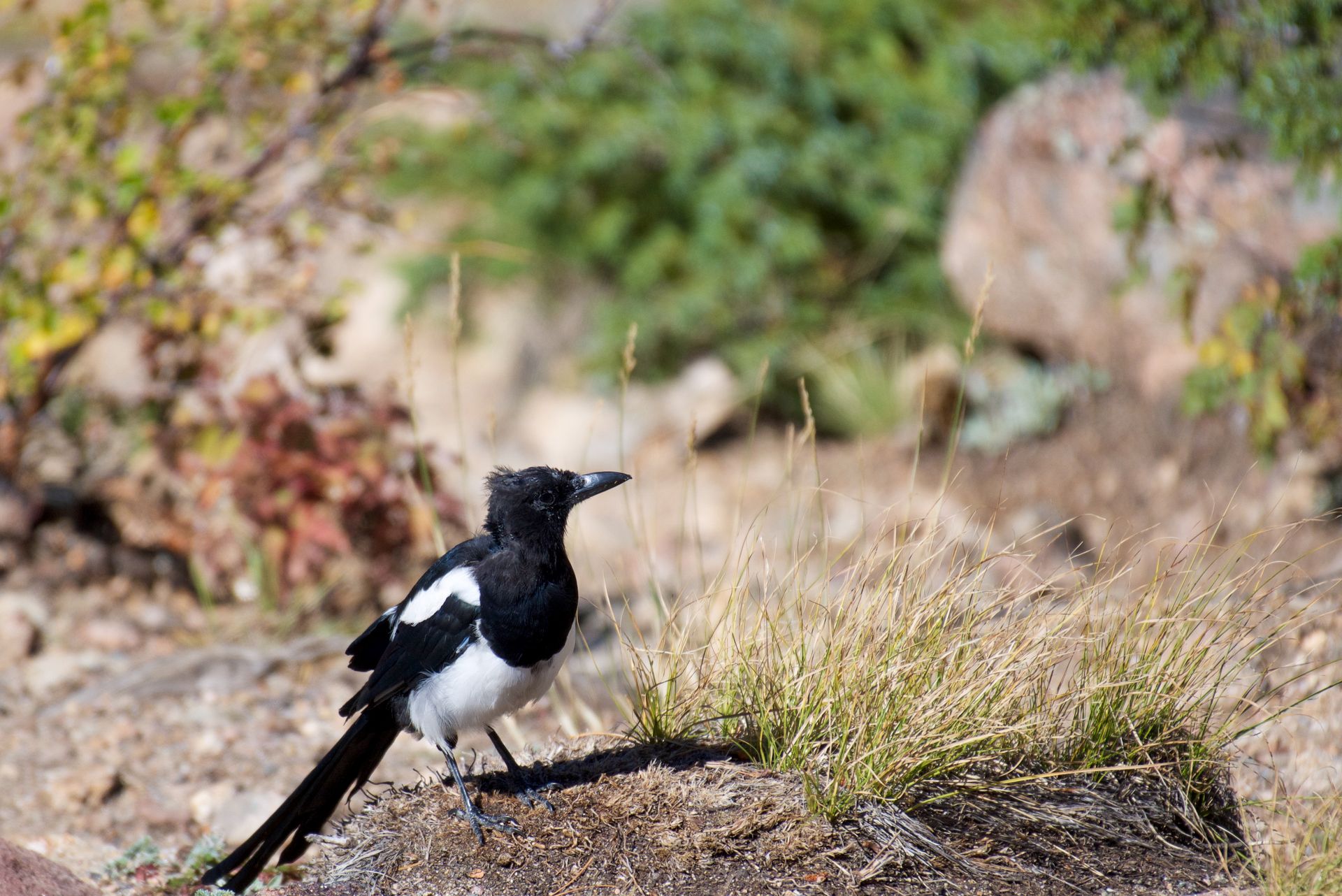
Black-billed magpies can be a problem for humans in various ways. They eat eggs and young chickens grown by farmers, which can lead to significant losses.
They also eat insects that live on animal dung, as well as dead or dying animals. This behavior can spread disease and cause infection.
In addition, magpies will pick insects out of open wounds on the back of farm animals, which can cause infection and even death. This is a serious concern for farmers who rely on these animals for food and income.
Some magpies have even been known to eat the eyes of newborn animals. This is a particularly disturbing behavior that can have devastating consequences for the affected animals.
Here are some ways in which black-billed magpies might be a problem for humans:
- Crop pest
- Animal disease vector
- Farmer's property damage (through eating eggs and young chickens)
Frequently Asked Questions
Can black-billed magpies talk?
While black-billed magpies are known for their intelligence, they are not capable of true speech like humans, but one individual has been observed imitating human words and phrases. However, this remarkable ability is rare and not a characteristic of the species as a whole.
What does it mean when you see a black-billed magpie?
Seeing a black-billed magpie can symbolize a mix of good and bad omens, depending on the cultural context, with associations ranging from love and magic to witchcraft and ill fortune. Its appearance may also be connected to themes of transition and transformation.
How rare are Black-billed Magpies?
Black-billed Magpies are no longer considered rare, as they are now classified as a species of least concern by the IUCN. They are commonly seen throughout their range, indicating a stable population.
Do magpies live in the USA?
Yes, black-billed magpies are commonly found in western North America, including the USA. They inhabit various regions, from rural areas to suburban neighborhoods.
Is a black-billed magpie a crow?
No, a black-billed magpie is not a crow, but it does belong to the same intelligent corvid bird family as crows and ravens.
Featured Images: pexels.com