If you're a cat lover, you're probably familiar with the striking beauty of black and white cats. These felines have a unique appearance that's hard to resist.
The Tuxedo cat is a classic black and white breed that's easy to recognize. They have a distinctive coat pattern with a black body and white fur on their paws, chest, and face.
Whether you're a seasoned cat owner or a newcomer to the world of felines, there's a black and white cat type out there that's sure to capture your heart.
Bicolor Cat Types
Bicolor cat types are classified based on the amount of white fur and the distribution of colors. The white spotting scale is used to categorize bicolor cats, with low-grade cats having less than 40% white fur.
A true bicolor cat, also known as a medium-grade cat, has equal amounts of white fur and the contrasting color. This type of bicolor cat has patches of contrasting fur that are equally distributed across the body.
For another approach, see: Types of Cat Hair
There are several patterns with their own names, including Locket, Mitted, Tuxedo, and Van. The Tuxedo pattern, for example, has low-grade white spotting, typically around 25% white fur, and is often referred to as a "tuxedo cat" due to its resemblance to formal wear.
Here are the main types of bicolor cat patterns:
- Locket: mostly black with a small bit of white
- Mitted: black all over with white feet
- Tuxedo: black body with white feet, chest, stomach, and nose
- Bicoloured: half black and half white coloring
- Magpie: white cats with random black spotting
- Harlequin: similar to the magpie with random black spotting, but with a black tail
- Cap and saddle: coloured head with a saddle patch on the cat's back
- Van: splashes of black coloring between the ears with a black tail
The Van pattern, in particular, is a type of bicolor cat that is mostly white, with color around the ears and tail, and small colored spots on the spine.
Bicolor Facts
Bicolor cats are classified as bicolor or piebald cats, which means they have one primary color coupled with any amount of white fur.
The primary colors can be gray, cream, brown, or black, but black is the most popular. The term piebald can also refer to other animals like horses, birds, pigs, and even snakes.
Bicolor coat patterns are controlled by genetics, specifically the "white spotting gene", which can present in different ways depending on how many dominant and recessive alleles a cat inherits from its parents.
If a cat has two dominant white spotting alleles, it's likely to have white fur covering more than half of its body. If it has one dominant and one recessive gene, it will likely have an equal mix of white and dark fur.
Feline experts have created a white spotting scale to help identify different types of bicolor coat patterns. Here's a breakdown of the scale:
The Cat Fanciers Association grades bicolor cats on a scale of 1 to 10, with a cat on the low end having no white spotting and a 10 being completely white.
The white spotting gene can also affect where the white fur is located on the cat's body. In general, low-grade patterned cats have white markings on their chests or bellies, while higher-grade cats have white fur spreading to their front paws, sides, and eventually their legs and face.
Bicolor (Tuxedo) Patterns
Bicolor (Tuxedo) Patterns are a type of coat pattern that's a favorite among many cat enthusiasts.
Bicolor cats are graded from one to ten, with one being completely colored and ten being completely white. This grading system helps identify different types of bicolor coat patterns. The bicoloration in cats is a complex trait controlled by genetics, specifically the white spotting gene.
The white spotting gene can present in different ways depending on how many dominant and recessive alleles a cat receives from its parents. This is why bicolor coat patterns can vary in intensity and distribution.
Low-grade bicolor patterns typically have less than 40% white fur, while high-grade patterns have more than 60% white fur. The Cat Fanciers Association grades bicolor cats based on a scale of 1 to 10, with a cat on the low end of the scale having no white spotting and a 10 being completely white.
The tuxedo pattern is a specific type of bicolor pattern that's characterized by a colored coat with white fur limited to the paws, belly, chest, throat, and often the chin. Tuxedo cats can appear to have goatees due to the black coloration of their mandible, lower jaw, and chin.
Here are some common types of bicolor patterns:
- Locket: mostly black with just a small bit of white, usually located on the stomach or neck.
- Mitted: black all over with only white feet which look like mittens.
- Tuxedo: black body with white feet, chest, stomach and nose which makes the cat appear like they're wearing a tuxedo.
- Bicoloured: half black and half white colouring.
- Magpie: white cats with random black spotting.
- Harlequin: similar to the magpie with random black spotting, but with a black tail as well.
- Cap and saddle: coloured head with a saddle patch on the cat's back, these felines might also have a black tail.
- Van: Splashes of black colouring between the ears with a black tail.
These patterns are not mutually exclusive, and some bicolor cats may exhibit characteristics from multiple patterns.
Coat Patterns and Genetics
Coat patterns in cats are determined by genetics, and it's fascinating to learn about the science behind them. The basic colors and patterns of cat fur are defined by fewer than ten genes.
Cats with white color in their coats have a mutant white-spotting gene that prevents the formation of coat color in patches over the cat's body. This gene has been investigated in several species, particularly mice.
The genetics of coat patterns involve the S (white spotting) gene, which has three possible genotypes. The SS genotype results in high grades of white spotting, sometimes resulting in a solid-looking white cat or a white cat with just a few color hairs.
The lack of tabby striping in bicolor cats is controlled by the agouti protein, which inhibits the production of melanin and thus prevents the formation of dark hair colors. In agouti cats, the gene is turned on and off as the hair grows, producing hairs with alternating stripes yellow and black.
Curious to learn more? Check out: Cat Personality Types by Color
The agouti gene is responsible for the tabby pattern, and its inactivation by a deletion mutation causes all-black coat color. This means that bicolor cats do not have the tabby gene, which is why they lack the striping pattern.
Here are the three possible genotypes of the S (white spotting) gene:
- SS (two dominant alleles) results in high grades of white spotting
- Ss (one dominant, one recessive allele) results in medium grades of white spotting
- ss (two recessive alleles) results in solid color or low grades of white spotting
True Bicolor Cats
True bicolor cats are a type of cat that has equal amounts of both white fur and their other color. They are considered a medium-grade cat on the white spotting scale, with approximately 50%-25% white fur.
These cats have patches of contrasting fur that are equally distributed across their body. The contrasting fur can come in any color, not just black and white.
True bicolor cats are the preferred pattern in show-quality bicolor purebred cats. They must meet specific requirements, such as having color patches that are separated from each other, even in color, and harmoniously distributed.
On a similar theme: Color Point Cat Breeds
The Fédération Internationale Féline (FIFe) has specific standards for bicolor cats, stating that at least 1/2 of the cat's body should be colored, but no more than 3/4. The World Cat Federation (WCF) allows an amount of color between 1/2 up to 2/3.
Here is a summary of the requirements for true bicolor cats:
The Cat Fanciers' Association (CFA) has a slightly different standard, stating that cats with no more than a locket and/or button patch on their chest do not qualify for this color class.
Bicolor Breeds and Characteristics
Bicolor breeds are a delight, and if you're a fan of black and white cats, you're in luck! Many breeds have bicolor coat patterns in their breed standards.
The Turkish Van, British Shorthair, and American Shorthair are just a few breeds that include bicolor coat patterns. The Turkish Van, in particular, is known for its striking bicolor pattern.
You can also find bicolor cats at animal shelters, where they're waiting for a forever home. It's a great way to give a loving home to a cat with a unique coat pattern.
Here are some breeds that include bicolor coat patterns in their breed standards:
- Turkish Van
- British Shorthair
- American Shorthair
- Manx
- Turkish Angora
The Cat Fanciers Association grades bicolor cats on a scale of 1 to 10, with 1 being no white spotting and 10 being completely white.
Bicolored Breeds
The bicolor coat coloration is not restricted to a specific breed of cat, as it can be found in many different types of pure-breed as well as mixed-breed domestic cats.
Some breeds have bicolor coats in their breed standards, including the Ragdoll, American Shorthair, Manx, British Shorthair, and Turkish Angora.
The Turkish Van and Snowshoe cat breed are restricted to cats with bicolored coats, which means they only come in bicolor patterns.
Bicolor cats can be found at animal shelters, but cat breeders also plan pairings in hopes of having kittens with specific black and white patterns.
Here are some breeds that include bicolor coat patterns in their breed standards:
- Ragdoll
- American Shorthair
- Manx
- British Shorthair
- Turkish Angora
- Turkish Van
- Snowshoe
Breeds with Green Eyes
Some bicolor cat breeds are more likely to have green eyes, but it's not a guarantee. The Egyptian Mau is one of these breeds.
The Egyptian Mau is known for its distinctive spotted coat, but its green eyes are also a notable feature.
Expand your knowledge: Different Types of Cat Eyes
What Breed is My Dog?
If you're wondering what breed your dog is, start by looking for distinct physical characteristics such as fur length and texture, which can be a dead giveaway.
Some breeds have unique coat types, like the Cornish Rex's curly fur or the Maine Coon's long, silky fur. Check your dog's fur to see if it matches any of these descriptions.
Eye shape and color can also be a clue, as breeds like the Siamese are known for their striking blue almond-shaped eyes.
Body shape is another important factor, with some breeds having distinct builds like the British Shorthair's stocky build or the Oriental Shorthair's slender elegance.
Facial features can also be telling, with breeds like the Persian having a flat face or the Russian Blue having prominent cheekbones.
If you're still unsure, consider getting a DNA test, which can provide insights into your dog's breed and ancestry, just like it can for cats.
You can also consult books and websites dedicated to dog breeds, comparing your dog's features to descriptions and photos to try and identify a breed or mix.
For another approach, see: Russian Blue Cat vs British Shorthair
Tuxedo Cats and Identification
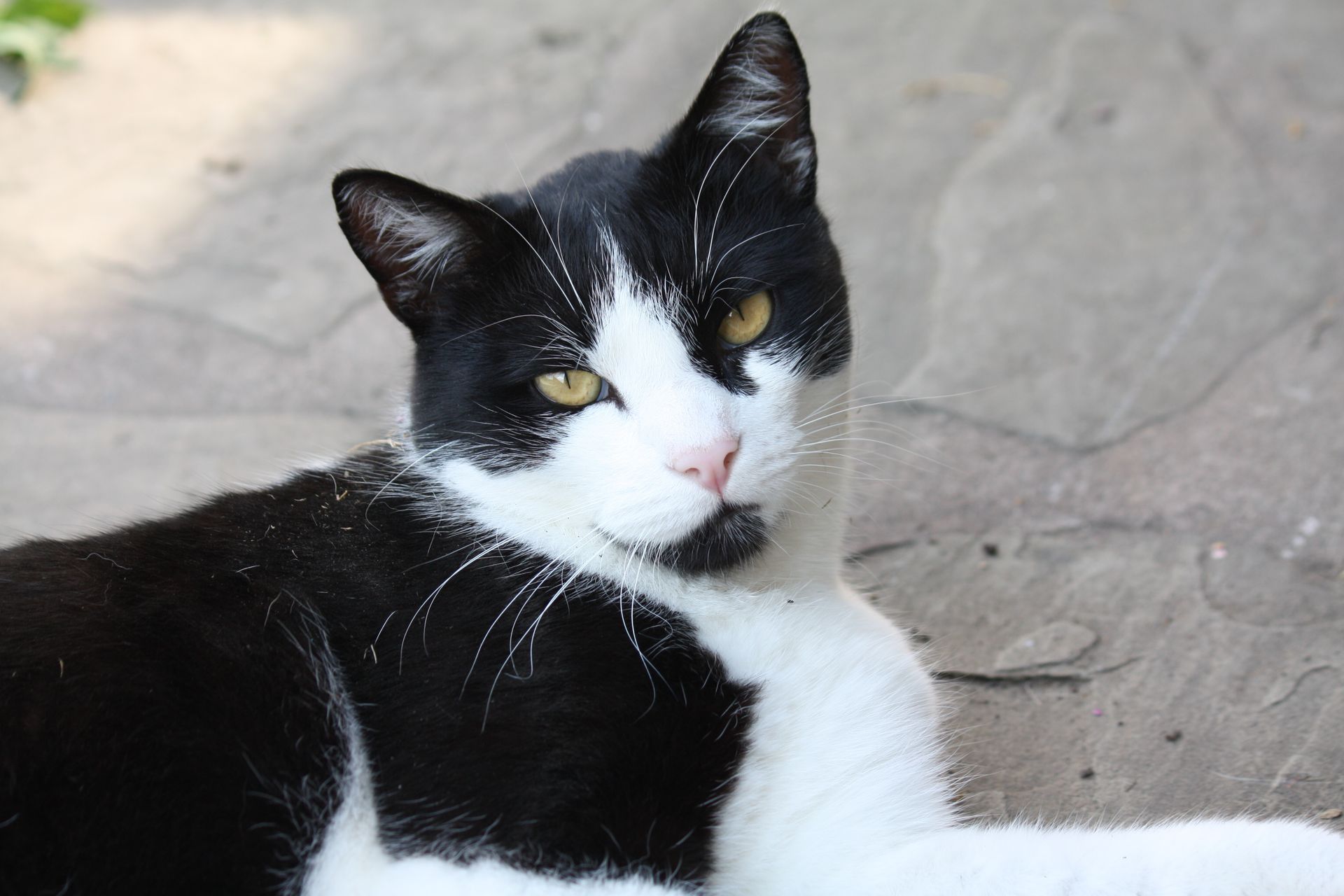
Tuxedo cats are a specific type of black and white cat, known for their distinctive coat pattern.
Their coat pattern is characterized by a black body with white fur on their paws, chest, and face, resembling a formal tuxedo.
Some Tuxedo cats have a small white patch on their nose, while others have a more extensive white marking.
Their unique appearance makes them easily identifiable, and many people recognize them as a distinct breed.
Tuxedo cats can be found in a variety of sizes, from small to large, and can weigh anywhere from 8 to 12 pounds.
Their weight and size can vary depending on their lineage and overall health.
In terms of temperament, Tuxedo cats are known for their playful and affectionate nature, making them great companions.
Many Tuxedo cat owners report that their cats are extremely loyal and loving.
Their intelligence and adaptability also make them well-suited for life in a busy household.
Some Tuxedo cats may require more attention and stimulation than others, but with proper care and interaction, they can thrive in any environment.
See what others are reading: Tuxedo American Shorthair Cat
Featured Images: pexels.com