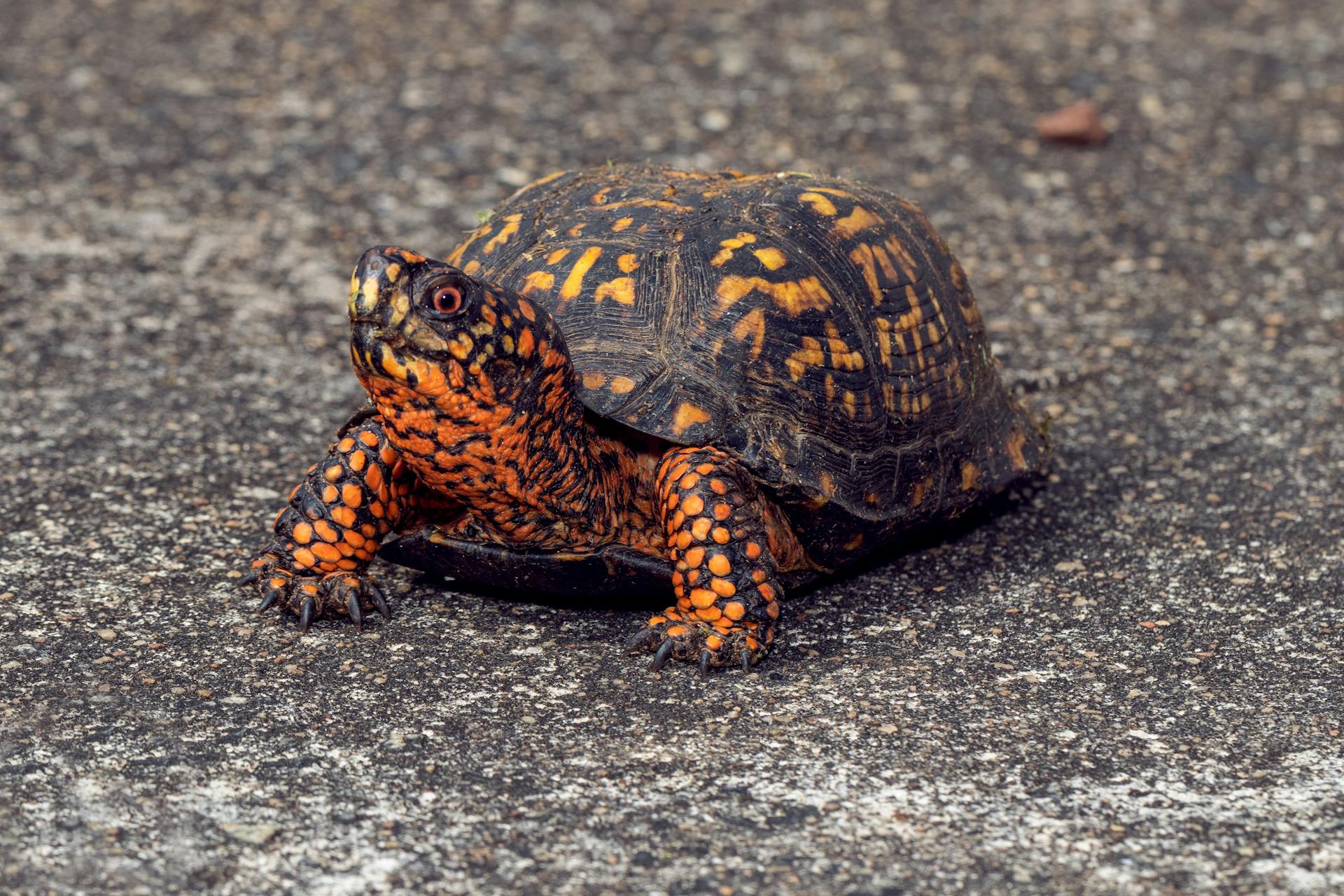
Box turtles are facing a significant threat in the wild, and it's essential to understand the scope of the issue. According to the International Union for Conservation of Nature (IUCN), box turtles are listed as vulnerable in their native habitats.
In the United States, box turtles are protected by laws in several states, including Alabama, Arkansas, and Georgia. These laws aim to prevent overcollection and habitat destruction.
The main reasons for the decline in box turtle populations are habitat loss and fragmentation, as well as the collection of turtles for the pet trade. The pet trade is a significant contributor to the decline of box turtle populations, with thousands of turtles being removed from the wild each year.
Discover more: Pet Common Snapping Turtle
Threats to Box Turtles
Box turtles are facing numerous threats that could potentially lead to their extinction. One of the main threats is predation, with juveniles and eggs being preyed upon by animals such as raccoons, foxes, and snakes.
Habitat loss and alteration are also major concerns, particularly in Florida where natural landscapes are being converted for agricultural, industrial, and urban development. This has resulted in a significant loss of box turtle habitats.
Road mortality is another significant threat, as box turtles frequently cross roads to move between foraging and nesting habitats, resulting in a high level of road mortalities.
The pet trade is also a major threat to box turtles, with many being collected from the wild and sold as pets. In fact, a study in Louisiana found that 30,000 box turtles were taken from the wild over 41 months.
Box turtle populations are also susceptible to disease, particularly ranavirus infections.
Here are some of the main threats to box turtles:
- Predation: Juveniles and eggs are preyed upon by animals such as raccoons, foxes, and snakes.
- Habitat loss and alteration: Conversion of natural landscapes for agricultural, industrial and urban development in Florida has caused a significant loss of box turtle habitats.
- Road Mortality: Box turtles frequently cross roads to move between foraging and nesting habitats, resulting in a high level of road mortalities.
- Exploitation: Box turtle populations are in decline due to over-collection for pet trade.
- Disease: Box turtle populations are susceptible to ranavirus infections.
Conservation Efforts
Box turtles have a strong connection to their birthplace and rarely travel far from it, which is why conservation efforts are crucial to protect their habitats.
Researchers are using radio telemetry to track box turtles in North Carolina, which involves attaching a small transmitter to the turtle's shell that doesn't hurt them or interfere with their behavior.
Box turtles are considered an indicator species, meaning a drop in their numbers or health can signal a threat to the entire ecosystem.
The International Union for Conservation of Nature has listed Eastern Box turtles as a vulnerable species due to habitat loss and urbanization.
Citizen scientists like Branwen Nhikawa are contributing to conservation efforts by taking photos of box turtles in their backyards, forests, or on the roadside, which helps researchers track their movements and habitats.
By tracking box turtles, researchers can identify areas where conservation efforts are needed most, and develop strategies to protect their habitats and prevent further decline in their populations.
Recommended read: Common Snapping Turtle Species
Impact and Status
The Coahuilan (Aquatic) box turtle is possibly the most endangered American box turtle, and several Asian box turtles are near extinction or already extinct in the wild. This is largely due to habitat loss and urbanization, which have caused a significant loss of box turtle habitats.
Box turtles are also threatened by predation, with juveniles and eggs being preyed upon by various animals such as raccoons, foxes, and snakes. Habitat loss and alteration, road mortality, exploitation, and disease are also major threats to box turtle populations.
Here are some of the main threats facing box turtles:
- Predation: Juveniles and eggs are preyed upon by various animals.
- Habitat loss and alteration: Conversion of natural landscapes for agricultural, industrial, and urban development has caused a significant loss of box turtle habitats.
- Road Mortality: Box turtles frequently cross roads, resulting in a high level of road mortalities.
- Exploitation: Box turtle populations are in decline due to over-collection for the pet trade.
- Disease: Box turtle populations are susceptible to ranavirus infections.
By understanding these threats, we can take steps to help protect box turtles and their habitats. This includes learning how our actions can inadvertently harm box turtles, stopping littering and other forms of pollution, and supporting conservation efforts.
Research and Study
Box turtles are an indicator species, meaning their decline in numbers can signal a threat to the entire ecosystem.
Biologists have identified habitat loss and urbanization as major threats to their survival.
The International Union for Conservation of Nature has listed Eastern Box turtles as a vulnerable species.
Urbanization occurs when natural areas are converted into cities through construction of roads, houses, and other buildings.
Researchers are using radio telemetry to track Box turtles in the wild.
A transmitter is attached to the turtle's shell, allowing researchers to track its location.
The transmitter doesn't hurt the turtle or interfere with its behavior.
Researchers record the turtle's GPS location, size, and outside temperature at the time of sighting.
Citizen scientists like Branwen Nhikawa are contributing to the conservation effort by submitting photos of turtles they've spotted in backyards, forests, or on the roadside.
These photos, known as "shelfies", are helping researchers develop an AI tool to identify individual turtles.
Getting Involved
If you live in an area with wild box turtles, keep an eye out for them on the road so you don’t hit them yourself. This is a slow process for them, and they often get hit.
You can help box turtles by moving them out of the road safely. Just make sure to do it in a way that's safe for both yourself and other drivers.
If you discover box turtles have started nesting in your backyard, you can help protect their eggs by creating a dome of chicken wire around the nest. Make sure there are two-inch gaps at the base of the structure.
To create a more suitable habitat for box turtles, leave leaf litter and fallen woody debris on the ground. This will provide them with shelter and protection.
By spreading information about the importance of leaving box turtles alone, you can help prevent accidental harm to these amazing creatures. People need to know that they can accidentally kill a box turtle as easily as by picking it up and setting it down in a different place.
You can also get involved by participating in box turtle research as a volunteer. Professionals may ask you to find and safely secure box turtles in the wild, which will then be tagged and released back into their natural habitat.
Intriguing read: What Are Some Things You Can Do to Help a Ferret Go to Sleep?
Featured Images: pexels.com