The Arctic Ground Squirrel is a fascinating creature that calls the Arctic tundra home. They are well adapted to the harsh, cold climate of their environment.
Their burrows, which can extend several feet underground, provide them with protection from predators and harsh weather conditions. These burrows also help regulate their body temperature.
Arctic Ground Squirrels are herbivores, feeding on a variety of plants including grasses, sedges, and lichens. They play a crucial role in seed dispersal and nutrient cycling in their ecosystem.
Physical Description
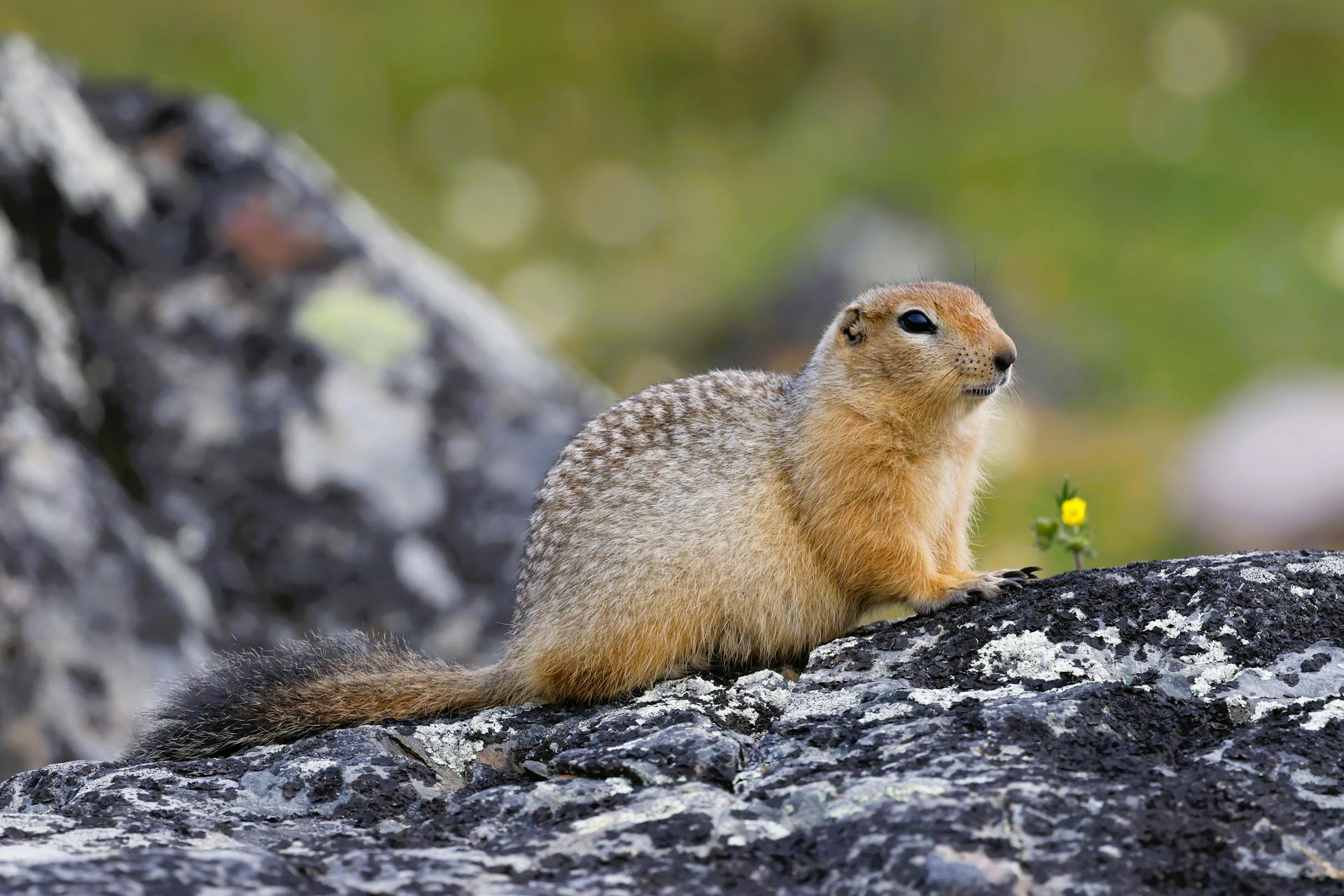
The Arctic ground squirrel's physical description is quite unique. They typically have a beige-tan pelage with a lightly spotted backside.
Their face is shorter than that of typical arboreal squirrels, likely due to their burrowing lifestyle. This adaptation helps them navigate through tight spaces in their underground tunnels.
Arctic ground squirrels have smaller ears, which are a distinctive feature of this species. Their dark tail and white markings around the eyes add to their distinctive appearance.
During the brief summer, they undergo an annual molting cycle, shedding their coat in preparation for the onset of colder weather. This process is seen in other Arctic species as well.
Their summer coats include reddish and yellow colorations along the cheeks and sides of the body. These vibrant colors are shed in the fall, replaced by a more silvery color.
The lighter coloration in winter helps them camouflage against the snow-white ground, making it easier to evade predators. Their average length is approximately 39 cm (15 in).
Arctic ground squirrels range in weight from 524 to 1,500 grams, with males being larger than females. Adult females typically weigh around 750 g (26 oz), while males may weigh nearly 100 g (3.5 oz) heavier.
Their cylindrical shape, short strong forearms, and hind legs make them well-suited for burrowing and digging. They have sharp claws and soft pads on the undersides of their hands, which aid in manipulating food and dirt.
Their heads and ears are rounded, and their tails are relatively short compared to other squirrel species.
Worth a look: Squirrel Monkey Species Common Characteristics
Habitat and Distribution
The Arctic ground squirrel has a vast distribution, spanning across northern Canada, Alaska, and even into eastern Siberia. Its range includes parts of western Northern Canada, the Yukon, northern British Columbia, and the Northwest Territories.
Arctic ground squirrels prefer to live in sandy soil due to its ease of manipulation for burrowing and superior drainage. This is why you'll often find them in hillside or mountain slopes, riparian areas, or tundra ridges.
They can be found in tundra, meadow, riverbank, and lakeshore habitats with loose soils that provide early vegetation. This is particularly true in Alaska, where they range across northern, eastern, and southwestern regions.
Arctic ground squirrels have adapted to human modifications to the landscape, and are now common throughout road systems in Alaska. They've even been known to den in soft sandy soils along the coast, although this can be a double-edged sword as they may drown in high fall storm surges or be dug up by grizzlies.
Here's a breakdown of the average territory size of Arctic ground squirrels:
- Average territory size: 0.14 to 2.4 ha/km^2
Behavior and Life Cycle
Arctic ground squirrels have a unique mating system where males aggressively defend territories with multiple females. This behavior is a key factor in their life cycle.
In late April to early May, males will often engage in infanticide to expand or find new territory, which is a significant threat to females and their young. Females group together after breeding to provide protection from infanticidal males and predators.
Males display a trade-off between survival rate and reproduction, with aggressive territorial behavior resulting in raised stress levels, lowered body mass, and compromised immune systems. This compromise leads to a high mortality rate in male arctic ground squirrels after breeding season.
Explore further: Common Snapping Turtle Growth Rate
Life History
Arctic ground squirrels have a unique life history. Mating season typically occurs in late April to early May, after they wake up from hibernation.
During this time, males aggressively defend territories with multiple females, displaying a polygynous mating system. This behavior is crucial for their survival, but it comes with a significant trade-off.
Males experience raised stress levels due to their aggressive territorial behavior, which can result in up to 21 percent lowered body mass and compromised immune systems. This compromises their body conditions and leads to a high mortality rate after breeding season.
Females, on the other hand, have a relatively short gestation period of 25-30 days. After giving birth, they care for their young, which are born blind, hairless, and toothless.
Home Range
Arctic ground squirrels have home ranges between 0.2 to 4 ha, which is a relatively small area for these energetic creatures.
Their home ranges can vary greatly depending on the availability of food and suitable habitats.
Arctic ground squirrels are known to den in a variety of habitats, including tundra, meadow, riverbank, and lakeshore habitats with loose soils that provide early vegetation.
Human modifications to the landscape have also led to arctic ground squirrels inhabiting road shoulders and soft sandy soils along the coast.
Hibernation and Adaptation
Hibernation is a remarkable adaptation that helps arctic ground squirrels survive the harsh winter months. They can reduce their body temperatures from 37 °C (99 °F) to as little as −3 °C (27 °F) during hibernation.
Arctic ground squirrels typically hibernate for about eight months out of the year, with females entering hibernation first in August and males following in September. During hibernation, their body temperature drops drastically, and they enter a state of torpor, a period of reduced activity and lowered body temperature.
Their body temperature can drop as cold as 27 degrees F (-3 degrees C), below freezing, and they will shiver or use stored fat to bring their body temperatures back to a comfortable state. This rewarming period usually lasts one to two days before they return to their state of torpor.
Arctic ground squirrels have a unique physiological adaptation that allows them to survive during winter. During hibernation, their body temperature drops below freezing, a condition referred to as supercooling.
Suggestion: Oklahoma State Bird Scissor Tailed Flycatcher
Diet and Predation
Arctic ground squirrels are highly adaptable omnivores, which means their diet consists of both plants and animals. They will eat almost anything they can find, from vegetation like stems, leaves, and roots to insects, small vertebrates, and even their own young.
Arctic ground squirrels have a unique way of storing food for the winter. Only male squirrels cache food in their burrows, and they only store plant material, not animal matter. This is because they need to maintain a diet with moderate levels of polyunsaturated fatty acids (PUFAs) to survive hibernation.
Some of the common plant families that arctic ground squirrels eat include Polygonaceae, Juncaceae, and Cyperaceae. They also consume various parts of plants, such as foliage, roots, seeds, flowers, and fruits.
Here's a breakdown of their diet:
- Plant Foods: leaves, roots and tubers, seeds, grains, and nuts, fruit, flowers
- Animal Foods: birds, mammals, eggs, carrion, insects, terrestrial non-insect arthropods
Their diet is crucial to their survival, especially during hibernation when their body temperatures drop to subnormal levels. They need the right balance of nutrients to maintain flexibility in their cell membranes.
Feeding Ecology
Arctic ground squirrels are highly opportunistic feeders, which means they'll eat just about anything they can find. Their diet is incredibly varied, including vegetation like stems, leaves, roots, fruits, seeds, flowers, grasses, and sedges.
They also eat eggs, invertebrates, and small vertebrates, including juvenile snowshoe hares, collared lemmings, and even their own young. This is a pretty impressive list of food sources, and it's no wonder they're able to survive in the harsh Arctic environment.
Arctic ground squirrels are generalist foragers, which means they'll feed on a wide range of food sources. This includes plants, invertebrates, small vertebrates, eggs, birds, and even carrion. They've even been known to actively prey on the eggs and chicks of birds, as well as collared lemmings.
Plant matter makes up the majority of their diet, and when caching food for winter stores, they use only plant material. They consume all parts of plants, depending on the species, including foliage, roots, seeds, flowers, and fruits.
A unique perspective: American Bald Eagle Food Chain
Here are some common plant families that arctic ground squirrels like to eat:
- Polygonaceae
- Juncaceae
- Cyperaceae
- Ranunculaceaea
- Rosaceae
- Brassicaceae
- Caryophllaceae
- Poaceae
- Saxifragaceae
- Salicaceae
- Gentianaceae
- Scrophulariaceae
- Plantaginaceae
- Fabaceae
- Santalaceae
Arctic ground squirrels are also selective about the foods they cache for winter, choosing plants that provide moderate levels of polyunsaturated fatty acids (PUFAs). These essential fatty acids help them maintain flexibility in their cell membranes during hibernation.
Predation
Predation is a significant factor in the lives of arctic ground squirrels. They have evolved various anti-predator adaptations to stay safe.
One of their key adaptations is extreme vigilance while above ground and away from their protective burrows. They frequently sit or stand up on their hind legs to listen and look around them.
Arctic ground squirrels also give alarm calls to alert other family members when predators are nearby. This warning call can trigger a swift response, with individuals running for the protection of their burrows.
Their preferred habitat of open areas with little vegetation allows them to see predators coming from greater distances. This is crucial for their survival.
Some of the common predators of arctic ground squirrels include lynxes, coyotes, wolverines, and many others. Here are some of the known predators:
- lynxes
- coyotes
- wolverines
- red foxes
- arctic foxes
- wolves
- grizzly bears
- ermines
- northern goshawks
- great horned owls
- red-tailed and Harlens hawks
- common ravens
- long-tailed jaegers
- snowy owls
- short-eared owls
- golden eagles
- northern harriers
- gyrofalcons
- rough-legged falcons
- peregrine falcons
Conservation Status
The Arctic ground squirrel is considered a species of least concern on the IUCN Red List. This means they're not currently threatened with extinction.
Their conservation status is listed as "secure" by Environment Yukon. This is a positive sign for their population health.
The Arctic ground squirrel is classified under the IUCN Red List as least concern (LC). This classification is based on their relatively stable population and lack of major threats.
Here are some categories where the Arctic ground squirrel is listed:
- IUCN Red List least concern species
- Urocitellus
- Mammals of the Arctic
- Arctic land animals
- Mammals described in 1825
- Mammals of Russia
- Mammals of Siberia
- Rodents of the United States
- Rodents of Canada
- Fauna of the Holarctic realm
- Taxa named by John Richardson (naturalist)
General Information
Arctic ground squirrels are the largest of the North American ground squirrel species, ranging from 524 up to 1,500 grams in weight, and 332 to 495 mm in length.
They undergo significant seasonal changes in body mass, losing weight during hibernation. Their body mass can drastically vary between summer foraging bouts and winter hibernation.
Males are larger than females, exhibiting sexual dimorphism. Their tawny brown coloration with white flecks on the dorsal side of the pelage and light tan or beige coloration on their undersides is quite distinctive.
Intriguing read: Wandering Albatross Weight
Their undersides lighten during winter months, which is quite an adaptation to their hibernation habits. They have a relatively short tail compared to other squirrel species.
Arctic ground squirrels are built for burrowing and digging, with cylindrical bodies, short strong forearms, and hind legs. They have sharp claws and soft pads on the undersides of their hands, which aid them in manipulating food and dirt.
Their heads and ears are rounded, which suits their burrowing lifestyle.
Explore further: Burrowing Owl Florida Protected
Frequently Asked Questions
Do arctic ground squirrels eat blueberries?
Arctic ground squirrels eat berries, but it's not specified if blueberries are a part of their diet. They do eat other types of berries, so it's possible they might eat blueberries as well.
Featured Images: pexels.com