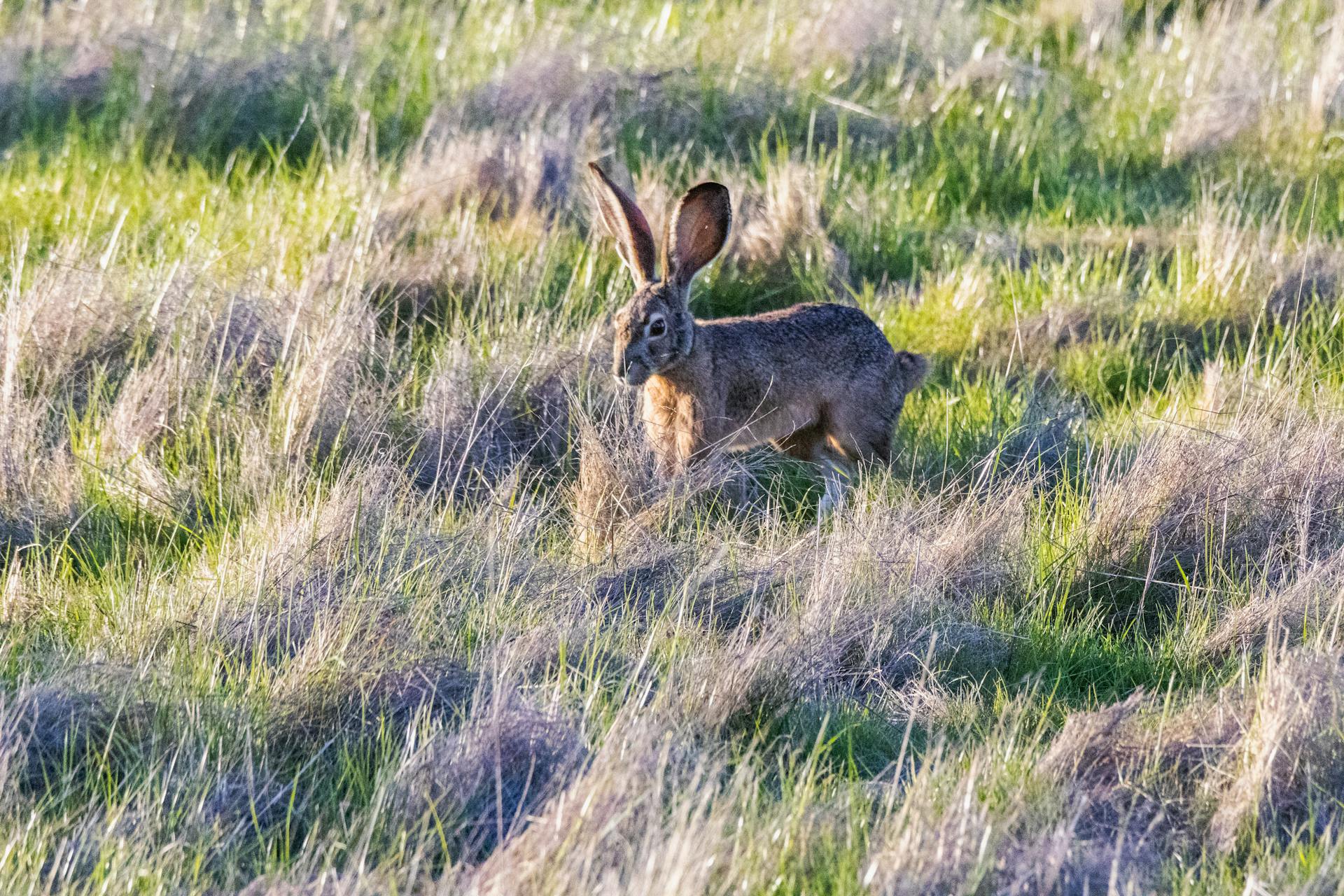
The antelope jackrabbit is a fascinating creature, and learning about its habits and habitats can be quite enlightening.
These remarkable animals can be found in the southwestern United States and northern Mexico, where they inhabit areas with scrubby desert vegetation.
The antelope jackrabbit's unique appearance is characterized by its long ears and powerful hind legs, which enable it to reach speeds of up to 45 miles per hour.
Here's an interesting read: Black Buck Antelope Texas
Physical Characteristics
The antelope jackrabbit is a large and impressive creature. Its size is one of its most distinctive traits, with a head and ears that are especially large.
The head and ears of the antelope jackrabbit are truly remarkable. On average, their ears are 162mm long and mostly devoid of hair except for fringes of white hair along the edges and on the tips.
Antelope jackrabbits have a unique coat coloration, with white hair on the sides of the body, including the limbs, hips, and rump, and black tips on these areas. The ventral surface, including the chin, throat, stomach, and insides of the limbs, are all white haired, as well as the tail. The rest of the body is yellow/brown with some black.
Curious to learn more? Check out: White Tailed Jackrabbit
Their fur is highly reflective and insulated, helping to eliminate heat gain from the environment. This is especially important in hot climates, where the antelope jackrabbit can tolerate heat stress at high levels better and for a longer time than some other species.
Here are some key physical characteristics of the antelope jackrabbit:
- Range mass: 2.7 to 4.73 kg (5.95 to 10.42 lb)
- Average mass: 3.8 kg (8.37 lb)
- Range length: 553 to 670 mm (21.77 to 26.38 in)
- Average length: 622 mm (24.49 in)
- Range basal metabolic rate: 8.34 to 10.06 cm^3.O2/g/hr
Antelope jackrabbits have long, pointed ears and a distinct coat coloration, including a white belly, light grey sides, and a back peppered with black.
Habitat and Distribution
The antelope jackrabbit is a fascinating creature that can be found in various parts of the southwestern United States and northwestern Mexico. Its habitat preferences are quite specific, ranging from grassy slopes at moderate elevations to open, flat places with desert scrub and mesquite grasslands.
In Arizona, antelope jackrabbits are commonly found in areas with grass growing well under desert shrubs that are moderately high and open. They are less common in creosote bush desert and low-lying valleys with dense mesquite stands.
Broaden your view: Black Buck Antelope
The ideal habitat for an antelope jackrabbit includes grassy ground cover and a mesquite overstory, as indicated by a 2014 study on ecology. This species does not prefer an arid climate, instead thriving in areas with summer precipitation amounts ranging from 90 mm to 360 mm.
Antelope jackrabbits are found in a variety of tropic and subtropic habitats, including grassy hills or plains, and more barren desert habitats. In Mexico, they inhabit the coastal foothills, as well as foothills with patchy, low bushes and grass.
Here's a breakdown of the antelope jackrabbit's habitat regions:
- Temperate
- Terrestrial
And here are the terrestrial biomes where antelope jackrabbits can be found:
- Desert or dune
- Savanna or grassland
- Chaparral
The antelope jackrabbit's range is limited to southern Arizona and northwestern Mexico, with a unique distribution along Mexico's coastal foothills.
Behavior and Reproduction
Antelope jackrabbits have a unique breeding season that lasts from December to September.
Their gestation period is surprisingly short, lasting only about six weeks.
Female antelope jackrabbits can have up to four litters per year, which is a remarkable reproductive rate.
Each litter can range from one to five individuals, making for some exciting family dynamics.
Baby antelope jackrabbits, called leverets, are born precocial, meaning their eyes are open, they're active, and covered with fur from the start.
They're even born in shallow dirt nests that their mothers carefully prepare by scraping the surface of the ground.
Restoring the Ears
The antelope jackrabbit's ears are quite impressive, and they play a crucial role in its behavior and survival. They are long and pointed, which helps the jackrabbit to hear potential predators from a distance.
One interesting thing about the antelope jackrabbit is that it is most active during twilight and nocturnal periods. This makes its long ears especially useful for detecting sounds in low light conditions.
The jackrabbit's large ears also help it to regulate its body temperature. In the hot desert environment where it lives, this is a vital function.
Male and female antelope jackrabbits are identical in appearance, which can make them harder to tell apart. However, their distinctive ear shape and coat coloration help to identify them as a species.
Behavior
Antelope jackrabbits are crepuscular and nocturnal, which means they're most active at dawn and dusk. They can also be active during the day on cloudy days.
These animals have a unique way of coping with the extreme heat during the day. They create "shelter forms" by backing up under grass, weeds, or brush, or simply sitting in the shade of a cactus or mesquite trunk. They preferentially choose mesquite and creosote bush.
Antelope jackrabbits are also solitary animals, meaning they like to be alone. They don't have a large social group like some other animals.
Here are some key behaviors associated with antelope jackrabbits:
- Cursorial (meaning they're well adapted for running)
- Terricolous (meaning they spend most of their time on or near the ground)
- Saltatorial (meaning they're good jumpers)
- Nocturnal (meaning they're active at night)
- Crepuscular (meaning they're active at dawn and dusk)
- Motile (meaning they're capable of movement)
- Nomadic (meaning they don't have a fixed home range)
- Sedentary (meaning they don't move around much)
- Daily torpor (meaning they experience a period of reduced activity and lowered body temperature during the day)
- Solitary (meaning they're alone most of the time)
Feeding
The Antelope Jackrabbit is a unique eater. It feeds on cacti, grasses, and other leafy vegetation.
They also have a fascinating way of obtaining additional nutrients - they've been observed digging and eating soil. This behavior allows them to intake minerals and other essential nutrients.
Their diet consists of both folivores and graminivores, making them adaptable to their desert environment.
In the wild, I've noticed that these animals can be quite calm, but only on rare occasions. This individual we encountered was unusually cooperative, sitting calmly by the roadside for several minutes as we photographed it.
Their calm demeanor is a stark contrast to their typical behavior, which is to run at blazing speed as humans approach.
Reproduction
Antelope jackrabbits breed from December to September, which is a relatively long breeding season.
The gestation period is roughly six weeks long, which is impressive considering the short time it takes for the young to develop.
Females have up to four litters per year, which is a remarkable reproductive strategy.
A baby hare, called a leveret, is born precocial, meaning its eyes are open, it's active, and covered with fur.
Young jackrabbits are born in shallow dirt nests that are formed by scraping the surface of the ground.
For your interest: How Long Have Cats Been Pets
Conservation and Ecology
Conservation efforts for the antelope jackrabbit are crucial due to habitat threats from non-native grass species like Lehmann lovegrass, which is not edible for these animals.
Human impacts such as housing developments, livestock grazing, and canal building also pose a threat to their habitat.
The IUCN Red List classifies the antelope jackrabbit as Least Concern, and it has no special status on the US Federal List, CITES, or the State of Michigan List.
Antelope jackrabbits play a vital role in their ecosystems through grazing, which can force habitat succession and influence the composition and health of their native habitats.
Their grazing also makes them an important food source for medium to large terrestrial and avian predators.
Antelope jackrabbits can consume as much as 1 sheep or 1 domestic cow, depending on the number of individuals, making their grazing impact substantial.
Here's a comparison of the grazing impact of antelope jackrabbits and domestic animals:
Conservation Status
The antelope jackrabbit's conservation status is a pressing concern. The IUCN Red List classifies it as Least Concern, but human impacts on its habitat are a major threat.
Lehmann lovegrass, a non-native grass species, is not edible for antelope jackrabbits, making it a significant threat to their survival. This invasive species is just one of the many human-induced changes to their habitat.
Human activities such as housing developments, livestock grazing, recreational trails, and canal building are also causing a decline in antelope jackrabbit populations. These changes alter the natural landscape and disrupt the delicate balance of the ecosystem.
Here's a breakdown of the antelope jackrabbit's conservation status:
- IUCN Red List: Least Concern
- US Federal List: No special status
- CITES: No special status
- State of Michigan List: No special status
These classifications indicate that the antelope jackrabbit is not currently considered threatened or endangered under these specific lists. However, it's essential to continue monitoring its population and habitat to prevent potential declines.
Ecosystem Roles
Antelope jackrabbits play a crucial role in shaping their ecosystems through their grazing habits. By forcing habitat succession in the direction of the climax stage, they can improve the health and composition of their native habitats.
Their grazing can have a significant impact, consuming as much as 1 sheep for every 15 antelope jackrabbits or 1 domestic cow for every 74 antelope jackrabbits. This highlights the importance of considering their grazing habits when managing land.
Antelope jackrabbits are also an important food source for many animals, including coyotes, hawks, eagles, foxes, bobcats, and humans. This underscores their place in the ecosystem and the need to conserve their populations.
Here are some key statistics on the grazing habits of antelope jackrabbits:
- 1 sheep = 15 antelope jackrabbits in terms of grazing impact
- 1 domestic cow = 74 antelope jackrabbits in terms of grazing impact
Their diet consists mainly of grasses, twigs, leaves, clover, alfalfa, seeds, beans, and cacti.
Evolution and Classification
The antelope jackrabbit has a rich evolutionary history. Fossil evidence places the genus Lepus in North America approximately 2.5 million years ago.
A now extinct species, Lepus giganteus, shared similar physical traits with the antelope jackrabbit, making it difficult to differentiate fossils of the two species. This species is thought to have coexisted with the antelope jackrabbit.
The black-tailed jackrabbit and antelope jackrabbit maintain a sympatric relationship, meaning they coexist in the same geographic area. This relationship has been studied extensively.
Genetic analysis has shown that the antelope jackrabbit shares a common ancestor with the white-sided jackrabbit and Tehuantepec jackrabbit.
Frequently Asked Questions
How fast can an antelope jackrabbit run?
Antelope jackrabbits can run at speeds of up to 72 km per hour, making them one of the fastest runners in their genus.
What does an antelope jackrabbit eat?
Antelope jackrabbits primarily feed on cacti, grasses, and leafy vegetation, as well as soil to supplement their mineral intake
Featured Images: pexels.com