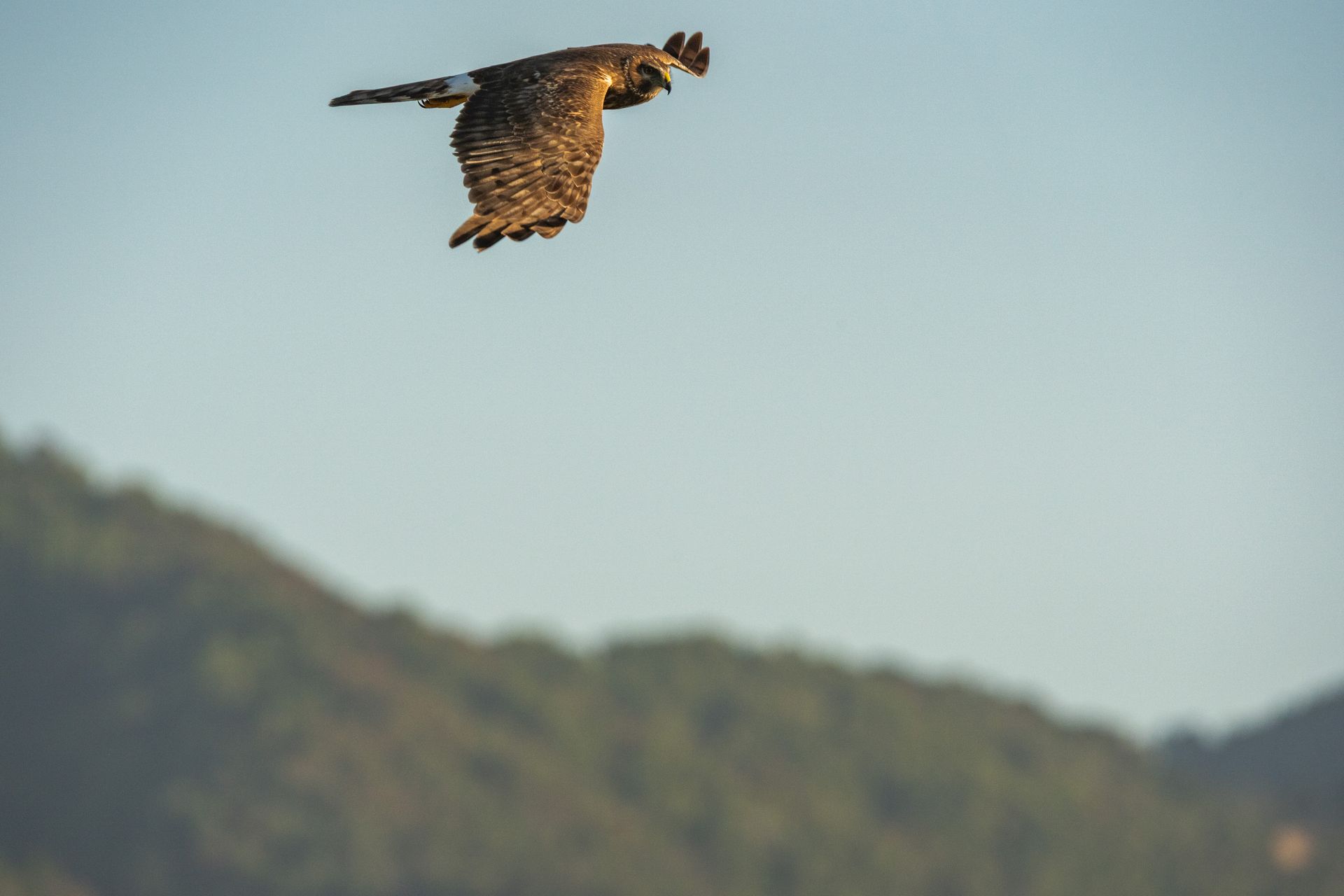
The American Peregrine Falcon is a magnificent bird of prey, with a rich history and fascinating conservation story.
Historically, the species was listed as Endangered in 1970 due to pesticide poisoning, which led to a significant decline in population.
Conservation efforts have been successful, and the species was removed from the Endangered list in 1999.
Today, the American Peregrine Falcon is listed as Least Concern on the IUCN Red List.
You might enjoy: Conservation-reliant Species
Conservation Status
The American Peregrine Falcon's conservation status is a story of dramatic decline and eventual recovery. By the mid-1960s, there were no peregrines in the eastern United States.
Loss of habitat, shootings, egg collecting, and other human disturbances had weakened North American populations for decades, but drastic declines didn't occur until after the widespread use of DDT. The use of DDT as a pesticide was especially devastating to birds like the peregrine falcon that sit at the top of the food chain.
DDT poisoning caused thin, frail eggshells that would break under the weight of the parent during incubation, leading to a precipitous drop in peregrine falcon populations. By 1975, only 324 pairs existed in the US, down from an estimated 3,875 nesting pairs prior to the '40s.
The peregrine falcon's decline served as a warning about the dangers of chemical pollution and the importance of protecting our environment.
Biology and Habitat
The American peregrine falcon is a bird of prey that can be found in a variety of habitats, from open spaces with high cliffs and bluffs to tall buildings in cities.
Peregrine falcons are known for their impressive wingspans and powerful flight muscles, which enable them to fly at speeds of up to 200 mph and catch their prey in mid-air.
They primarily feed on birds, ranging in size from a duck to a songbird, and are often successful in killing their prey with the impact alone.
Peregrine falcons are found on every continent except Antarctica, with breeding populations occurring in various subspecies.
Habitat
Peregrine falcons typically inhabit open spaces with high cliffs and bluffs overlooking rivers and coasts.
They can also be found in cities with tall buildings, which have become a more recent habitat for some peregrine populations.
Some peregrine populations are migratory and travel great distances, as their Latin name implies.
Peregrines breed in areas such as Alaska and the Canadian Arctic, as well as in the mountainous western United States.
They can be found sparingly in the eastern United States, and their range extends south to the state's western border in Colorado, where they can be found from the Front Range to the state's western border.
Falco Peregrinus
The peregrine falcon is a bird of prey that's incredibly skilled at hunting. With its long, pointed wings and powerful flight muscles, it can reach speeds of up to 200 mph while diving towards its prey.
A peregrine falcon's diet primarily consists of birds, which it catches in mid-air after gaining momentum with rapid wing beats. Its prey ranges from small songbirds to larger ducks.
The peregrine falcon's impressive hunting abilities are matched only by its impressive range. It's found on every continent except Antarctica, with breeding populations occurring in various subspecies.
Peregrines that nest in the Arctic may migrate as far south as South America, while those in lower latitudes may not migrate at all. This remarkable adaptability is a testament to the peregrine falcon's ability to thrive in diverse environments.
In the past, the peregrine falcon was threatened by the pesticide DDT, which caused eggshell thinning and reproductive failure. However, thanks to conservation efforts and the banning of DDT, the species has made a remarkable recovery.
Discover more: South American Tapir
Quick Facts and Information
The American Peregrine Falcon is an impressive bird of prey.
Its scientific name is Falco peregrinus anatum.
They can grow to be 15 - 20 inches long.
Their wingspan is quite wide, ranging from 38 - 44 inches.
These birds typically weigh between 1.25 - 2.75 pounds.
You can spot them in various plumage, including dark blue-grey, black mustache marks, and black bars on the chest.
They have long, pointed wings that help them soar through the skies.
Here are some key characteristics of the American Peregrine Falcon:
These birds are known to be foragers and birds of prey, which means they hunt for food.
Their diet consists mainly of other birds, such as songbirds and waterfowl.
They also occasionally eat bats and small mammals.
However, they face threats from larger birds of prey and humans.
Frequently Asked Questions
What is the fastest killing bird in the world?
The peregrine falcon is the fastest killing bird in the world, reaching speeds of over 320 km/h when diving at its prey. Its incredible speed allows it to strike with deadly precision, making it a formidable hunter.
How aggressive are peregrine falcons?
Peregrine falcons are highly territorial and can be aggressive when defending their domain, but attacks on humans are rare. They are generally a force to be reckoned with, but their aggression is mostly directed at other birds and potential threats to their territory.
Featured Images: pexels.com