The Amazon Rainforest is home to over 1,500 species of birds, with many more still waiting to be discovered. This incredible diversity is due in part to the rainforest's unique geography, which provides a wide range of habitats for birds to thrive in.
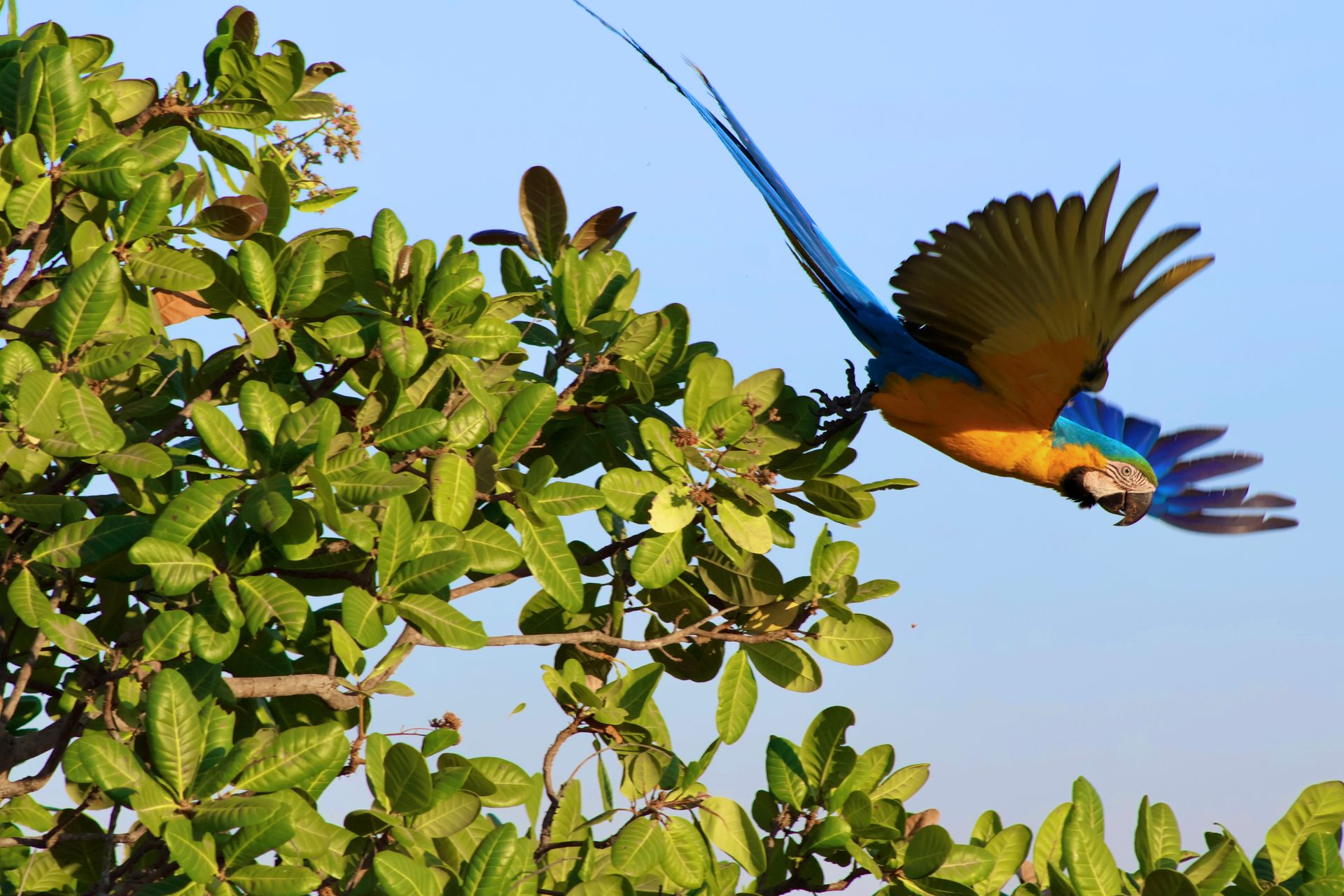
The majestic macaw, a symbol of the Amazon, is one of the most recognizable birds in the region. With its vibrant plumage and bright colors, it's a sight to behold.
The Amazon Rainforest is facing numerous threats, including deforestation, habitat fragmentation, and climate change. These threats are having a devastating impact on bird populations, with many species facing extinction.
The Spangled Cotinga, a rare and endangered bird, is just one example of the many species struggling to survive in the Amazon. Its population is declining rapidly due to habitat loss.
For your interest: How to Put a Bird Out of Its Misery?
Bird Species
The Amazon rainforest is home to an astonishing variety of avian species, making it a paradise for bird enthusiasts. From the elusive hoatzin, often called the “prehistoric bird,” to the striking harpy eagle soaring above the canopy, birds in the rainforest showcase an incredible diversity of colors, sizes, and behaviors.
Early morning excursions offer the best chance to witness flocks of oropendolas building intricate hanging nests or to hear the haunting calls of the tinamou echoing through the dense foliage. Each encounter with these remarkable birds deepens the appreciation for the delicate balance of life in the Amazon.
Spot fascinating creatures like pink river dolphins, vibrant parrots, and curious monkeys during expertly guided excursions in the Amazon Rainforest.
Macaws as Popular Birds
Macaws are incredibly popular birds to see in the Amazon, especially among birdwatchers. Their vibrant colors and long tails make them a sight to behold.
Macaws are famous for their colorful plumage and long tails, and their unique appearance and intelligence make them a favorite among researchers and bird enthusiasts alike. They're even known to mimic human voices along with other sounds.
One of the most distinctive macaw species is the Scarlet Macaw, with its bright red plumage covering most of its body, along with yellow and blue feathers in the lower wings. It's also the largest parrot in the world, with a span of almost 33 inches from beak to tail.
Scarlet Macaws are native to humid forests and prefer to spend their time near rivers, often in large groups. They're known to mate for life and take care of one another by cleaning bugs from each other's feathers and their offspring.
Sadly, domestication and deforestation have negatively impacted the macaw population, making several species endangered. Conservation efforts and raising awareness about the plight of macaws are crucial in ensuring their survival for future generations to admire and cherish.
King Vulture
The king vulture is the largest New World vulture, except for condors.
These birds are not the most attractive rainforest birds, but they have some unique features that set them apart.
One notable feature is the absence of eyelashes, which is unusual among New World vultures.
Both males and females have a fleshy wattle known as a "caruncle" that bulges from their beaks.
The purpose of this caruncle is unknown to scientists, but it's an interesting characteristic nonetheless.
The king vulture's distinctive appearance includes a neck of orange, green, yellow, and purple-blue feathers.
The majority of its body is covered in white feathers, with a black band running along the rear edge of the wings.
Worth a look: Which Bird Is the King of All Birds?
Golden Headed Manakin
The Golden-Headed Manakin is a tiny bird species that's found in the American tropics. They typically weigh less than half an ounce.
Their size is quite small, measuring just slightly over 3.5 inches. This makes them one of the smallest birds you'll ever see.
The males are easily recognizable due to their completely black body, except for their yellow bill, golden head, pink legs, and white and red thighs. It's like they're wearing a bright outfit!
They're known for their sliding mating ritual, jumping, and call. It's a unique way to attract a mate, and it's definitely worth watching.
Harpy Eagle
The Harpy Eagle is a sight to behold, and one of the largest eagles in the world. They are found in the Amazon rainforest and are named after the harpies of Greek mythology.
Harpy Eagles are the largest raptors in the Amazon rainforest, and they mostly feed on mammals, including sloths and monkeys. They will also go after macaws and toucans.
Their legs are almost as thick as the wrist of a small child, and their back talons are larger than the 5-inch claws of a grizzly bear. This makes them a formidable hunter.
Early morning excursions offer the best chance to spot a Harpy Eagle in the wild, soaring above the canopy of the Amazon rainforest.
Gray-Winged Trumpeters
Gray-Winged Trumpeters are polyandrous, meaning females are allowed to mate with more than one male. This unique social structure is a fascinating aspect of their behavior.
These birds are known to hunt snakes, which is one reason why people often keep them as pets. They also have a loud alarm call that can be an effective warning system.
Gray-Winged Trumpeters are primarily covered in black feathers, with a splash of purple, green, and bronze plumage on their neck. This distinctive coloring is a notable feature of their appearance.
They have an impressive courtship dance, which can be quite elaborate and loud. In fact, they're known to take it to a new level and sometimes even somersault.
You're unlikely to see Gray-Winged Trumpeters flying, but they can run quickly if needed. This unique ability is a testament to their adaptability.
Parakeets: Chirpy Charmers
Parakeets are small but outgoing birds, commonly found worldwide, with the largest diversity in South America.
They range from 7” to 18” in size, and are known for their social behavior, often living in monogamous pairs or small groups.
These birds frequently congregate at clay licks in the rainforest, showcasing their acrobatic flying skills.
Their vibrant plumage and cheerful demeanor make them a popular choice as pets, captivating bird enthusiasts worldwide.
Parakeets play a crucial role in their ecosystems by dispersing seeds and controlling insect populations.
Their ability to form tight-knit bonds with their mates and companions is quite remarkable, and they're known for their chatty nature, exhibiting a fascinating range of behaviors, from mimicry and vocalizations to playful interactions within their flocks.
Birds in Ecuador
The Amazon rainforest in Ecuador is home to an astonishing variety of avian species, making it a paradise for bird enthusiasts.
From the elusive hoatzin, often called the “prehistoric bird,” to the striking harpy eagle soaring above the canopy, birds in the rainforest showcase an incredible diversity of colors, sizes, and behaviors.
Early morning excursions offer the best chance to witness flocks of oropendolas building intricate hanging nests.
The haunting calls of the tinamou echoing through the dense foliage is a sound you won't want to miss.
Experience the wonders of Ecuador, a country brimming with diverse landscapes and cultural treasures.
From the breathtaking Galapagos Islands to the lush Amazon Rainforest, every region offers a unique adventure.
Spot fascinating creatures like pink river dolphins, vibrant parrots, and curious monkeys during expertly guided excursions.
This eco-friendly experience combines incredible wildlife encounters with support for local communities and conservation initiatives.
Rainforest Birds
Over 1,500 bird species reside in the Amazon Basin, making it a bird-watcher's paradise. The birds of the Amazon Rainforest are colorful, intelligent, and social, with tropical species like macaws, toucans, parakeets, and parrots densely populating this region.
Home to ⅓ of the world's birds, South America, and the Amazon Rainforest specifically, have incredible diversity when it comes to our feathered friends. The Amazon Rainforest's vast array of bird species is a sight to behold, with majestic waterfalls streaming through the vibrant landscape and the captivating calls of Amazon birds resonating through the canopy above.
Macaws are famous for their colorful plumage and long tails, making them incredibly popular for birdwatchers. With their vibrant colors, macaws are a sight to behold in the dense Amazon rainforest.
Plum Throated Cotinga
The Plum Throated Cotinga is a bird found in various countries in South America, including Bolivia, Brazil, Colombia, Ecuador, and Peru. It's named after the male's distinctive plumage.
These birds have a unique appearance, with males sporting bright blue feathers and a plum-colored throat, while females are gray-brown with hints of blue.
In their natural habitats, Plum Throated Cotingas feed on fruit and insects, which are abundant in tropical or subtropical moist lowland forests, swamps, or even heavily degraded former forests.
The Rainforest
The Amazon Rainforest is home to over 1,500 bird species, which is a third of the world's total bird population.
Tropical species like macaws, toucans, parakeets, and parrots densely populate this region, making it a bird-watcher's paradise.
The Amazon Rainforest's lush canopy provides a perfect habitat for birds, with majestic waterfalls and vibrant landscapes adding to their natural beauty.
Deforestation and extinction threaten many bird species in the Amazon, making it crucial to protect these areas.
The Amazon Rainforest is also home to a wide variety of bird species, including the elusive hoatzin, often called the "prehistoric bird", and the striking harpy eagle soaring above the canopy.
Early morning excursions offer the best chance to witness flocks of oropendolas building intricate hanging nests or to hear the haunting calls of the tinamou echoing through the dense foliage.
The Amazon Rainforest is a vast and diverse ecosystem, with many regions offering unique adventures, from the Galapagos Islands to the stunning Andes.
Hike through the stunning Andes, explore colonial gems like Quito and Cuenca, or relax in the coastal beauty of Montañita, and experience the wonders of Ecuador.
The Amazon Rainforest is also home to the green oropendola, a common sight with a pale bill and distinctive orange tip, and a pale olive green head, breast, and back.
Green oropendolas are polygamous birds that have multiple mates and are sociable, often building distinctive long bag-shaped nests.
Macaws are famous for their colorful plumage and long tails, and are known to mimic human voices along with other sounds, making them incredibly popular for birdwatchers.
Domestication and deforestation have negatively impacted the macaw population, making several species endangered.
Parrots come in many shapes, sizes, and colors, with over 350 sub-species, and all have the same curved beaks and feet.
Their communication, intelligence, and colors make them appealing to a wide audience, but conservation efforts are crucial to safeguard these magnificent birds from habitat loss, illegal trade, and climate change.
Toucans
Toucans are iconic birds of the Amazon Rainforest, known for their unique appearance and distinctive calls that resemble croaking frogs. They're a sight to behold, with their brightly colored beaks and black plumage.
The toucan's bill can be up to four times the size of its head and almost as long as the rest of its body, making it a truly remarkable sight. This remarkable feature sets them apart from other birds.
Toucans are social birds that can be found in the rainforest canopy, and they're known for their extensive variety of sounds, from barking and croaking to growling and tapping. They're a bird-watcher's delight, with their vibrant colors and unique calls.
In Amazonian tribes, the toucan holds special significance as a channel between the spirit world and the earth. They believe the toucan's presence brings blessings and protection to their communities.
The toucan's unique appearance has made it a popular symbol in pop culture, gracing the covers of cereal boxes and appearing in cartoons. But for the Amazonian tribes, it's so much more than just a pretty face.
Bird Pages
The Amazon rainforest is home to a staggering 200 pages of bird species, according to the "Birds of the Amazon rainforest" category.
These pages make up only a portion of the total number of bird species in the Amazon, which is approximately 517.
The sheer diversity of birds in the Amazon is a testament to the region's unique ecosystem.
The list of bird species in the Amazon may not reflect recent changes, so it's possible that some species may have been added or removed since the last update.
Despite this, the 200 pages of bird species in the Amazon category provide a valuable resource for learning about the region's avifauna.
Climate Change
Climate change is having a profound impact on Amazon rainforest birds. The most pristine parts of the Amazon rainforest are being affected by human-induced climate change.
Over the past four decades, the number of resident birds in the Amazon rainforest has declined, and the body size and wing length of most studied species have changed. These physical changes track increasingly hot and dry conditions in the dry season from June to November.
Birds in the Amazon rainforest have become smaller and their wings have become longer over several generations, indicating a response to shifting environmental conditions. This is the first study to discover these changes in non-migratory birds' body size and shape.
The data reveal that nearly all the birds' bodies have reduced in mass, or have become lighter, since the 1980s. Most of the bird species lost about 2% of their body weight every decade.
The phenomenon is pervasive, covering a large range of the rainforest, so changes in the birds' bodies and wings across communities are not tied to one specific site.
Frequently Asked Questions
What is the rarest bird in the Amazon rainforest?
The rarest bird in the world is the Spix's macaw, which is native to the Amazon rainforest region. This critically endangered bird is known for its striking blue, green, and yellow plumage.
Featured Images: pexels.com