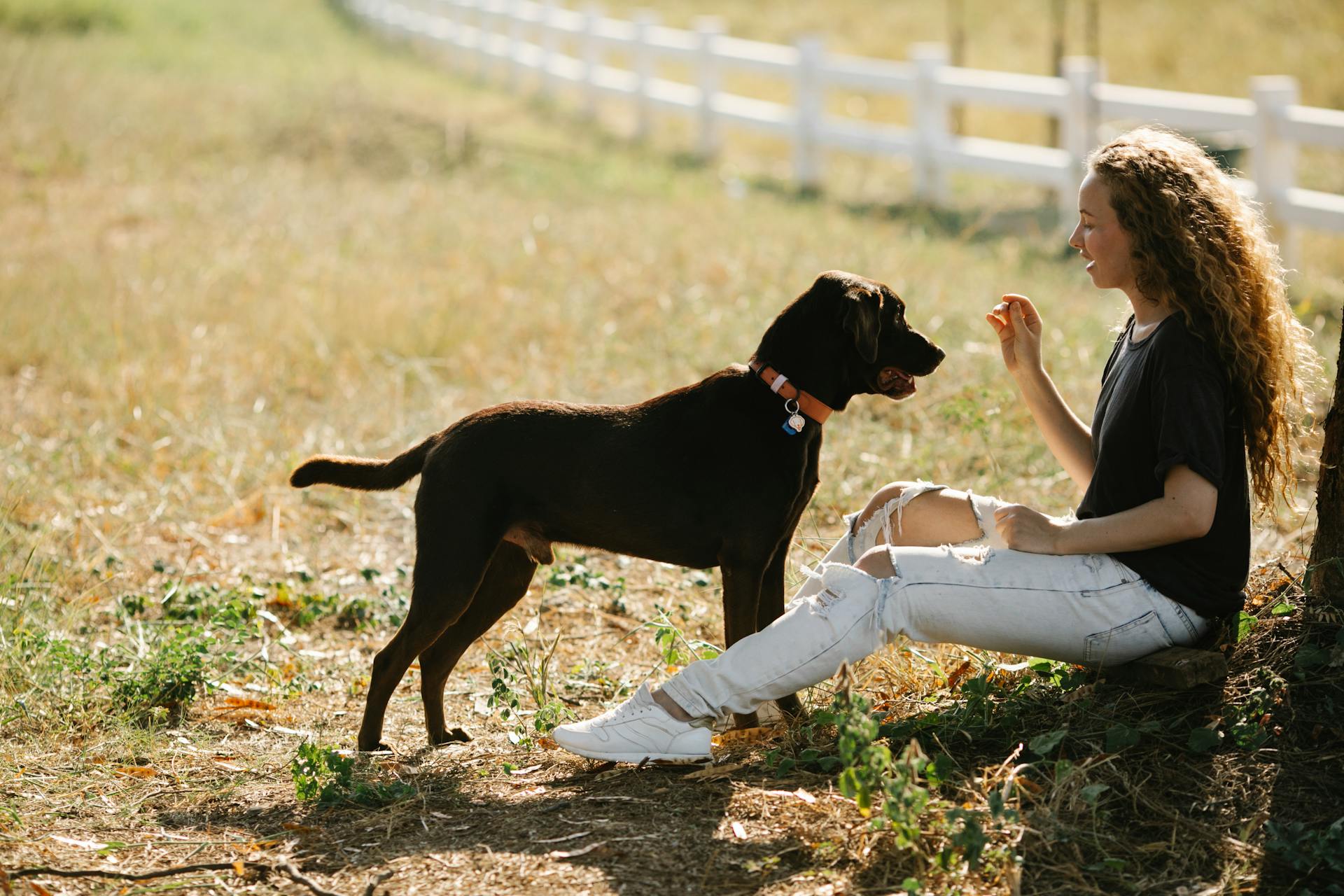
Labradors have a rich history as working retrievers, bred to assist fishermen in Newfoundland, Canada. They were originally called "Lesser Newfoundland" dogs.
Their strong swimming ability and water-resistant coats made them ideal for retrieving fish and other items from the water.
The breed's early history is closely tied to the fishing industry, where they worked alongside fishermen to help with tasks such as retrieving fish and other items from the water.
In the 18th century, the breed was developed further to become the Labrador Retriever we know today, with a focus on their exceptional retrieving abilities.
See what others are reading: Do Labradors like Water
Labrador History
The Labrador Retriever has a rich history that dates back to the island of Newfoundland, where they descended from the St. John's Water Dog, a working dog.
These St. John's Dogs were bred to retrieve nets for fishing boats, and it's said that the 2nd Earl of Malmesbury was so impressed that he had some of them imported to England.
You might like: Saint Bernard Dog Origin
The first recorded pedigrees of the Labrador Retriever date back to 1878, but it wasn't until 1917 that the breed was officially recognized by the AKC.
The breed has since been split into two main types: field-bred, or American Labrador, and show-bred, or English Labrador.
Show-bred Labradors tend to be stocky, with a calm demeanor, while field-bred Labs are leaner and more energetic, reflecting their original purpose as hunting dogs.
The original Labradors bred in England were bred to excel in both the hunt and as family pets, making them a versatile breed that's well-suited to many roles.
Explore further: Labrador Show Dog
Original Purpose
Labradors were originally bred for a very specific job - to retrieve game birds for hunters. They were developed in response to the introduction of guns in the UK, which changed the way people hunted.
The first guns were cumbersome muzzle loaders, but with the advent of faster breech loading guns and driven game shooting, a new type of dog was needed. A dog that could remain calm in the midst of excitement and retrieve bird after bird without disturbing the game was required.
Labradors were specifically bred to fill this need, and they quickly became the top choice for this job.
From St John's Water Dog to Labrador Retriever
The original Labrador Retriever was bred from St Johns Water dogs imported from Newfoundland, which had originally been taken there from the UK by emigrating fishermen.
These St Johns Water dogs were a crucial part of the development of the Labrador Retriever breed, and it's fascinating to think about the journey they took to get here.
The Labrador Retriever was developed to meet the needs of game hunters in the UK, who required a dog that could remain calm in the midst of excitement and retrieve bird after bird.
A dog that could do this job was needed because the advent of faster breech loading guns and driven game shooting in the UK had changed the face of game hunting, making it more efficient and productive.
The Labrador Retriever was bred to be this dog, and it was these working dogs that were exported to the USA to form the foundations of all the lines of both field and show labs that exist today.
Suggestion: How Was the Boxer Breed Created
Original Role of the Working Retriever
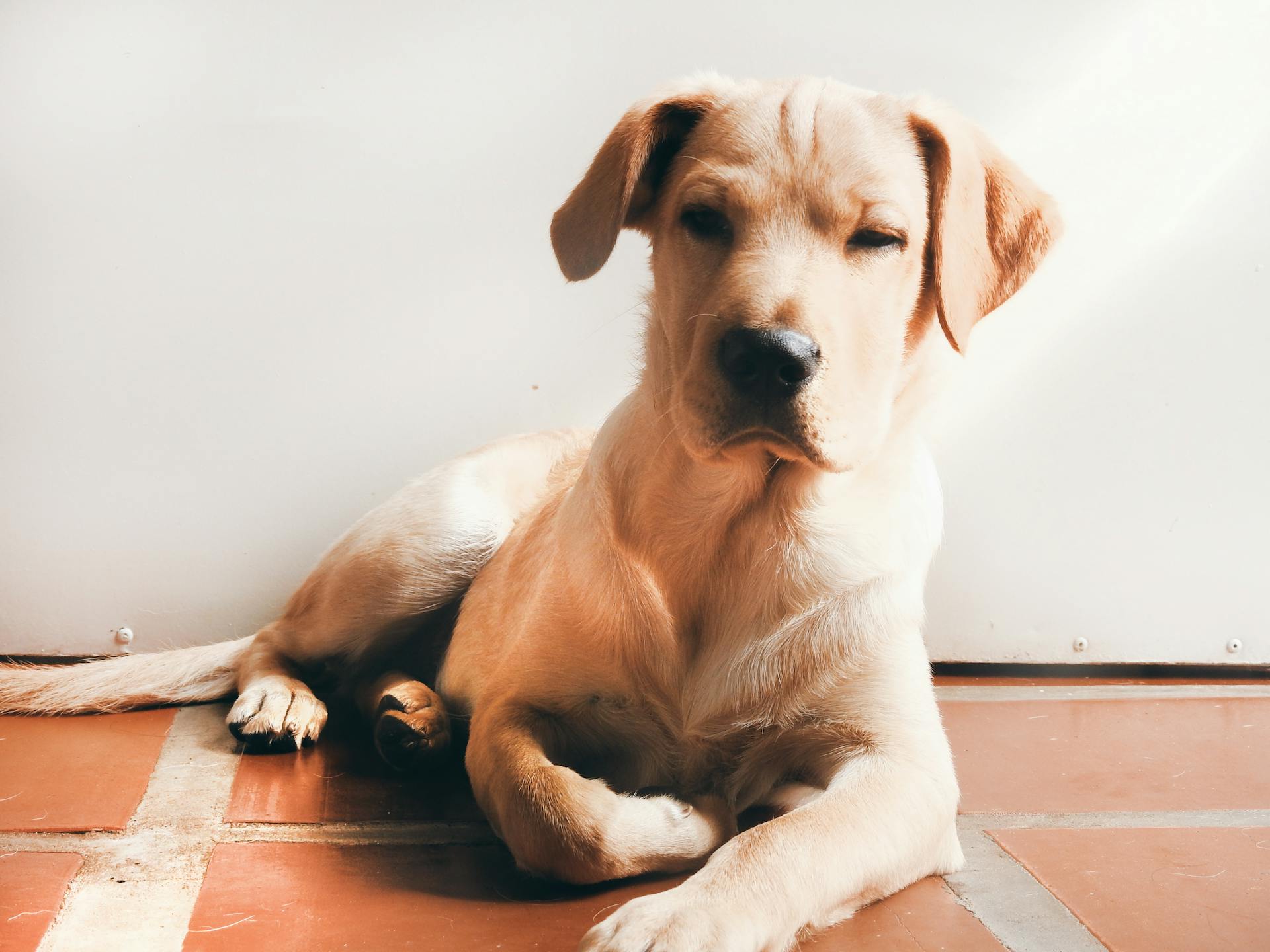
The original role of the working retriever was a direct response to the development of guns, which changed the face of game hunting.
The first guns were cumbersome muzzle loaders, and dogs like pointers and setters were used to hunt vast areas and seek out individual birds.
A dog that could remain calm in the midst of excitement and retrieve bird after bird was required, which led to the development of retriever breeds.
The Labrador Retriever was the breed that reigned supreme at this task, and it was these working dogs that were exported to the USA to form the foundations of all the lines of both field and show labs.
The first Labs were bred from St Johns Water dogs imported from Newfoundland, having originally been taken there from the UK by emigrating fishermen.
Intriguing read: Where Are Beagle Dogs from
Training and Requirements
Labradors are highly trainable, making them a popular choice for service dog training. Their keen nose gives them an advantage as search and rescue dogs.
Labradors are bred to work, and with a keen sense of smell and desire to please, this athletic breed is designed for the hunt. They excel as sporting dogs, and hunting breeders can help you find a Lab with the hunting dog qualities you most desire.
To be a successful service dog or search and rescue dog, Labradors need advanced training that leverages their keen sense of smell and athleticism.
Requirements
To become a successful professional in this field, you'll need to meet certain requirements. You'll need to have a bachelor's degree in a relevant field, such as computer science or engineering.
A strong foundation in programming languages is essential, with a focus on languages like Java, Python, and C++. You'll also need to have experience with data structures and algorithms.
In terms of soft skills, good communication and teamwork skills are crucial, as you'll be working with cross-functional teams to develop and implement solutions. You'll also need to be able to adapt to new technologies and tools quickly.
Intriguing read: Do Labradors Need Winter Coats
You'll need to have a minimum of 2 years of experience in a related field, such as software development or data analysis. This experience can be gained through internships, co-op programs, or entry-level positions.
A professional certification, such as the Certified Data Scientist (CDS) certification, can also be beneficial in demonstrating your expertise and commitment to the field.
Advanced Training
Labradors are highly capable of advanced training, thanks to their keen nose and strong desire to please. This makes them well-suited for roles that require intense focus and attention to detail.
Their athleticism and endurance also make them ideal for physically demanding tasks, such as search and rescue work. They can keep up with the demands of these roles without getting tired easily.
In fact, Labradors are one of the most popular breeds for service dog training, and their keen nose gives them an advantage as search and rescue dogs.
Check this out: Labradors and More Rescue
Types of Labradors
Labradors were originally bred for three distinct purposes: as waterfowl retrievers, as guides for the blind, and as family companions.
The Labrador Retriever's history as a waterfowl retriever dates back to the 18th century in Newfoundland, where they were bred to hunt and retrieve game for fishermen.
Their strong instinct to retrieve and their love of water made them an ideal breed for this task.
In the early 20th century, the Labrador Retriever was also bred as a guide dog for the visually impaired, leveraging their intelligence, loyalty, and gentle nature.
Their ability to learn and adapt quickly made them a popular choice for this role.
The Labrador Retriever's friendly and outgoing personality also made them a natural fit as family companions, and their popularity in this regard has endured to this day.
Their intelligence, loyalty, and affectionate nature have cemented their place as one of the most popular breeds in the world.
For your interest: Pitbull Dog Family Tree
Featured Images: pexels.com