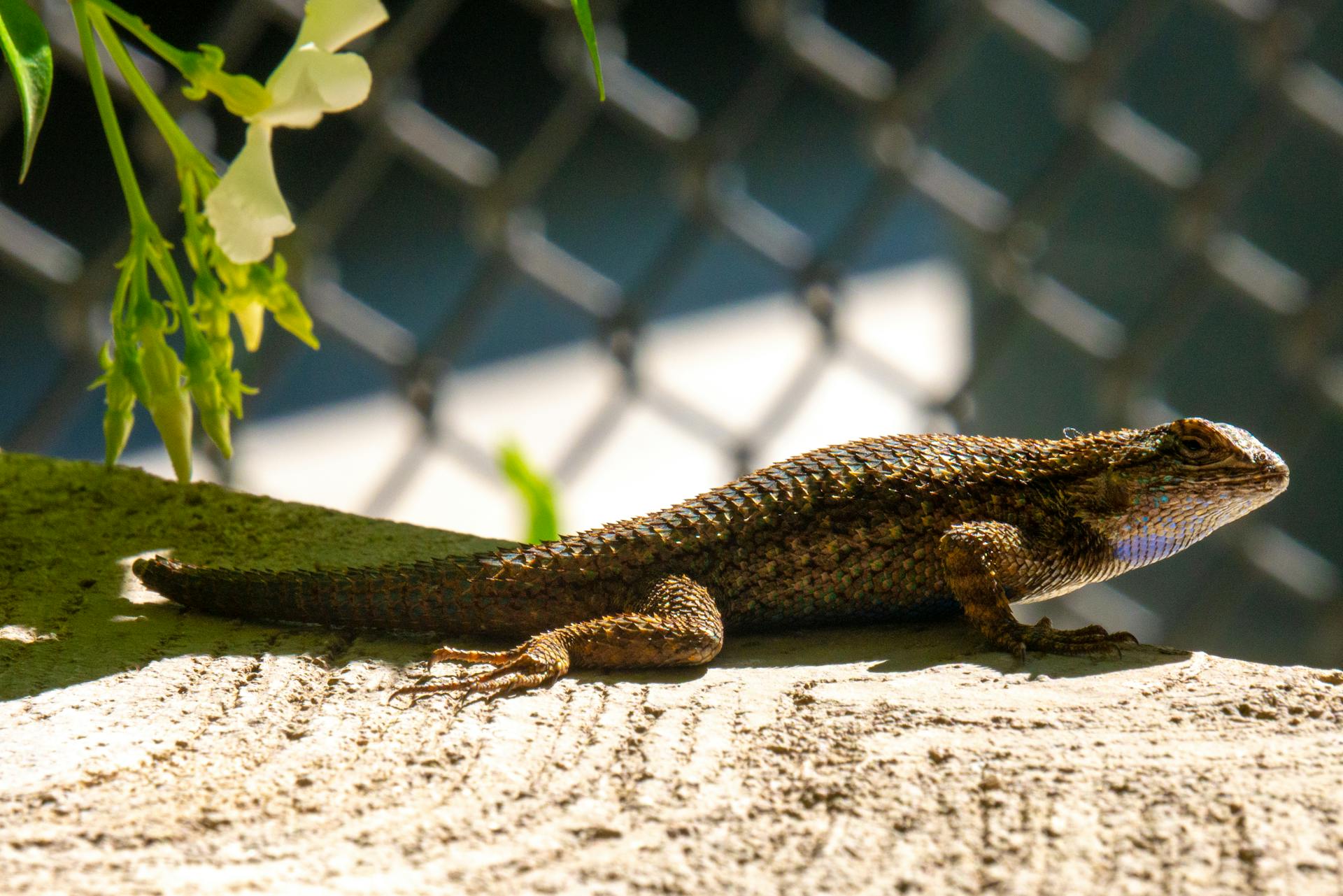
The Western fence lizard is a fascinating creature, and understanding its characteristics and habitat is essential to appreciating its unique qualities.
These lizards are typically 5-8 inches long, with a brown or grayish-brown color that helps them blend in with their surroundings.
They have a distinctive pattern of dark spots or stripes on their back, which can vary in intensity depending on their mood and the environment.
Their tails are long and slender, often making up about half of their total body length.
Western fence lizards are found in the southwestern United States and northern Mexico, where they inhabit dry, rocky areas with scrubby vegetation.
They are often seen basking in the sun on rocks, logs, or other warm surfaces, using their keen sense of sight to scan for potential threats.
Their diet consists mainly of insects, spiders, and other small invertebrates, which they catch using their sharp, pointed snouts.
In the wild, Western fence lizards can live up to 6-8 years, although their average lifespan is about 3-5 years due to predation and environmental factors.
Physical Characteristics
The western fence lizard is a remarkable creature, and its physical characteristics are just one of the many fascinating aspects of its biology. They typically measure 5 to 8 inches long.
Their slender body and long, tapering tail make them well-suited for climbing walls, fences, and trees. You can often spot them basking in the sun on a rocky outcropping or scampering up a tree trunk.
The western fence lizard's coloration varies depending on its environment, but it usually sports a grayish-brown or olive-brown hue. This helps them blend seamlessly with their surroundings, making them expert hide-and-seekers.
One of the most striking features of this lizard is the rows of spiky scales running along its back, giving it the appearance of a miniature dinosaur. These scales are actually quite rough to the touch, thanks to their keeled texture.
Males display bright blue patches on their belly and throat, which become more vibrant during breeding season. This is a clear indicator of their gender, as females and juveniles lack these bright colorations.
Here's a summary of the western fence lizard's physical characteristics:
- Length: 5-8 inches
- Coloration: Grayish-brown, olive-brown, or varying shades of brown, gray, or black
- Pattern: Dark crossbands or wavy markings across the back
- Scales: Spiky, with a keeled texture
- Distinctive feature: Males display bright blue patches on their belly and throat
Habitat and Distribution
The western fence lizard is a remarkable creature, and one of its most impressive traits is its adaptability. They can thrive in a wide range of environments, from grasslands and meadows to woodland edges and clearings.
These lizards are particularly fond of areas with vertical structures, such as rocks, fallen logs, and fence posts, where they can bask and display. They make excellent use of these surfaces for thermoregulation and territorial displays.
You can find western fence lizards in many different places, including California, Oregon, Washington, Idaho, Nevada, Utah, Arizona, and northwestern Baja California in Mexico. They also live on some islands off the coasts of California and Baja California.
Their geographic range is quite impressive, covering most of California, western Nevada, Oregon, Washington, parts of Idaho, northern Baja California, and western Utah. They can be found at elevations ranging from sea level to over 10,800 feet in the Sierra Nevada mountains.
Here are some of the specific habitats where you can find western fence lizards:
- Grasslands and meadows
- Woodland edges and clearings
- Chaparral and scrubland
- Suburban environments (yards, parks, gardens)
- Rocky areas where they can bask and seek shelter
Behavior and Life Cycle
Western fence lizards are active during the day, often basking in the sun on rocks, paths, or fence posts. This behavior helps them warm up, but also makes them easy targets for predators like birds and small mammals.
They use their quick reflexes to escape from predators and may also bite or poop on them to defend themselves. This defensive strategy is quite effective, allowing them to protect themselves from harm.
Western fence lizards primarily feed on spiders and insects, including beetles, mosquitoes, and various types of grasshoppers. Their diet is diverse and abundant, allowing them to thrive in their environments.
These lizards typically go into a deep sleep called brumation during the winter, with the duration and timing of their sleep depending on the weather. This adaptation helps them conserve energy and survive the harsh winter conditions.
Male western fence lizards protect their territory during mating season, engaging in territorial displays to attract females. They bob their heads and extend their bright blue throat patches to showcase their suitability as mates.
The reproductive cycle of western fence lizards follows a seasonal pattern, with breeding typically occurring from April to June. Females lay eggs in clutches, which can range from 3 to 17 eggs, with an average of 6-8 eggs per clutch.
Here's a breakdown of the reproductive cycle:
- Breeding season: April to June
- Clutch size: 3-17 eggs (average 6-8)
- Multiple clutches: 2-3 clutches per season in favorable conditions
- Incubation: 7-9 weeks in soil temperatures of 75-85°F (24-29°C)
- Maturation: Juveniles reach sexual maturity at 1-2 years of age
- Lifespan: Average 5-7 years in the wild, potentially longer in captivity
What It Eats
Western fence lizards are primarily insectivorous, feasting on a variety of small invertebrates. Their diet typically includes small beetles and their larvae, various ants and other small hymenopterans, grasshoppers and crickets, spiders (including small scorpions), flies and mosquitoes, caterpillars and other soft-bodied insects, and occasionally small snails.
They're particularly effective at reducing populations of many nuisance insects, making them valuable natural pest controllers in gardens and yards.
Scientific Classification and Overview
The western fence lizard is part of the family Phrynosomatidae, which includes spiny lizards and horned lizards.
This family classification is important because it helps us understand the western fence lizard's behavior and physical characteristics.
The western fence lizard is commonly known as the "blue-belly" due to the vivid blue patches on the male's underside.
Broaden your view: Electric Blue Gecko
Subspecies
Western fence lizards have been recognized as having several subspecies based on their geographic location and slight variations in appearance.
Researchers have identified four distinct subspecies: the Pacific western fence lizard, the Great Basin western fence lizard, the Great Basin fence lizard, and the Coast Range fence lizard.
These subspecies have adapted to their specific regional habitat conditions, showcasing the remarkable diversity within this single species.
The Pacific western fence lizard, S. o. occidentalis, is one of the recognized subspecies.
The Great Basin western fence lizard, S. o. biseriatus, is another notable subspecies, found in the Great Basin region.
Here's a brief overview of the subspecies:
- S. o. occidentalis: The Pacific western fence lizard
- S. o. biseriatus: The Great Basin western fence lizard
- S. o. longipes: The Great Basin fence lizard
- S. o. bocourtii: The Coast Range fence lizard
Scientific Classification
The western fence lizard, a fascinating species, belongs to the family Phrynosomatidae. This family includes spiny lizards and horned lizards.
The western fence lizard is commonly known as the "blue-belly" due to the vivid blue patches on the male's underside.
On a similar theme: Blue Tongue Lizards Australia
Species Overview
The species we're discussing is quite fascinating. It belongs to the kingdom Animalia, which is the largest and most diverse kingdom of life on Earth.
These organisms are multicellular, meaning they're made up of many cells, and they're heterotrophic, relying on other sources for nutrition.
Their bodies are typically made up of tissues, organs, and systems that work together to maintain homeostasis, or a stable internal environment.
This species is also characterized by its ability to move, reproduce, and respond to stimuli, all of which are essential for its survival.
In terms of their physical structure, they have a body, organs, and tissues that are adapted to their specific environment and lifestyle.
Featured Images: pexels.com