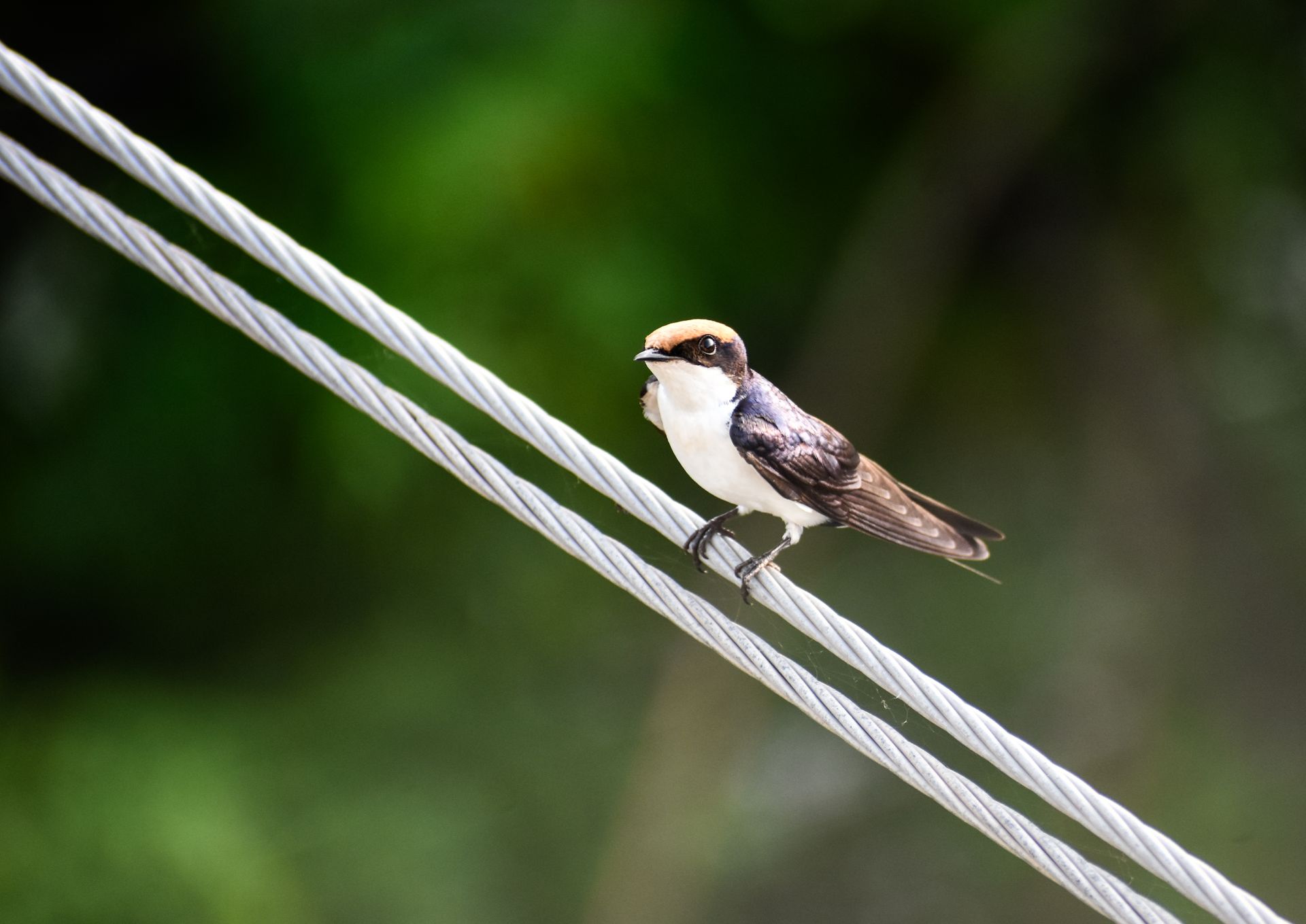
The Violet Green Swallow is a fascinating bird species that's native to North America. They're known for their iridescent feathers, which reflect shades of green, purple, and bronze.
In terms of size, Violet Green Swallows are relatively small, measuring around 4-5 inches in length. Their wings are long and pointed, perfect for their fast and agile flight.
These birds are highly social creatures, often found in large flocks during their migratory seasons. They're also known to be quite territorial, with males engaging in aggressive displays to defend their nesting sites.
Their diet consists mainly of insects, which they catch in mid-air with incredible speed and agility.
Take a look at this: Violet Chinchillas
Physical Characteristics
The violet-green swallow is a stunning bird, and its physical characteristics are truly unique. The species is best identified by its glossy green on the top of the head and back, as well as hints of purple on the nape, rump, and upper tail.
One of the most distinctive features of the violet-green swallow is its coloration. The green back is a deep, rich color that really catches the eye, especially when the bird is in flight. The white below is a nice contrast to the green above, and it helps to make the bird's distinctive markings stand out.
Expand your knowledge: Black Capped Chickadee Bird
The violet-green swallow's wings are long and pointed, perfect for catching insects in mid-air. In fact, the species is an aerial insectivore, and it spends most of its time flying over lakes and streams in search of food. The wings are also a nice grayish-bronze color, which helps to distinguish the violet-green swallow from other members of its family.
Here are some key physical characteristics of the violet-green swallow:
- Glossy green on top of the head and back
- Hints of purple on the nape, rump, and upper tail
- Grayish-bronze color on the wings
- White below, including the cheeks and rump side-patches
- Long, pointed wings perfect for catching insects
It's worth noting that the violet-green swallow exhibits very little sexual dimorphism, with adult males simply showing brighter colors than adult females. This means that the difference between males and females is relatively subtle, and it's not always easy to tell them apart.
Taxonomy
The violet-green swallow is a bird that's been well-studied ecologically, but only recently has its phylogeny been thoroughly researched. It's a member of the family Hirundinidae, which is split into two subfamilies: Pseudochelidoninae and Hirundininae.
The Hirundininae subfamily is further divided into three groupings: mud nesters, basal relicts, and core martins. The violet-green swallow falls into the last group, making it an important member of the Tachycineta clade.
The Tachycineta genus is a monophyletic group and is considered the sister taxa of all other New World swallows. Within this genus, the violet-green swallow is a member of the North American grouping, along with the North American tree swallow, the golden swallow of Hispaniola and Jamaica, and the Bahama swallow.
Here's a breakdown of the taxonomy of the violet-green swallow:
- Kingdom: Animalia
- Phylum: Chordata
- Subphylum: Vertebrata
- Class: Aves
- Order: Passeriformes
- Family: Hirundinidae
- Genus: Tachycineta
- Species: Tachycineta thalassina
The taxonomy of the violet-green swallow is well understood up to the genus level, but some uncertainty surrounds the placement of T. thalassina within the North American clade of the genus Tachycineta.
Adapts to diverse habitats
The violet-green swallow is an incredibly adaptable bird species, capable of thriving in a wide range of habitats. From deciduous and coniferous forests to open meadows and rocky cliffs, these birds have been spotted in various environments across their geographical range.
In fact, violet-green swallows can be found in over 10 different types of habitats, including temperate, tropical, and terrestrial biomes. They are particularly fond of areas with moist soil, which allows them to feed on aerial insects that depend on these conditions to survive.
One of the key factors that enable violet-green swallows to adapt to diverse habitats is their ability to nest in a variety of cavities. In Mediterranean woodland environments, they use decaying trees or holes constructed by woodpeckers to build their nests. In Alaska, they typically nest in trees along coastlines and in artificial nesting boxes when available.
Here are some of the specific habitats where violet-green swallows have been spotted:
- Deciduous and coniferous forests
- Open meadows and rocky cliffs
- Temperate, tropical, and terrestrial biomes
- Lakes and ponds
- Rivers and streams
- Marshes, swamps, and bogs
- Urban and rural areas
Their ability to adapt to different environments has allowed violet-green swallows to thrive in a wide range of locations, from the Pacific Coast to Mexico and beyond.
Behavior and Migration
Violet-green Swallows are highly social birds, often found in flocks of mixed-swallow species and in single-species flocks.
They are incredibly agile in flight, foraging almost exclusively in the air. Their flight is more fluttery than that of Tree Swallows.
These birds will often fly high, but they're not above feeding low over open water, especially when the weather is bad.
For your interest: Dog Swallows
Hybridization
Hybridization is a rare occurrence among swallows, with only a few reported cases of violet-green swallows interbreeding with other species.
Breeding between violet-green swallows and both tree and barn swallows has been recorded, but resulting offspring were not observed.
One notable case of possible successful hybridization was reported in British Columbia, Canada, in 2000, where a swallow with unusual plumage suggested a possible mix between a violet-green swallow and a cliff swallow.
These observations are indeed rare, which is why there's minimal research into swallow hybridization.
Behavior
Violet-green swallows are highly social birds that often gather in flocks of mixed-swallow species and single-species flocks.
Their flight is quite distinctive, being more fluttery than that of Tree Swallows and often taking them higher than other swallow species.
In bad weather, violet-green swallows will feed low over open water, showing their adaptability.
These birds are also incredibly agile, foraging almost exclusively in flight.
Migration Status
One of the most fascinating things about Violet-green Swallows is their migration status. They arrive early in spring, especially in eastern Washington, and are one of the first returning migrants.
These birds are prolific travelers, with some wintering on the southern California coast, but most heading to Mexico and Central America. Two waves of migrants can often be detected, with birds that have bred in Washington leaving the state in late July or early August.
In contrast, breeders from farther north, including many immature birds, pass through in late September. It's not uncommon to spot them migrating in flocks, often traveling along ridges and major rivers.
Interspecific Competition
Interspecific competition is a fascinating aspect of violet-green swallow behavior. They've been observed competing with other bird species for nesting sites, often with physical altercations.
In 1974, a field observer noted a competitive behavior between mountain chickadees and violet-green swallows. The swallows attempted to overtake a nesting site occupied by a pair of chickadees and their fledglings, resulting in multiple aerial battles.
The chickadees regained control of their nest and successfully defended against future violet-green swallow attacks. This outcome was repeated in a similar altercation between violet-green swallows and hairy woodpeckers.
A scarcity of viable nesting sites may lead to this interspecific competitive behavior in violet-green swallows. They're summer residents with late breeding habits, while species like mountain chickadees and hairy woodpeckers are permanent residents with first choice of nesting sites.
Violet-green swallows have also been involved in competitive behavior with acorn woodpeckers for potential nesting sites. This behavior is a result of the swallows' need to find suitable nesting sites for breeding and raising their young.
Here are some examples of species that violet-green swallows have competed with for nesting sites:
Vocalizations
Violet-green swallows are quite vocal creatures, but there's still much to be learned about their vocalizations.
One thing we do know is that they make two main classes of vocalizations: chee-chee calls and twitter calls.
Chee-chee calls are typically mono- or bi-syllabic and can be as high as 7.0 kHz in frequency. They're also relatively long, lasting around 165 milliseconds.
Twitter calls, on the other hand, are monosyllabic and fall within a frequency range of 2.0 to 6.5 kHz. They're shorter, lasting around 125 milliseconds.
Here's a breakdown of the characteristics of these two types of calls:
Nesting and Conservation
The violet-green swallow's nesting habits are quite fascinating. They are known to make seasonal movements between breeding and wintering grounds.
One of the unique aspects of their nesting behavior is their ability to nest in a variety of habitats, including cities and towns. This adaptability has helped their population remain stable in some areas.
The violet-green swallow's conservation status is also worth noting. Despite experiencing a 28% population decline from 1966 to 2015, they are still considered a species of "least concern" on the IUCN Red List.
Here are some key facts about the violet-green swallow's conservation status:
- IUCN Red List: Lower Risk - Least Concern
- US Migratory Bird Act: Protected
- US Federal List: No special status
- CITES: No special status
Nesting Sites
Violet-green swallows are secondary cavity nesters, meaning they typically nest in natural holes or previously occupied nests. They often take over nests from other species, and a majority of their nests are in tree holes excavated by other animals or within the cracks of large cliffs.
These birds are highly impacted by forest management practices due to their dependence on large trees. In fact, they have been observed occupying artificial nest boxes.
Violet-green swallows typically breed in independent nests, except on cliffs where large colonies can be found nesting together. This communal nesting behavior is a notable exception to their usual solitary nesting habits.
It's worth noting that violet-green swallows have been involved in interspecific competition for nesting sites, as seen in a 1974 observation of a physical altercation between mountain chickadees and violet-green swallows. The chickadees successfully defended their nest against the swallows.
Here's a list of some of the natural cavities that violet-green swallows might nest in:
- Tree holes excavated by other animals
- Cracks in large cliffs
- Artificial nest boxes
These nesting sites are crucial for the survival of violet-green swallows, and conservation efforts should prioritize preserving natural habitats and providing alternative nesting options.
Interspecific Egg-Dumping
Interspecific egg-dumping is a fascinating phenomenon where a female violet-green swallow will lay her egg in an active bluebird nest box. This behavior is often the result of the swallow being unable to access her original nest after laying her egg.
Readers also liked: Dog Swallow
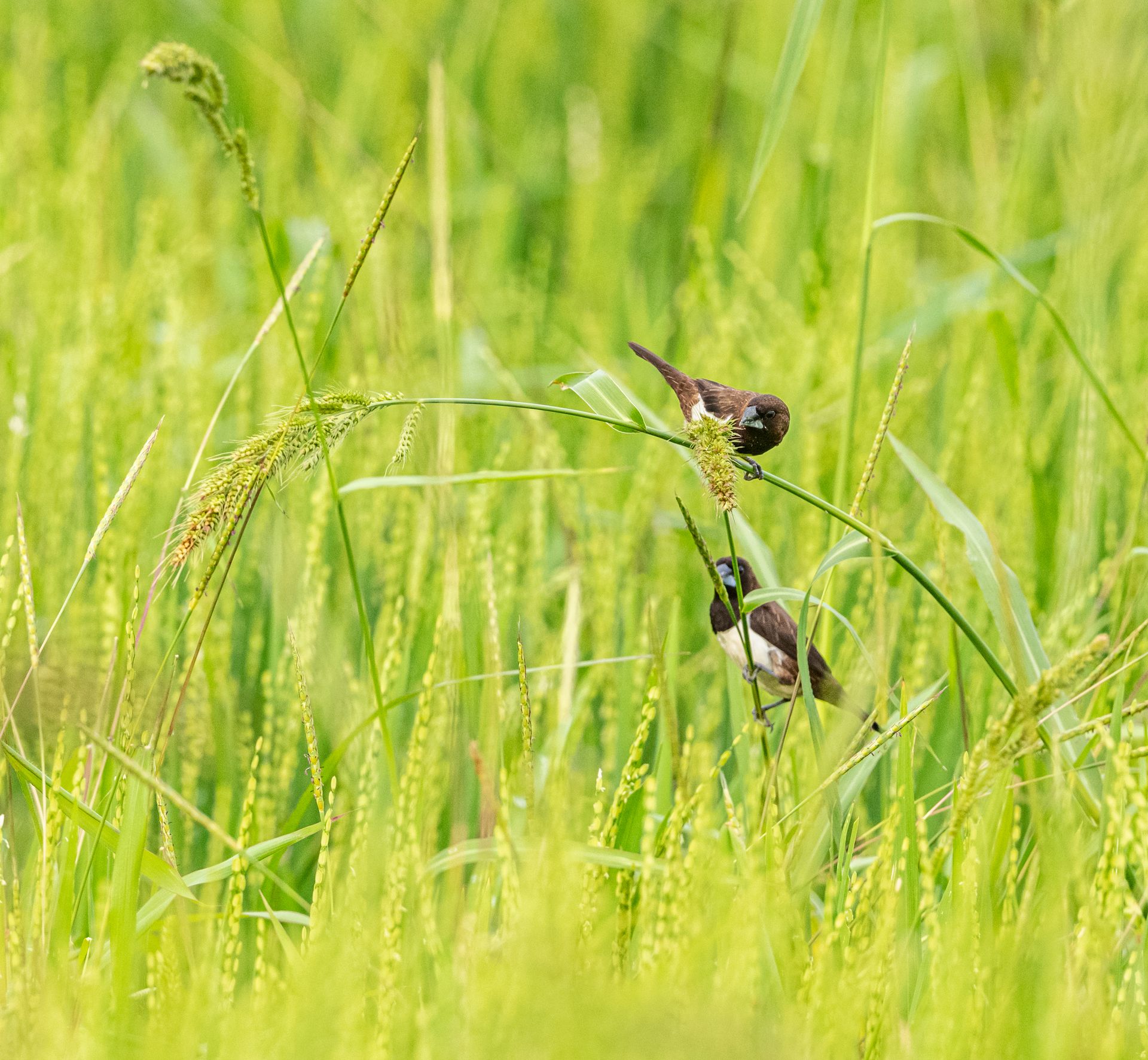
Violet-green swallows have been observed cooperating and competing with western bluebirds, and in some cases, they'll even lay their eggs in bluebird nests. The male bluebird will often try to drive the swallow away from the nest cavity.
In one observed instance, a female violet-green swallow laid an egg in a bluebird nest box, and the bluebirds tolerated her presence. However, the next day, the newly laid egg was found smashed below the nest.
This behavior suggests that when unable to access her original nest, a female violet-green swallow may participate in interspecific egg-dumping as a last resort.
For more insights, see: Northern Mockingbird Male vs Female
Conservation Status
The violet-green swallow's conservation status is a bit of a mixed bag. They're considered a species of "least concern" on the IUCN Red List, which is good news. However, their population has declined by about 28% from 1966 to 2015, which is concerning.
They're protected under the U.S. Migratory Bird Act, which is a positive step. But they don't have any special status on the U.S. Federal List or CITES.

Here's a breakdown of their conservation status:
- IUCN Red List: Lower Risk - Least Concern
- US Migratory Bird Act: Protected
- US Federal List: No special status
- CITES: No special status
It's worth noting that their population decline may be linked to the decline of aerial insect populations due to insecticides, global warming, and pollution. This is a trend we're seeing in many species, not just the violet-green swallow.
Identification and Media
The Violet-green Swallow is a bird that's a joy to spot, and knowing how to identify it can make all the difference. They fly at various heights with rapid wingbeats.
One way to spot these birds is to look for them over water bodies, as they often search for flying insects in these areas.
Their distinctive white patches on either side of the rump are a dead giveaway.
General Information
The violet-green swallow is a small bird, measuring 5¼ in. (13 cm) in length, with a sleek and streamlined body.
They have iridescent violet-green feathers on their back and wings, and white feathers on their belly and face.
Their tails are moderately forked, and their wings extend beyond their tail when perched.
In Washington, they can be confused with tree swallows, but the violet-green swallow has white patches on its sides and a distinctive wing shape.
Females are drab in color compared to males, and juveniles have a brownish-gray back and a grayish-white belly.
Juveniles also have dusky faces and lack the breast-band that juvenile tree swallows have.
The violet-green swallow's body is well-suited for catching insects in flight, with a long pointed wing and a slim, streamlined body.
They perform acrobatic stunts over lakes and streams in search of flying insects, and can be seen in the West during spring and summer.
Their true colors are revealed when sunlight illuminates their metallic green backs and iridescent purple rumps.
They spend the winter months in Mexico and Central America, but return to the West in the spring.
Explore further: American Tree Sparrow
Frequently Asked Questions
Do Violet-green Swallows eat mosquitoes?
Yes, Violet-green Swallows are known to feed on mosquitoes and other small flying insects. They can consume hundreds of these insects in a single day.
What does a Violet-green Swallow symbolize?
Violet-green Swallows symbolize good luck, positive change, love, and devotion, while also embodying traits like loyalty, cheerfulness, and patience. Seeing one is often considered a fortunate sign, associated with uplifting energies.
Featured Images: pexels.com