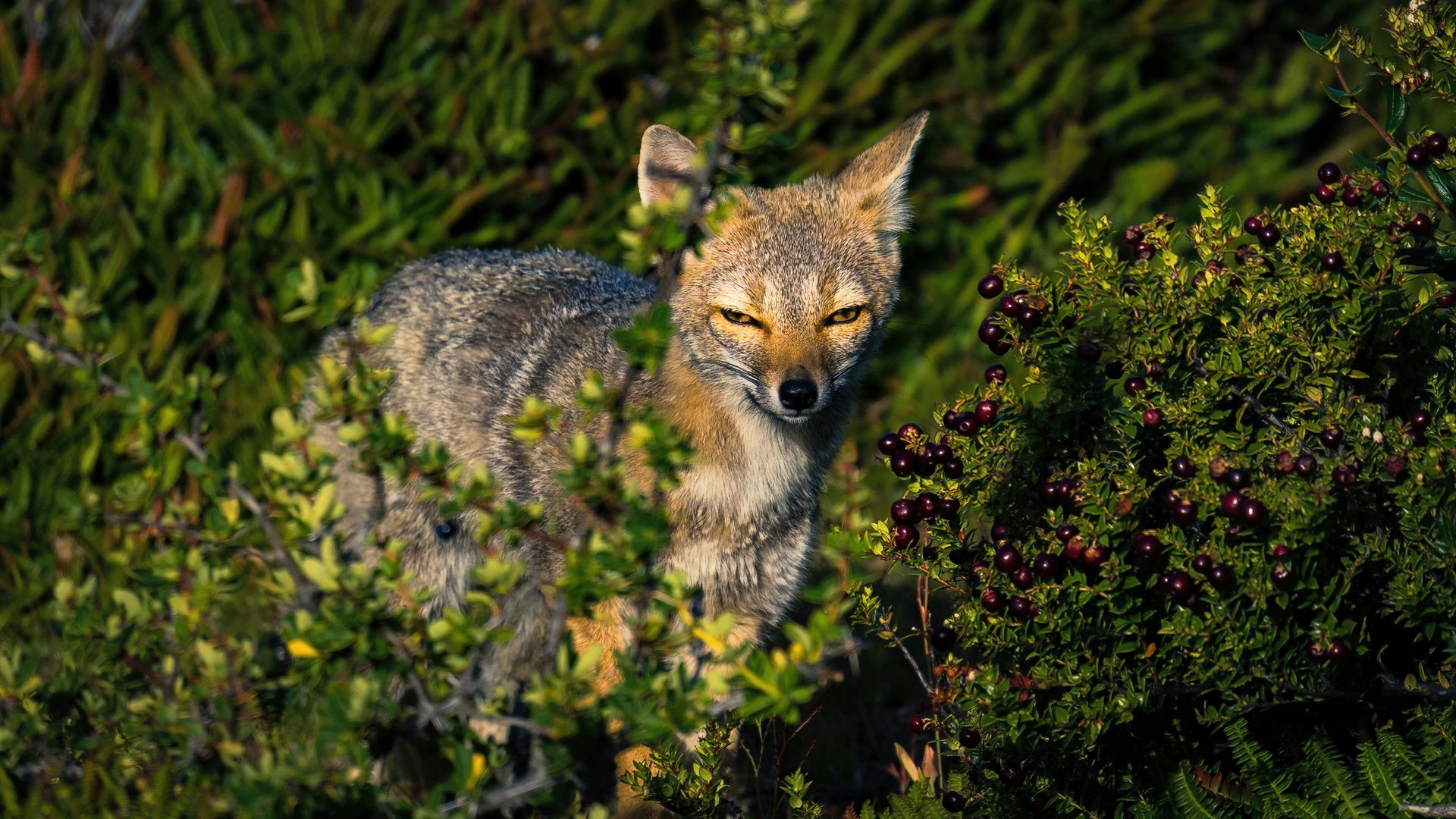
The Gray Fox, also known as Urocyon cinereoargenteus, is a unique and fascinating species.
They are found in a variety of habitats, including forests, grasslands, and deserts, across the southwestern United States, Mexico, and Central America.
The Gray Fox is known for its distinctive black-tipped ears and bushy tail.
This species is highly adaptable, thriving in different environments with ease.
Physical Description
Gray foxes are medium-sized canids with elongated bodies and relatively short legs. They usually weigh between 3 and 5 kg, but can weigh up to 9 kg. Males are slightly larger than females.
Their fur is a mix of white, red, black, and gray, with new born pups being dark brown. Gray foxes have a distinctive black stripe along the dorsal surface of their tail and a black tip. The top of the head, back, sides, and rest of the tail are gray, while the belly, chest, legs, and sides of the face are reddish brown.
Here are some key physical features of gray foxes:
- Endothermic
- Homoiothermic
- Bilateral symmetry
Gray foxes have oval-shaped pupils and a thin black stripe around their eyes. They also have a thick black stripe running from the inside corner of the eye, down the muzzle to the mouth.
Habitat and Distribution
Gray foxes are adaptable creatures that thrive in a variety of habitats. They prefer to live in deciduous forests interspersed with brushy, woodland areas, where proximity to water is a key feature.
Gray foxes are found in a range of terrestrial biomes, including savanna or grassland, forest, and scrub forest. Their ability to climb trees sets them apart from other members of the Canidae family.
Their geographic range spans from southern Canada to Venezuela and Colombia, with a preference for elevations below 3000 meters.
Here are some of the key habitat regions and terrestrial biomes where gray foxes can be found:
- Habitat Regions:
- temperate
- terrestrial
- Terrestrial Biomes:
- savanna or grassland
- forest
- scrub forest
Distribution
Gray foxes are found in a wide range of geographic locations, spanning from southern Canada to Venezuela and Colombia.
Their range includes the lower half of the Nearctic region, which is a biogeographic region that covers a significant portion of North America.
The Nearctic region is one of the two main biogeographic regions that gray foxes inhabit, the other being the Neotropical region.
Here are the biogeographic regions where gray foxes can be found:
- nearctic
- neotropical
Gray foxes are not found in the Great Plains or the mountainous regions of northwestern United States, nor on the eastern coast of Central America.
Habitat
Gray foxes are adaptable creatures that thrive in a variety of habitats. They prefer to live in deciduous forests with brushy, woodland areas.
Their denning sites are often located in hollow trees or logs, under large rocks, or in underground burrows. They've even been found in the lower forest canopy, 10 m above the forest floor, in hollow tree trunks and limbs.
Gray foxes are unique in their ability to climb trees, a skill that sets them apart from other members of the Canidae family. They typically live below 3000 m in elevation.
The gray fox is considered a habitat generalist, meaning they can make themselves at home in a variety of forest types. Their preferred habitat includes deciduous forests, mixed forests, and coniferous forests in the northeast.
Here are some specific habitat regions and biomes where gray foxes are commonly found:
- Habitat Regions: temperate, terrestrial
- Terrestrial Biomes: savanna or grassland, forest, scrub forest
Fox Habitat
Gray foxes prefer to live in deciduous forests interspersed with brushy, woodland areas. Many populations thrive where woodlands and farmlands meet. Proximity to water is a key feature of their preferred habitat.
They are most often found below 3000 m in elevation and are the only member of the Canidae family that can climb trees. Their dens are usually located in hollow trees or logs, in crevices between and under large rocks, and in underground burrows.
Their home ranges vary between 1 and 7 km^2, depending on geographic range, with an average home range size of 2.1 km^2. Gray foxes use only small portions of this range each day.
Here are the different types of habitats where gray foxes can be found:
- savanna or grassland
- forest
- scrub forest
They are considered habitat generalists and may make their homes in a variety of forest types, including deciduous, mixed, and coniferous forests. Gray foxes are most closely associated with deciduous forests, but are also found in thickets, swamps, and old fields bordering extensive forested areas.
Behavior and Conservation
Gray foxes are primarily nocturnal, but have been occasionally spotted during daytime. They are solitary animals, only socializing with their mate and offspring during winter.
Their home ranges vary in size, but on average, they cover about 2.1 square kilometers. Gray foxes use urine and feces to mark their territory and advertise ownership.
Some key behaviors of gray foxes include being scansorial, meaning they climb trees, and being terriocolous, meaning they live on the ground. They also exhibit daily torpor, a state of reduced activity, and are known to be motile, meaning they move around frequently.
Here are some of the key behaviors of gray foxes:
- Scansorial
- Terriculous
- Troglophilic
- Nocturnal
- Motile
- Nomadic
- Daily torpor
- Solitary
- Teritorial
Behavior
Gray foxes are primarily solitary animals, only socializing with their mate and offspring during winter. They're also nocturnal, but have been spotted during the day on occasion.
Their physical traits, such as short legs and retractable claws, suggest they're one of the more primitive members of the Canidae family. This is supported by research from Fritzell and Haroldson in 1982.
Gray foxes are territorial, with their home ranges varying in size depending on habitat and food supply. On average, their territory size is around 2.1 square kilometers.
Here's a breakdown of some of the key behaviors exhibited by gray foxes:
- scansorial (climbing)
- terricolous (living on land)
- troglophilic (preferring dark or underground areas)
- nocturnal (active at night)
- motile (able to move)
- nomadic (wandering in search of food)
- daily torpor (periods of reduced activity)
- solitary (living alone)
- territorial (defending a specific area)
Gray foxes are agile climbers, using their sharp claws and flexible forelegs to ascend trees in search of food or to escape predators. They're not as skilled as raccoons or cats, but they're still quite nimble.
Conservation Status
Gray foxes are abundant throughout most areas in the lower two-thirds of North America, which is a good sign for their conservation status. They have no special conservation status at this time.
According to the IUCN Red List, gray foxes are listed as Least Concern. This is also reflected in their status on the US Federal List, CITES, and the State of Michigan List, all of which show no special status.
Gray foxes are widespread, living in the Nearctic biogeographic province, which includes Greenland, the Canadian Arctic islands, and all of North America as far south as the highlands of central Mexico.
Here's a quick rundown of their conservation status:
- IUCN Red List: Least Concern
- US Federal List: No special status
- CITES: No special status
- State of Michigan List: No special status
It's worth noting that despite being trapped and hunted by humans, there doesn't appear to be any immediate threat to their population.
Mortality and Predators
In the wild, Gray Foxes face a significant threat from human activities. Hunting and trapping are legal throughout most of their range, and in many areas, this is the major cause of mortality.
A 2018 DEC survey of small game hunters estimated that hunters killed around 3,667 Gray Foxes in New York State alone. This number is likely an underestimate, given the lack of reporting requirements.
Trapping is also a major concern, with no limit on the number of Gray Foxes killed with traps. Trappers are required to take a mandatory trapper education course to obtain a trapping license.
The primary predator of the Gray Fox is man, and hunting and trapping are the main causes of mortality. In contrast, non-human predators like Eastern Coyotes, Bobcats, and large raptors like Great Horned Owls only occasionally take Gray Foxes.
Here are some key facts about Gray Fox mortality:
- Hunting is allowed in New York State from 25 October to 15 February, at any hour of the day or night, using handguns, shotguns, rifles, bows, or crossbows.
- Trapping of the Gray Fox is legal in New York State from 25 October to 15 February, using body-gripping traps.
- A 1982 study found that trapping was the principal cause of mortality for both Gray Foxes and Red Foxes in Cayuga County, western New York.
Disease is a less important mortality factor than human predation, although Gray Foxes can be affected by canine distemper and rabies.
Reproduction and Mortality

In the wild, Gray Foxes can live for six to eight years, although the oldest recorded individual was ten years old at the time of capture.
Human activities are the primary cause of mortality for Gray Foxes, with hunting and trapping being legal throughout most of their range.
In New York State, hunting is allowed from October 25 to February 15, at any hour of the day or night, using various firearms and bows, and a hunting license is required.
There is no limit on the number of Gray Foxes killed in this way, and hunters are not required to submit a report.
Trapping of Gray Foxes is also legal in New York State during the same period, and trappers must take a mandatory trapper education course to obtain a trapping license.
However, there is no limit on the number of Gray Foxes killed with traps, and trappers are not required to submit a report either.
A 1982 study found that trapping was the principal cause of death for both Gray Foxes and Red Foxes in Cayuga County, western New York.
Disease appears to be a less important mortality factor than human predation, with the Gray Fox having a natural resistance to sarcoptic mange.
The main disease affecting the Gray Fox is canine distemper, although some cases of rabies have been reported in the species.
Here's a summary of the mortality factors affecting Gray Foxes in New York State:
- Hunting: allowed from October 25 to February 15, no limit on number killed
- Trapping: allowed from October 25 to February 15, no limit on number killed
- Disease: canine distemper is the main disease affecting the species
Fox
The Gray Fox is a fascinating creature, and I'm excited to share some interesting facts about it.
Gray Foxes are nocturnal and elusive, making them hard to spot. They are most closely associated with deciduous forests, but are also found in mixed and coniferous forests in the northeast.
One of the best ways to see a Gray Fox up close is by visiting the Adirondack Wildlife Refuge and Rehabilitation Center in Wilmington. The Refuge takes in and rehabilitates injured or disabled wildlife, and knowledgeable staff members are on hand to provide background information on the species and answer visitor questions.
Gray Foxes are opportunistic omnivores, meaning they don't rely on a single food source. Their diet varies with the season and the prey and plant materials available, including small mammals, birds, eggs, insects, fruits, and nuts.
If you're interested in spotting a Gray Fox in the wild, winter offers the best time to see Gray Fox tracks. Gray Foxes are said to be active in late winter, and snow cover provides a canvas for animal tracks.
Here's a rough idea of when to see a Gray Fox in the wild:
- June and July: Best chances of seeing a Gray Fox in the wild, as the young are being weaned and the parents are more likely to be out and about during daytime hours.
- Winter: Best time to see Gray Fox tracks, as they are active in late winter and snow cover provides a canvas for animal tracks.
- Breeding cycle: Gray Foxes are most likely to be seen leaving and returning from their dens, so nature watchers in search of a fox might want to pay close attention to likely den sites in preferred Gray Fox habitat.
Gray Foxes are an ancient species, with fossil evidence placing it in North America some 3.6 million years ago. They are the only canid native to Ohio, and are considered a paraphyletic fox, meaning it's not a true fox because it doesn't belong to the genus Vulpes but rather the genus Urocyon.
General Information
The urocyon cinereoargenteus, also known as the gray fox, is a small omnivorous mammal.
They are native to the southwestern United States, Mexico, and Central America, with a wide range of habitats including forests, deserts, and mountains.
Their diet consists mainly of small mammals, fruits, and insects, which they hunt and gather at night.
They are solitary animals, only coming together for mating or to protect their young.
Frequently Asked Questions
What does Urocyon cinereoargenteus mean?
The scientific name Urocyon cinereoargenteus breaks down to "tailed dog" in Greek and "silver" or "gray" in Latin, reflecting the gray fox's distinctive appearance. This unique name combination provides insight into the species' characteristics and origins.
Featured Images: pexels.com