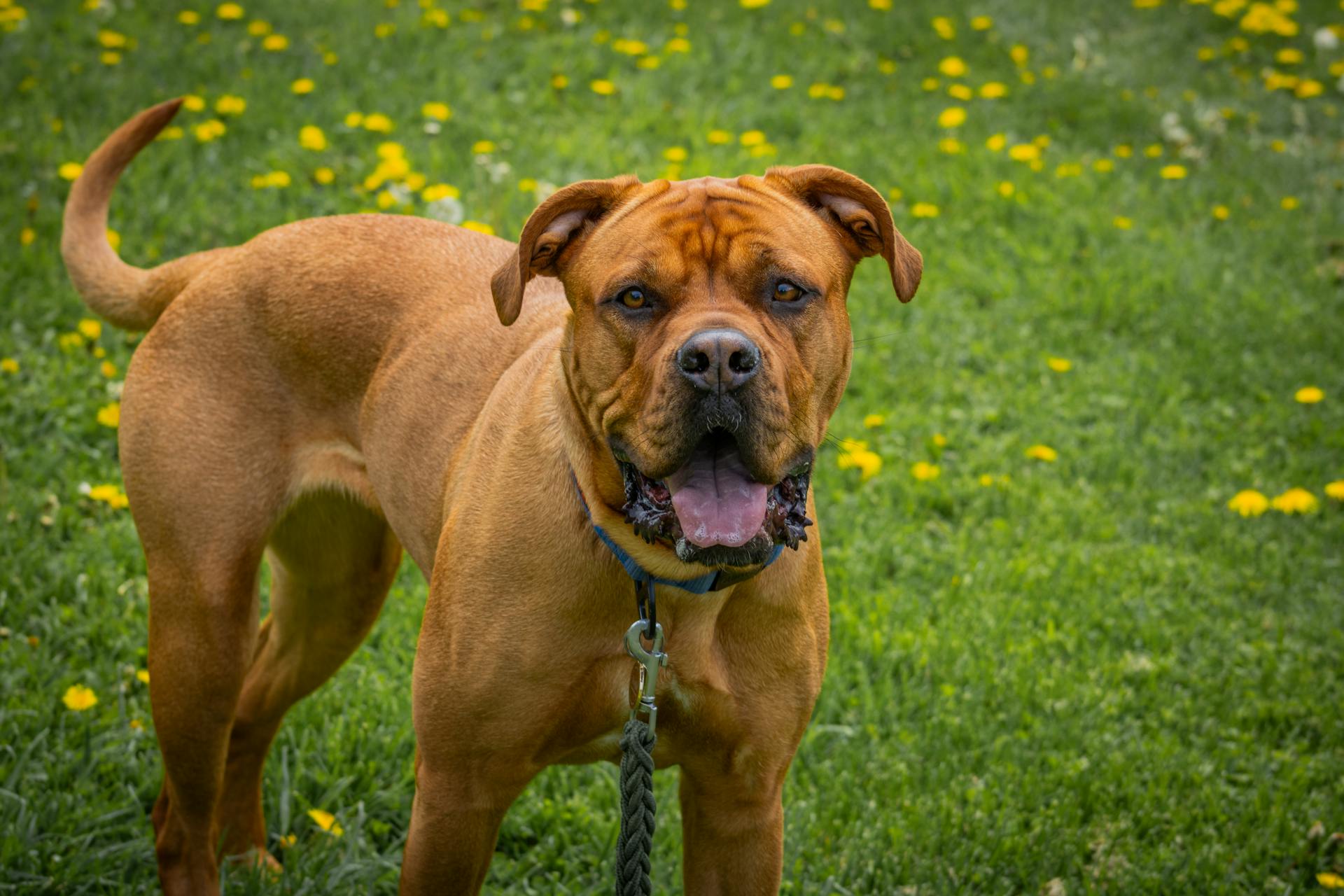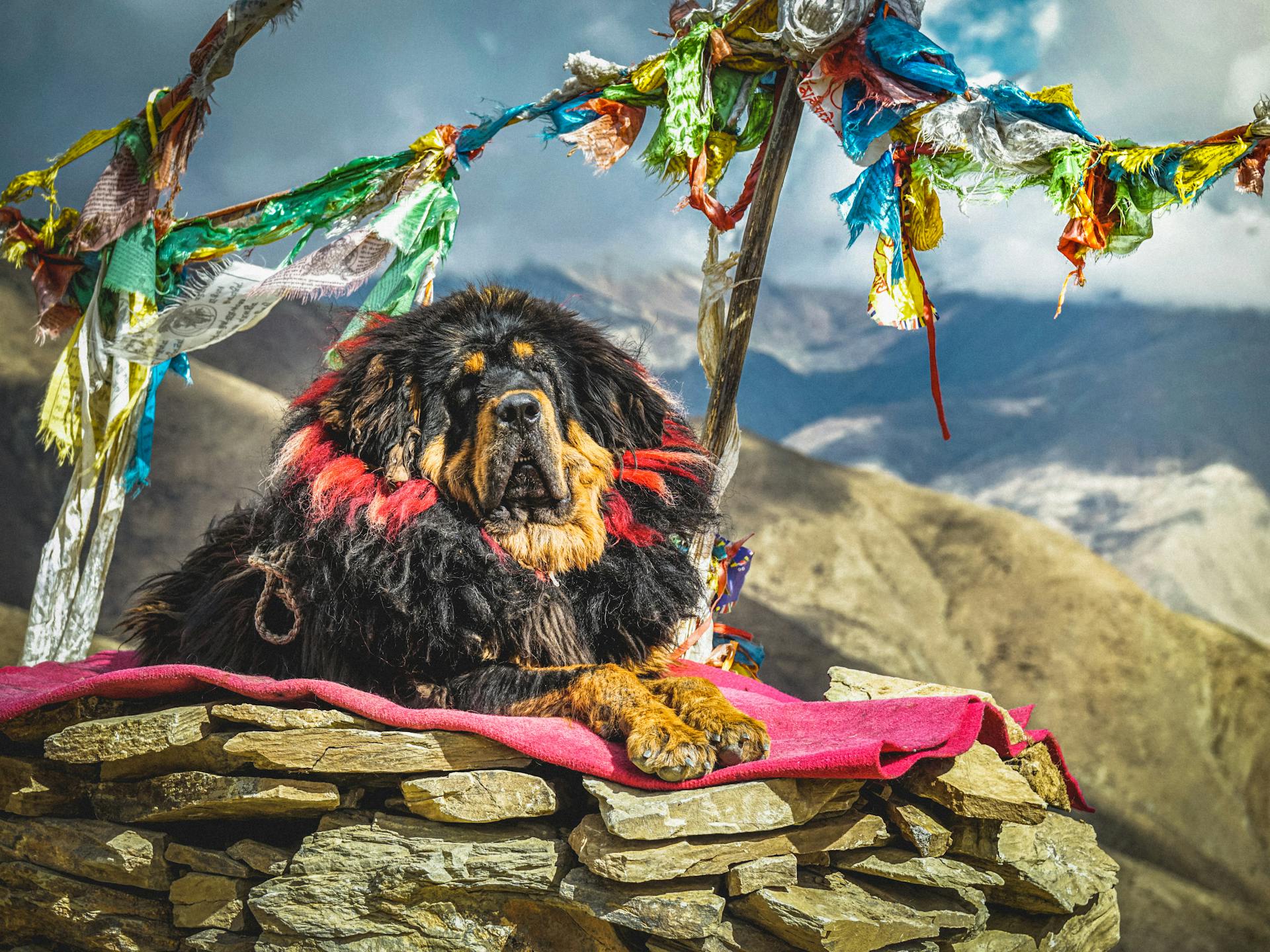
The Tibetan Mastiff is a majestic breed that originated in the Himalayan region of Tibet. They are a large and powerful dog with a sturdy build, weighing between 160-230 pounds.
Their distinctive appearance is characterized by a thick double coat that sheds heavily, requiring regular grooming to prevent matting.
Their origins date back to the 13th century, where they were bred to guard livestock and homes from predators.
Characteristics
The Tibetan Mastiff is a majestic breed with a unique set of characteristics. They can grow up to 26 inches tall at the shoulder, with males weighing between 90 and 150 pounds and females weighing around 70 to 120 pounds.
Their distinctive appearance is marked by a majestic mane, medium-sized V-shaped ears, and catlike feet. They have a double coat of thick, bristly hair and a wooly undercoat that comes in various colors, including black, brown, gray, and blue, with tan or gold markings.
Tibetan Mastiffs are known to be slow-maturing, with males taking around 4 to 5 years and females taking around 3 to 4 years to reach full maturity. They typically live for 10 to 12 years.
General Appearance
Tibetan Mastiffs are truly majestic dogs, with a commanding presence that's hard to ignore.
Adult males can grow as tall as 26 inches or more at the shoulder, while females typically stand at around 24 inches.
Their mammoth size is matched only by their regal demeanor, thanks in part to their thick, bristly coats that can be black, brown, gray, or blue, and sometimes have tan or gold markings.
Males typically weigh between 90 and 150 pounds, while females weigh around 70 to 120 pounds.
The Tibetan Mastiff's distinctive mane gives them a lionlike appearance, and is more noticeable in males.
Their ears are medium-sized and V-shaped, falling forward, and their catlike feet are large and strong, with possible feathering between the toes.
Tibetan Mastiffs usually have a double coat that requires regular grooming, especially during shedding season.
The typical lifespan of this breed is around 10 to 12 years, with males maturing at around 4 to 5 years and females at around 3 to 4 years.
Temperament
Tibetan Mastiffs are naturally reserved and can take time to warm up to new people and environments. This aloofness is a result of their protective nature, making them loyal family dogs.
They tend to be more active at night, which can make them a great fit for rural life where they can roam freely. However, this also means they can be a bit lazy indoors and sleep during the day.
Tibetan Mastiffs are not overly affectionate, but they do have a strong devotion to their owners. Proper introductions to children, unfamiliar guests, and other animals are essential to help them feel comfortable and confident.
They can be possessive of food or toys, so it's crucial to establish clear boundaries and rules from an early age. This will help them learn how to interact with others and avoid any potential conflicts.
Their tendency to bark, especially if left outdoors overnight, makes them a better fit for rural life where the noise won't disturb close neighbors. This is an essential consideration for anyone thinking of bringing a Tibetan Mastiff into their family.
Discover more: How Long Does a Tibetan Mastiff Live
Care and Nutrition
The Tibetan Mastiff is a unique breed that requires special care and handling. Early socialization is mandatory to prevent potential behavioral problems.
Tibetan Mastiffs don't have huge appetites, eating far less than you might assume. They may even go on food strikes, refusing to eat for days at a time.
Feeding your Tibetan Mastiff high-quality dog food is crucial, as recommended by your breeder or veterinarian. This will help ensure they're getting the nutrients they need.
Tibetan Mastiffs are prone to heatstroke due to their thick coats, so it's essential to stay alert for signs of heatstroke, especially in warmer areas.
Regular brushing is a must for Tibetan Mastiffs to keep their coats beautiful and healthy. A deshedding brush can help remove excess undercoat, especially during warmer months.
You can give your Tibetan Mastiff a weekly brushing using a slicker or pin brush to get rid of dirt and knots. An undercoat rake or de-shedding tool can help during shedding season.
Tibetan Mastiffs eat only when hungry, and it's common for them to skip meals. Adult Tibetan Mastiffs typically eat around 2 to 4 cups of dog food a day.
Female Tibetan Mastiffs may skip meals during heat, losing 10% to 15% of their body weight. It's essential to provide fresh and clean water at all times.
Tibetan Mastiffs are intelligent dogs that learn quickly, but they can be independent-minded and require a job to be happy. Socializing them is crucial to prevent potential behavioral problems.
You should feed your Tibetan Mastiff according to their age, with high-quality puppy food for 6-8 weeks old to 2 years old, and adult-formulated food after that.
Adoption and Purchase
If you're looking to bring a Tibetan mastiff into your life, you'll want to start by finding a reputable breeder to talk to. They can give you a realistic idea of what to expect from the breed.
Reputable breeders are essential when it comes to finding a healthy and well-socialized Tibetan mastiff puppy. Expect to pay between $1,500 to $5,000 for a purebred Tibetan mastiff.
You can also consider reaching out to Tibetan Mastiff Rescue, which has an active Facebook page to help connect you with available dogs. They may have adult Tibetan mastiffs in need of a forever home.
If you're serious about getting a Tibetan mastiff, be prepared for a long waitlist, often several months or even years long. To get on the waitlist, you'll need to track down a reputable breeder.
If you're looking for a more immediate option, you can also check out the AKC Marketplace for Tibetan mastiff puppies or adults for sale from reputable breeders.
Pros and Cons
The Tibetan Mastiff is a loyal and loving companion, but it's not without its characteristics that might surprise you. One of the Tibetan Mastiff's most notable traits is its exceptional guard dog abilities.
If you're looking for a low-maintenance exercise routine, the Tibetan Mastiff is a great choice, as it doesn't require a lot of exercise. This makes it perfect for busy owners who want a furry friend without the hassle of daily runs or long walks.
One thing you won't have to worry about with the Tibetan Mastiff is excessive shedding. It sheds very little outside of the seasonal shedding in spring or summer, making it a great choice for those with allergies or a preference for low-maintenance grooming.
Expand your knowledge: Are Great Danes Mastiffs
Health and Wellness
Tibetan Mastiffs are generally a healthy breed, but like many dogs, they can be prone to certain health issues. Their average lifespan is 10-12 years.
Hip dysplasia is a common concern for Tibetan Mastiffs, a genetic condition that affects the hip joints. This can lead to arthritis and restricted movement as they age.
Regular check-ups with a veterinarian are crucial to detect potential issues early on. You should get your dog's hips evaluated by the Orthopedic Foundation for Animals (OFA) and aim for an "excellent", "good", or "fair" rating.
Eye exams are also essential, with a recommended bi-annual check-up to ensure a "clear" recommendation from the OFA. This will help detect any potential eye problems early on.
Tibetan Mastiffs are generally quiet dogs, but they can be more active in the latter part of the day and early morning hours. If you live in a residential area, it's a good idea to keep them indoors to avoid disturbing your neighbors.
Recommended read: Are Mastiffs Good with Kids
Grooming and Coat Care
Tibetan Mastiffs have a thick, double-layered coat that requires regular brushing, especially during shedding periods when they blow their coats.
The breed standard does not allow the clipping or trimming of the coat, so you'll need to get used to the idea of a long, thick outer coat.
During seasonal shedding periods, Tibetan Mastiffs require almost daily grooming with a de-shedding tool to remove the undercoat.
A weekly brushing to remove dirt, debris, and tangles is sufficient for the rest of the year, but you may need to use an undercoat rake or de-shedding tool to take care of loose hair.
Tibetan Mastiffs have a tendency to shed heavily in spring and summer, so be prepared for lots of flying fluff.
They also have a wooly, soft undercoat that needs to be brushed regularly to prevent matting and tangling.
You can use a deshedding brush, such as the FURminator, to help remove excess undercoat, especially during warmer months.
Related reading: Tibetan Mastiff Why so Expensive
Tibetan Mastiffs don't need much grooming for most of the year, but a weekly brushing with a slicker or pin brush will help keep their coat healthy and beautiful.
You should also trim or clip your dog's nails regularly, and brush their teeth to support their overall health.
Good dental hygiene is essential for Tibetan Mastiffs, and regular teeth brushing and veterinarian-recommended dental chews can help prevent ear infections and other health issues.
Regular nail trims and ear cleaning can also help reduce the risk of ear infections and other problems.
Suggestion: Tibetan Mastiff Health Problems
Training and Behavior
Tibetan Mastiffs need moderate exercise and plenty of space to roam and play, so a fenced-in yard is a must.
They don't do well in apartments and can become destructive and anxious if confined or bored.
Tibetan Mastiff puppies need to be well-socialized with people and other pets to help them be more accepting of strangers as they age.
Training a Tibetan Mastiff requires patience, persistence, and positive reinforcement, as they can be willful and resistant to training.
Tibetan Mastiffs learn fast but can also get bored quickly, so training sessions should be short and engaging.
They're not overly motivated by treats or praise, which can make training a challenge.
Even a well-trained Tibetan Mastiff may not always come when called, so it's best to keep them on a leash in unsecured areas.
Their intelligence and athleticism make them a unique breed that requires careful consideration and attention to their needs.
Fun and Activities
Tibetan mastiffs are natural athletes and need plenty of exercise to stay happy and healthy. They love going on long walks to explore their surroundings and get some exercise.
One of the best ways to keep your Tibetan mastiff entertained is to try agility training. This activity challenges their physical and mental abilities, and it's a great way to bond with your dog.
If you live on a farm or have livestock, your Tibetan mastiff can help guard them. This is a natural instinct for the breed, and they take their job very seriously.
There's nothing quite like watching a Tibetan mastiff run through the snow, their fur fluffed up and their tail wagging wildly. It's a joy to behold, and it's a great way to get some exercise in the winter months.
Here are some fun activities to try with your Tibetan mastiff:
- Going on a walk
- Agility
- Guarding livestock
- Running through the snow
History and Origin
The Tibetan Mastiff has a rich history that spans thousands of years. They're believed to be the basic stock for most of the present-day large working breeds of dogs.
The breed is native to Central Asia, where it has lived for thousands of years, with earliest accounts dating back to the 12th century B.C. in China. The Tibetan Mastiff has been part of many armies in the Middle Ages, including the Persian and Assyrian armies.
Tibetan Mastiffs were traditionally used for specific purposes, such as traveling with sheepherders and traders to protect them against beasts of prey like snow leopards and wolves. They were also trained to guard homes.
The breed was first brought to Europe in 1847, with the first sighting being in England, and finally reached the U.S. in the 1950s. As a result of their isolation, the Tibetan Mastiff was a rare breed.
The Tibetan Mastiff is an ancient breed mentioned in writings dating back to 1100 B.C., and was called Do-Khyi, or "tied dog", in Tibet, China. This was a reference to the common practice of tying guard dogs to the gates during the day.
Tibetan Mastiffs remained isolated in the Himalayan Mountains, where they guarded tents and protected their owners from wolves, snow leopards, and other predators. This isolation led to the development of a rare breed.
The Nyingchi Tibetan Mastiff is a subtype of the Tibetan Mastiff, which is an ancient breed dating back to 1100 B.C. These massive dogs guarded property and used their strong, deep barks to alert their owners to uninvited visitors.
Because of their centuries-long isolation, the Nyingchi Tibetan Mastiff and Tibetan Mastiff are rare breeds today.
You might like: Tibetan Mastiff Russian Guard Dog
General Information
The Tibetan Mastiff is a majestic breed originating from Tibet. It stands tall, with a minimum height of 24 to 26 inches at the shoulder.
This breed has a unique double coat, consisting of a fine but hard outer coat and a heavy, soft undercoat. The coat color can vary, with options ranging from black to gold/yellow.
The Tibetan Mastiff has a relatively long lifespan, living between 10 to 12 years. Its temperament is intelligent, protective, and strong-willed, making it a loyal companion.
Here's a breakdown of the breed's temperament traits:
The Tibetan Mastiff has relatively low exercise needs and a low energy level, making it a suitable breed for those with limited mobility or living in small spaces.
Frequently Asked Questions
Are Tibetan mastiffs legal in the US?
In the US, there are no federal laws banning Tibetan Mastiffs, but local regulations may vary. However, their size and protective instincts can be a concern, making training and local laws worth considering.
What is the #1 most expensive dog?
The #1 most expensive dog is a red Tibetan Mastiff, specifically Big Splash, which sold for a record-breaking $1.5 million. This rare breed holds the title of the world's most expensive dog ever sold.
Can Tibetan Mastiff be a house dog?
Yes, Tibetan Mastiffs can make great house dogs, as they are generally quiet and laid back indoors. With proper training, they can thrive in a home environment and follow household rules.
Is a Tibetan Mastiff a good family dog?
Tibetan Mastiffs are loyal and loving companions, making them a great fit for families who want a devoted pet. However, they do require proper training and socialization to thrive in a household with children
Why is Tibetan Mastiff so expensive?
Tibetan Mastiffs are one of the most expensive dog breeds due to their rare and pure bloodline. Their exceptional value was further proven when one was sold for a record-breaking $1.5 million.
Featured Images: pexels.com