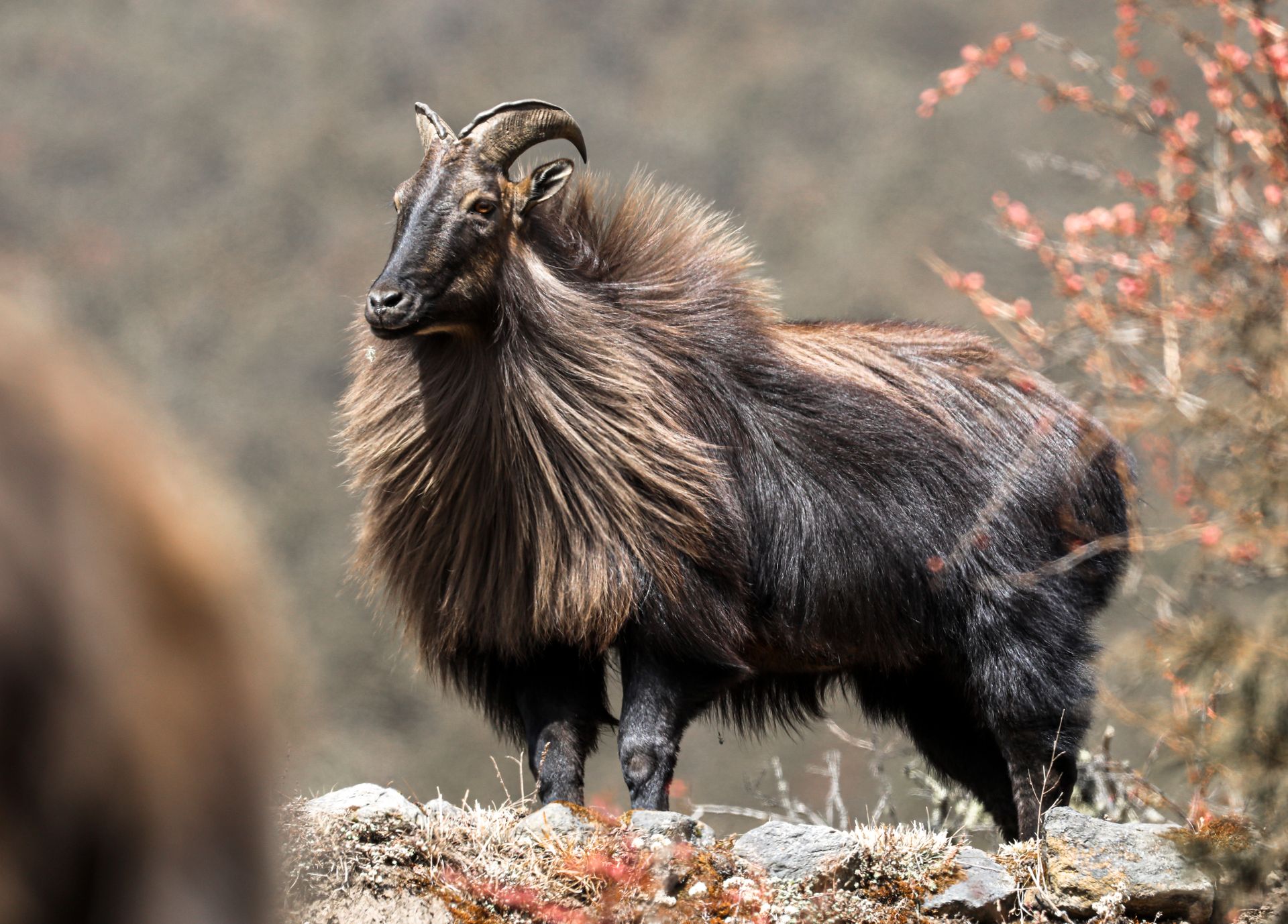
The Tetraogallus himalayensis is a species of bird that's native to the Himalayan region. It's also known as the Himalayan snow cock.
This bird is well adapted to its high-altitude habitat, with a thick coat of feathers to keep it warm in freezing temperatures. It's a large bird, with a distinctive crest on its head.
The Himalayan snow cock can be found in the mountain ranges of the Himalayas, including Nepal, Bhutan, and parts of India.
Classification
Tetraogallus himalayensis is a bird species with a complex classification. The main populations of this species are separated by the Taklamakan desert, with the separation estimated to have happened after the Pleistocene glaciations (1 mya).
The nominate subspecies was described by G.R. Gray in 1843 and refers to the populations from eastern Afghanistan extending to Ladakh and the central Himalayas of Nepal.
There are several subspecies of Tetraogallus himalayensis, but not all are recognized. Some of the subspecies include incognitus, which was described by Zarudny in 1911 from the mountains of southern Tajikistan and northern Afghanistan, and is overall much paler with very light chestnut and black markings on underside and buffier.
Here are some of the recognized subspecies of Tetraogallus himalayensis:
- The nominate subspecies (Tetraogallus himalayensis himalayensis)
- incognitus (Tetraogallus himalayensis incognitus)
- grombczewskii (Tetraogallus himalayensis grombczewskii)
- koslowi (Tetraogallus himalayensis koslowi)
The subspecies sewerzowi is not recognized by Ernst Hartert, and was described by Zarudny in 1910 from the Tien Shan to Zaysan (Kazakhstan) east to Xinjiang.
Habitat and Status
The Himalayan snowcock is a hardy bird that thrives in alpine pastures and steep ridges of mountains in Central and South Asia. It's found above the treeline and near the snowline.
In the Himalayas, it inhabits areas between 4000 and 5000 meters elevation during the summer months. It descends to 2400 meters during severe winters.
This bird has a large distribution range, which is why it's considered a species of "least concern" by the IUCN. There are no visible declines in population, which is a positive sign.
In fact, the Himalayan snowcock was considered a good game bird for introduction in the Nevada region due to the similarity of the Himalayan landscape. The Nevada Fish and Game Commission approached the President of Pakistan for some birds in 1961.
Behavior and Habitat
Himalayan snowcocks are social birds that live in small groups, often inhabiting the same hill. These groups are typically found in open country, with a preference for rocky hill-sides.
They feed on a variety of plants, including grass, shoots, berries, and seeds. In the mornings, they fly downhill to drink water.
Their diet consists of tender blades of grass, young shoots of plants, and berries of Ephedra. They have also been known to eat leaves of Artemisia, grass shoots, bulbs, and the heads of a rye-like grass.
In the Hunza range, Himalayan snowcocks have been observed to prefer Sibbaldia cuneata. Once they reach the top of a ridge, they fly off to an adjacent hill, alighting some distance down.
Flocking helps Himalayan snowcocks to keep an eye out for predators, allowing them to forage more efficiently. In the Hunza range, flock sizes tend to be larger in rocky habitats, where they risk predators like Golden Eagles.
The breeding season for Himalayan snowcocks is in the summer, from April to June. During this time, they are generally silent, but in the spring, their call becomes a familiar part of the landscape.
Their song is a loud whistle with three parts, and the tone ascends. They also make a rising, shrill piping call.
Here's a summary of their habitat preferences:
- Open country
- Rocky hill-sides
- Grassy meadows (although they tend to prefer rocky habitats in the Hunza range)
These birds are generally wary and will run uphill when disturbed, then launch themselves from the crests in flight, gaining considerable speed.
Description and History
The Himalayan snowcock is a large bird, measuring 55-74cm in length and weighing 2-3.1kg.
Its plumage is quite distinctive, with a grey head pattern that resembles that of the chukar partridge, and a chestnut moustachial stripe and dark broad chestnut band on the head.
The upper parts of the bird are grey, with feathers on the rump and wings bordered with rufous. The legs and orbital skin are yellow.
Scientific Naming Rule
Scientific names can be tricky to understand, but they're actually quite straightforward. The Himalayan Snowcock's scientific name is a combination of its genus and species identifiers, which are used universally to identify species.
Species names are typically derived from the species' characteristics or habits. The Himalayan Snowcock's species name likely reflects its habitat or behavior.
The use of scientific names helps to avoid confusion and ensures that everyone is referring to the same species. This is especially important for birds like the Himalayan Snowcock, which can be difficult to access and observe.
Description
The Himalayan snowcock is a large bird, measuring 55-74cm in length and weighing between 2-3.1kg.
Its head pattern bears a resemblance to that of the chukar partridge, with a white throat and sides of the head bordered by a chestnut moustachial stripe and a dark broad chestnut band.
The upper parts of the bird are grey, with feathers on the rump and wings bordered with rufous, and the upper breast has dark crescent bars.

The lower breast plumage is dark grey, and the sides of the body are streaked with black, chestnut, and white.
The undertail coverts are white, and the legs and orbital skin are yellow.
Sexes are alike in plumage, but the female is smaller and lacks the large tarsal spur of the male.
In flight, the bird is distinctive due to its white primaries tipped in black and rufous outer tail feathers.
Explore Related Subjects
If you're interested in learning more about the Himalayan snowcock, you might also want to explore related subjects in the field of zoology.
Biological taxonomy is a crucial aspect of understanding the classification and relationships between species, including Tetraogallus himalayensis.
The study of invertebrate zoology is also relevant, as it can provide insights into the evolution and behavior of birds like the Himalayan snowcock.
Helicobacter pylori, a type of bacteria, is not directly related to Tetraogallus himalayensis, but it can be interesting to compare the bacterial world with the world of birds.
Here are some related subjects to explore:
- Lotus japonicus: A plant species that, like the Himalayan snowcock, can be found in mountainous regions.
- Bacillus subtilis: A type of bacteria that, while not directly related to birds, can provide insights into the evolution of life on Earth.
- Zebra finch: A bird species that, like the Himalayan snowcock, is known for its unique characteristics and behaviors.
Frequently Asked Questions
What's the best time to spot a Himalayan snowcock?
Best time to spot a Himalayan snowcock: Summer months are ideal for sightings at high elevations, while winter months offer opportunities at lower elevations, but with challenging terrain
How much does a Himalayan snowcock weight?
A Himalayan snowcock typically weighs between 4.4 to 6.8 pounds. Males tend to be heavier than females.
Featured Images: pexels.com