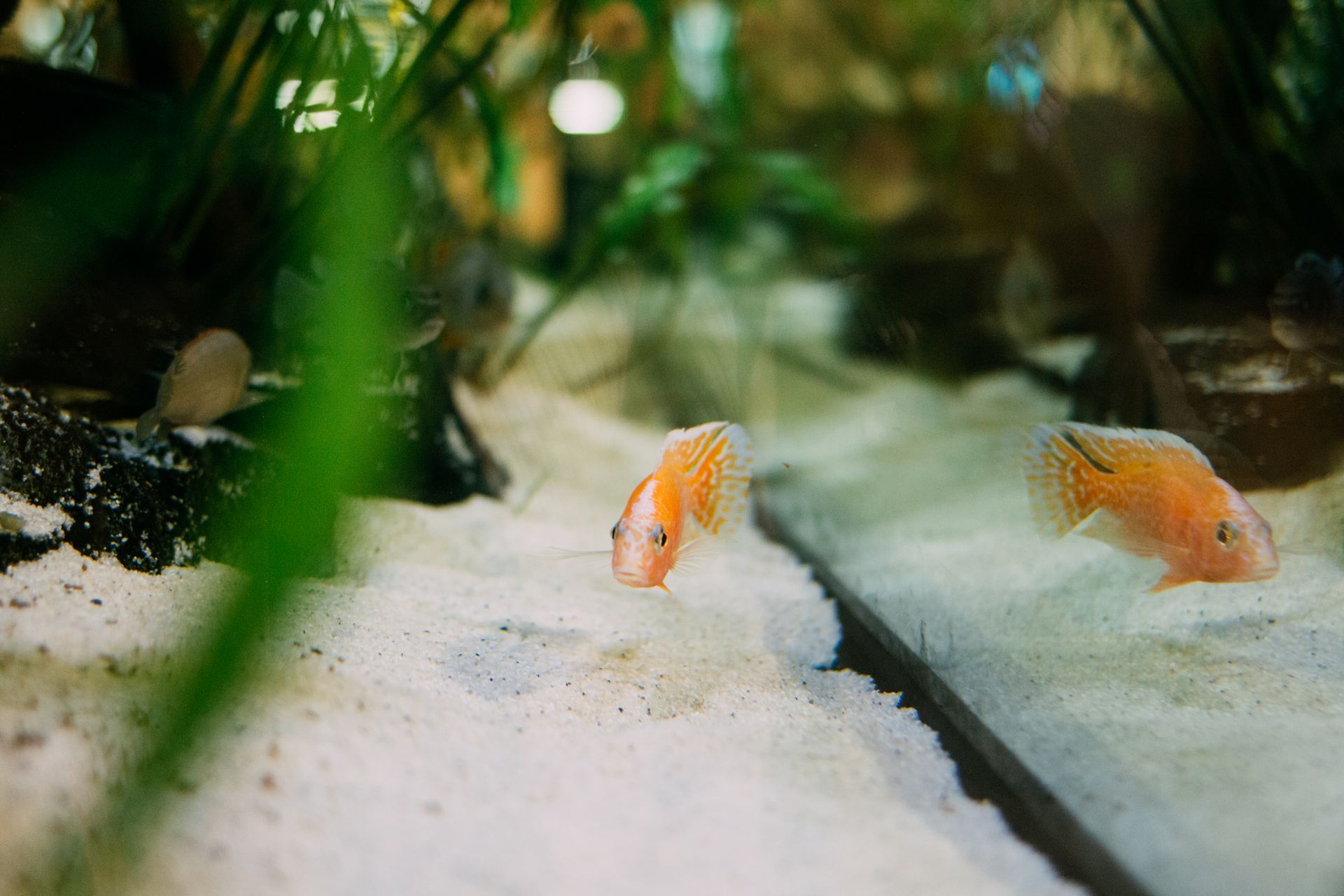
Tanichthys albonubes, also known as White Cloud Mountain Minnows, are a popular freshwater aquarium fish. They are native to the mountain streams of Guangdong Province in China.
These fish are relatively small, reaching a maximum length of about 1.5 inches. They have a slender body and a distinctive white stripe along their sides.
White Cloud Mountain Minnows are active swimmers and prefer to be kept in schools of at least 6-10 individuals. This helps to reduce aggression and stress within the group.
For your interest: Lake Tanganyika Fish
Setting up an aquarium for white cloud minnows
White cloud minnows are extremely hardy and can live in a wide range of pH from 6.5-8.5 and temperatures from 65-77°F (18-25°C). They can even thrive in a fish tank with no heater.
To keep them happy, get a group of at least six and keep them in a 10-gallon tank or larger. This will give them the space they need to school and feel comfortable.
In their natural habitat, white cloud minnows might get stressed if the water gets too warm. But don't worry, they can still live in a fish tank without a heater.
If you want to minimize any squabbling among your white cloud minnows, try increasing the size of the school and adding aquarium plants to block their line of sight. This will help them focus on swimming and exploring their environment.
White cloud minnows get along with peaceful community fish that are similarly sized and live in similar conditions. Consider pairing them with other species that enjoy cooler waters, such as shrimp, danios, and smaller killifish.
Care and Feeding
The White Cloud Mountain Minnow is a hardy and active fish that thrives in a variety of water conditions. It's a staple of the community and planted aquarium, and with proper care, it can live a long and healthy life.
To keep your White Cloud Mountain Minnow happy and healthy, provide a varied diet of carnivorous foods. High-quality flake food, pellets, and live, frozen, or freeze-dried foods such as Artemia, microworms, and cyclops will all be readily accepted. Some vegetable matter like spirulina is also ideal.
A minimum tank size of 10-15 gallons is recommended, with a temperature range of 57° - 72° F (14° - 22° C) and a pH of 6.0-8.5, with acidic to neutral water being preferred. The White Cloud Mountain Minnow is a peaceful, schooling fish that should be kept in schools of 6-8 or more, with larger schools of 10+ being ideal.
Water Conditions
To keep your fish thriving, it's essential to get their water conditions just right. The ideal pH range for these fish is between 6.0 and 8.5.
In my experience, maintaining a consistent pH level can be a challenge, especially if you're new to fish keeping. The hardness of the water also plays a crucial role, and for these fish, it should be between 90 and 357 ppm.
A stable and well-maintained water environment will go a long way in keeping your fish happy and healthy. The reduced tolerance to cooler temperatures in wild fish from Hainan Island is a great reminder of how sensitive these fish can be to changes in their environment.
Diet of White Cloud Mountain Minnows
White Cloud Mountain Minnows are happy to eat almost any fish food that is small enough to fit in their mouths.
In the wild, WCMMs feed on plankton and insect larvae, so they thrive on small, nutrient-rich foods like flakes, nano pellets, and Easy Fry and Small Fish Food.
They also enjoy small frozen foods, such as daphnia, cyclops, and baby brine shrimp, which provide essential nutrients for a long and healthy life.
If you want to really spoil them, give them live micro worms and baby brine shrimp – a treat they'll surely appreciate.
Behavior and Compatibility
Tanichthys albonubes is a schooling fish by nature, so it's ideal to keep a group of 10+ specimens together.
Keeping a group of this size will make individuals less nervous and result in a more natural-looking display.
In fact, maintaining such numbers will also encourage males to display their best colours as they compete with each other for female attention.
Some species that enjoy comparable conditions to Tanichthys albonubes include Pethia conchonius, P. padamya, and Macropodus opercularis.
However, it's not recommended to keep Tanichthys albonubes with goldfish, despite being often sold together.
Tanichthys albonubes can thrive in a stream-style tank with rheophilic species from genera such as Danio, Devario, and Garra, as well as many loaches.
A separate, smaller aquarium can be set up for a more controlled approach if needed.
Breeding and Reproduction
Breeding Tanichthys albonubes, also known as the White Cloud Mountain Minnow, is a relatively easy process.
These fish are prolific breeders and can produce a large number of offspring, with up to 200 to 300 fry at a time.
To breed them, you'll need to separate the male and female for three weeks before introducing them to each other.
This allows the female to store up eggs and ensures that she's ready to spawn when you put the couple together.
The female will deposit eggs between the leaves of plants in the tank, and the parents will hardly ever eat their own fry.
After 36 to 72 hours, the eggs will hatch, and the larvae will live on their yolk sac for another day before swimming freely and starting to feed.
You can feed the fry infusoria and very fine dust food, and they'll grow quickly if you provide them with good food and clean water.
In fact, the young White Cloud Mountain Minnows mainly swim on the surface and look for food there, so you'll need to change the water often to keep up the water quality.
Here's a rough guide to the breeding process:
Scientific Research
Tanichthys albonubes is a fascinating species that has been extensively studied through scientific research.
It belongs to the family Cyprinidae, which makes up a large group of small to medium-sized fish.
Research has shown that Tanichthys albonubes is native to China and Southeast Asia.
Its scientific classification is as follows: Kingdom: Animalia, Phylum: Chordata, Class: Actinopterygii, Order: Cypriniformes, Family: Cyprinidae, Genus: Tanichthys, Species: T. albonubes.
Data Description
Data Description is a crucial step in scientific research. It involves organizing and summarizing the data collected during an experiment or study.
Data can be described using various statistical measures, such as mean, median, and mode. These measures provide a snapshot of the data's central tendency and distribution.
The mean is the average value of a dataset, calculated by summing all the values and dividing by the number of observations. In a study on the effects of climate change, the mean temperature increase was found to be 2.5°C over the past century.
The median is the middle value of a dataset when it is sorted in ascending or descending order. In a study on the impact of social media on mental health, the median number of hours spent on social media per day was found to be 2 hours.
The mode is the most frequently occurring value in a dataset. In a study on the types of food consumed by a population, the mode was found to be pizza.
Data can also be described using measures of variability, such as range and standard deviation. The range is the difference between the largest and smallest values in a dataset. In a study on the effects of exercise on heart rate, the range of heart rates was found to be 60-120 beats per minute.
The standard deviation is a measure of the spread or dispersion of a dataset. In a study on the impact of noise pollution on sleep quality, the standard deviation of sleep duration was found to be 1.5 hours.
Sample Collection
When collecting samples for scientific research, it's essential to do so in a responsible and careful manner.
Fish were collected from Guangzhou Conghua Nature Reserve for the White Cloud Mountain minnow study.
The specific location of the sample collection was in Liangkou, Conghua, Guangzhou, Guangdong, China.
The researchers obtained approval from the reserve's management council before collecting the fish.
A total of three fish were caught, including one juvenile and two adult individuals.
One of the adult fish was a female, and the other was a male.
The fish were caught using a hand net on May 5, 2020.
Their body weight ranged from 0.083 to 0.169 grams.
The researchers took care to avoid causing any harm to the fish during the collection process.
They examined the fish's physical conditions by eye to check for any signs of disease or damage.
Full-Length Transcriptome Assembly
Raw sequencing reads were first processed using the SMRTlink version 6.0, generating circular consensus sequences (CCSs) from subread BAM files.
CCSs were then trimmed and clustered to obtain FLNC (full-length non-chimeric) reads, which were further classified into high-quality and low-quality FLNC reads.
High-quality FLNC reads were predicted to have an accuracy greater than 99% and were supported by at least two full-length reads.
The completeness of the assembly was assessed using BUSCO version 3.0.1 with default parameters, showing a completeness of 75.60% in the White Cloud Mountain minnow full-length transcriptome.
Unigenes were obtained by clustering isoform sequences with a similarity of 98% using CD-HIT version 4.6.7.
The dataset of Unigenes was used for downstream analysis, providing a comprehensive view of the transcriptome.
The mean length of the Unigenes ranged from 70 nt to 11,138 nt, with a mean length of 2,585 nt.
BUSCO analysis showed that the White Cloud Mountain minnow full-length transcriptome had a higher proportion of “missing” orthologs (22.40%) than other full-length transcriptomes from Cypriniformes fishes.
White Cloud Mountain Minnow
The White Cloud Mountain Minnow is a classic aquarium fish that's hard to beat. It's a staple of the community and planted aquarium, and for good reason - it's incredibly durable and easy to care for.
This fish is native to the White Cloud Mountain area of China, where it shares its habitat with only a few other species. In the wild, it's considered endangered, but all specimens in the aquarium hobby have been tank-bred for decades.
The White Cloud Mountain Minnow is a small fish, typically growing to 1.2-1.6 inches in length. It's a peaceful, schooling fish that's safe with other small, peaceful fish and can even be kept with dwarf shrimp.
To keep a White Cloud Mountain Minnow happy and healthy, you'll want to provide it with a varied diet that includes high-quality flake food, pellets, and live, frozen, or freeze-dried foods like Artemia and microworms. It's also a good idea to include some vegetable matter, like spirulina, in its diet.
Here are some key care requirements for the White Cloud Mountain Minnow:
- Temperature: 57-72°F (14-22°C)
- pH: 6.0-8.5, with acidic to neutral water preferred
- KH: 2-15 dKH
- Minimum tank size: 10-15 gallons
In terms of social behavior, the White Cloud Mountain Minnow is a peaceful, schooling fish that does best in schools of 6-8 or more. It's also a good idea to provide plenty of cover and dense plants, like Pogostemon stellatus 'octopus', to help the fish feel secure and reduce predation on its young.
Frequently Asked Questions
What is the diet of the Tanichthys?
The Tanichthys is an omnivorous species that primarily feeds on small invertebrates. It is also known to accept a wide variety of foods.
How long do cloud minnows live?
Cloud minnows typically live for 5 years or longer in optimal conditions. Their lifespan can vary depending on factors such as environment and care.
Featured Images: pexels.com