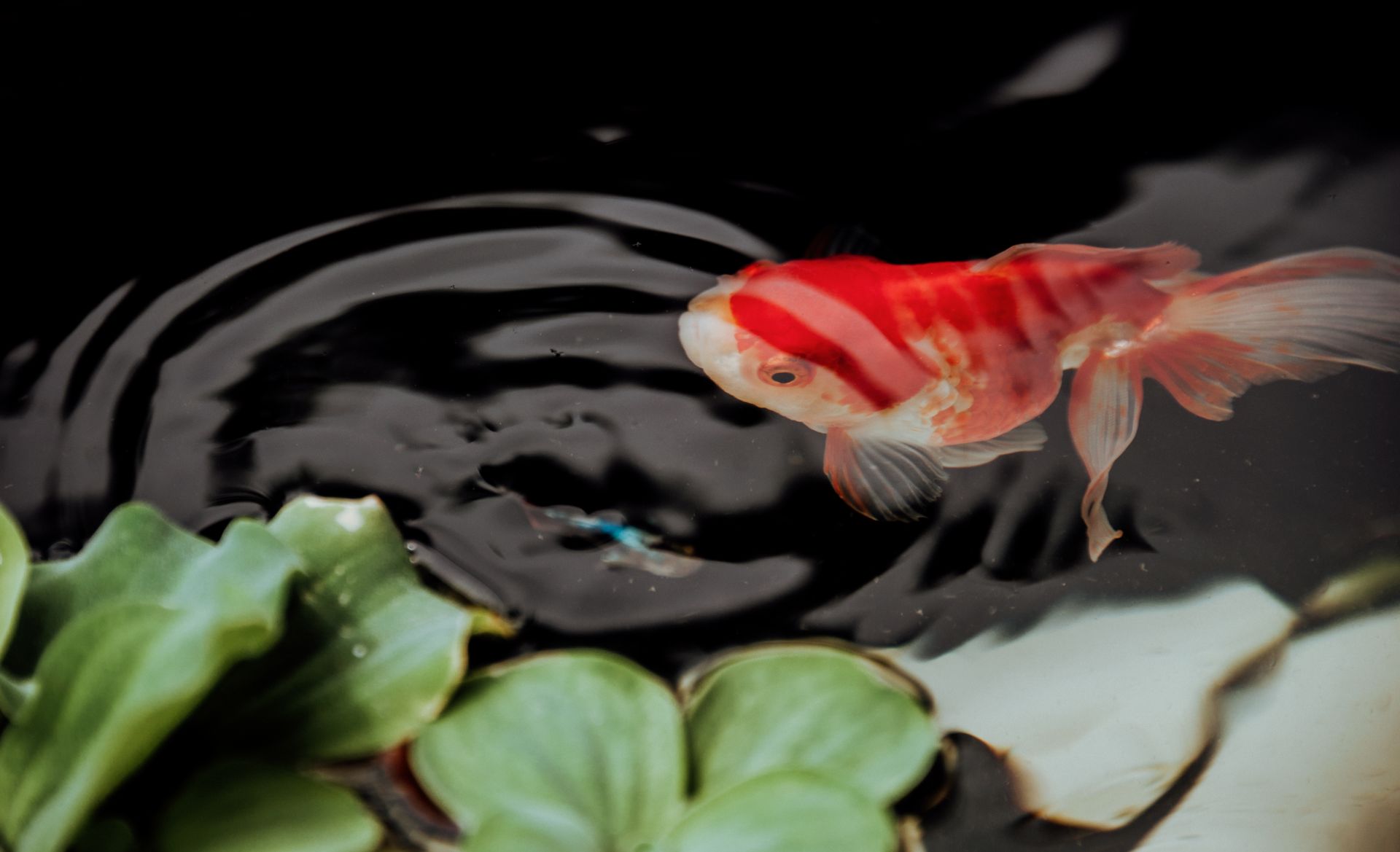
Synchiropus splendidus is a species of fish that's native to the Indo-Pacific region. It's a type of dragonet, a family of fish known for their vibrant colors and distinctive appearance.
The Synchiropus splendidus is a relatively small fish, growing up to 9 centimeters in length.
Classification and Etymology
The mandarinfish, scientifically known as Synchiropus splendidus, has a rich history and classification. It was first described in 1927 by Albert William Herre.
The generic name Synchiropus comes from Ancient Greek, with "syn-" meaning "together" and "-chiropus" meaning "hand-foot". This refers to the fish's unique body shape.
The specific epithet splendidus is derived from the Latin word for "bright" or "glittering", which suits the fish's vibrant coloration. Its common name, mandarinfish, is inspired by the fish's striking appearance, evoking the robes of an Imperial Chinese mandarin.
The mandarinfish belongs to the perciform family Callionymidae, also known as the dragonets. This family includes 10 genera and over 182 species.
Here's a breakdown of the mandarinfish's classification:
- Kingdom: Animalia
- Phylum: Chordata
- Subphylum: Vertebrata
- Class: Actinopterygii
- Order: Perciformes
- Family: Callionymidae
- Genus: Synchiropus
- Species: Synchiropus splendidus
Physical Characteristics
The mandarinfish, also known as Synchiropus splendidus, is a small but strikingly colored fish. Its bright blue background, swirly orange stripes, and bold blue stripes make it a standout in the ocean.
Mandarinfish have a unique body shape, similar to a goby, but that's where the resemblance ends. They have a broad, depressed head and are primarily blue with orange, red, and yellow wavy lines.
They are small fish, reaching a maximum length of 6 cm, and males are notably larger than females. This size difference is one of the key characteristics that distinguish males from females.
Here are some key physical characteristics of the mandarinfish:
- Maximum length: 6 cm (0.02 to 6 cm)
- Sexual dimorphism: males are larger than females
- Body shape: similar to a goby
- Coloration: bright blue background, swirly orange stripes, and bold blue stripes
- Scales: lack scales, instead have a thick mucus coating
Their bright coloration is not just for show; it's also an aposematic warning to predators that they are not a good meal. And with their unique slime coating, they're also less likely to contract diseases like marine ich.
Habitat and Distribution
Synchiropus splendidus, also known as the Mandarin fish, can be found in tropical waters with a temperature range of 24 to 26ºC.
They inhabit the western Pacific, including the Philippines, Indonesia, Hong Kong, Australia, and New Guinea, with a depth range of up to 18 meters.
In their natural habitat, they live on coral reefs and shallow lagoons, often hidden under foliose and dead coral.
Geographic Range

Synchiropus splendidus can be found in the western Pacific, including the Philippines, Indonesia, Hong Kong, Australia, and New Guinea.
This fish has a wide range that extends to the Ryukyu Islands.
It's worth noting that outside of its native range, S. splendidus is primarily a marine aquarium fish.
Here's a breakdown of the biogeographic regions where this fish can be found:
- Oriental
- Australian
- Pacific Ocean
The depth range of S. splendidus is quite varied, from 1 to 18 meters, which is equivalent to 3.28 to 59.06 feet.
Habitat
Mandarin fish are found in tropical, marine waters with a temperature range of 24 to 26ºC. They thrive in this temperature range.
Mandarin fish are bottom dwellers, typically found at depths up to 18 m. This is a unique characteristic of the species.
They can be found on coral reefs and shallow lagoons, often hiding under foliose and dead coral. This is where they feel most at home.
Here are some key habitat regions for Mandarin fish:
- Habitat Regions: tropical
- Water Type: saltwater or marine
Mandarin fish are found in the oriental region of the world, which includes India and southeast Asia. They are not limited to these areas, however.
Ecology and Life Cycle
The Mandarin fish, Synchiropus splendidus, is found in the ocean, specifically in the Western Pacific, from the Ryukyu Islands to Australia. They inhabit coral reefs and shallow lagoons, often hiding under foliose and dead coral.
These fish are adapted to living in marine environments, with a preferred salinity of 7.5-8.5, a pH range of 7.5-8.5, and a temperature range of 24-26°C. They thrive in epipelagic waters, typically between 1 to 18 meters deep.
Mandarin fish are not migratory, and their diet is quite specific, making it challenging to maintain them in captivity.
Ecology
Mandarin fish can be found in the ocean, specifically in the Western Pacific, from the Ryukyu Islands to Australia. They thrive in coral reefs and shallow lagoons, often hiding under foliose and dead coral.
Their habitat ranges from 1 to 18 meters deep in the epipelagic zone. Mandarin fish are marine animals, requiring a salinity level of marine water.
The ideal temperature for them is between 24-26 °C, with a slightly higher temperature of 26°C during spawning. They are adapted to live in water with a pH level of 7.5-8.5.
Mandarin fish are not migratory, meaning they stay in one place. They are found in areas with oxic oxygen levels, indicating a well-oxygenated environment.
Life Cycle
Mandarin fish can live for more than 3 years. Their lifespan is quite impressive, especially considering their unique life cycle.
Spawning occurs on areas of the reef where small groups of males and females gather during the night. This is a crucial part of their reproduction process.
Mating occurs when the male and female release sperm and eggs after they align themselves and rise about a meter above the reef. This is a remarkable sight to witness.
Each female spawns only once each night and may go without spawning for a few days. This highlights the importance of timing in their reproductive cycle.
The larger and stronger males tend to mate more frequently because there seems to be a sexual preference by the females for larger males. This is a fascinating aspect of their behavior.
Spawning occurs at about weekly intervals where up to 200 eggs are released. This process continues for several months, resulting in a high reproductive output.
Eggs measure 0.8 mm in diameter and hatch after 13-16 hours at 26°C. This is a crucial stage in their life cycle, marking the beginning of their development.
Newly hatched larvae begin feeding four days post-hatching at 1.74 mm NL. This is a significant milestone in their growth and development.
Larvae exhibit an ontogenetic color change from yellow to orange prior to settlement. This change is a key indicator of their development stage.
Incidence of settlement was highest between 16-20 DPH. This highlights the importance of this stage in their life cycle.
Conservation and Human Impact
Synchiropus splendidus, like many other species, faces no special conservation status according to the IUCN Red List, US Federal List, or CITES. This lack of special status is a reminder that conservation efforts are always necessary, even for species that don't have a specific designation.

The coral reefs where Synchiropus splendidus lives are found in warm, shallow oceans with low nutrient availability. This unique environment is home to a rich community of other invertebrates, plants, fish, and protists.
Living on coral reefs, Synchiropus splendidus has a specialized structure that is produced by the calcium carbonate skeletons of coral polyps. This structure is fragile and dependent on the reef's ecosystem, highlighting the importance of preserving these delicate environments.
Conservation Status
Conservation Status is a crucial aspect of understanding the impact of human activities on wildlife. Many species are listed as having no special status under the IUCN Red List, US Federal List, and CITES.
Relationship to Humans
Humans have a significant impact on the environment, with their daily activities contributing to pollution, deforestation, and climate change.
The average person generates about 4.4 pounds of trash per day, which can lead to the destruction of habitats and the loss of biodiversity.
We've all seen the devastating effects of oil spills on marine life, with the 2010 Deepwater Horizon spill in the Gulf of Mexico killing an estimated 17,000 animals.
Deforestation is another major issue, with humans cutting down trees at an alarming rate of 13 million hectares per year, leading to the loss of oxygen and increased greenhouse gas emissions.
The Amazon rainforest, for example, is home to 10% of all known plant and animal species, and its destruction can have far-reaching consequences for the entire ecosystem.
Type and Illustration
Synchiropus splendidus is a species that has a specific type locality. Bungau, Philippines, is where it was found at a depth of 2 fathoms.
The type locality of Synchiropus splendidus is a notable fact, but the type illustration and type specimen are also important to understand its classification. Unfortunately, the article does not provide information on the type illustration or type specimen of Synchiropus splendidus.
Common Names and Classification
The Mandarin-fish, Synchiropus splendidus, has a fascinating classification. It belongs to the kingdom Animalia, which is home to a vast array of animals.
Within the kingdom Animalia, the Mandarin-fish is classified under the phylum Chordata, a group of animals that have a notochord, a dorsal nerve cord, and a post-anal tail.
The phylum Chordata is further divided into subphylum Vertebrata, which includes animals with backbones. The Mandarin-fish, being a vertebrate, has a backbone that supports its body.
Here's a breakdown of the classification hierarchy of the Mandarin-fish:
- Kingdom: Animalia
- Phylum: Chordata
- Subphylum: Vertebrata
- Class: Actinopterygii
- Order: Perciformes
- Family: Callionymidae
- Genus: Synchiropus
- Species: S. splendidus
This classification helps us understand the relationships between different species and their evolutionary history.
Featured Images: pexels.com