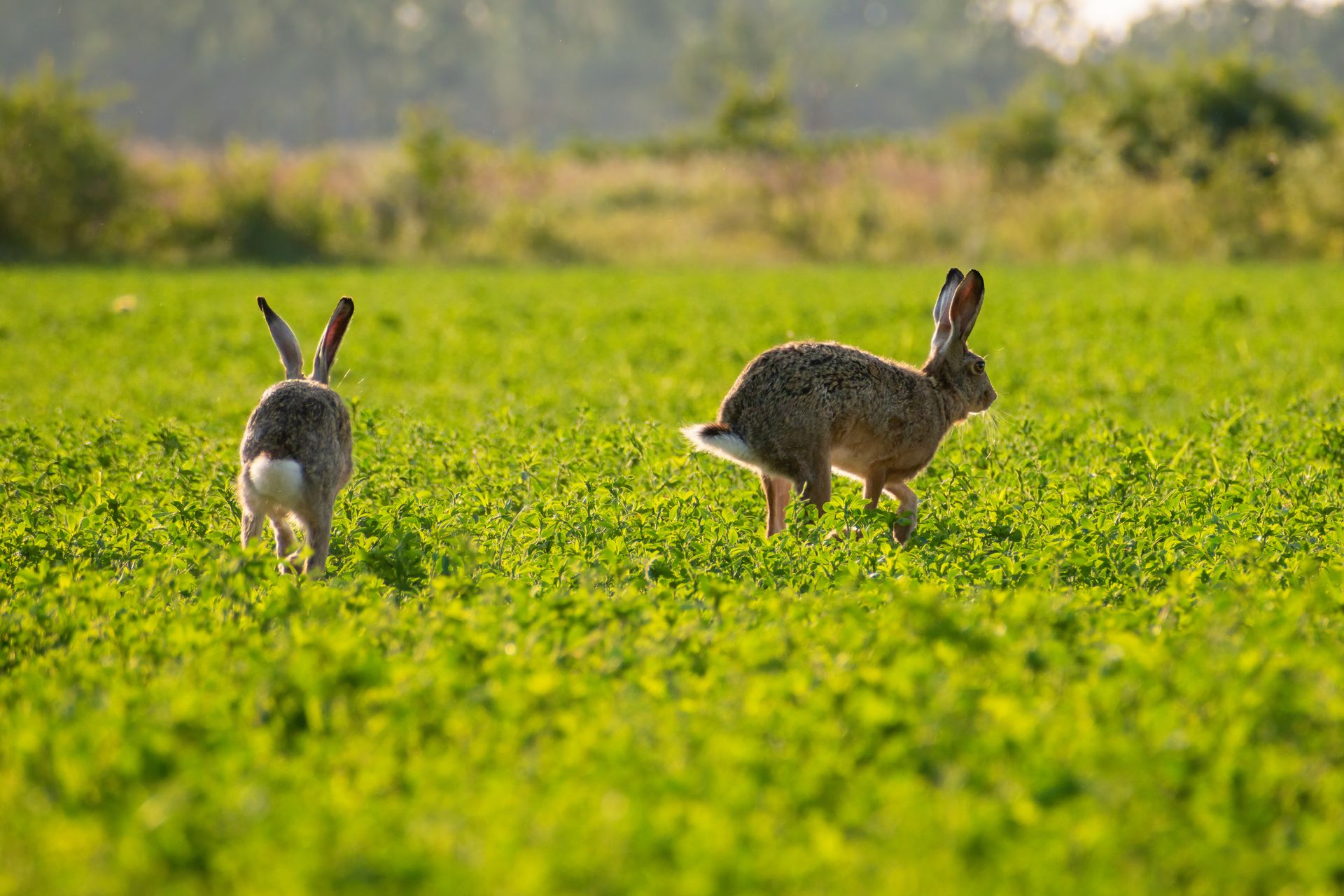
The Eastern Cottontail, Sylvilagus floridanus, is a common sight in many parts of North America. They can be found in a wide range of habitats, from forests to grasslands.
These adaptable creatures are well-suited to life in a variety of environments, and can often be seen in areas with dense vegetation. Their ability to thrive in different ecosystems is a testament to their hardiness.
Eastern Cottontails are herbivores, and their diet consists mainly of plants, including grasses, leaves, and fruits. They are also known to eat the leaves and twigs of woody plants.
In the wild, Eastern Cottontails can live up to 2 years, although their average lifespan is typically much shorter.
Reproduction and Lifespan
The eastern cottontail's reproductive habits are quite remarkable. They have a polygynous mating system, where a buck will mate with multiple does.
Their breeding season typically begins in late February and lasts through September, with some activity in January. This is a relatively long breeding season, allowing them to take advantage of the available food and suitable habitats.
Does can have anywhere from 1 to 7 litters per year, averaging 3 to 4. This high reproductive rate is likely due to the fact that only about half of the young will survive to independence.
Here's a breakdown of the reproductive features of the eastern cottontail:
- Breeding interval: 1 to 7 litters in a year
- Breeding season: February to September
- Range number of offspring: 1 to 12
- Average number of offspring: 5
- Range gestation period: 25 to 28 days
- Range weaning age: 16 to 22 days
- Range time to independence: 4 to 5 weeks
As for their lifespan, eastern cottontails are short-lived, with most not surviving beyond their third year in the wild. In captivity, however, they can live up to 9 years.
Reproduction
Reproduction is a crucial aspect of an eastern cottontail's life cycle. The breeding season typically begins in late February and lasts through September, with some activity in January.
Cottontails are polygynous, meaning bucks can mate with multiple does. A mating pair performs an interesting ritual before copulation, involving a chase, sparring, and a leap of about 2 feet in the air.
The doe prepares a grass and fur-lined nest a few days before giving birth, usually in a hollow beneath a shrub or a log. The nest is a vital part of the reproductive process.
Gestation lasts 25 to 28 days, and does can have 1 to 7 litters in a year, averaging 3 to 4. A litter typically consists of 1 to 12 neonates, with an average of 5.
Here's a breakdown of the reproductive cycle:
- Breeding interval: 1 to 7 litters in a year
- Breeding season: February to September
- Range number of offspring: 1 to 12
- Average number of offspring: 5
- Range gestation period: 25 to 28 days
- Range weaning age: 16 to 22 days
- Range time to independence: 4 to 5 weeks
- Range age at sexual or reproductive maturity (female): 2 to 3 months
- Range age at sexual or reproductive maturity (male): 2 to 3 months
The newborns are altricial, blind, and helpless, weighing between 25 to 35 grams at birth. They develop quickly, with their eyes opening around day 4 or 5, and they can leave the nest after about two weeks.
Lifespan/Longevity
Eastern cottontails are short-lived, with most not surviving beyond their third year. Their lifespan is significantly shorter in the wild compared to captivity.
In the wild, the average lifespan of an Eastern cottontail is around 5 years, according to the Max Planck Institute for Demographic Research. This is a relatively short lifespan, especially when compared to their potential lifespan in captivity.
In captivity, Eastern cottontails can live up to 9 years, which is a significant increase from their wild counterparts. This highlights the importance of providing proper care and living conditions for these animals.
Here's a breakdown of the lifespan of Eastern cottontails in different environments:
- Wild: 3.0 years (high)
- Wild: Average lifespan, 5.0 years (Max Planck Institute for Demographic Research)
- Captivity: 9.0 years (Max Planck Institute for Demographic Research)
Behavior and Habitat
The eastern cottontail is a solitary animal, and its home range is usually between 5 and 8 acres, depending on terrain and food supply. Males tend to have a larger home range than females.
Eastern cottontails are crepuscular and nocturnal, which means they're active at twilight and night, and can reach speeds of up to 18 miles per hour. They're also quick runners.
Their keen senses of sight, smell, and hearing help them detect predators, and they have a few escape methods, including freezing and "flushing" by rapidly zig-zagging to cover. Flushing consists of escaping to cover by a rapid and zig-zag series of bounds.
Here are some key behaviors of eastern cottontails:
- nocturnal
- crepuscular
- motile
- solitary
To increase cottontail populations, it's essential to provide plenty of escape cover in close proximity to feeding areas. This can be achieved by planting strips of VA-70 lespedeza or other dense vegetation adjacent to food plots.
Behavior
The eastern cottontail is a solitary animal, preferring to keep to itself rather than interacting with others. Its home range can vary in size, typically spanning between 5 and 8 acres, but increasing during the breeding season.
Males generally have a larger home range than females, which is interesting to note. The eastern cottontail has exceptional senses of sight, smell, and hearing, making it a formidable creature.
As a crepuscular and nocturnal animal, the eastern cottontail is most active during twilight hours and at night. It remains crouched in a hidden spot during the day, napping and grooming itself.
Escape methods of the eastern cottontail include freezing and/or "flushing", where it rapidly bounds away to safety. The cottontail can reach speeds of up to 18 miles per hour, making it a quick runner.
Here are some key behaviors of the eastern cottontail:
- nocturnal
- crepuscular
- motile
- solitary
Habitat Management
Providing plenty of escape cover in close proximity to feeding areas is key to attracting cottontails.
You can create a safe feeding area by planting a strip of VA-70 lespedeza adjacent to a food plot. This allows cottontails to feed safely and escape into the dense cover when attacked by a predator.
Clover, winter wheat, and rye are good choices for food plots as they provide a reliable source of food for cottontails.
Switchgrass plantings are also a great addition to any property being managed for rabbits, offering a mix of food and shelter.
You should survey your property to identify patches of good escape cover, such as blackberry and plum thickets, overgrown fencerows, and natural vegetation.
Natural patches of escape cover should be maintained, and periodic disking can help set back succession and allow native grasses, forbs, and legumes to flourish.
Disking every 3-5 years, preferably in the fall or winter, can result in more favorable plants.
Burning is another effective tool for creating and maintaining early successional habitat, but it's recommended to consult with a professional before starting a burning regime.
You can also benefit cottontails by providing habitat on marginal areas of your property, such as on the edges of crop fields and pastures.
Allowing a strip of herbaceous vegetation to regenerate on the edges of fields can provide safe feeding areas for cottontails, and it won't incur any real cost since field edges are generally less productive.
Predation and Threats
Eastern cottontails have a remarkable ability to escape predators with their fast, jumping form of locomotion, reaching speeds of up to 18 miles per hour. They can either flush, freeze, or slink to avoid danger.
Flushing is a fast, zig-zag dash to an area of cover, while slinking involves moving low to the ground with the ears laid back to avoid detection. Freezing, on the other hand, is simply remaining motionless.
Despite their impressive escape tactics, cottontails are heavily preyed upon by various predators. In most years, 80% or more of adult cottontails are killed.
Red foxes are among the cottontails' most significant predators, with cottontails making up nearly 50 percent of the fox diet. Bobcats are also a major threat, with up to 75 percent of their diet consisting of cottontails.
Other mammalian predators, such as coyotes, dogs, house cats, minks, raccoons, skunks, and weasels, also prey on cottontails. Additionally, many avian predators, including barred owls, broad-winged hawks, great-horned owls, red-shouldered hawks, and red-tailed hawks, feed on cottontails.
Crows are an interesting example of a predator that may play a significant role in controlling cottontail populations. A study found that crows frequently feed on young cottontails.
To minimize the risk of contracting diseases from cottontails, it's essential to follow some precautions. If you're a hunter, do not harvest rabbits that appear sluggish or do not run.
Conservation Status
The Eastern cottontail, Sylvilagus floridanus, has a relatively stable conservation status.
They are found in the Nearctic biogeographic province, which includes a vast area of North America, stretching from Greenland to central Mexico.
The IUCN Red List categorizes them as Least Concern, indicating they are not considered threatened with extinction.
Eastern cottontails are also listed as No special status in the US Federal List, CITES, and the State of Michigan List.
Here's a summary of their conservation status:
- IUCN Red List: Least Concern
- US Federal List: No special status
- CITES: No special status
- State of Michigan List: No special status
Eastern Cottontail
The eastern cottontail is a common sight in many areas, especially along country roads with dense vegetation. They're not picky eaters and will feed on a variety of grasses and forbs.
In central Texas, you can often find them in brush-dotted pastures, the brushy edges of cultivated fields, and well-drained streamsides. They're active at twilight and night, when they venture into open pastures, meadows, or lawns to forage.
These rabbits are prolific breeders, with a breeding season that's yearlong in southern Texas. They can have up to four or five litters of one to eight young per year.
The gestation period is 28-29 days, and the young are blind and helpless at birth. However, they grow rapidly and are distinguished from adults only with difficulty when they're 4-5 months old.
Eastern cottontails are preyed upon by various species, including merlins, barn owls, red-tailed hawks, opossums, coyotes, foxes, and weasels.
Frequently Asked Questions
What do sylvilagus floridanus eat?
Sylvilagus floridanus, also known as the eastern cottontail, primarily feed on herbaceous plants, including clovers, grasses, and low broad-leafed weeds. They also consume garden crops like cabbage during spring and summer.
Featured Images: pexels.com