The South African springhare is a unique and fascinating creature. It's a medium-sized, nocturnal rodent that is native to the southern parts of Africa.
One of the most distinctive features of the South African springhare is its long ears, which help it detect predators and navigate its surroundings.
These remarkable animals have a number of adaptations that enable them to survive in the harsh, arid environments of the southern African savannas. They can go without water for long periods of time, and their powerful hind legs allow them to jump great distances to escape danger.
Despite their impressive abilities, the South African springhare is a threatened species due to habitat loss and hunting.
Recommended read: Southern Red Muntjac
Physical Characteristics
The south african springhare has some amazing physical characteristics that set it apart from other animals. They can grow up to 80 cm in length, including their long tail, which makes up half of their body length.
Their hind legs are powerful and well-developed, perfect for hopping and leaping long distances. In fact, they can make hops of 20 cm and leaps of 2 meters.
Their front legs, on the other hand, are short and have five digits, each ending in a long, sharp, curved claw that can be up to 16 millimeters long.
Springhares also have large eyes and ears, which help them detect predators and navigate their surroundings.
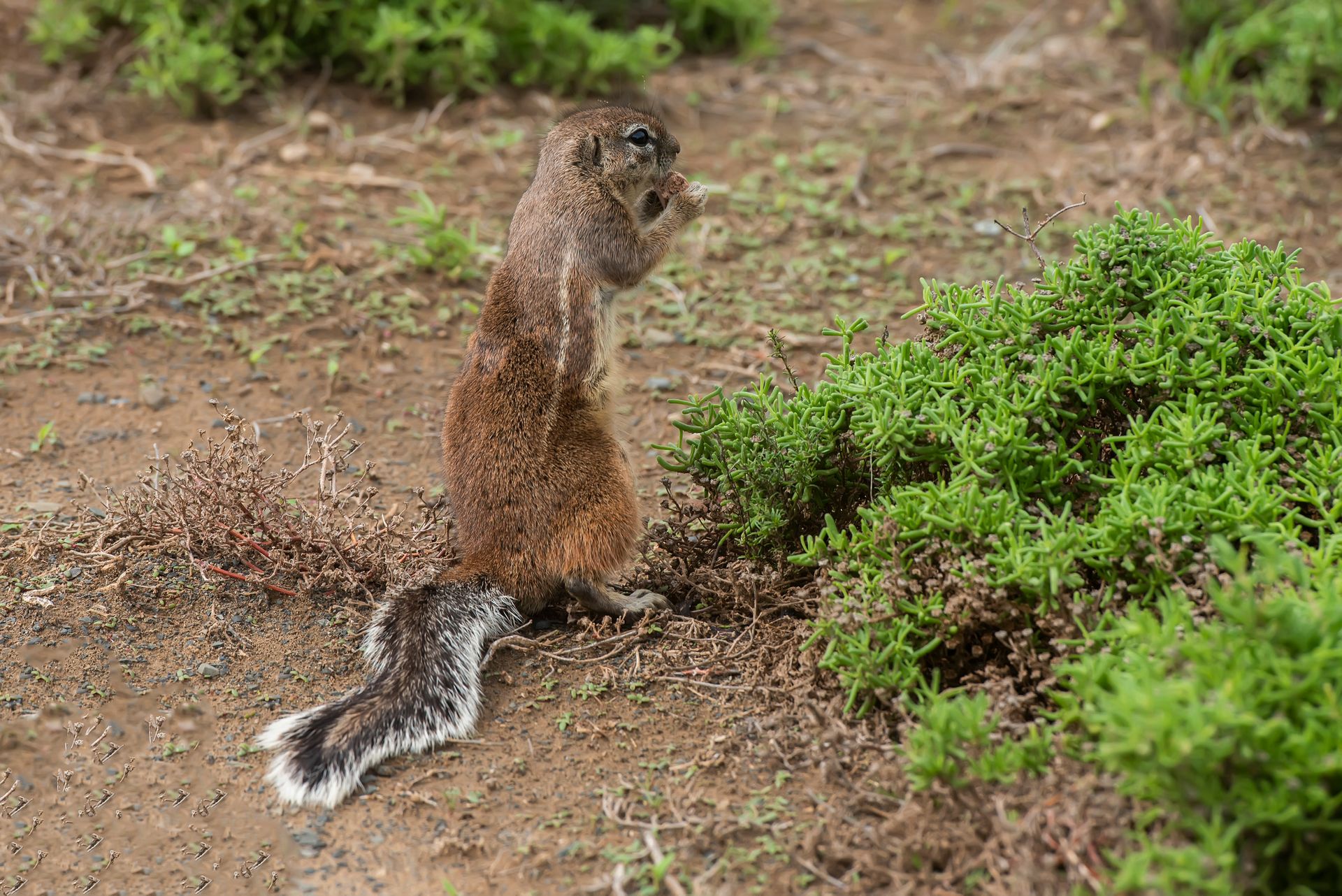
Their fur is long and soft, with a reddish-brown color on their upperparts and an off-white belly. Some springhares even have a black tip on their tail and black ear tips.
Young springhares have finer and fluffier fur, and often have black patches of fur under their hind feet and near their tail base.
Here are some key physical characteristics of the south african springhare:
- Body length: 35-45 cm (excluding tail)
- Tail length: 37-48 cm
- Shoulder height: 30 cm (when sitting on hind legs)
- Ears length: 7-9 cm
- Pelage: thin, soft, and long with no underfur
Taxonomy and Etymology
The springhare's scientific name, Pedetes capensis, has a fascinating history. The generic name Pedetes comes from the Greek word Πηδητές (Pidités), meaning "leaper or dancer".
In 1822, William John Burchell named the springhare in English, deriving the name "springhare" from the Afrikaans name springhaas. This name stuck, and the species was later officially recognized as P. capensis.
Related reading: Ancylostoma Caninum Common Name
The species was originally named Yerbua capensis by Johann Reinhold Forster in 1778, but this name didn't stick. It was later renamed Dipus cafer by Johann Friedrich Gmelin in 1788, placing it in the jerboa family.
The genus Pedetes was created by Caroli Illigeri in 1811, when the species was renamed Pedetes cafer. This was a significant step in the springhare's scientific classification.
Habitat and Distribution
Springhares live in areas with sandy, dry soil.
They can also be found in areas of cattle grazing and cultivation of crops such as wheat, oats, and barley.
Their homes are underground tunnels that they dig themselves.
Springhares are found in the south of Zaire, Kenya, and South Africa.
Some populations are also located in East Africa.
Behavior and Ecology
Springhares are nocturnal animals, foraging during the night and retreating to a burrow during the day.
They sleep standing up in their burrows, with their head and forelimbs bent down in between their hindlegs, and their tail wrapped around their feet.
Springhares have a variety of predators, including humans, and at least 21 species prey on them in the Kalahari.
Conservation and Classification
The south African springhare is a fascinating creature, and understanding its conservation status and classification can help us appreciate it even more. The IUCN lists the springhare as vulnerable due to a 20% decrease in population over the last ten years, primarily caused by intense hunting and habitat loss.
One key factor contributing to the springhare's vulnerability is its reliance on specific habitats, which are being destroyed or degraded. The springhare inhabits sub-Saharan Africa, south of 30 degrees north, and Madagascar, where it must adapt to harsh desert environments with low and unpredictable rainfall.
The springhare's classification is just as interesting. Here's a breakdown of its taxonomic hierarchy:
- Kingdom: Animalia
- Phylum: Chordata
- Class: Mammalia
- Order: Rodentia
- Family: Pedetidae
- Genus: Pedetes
- Species: Pedetes capensis
Conservation Status
The springhare's conservation status is a pressing concern. It's listed as vulnerable by the IUCN due to a 20% decline in population over the last decade.
Habitat loss and intense hunting are the main culprits behind this decline. The springhare's home in sub-Saharan Africa and Madagascar is being threatened.
The IUCN Red List categorizes the springhare as Least Concern, but this contradicts the current vulnerable status. There is a discrepancy here that needs to be addressed.
The US Federal List and CITES list do not provide any special status for the springhare. This lack of protection is concerning.
Here's a summary of the springhare's conservation status:
- IUCN Red List: Vulnerable
- IUCN Red List: Least Concern (contradictory)
- US Federal List: No special status
- CITES: No special status
Classification
Classification is a crucial step in understanding the complexity of the natural world. The South African spring hare, for instance, is classified under the kingdom Animalia.
The classification of the South African spring hare breaks down into several levels, each providing more specific information about its characteristics and traits. The phylum Chordata is the next level of classification, which includes animals with a backbone.
Vertebrata is a subphylum within Chordata, and it's here that we find animals with backbones, including the South African spring hare. Mammalia is the class that includes all mammals, and Rodentia is the order that includes rodents, which includes the South African spring hare.
Explore further: Animals Smarter than Dogs
The family Pedetidae is the next level of classification, which includes the springhare and its relatives. The genus Pedetes is the level that groups together species that share similar characteristics, and the species Pedetes capensis is the most specific level of classification, which includes the South African spring hare.
Here's a breakdown of the classification levels for the South African spring hare:
- Kingdom: Animalia
- Phylum: Chordata
- Subphylum: Vertebrata
- Class: Mammalia
- Order: Rodentia
- Family: Pedetidae
- Genus: Pedetes
- Species: Pedetes capensis
Traditional Uses and Facts
The San and baTswana people have traditionally hunted springhares for their meat, which can yield up to 1360 g (3 lb.) of edible flesh.
They also use springhare skins to make various items like bags, mats, karosses (garments or blankets made from sewn animal skins), and hats. The tail provides sinew for sewing, and an ornamental belt that produces sounds can be made by tying springhare toes on a string.
Springhares are not considered a threatened species, as they are listed as "least concern" on the IUCN Red List.
Traditional Human Uses
Springhares have been a valuable resource for traditional communities in Southern Africa. The San and BaTswana people have been hunting springhares for their meat, which can yield up to 1360g or 3lb.
The San people use springhare skins to make a variety of items, including bags, mats, karosses, and hats. They also use the skin to make an ornamental belt that produces sounds by tying the springhare toes on a string.
The tail of the springhare provides sinew for sewing, which is a valuable resource for traditional craftspeople.
Facts
Springhares are fascinating creatures, and here are some interesting facts about them.
The scientific name for the springhare is Pedetes capensis.
Springhares are relatively small, with males weighing between 3-4 kg.
Females also weigh between 3-4 kg.
The body length of both males and females is quite similar, ranging from 36-43 cm.
Here's a quick comparison of the physical characteristics of springhares:
Frequently Asked Questions
What does South African springhare eat?
South African springhares primarily feed on plant stems, roots, sprouts, herbs, and fruit. They also venture further in search of food and water during severe droughts.
What is a Springhare in Afrikaans?
In Afrikaans, a Springhare is known as a "springhaas". This term is used to refer to the Pedetes capensis, a medium-sized rodent native to South Africa.
What are the predators of Springhare?
Springhares are preyed upon by various predators, including jackals, lions, snakes, mongooses, owls, and eagles. They can jump up to 3m in a single leap, but their impressive jumping ability doesn't protect them from these predators.
Featured Images: pexels.com