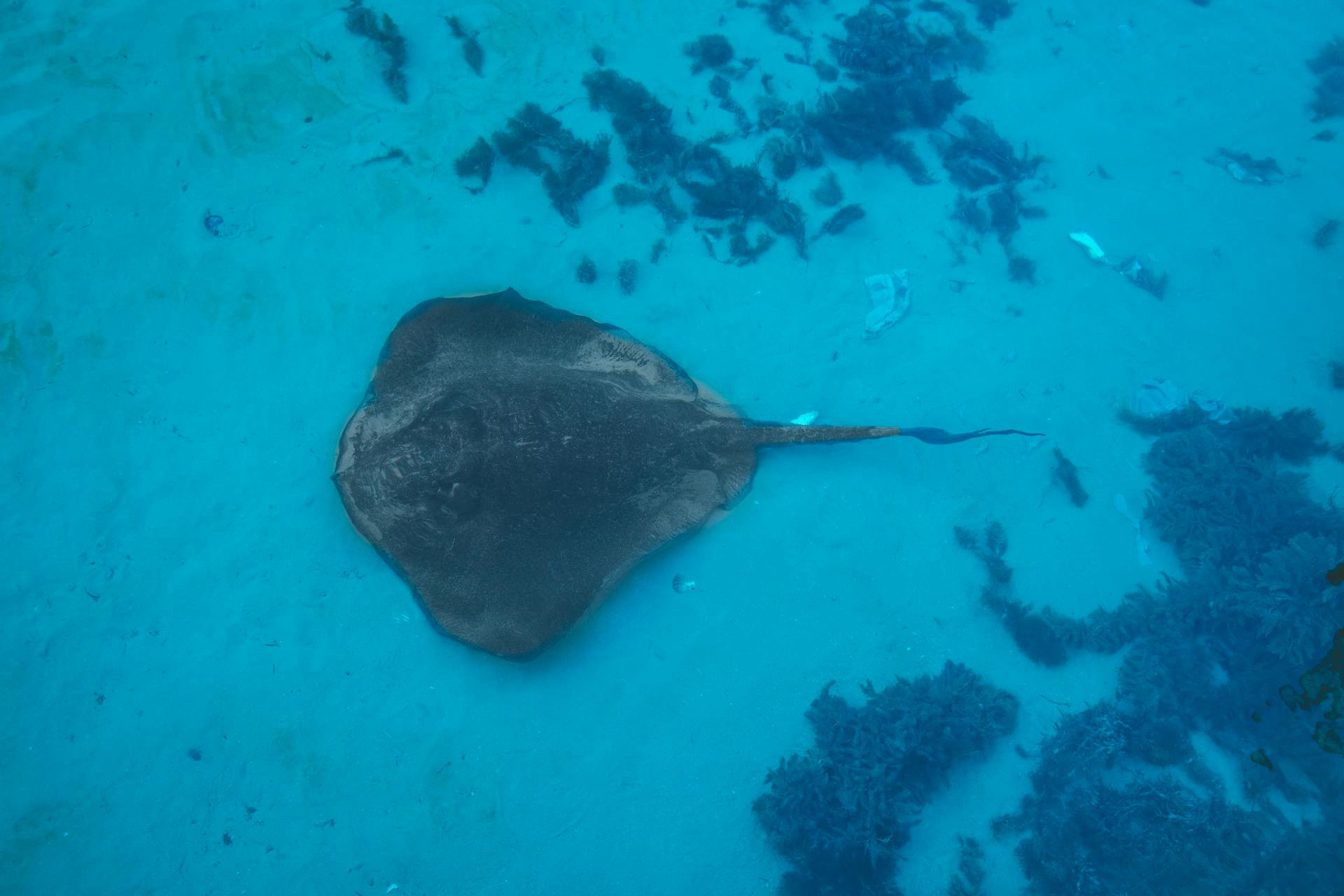
The short tail stingray is a fascinating creature. It's found in the coastal waters of the Indo-Pacific region, from Japan to Australia and Indonesia.
These stingrays can grow up to 1.5 meters in width and weigh up to 230 kilograms. They have a distinctive short tail and a flat, round body.
Short tail stingrays are nocturnal, meaning they're most active at night when their prey is more active. They use their electroreceptors to navigate and find food in the dark waters.
In the wild, short tail stingrays can live up to 20 years, but their lifespan in captivity is often shorter due to various health issues.
Physical Characteristics
Short-tail stingrays are the largest rays in the world, with males reaching up to 4.3 m long and 3 m wide.
Their bodies are shaped like an oblong disc or a blunt diamond, with a smooth texture except for their tails. The tails are skinny and serrated, averaging 22 cm long, and are venomous.
The eyes of short-tail stingrays are small and medial lateral to each other, indicating they are diurnal but have a preference for nocturnal activity. This is due to the low amount of cones in their retina, with a ratio of rods to cones being 10:1.
They have 10 gill slits, positioned in diagonal lines, and form an incomplete "V" shape. These gill slits are located closest to their mouths.
Here are some key physical characteristics of short-tail stingrays:
- Range mass: 350 (high) kg, 770.93 (high) lb
- Range length: 1.09 to 4.3 m, 3.58 to 14.11 ft
Their tails are made of cartilage and contain a neurotoxin that consists of phosphodiesterases, 5’ nucleotidases, serotonin, and other proteins. This venom is used for defense and can be deadly to humans.
The pelvic fins of short-tail stingrays are somewhat large and rounded at the tips. They have a unique pattern of teeth, with 45-55 densely arranged teeth, which are small, blunt, and conical.
Habitat and Distribution
The short-tail stingray is a fascinating creature that can be found in a variety of habitats, from shallow bays to deep ocean banks.
Its distribution is quite extensive, with records from southern Africa, Australia, New Zealand, and even Japan. In fact, it's been reported from Cape Town in South Africa to the Zambezi River in Mozambique, and from Shark Bay in Western Australia to Maroochydore in Queensland, including Tasmania.
The short-tail stingray is commonly found in temperate waters, but it can also be found in tropical waters. It's a bottom-dwelling creature, inhabiting a range of environments including brackish estuaries, sheltered bays and inlets, sandy flats, rocky reefs, and the outer continental shelf.
In southern Africa, it's rare in shallow water, preferring to stay over offshore banks at a depth of 180 to 480 m (590 to 1,570 ft). However, off Australia and New Zealand, it's found from the intertidal zone to no deeper than 156 m (512 ft).
Here's a breakdown of its typical habitats:
- Brackish estuaries
- Sheltered bays and inlets
- Sandy flats
- Rocky reefs
- Outer continental shelf
It's worth noting that the short-tail stingray is not a long-distance migrant, with a study in New Zealand showing that two rays moved to deeper waters in winter but didn't travel far.
Biology and Behavior
The short-tail stingray is a slow-moving creature, but it can suddenly burst into speed, flapping its fins so hard that it makes a loud "bang" sound in the water.
These rays are known to gather in large groups at certain times of the year, such as every summer at the Poor Knights Islands off New Zealand. They often gather under rocky archways.
Individual rays tend to stay in a small area, usually within 25 kilometers (16 miles) of their home. They have a special sensing system on their underside that helps them find tiny water movements made by buried clams or worms.
The short-tail stingray looks for food both during the day and at night, feeding primarily on bony fishes and invertebrates that live on the bottom. They also eat fish and invertebrates that live in open water.
Some of the short-tail stingray's predators include the copper shark, the smooth hammerhead, the great white shark, and the killer whale.
Related reading: Limber Tail in Labradors
Biology and Ecology
The short-tail stingray is a fascinating creature that can be found in various parts of the world. They are slow-moving, but can suddenly burst into speed, flapping their fins so hard that it makes a loud "bang" sound in the water.
These rays are known to gather in large groups at certain times of the year, a famous example being every summer (January to April) at the Poor Knights Islands off New Zealand. They often gather under rocky archways, and in some places, they move into very shallow water when the tide comes in.
Individual rays tend to stay in a small area, usually within 25 kilometers (16 miles) of their home. They can sense magnetic fields, which may help them navigate in nature.
The short-tail stingray forages for food both during the day and at night, primarily eating bony fishes and invertebrates that live on the bottom, such as molluscs and crustaceans. They have a special sensing system on their underside that helps them find tiny water movements made by buried clams or worms.
Here are some of the short-tail stingray's favorite foods:
- Bony fishes
- Invertebrates that live on the bottom, such as molluscs and crustaceans
- Fishes and invertebrates that live in open water
- Squid eggs (off South Africa)
The short-tail stingray has few predators due to its large size, but some animals that might hunt it include the copper shark, the smooth hammerhead, the great white shark, and the killer whale. When it feels threatened, it raises its tail over its back like a scorpion as a warning.
Intriguing read: What Does a Cat Do When It Loses Its Tail?
Predation
Short-tail stingrays have a few clever tricks up their sleeve to avoid predators. They use lateral lines to detect water movement and avoid predation.
Other animals that prey on short-tail stingrays include sharks and killer whales. These predators are a serious threat to stingrays, which is why they need to be so careful.
Short-tail stingrays also use cryptic camouflage to evade predators and sneak up on their own prey. This is a clever adaptation that helps them survive in the wild.
Some common parasites that associate with short-tail stingrays include monogeneans and tapeworms. Here are some specific examples:
- Monogenean Dendromonocotyle tsutsumii
- Monogenean Heterocotyle tokoloshei
- Tapeworm Acanthobothrium adlardi
- Tapeworm Dollfusiella ocallaghani
- Tapeworm Eutetrarhynchus ocallaghani
- Tapeworm Prochristianella mooreae
- Tapeworm Pterobothrium lintoni
- Tapeworm Pterobothrium platycephalum
- Tapeworm Rhinebothrium dasyatidis
- Tapeworm Trimacracanthus aetobatidis
- Isopod Gnathia
If you ever encounter a stingray, be careful not to get stung by its venomous tail. The venom can be lethal to humans, and it's only used as a defensive measure.
Identification and Special Features
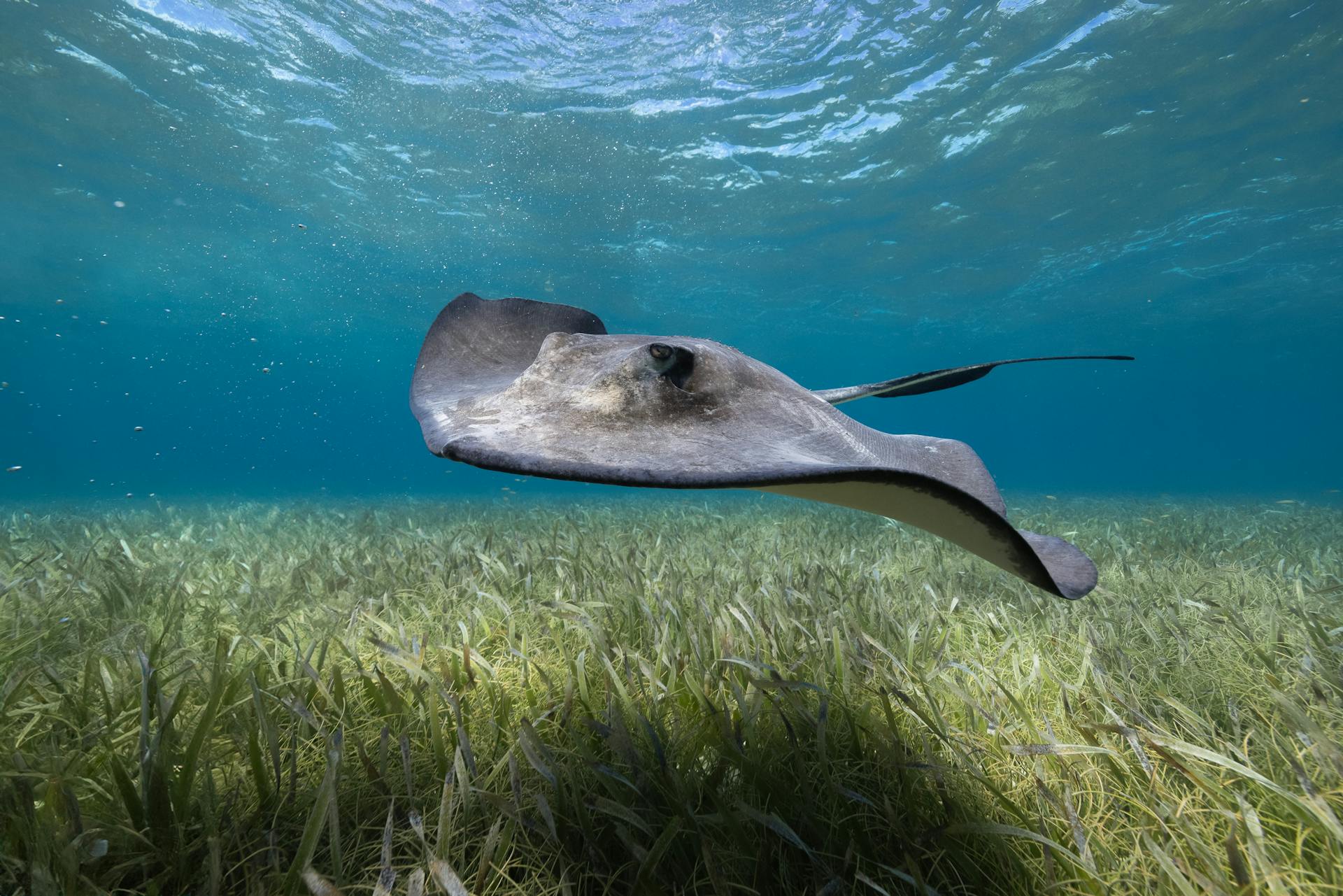
The short-tail stingray is a large and impressive creature, with a diamond-shaped body and a blunt, angular snout.
Its tail is stocky with two stinging barbs, and is shorter than the total length of the stingray as an adult. The tail is usually shorter than the body, and has one, or sometimes two, stinging spines with jagged edges on top.
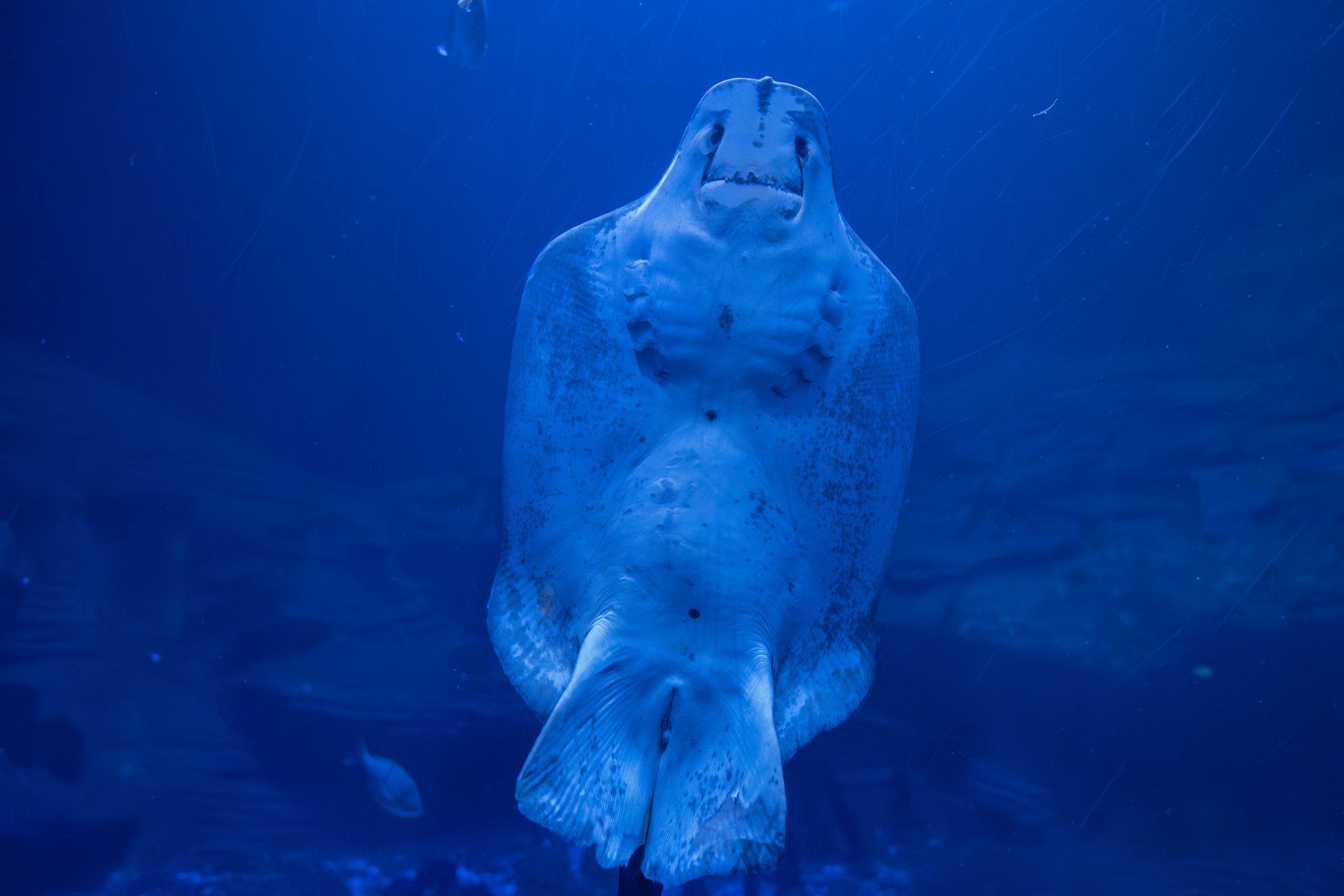
The short-tail stingray's body is grayish-brown on top, getting darker towards the tip of the tail and above the eyes. The underside of the ray is whitish, and some individuals have even been seen with an albino coloration, meaning they are completely white.
Its pectoral fins are somewhat large and rounded, and the ray has a row of large, spear-like thorns or flat bumps along the middle of the tail in front of the sting. The tail has a clear fin-like fold underneath and a small ridge on top.
The short-tail stingray can grow to be at least 2.1 meters (6.9 feet) wide, 4.3 meters (14 feet) long, and weigh 350 kilograms (770 pounds).
Conservation and Danger
Short-tail stingrays are listed as a species of "Least Concern" on the IUCN Red List, but they were of concern in 1994 due to overfishing.
Main threats to short-tail stingrays include predators like sharks and killer whales, and commercial fishing. Boats can also harm them, and people on boats sometimes fish for stingrays for food.
Regulations exist in some areas to control human tourism and short-tail stingray harvesting, but captive breeding programs have had difficulty reproducing and not harming their mates.
Conservation Efforts
Protecting and encouraging breeding and nursery grounds would be an act of conserving short-tail stingrays.
Conservation
The short-tail stingray is listed as Least Concern on the IUCN Red List, but its popularity as a gamefish in some regions poses a significant threat to its population.
In Western Australia, short-tail stingrays are protected from recreational fishing in certain areas, and in South Africa, anglers are restricted to catching only one chondrichthyan species per day.
In New Zealand, parts of the country represent the core distribution of the short-tail stingray, and it is a prohibited species in those areas.
The IUCN Red List is a global union of states, governmental agencies, and non-governmental organizations that assesses the conservation status of species.
Here's a summary of the short-tail stingray's conservation status:
- IUCN Red List: Least Concern
- US Federal List: No special status
- CITES: No special status
- State of Michigan List: No special status
Main threats to the short-tail stingray include predators like sharks and killer whales, as well as commercial fishing.
Danger to Humans
When interacting with stingrays, it's essential to exercise caution due to their barbed tail spines. These spines can inflict severe wounds.
The short-tail stingray is known to raise its tail when approached, which is often mistaken for aggression. However, this behavior is usually inquisitive.
The barbed tail spines can be fatal in some cases, making handling this species extremely risky.
Consider reading: Cats Wag Tail When Angry
General Information
The short tail stingray is a fascinating creature. They are found in tropical and subtropical waters around the world, including the Indo-Pacific region and the coastal waters of Australia.
These stingrays are relatively small, typically growing to a maximum length of about 2 feet. They have a distinctive short tail and a flat, round body.
Short tail stingrays are nocturnal, meaning they are most active at night. This is likely due to their preference for hunting in the dark.
Common Names
The short-tail stingray has a variety of common names in different languages.
English language common names include the short-tail stingray, bull ray, and giant stingray.
In Dutch, the stingray is known as the gladde pijlstaartrog.
Other languages have their own unique names for this species, such as the isokeihäsrausku in Finnish and the pastinaca in Italian and Spanish.
The stingray is also referred to as the peitschenrochen in German and the pigrokke in Danish.
Take a look at this: Short Names for Dog
What is a Stingray?
A stingray is a type of flatfish found in oceans worldwide. They have a distinctive body shape with a long, flat tail that they use for swimming and defense.
The short-tail stingray, for example, has a short tail, which is a key characteristic that distinguishes it from other stingrays. It's also known as the giant black ray or giant stingray.
Stingrays are closely related to other types of rays, such as the pitted stingray, which is smaller than the short-tail stingray. They were first studied by scientists like Frederick Hutton, who described the short-tail stingray in 1875.
Explore further: Giant Schnauzer with Tail
Contents
The short-tail stingray is a fascinating creature, and understanding where to find information about them can be just as interesting.
The article is organized into several sections, starting with "What is a Short-Tail Stingray?" which provides an introduction to this species.
In the "How to Identify a Short-Tail Stingray" section, you'll learn the characteristics that distinguish them from other stingrays.
Short-tail stingrays can be found in various locations, which are detailed in the "Where Short-Tail Stingrays Live" section.
Their behavior and diet are also discussed in the "Short-Tail Stingray Behavior and Diet" section, where you'll discover what they like to eat and how they interact with their environment.
Finally, the "Short-Tail Stingrays and Humans" section explores the relationship between these creatures and humans, which is essential for conservation and coexistence.
Here's a quick rundown of the sections:
- "What is a Short-Tail Stingray?" - An introduction to the species
- "How to Identify a Short-Tail Stingray" - Characteristics that distinguish them from other stingrays
- "Where Short-Tail Stingrays Live" - Locations where they can be found
- "Short-Tail Stingray Behavior and Diet" - What they eat and how they interact with their environment
- "Short-Tail Stingrays and Humans" - The relationship between these creatures and humans
Range and Location
Short-tail stingrays can be found in a wide range of habitats, from shallow bays and estuaries to rocky reefs and the open seabed.
They occur in both brackish and marine waters, and are distributed throughout temperate waters of the Indo Pacific, including South Africa, southern Australia, New Zealand, Japan, and eastern Russia.
Short-tail stingrays are found in the Indian Ocean, off the coasts of Australia and New Zealand, and along the African coast, south of the Tropic of Capricorn.
Their breeding grounds and nurseries are concentrated on the northwestern side of Poor Knights Island, New Zealand.
The short-tail stingray is common and widely distributed in the temperate waters of the Southern Hemisphere, with records from Cape Town in South Africa to the mouth of the Zambezi River in Mozambique.
It's found from Shark Bay in Western Australia to Maroochydore in Queensland, including Tasmania, and off North Island and the Chatham Islands in New Zealand.
Short-tail stingrays are bottom-dwellers in temperate waters, found on the seafloor in harbors, coastal bays, large inlets, and coastal reefs.
They typically inhabit areas with depths around 150 m, and as deep as 476 m, sometimes found in underwater caves and under large overhangs.
Here's a breakdown of their range and location:
- Geographical Range: Indian Ocean, off the coasts of Australia and New Zealand, and along the African coast, south of the Tropic of Capricorn.
- Depth Range: 0 to 476 m (0 to 1561.68 ft)
- Average Depth: 150 m (492.13 ft)
- Habitat Regions: Temperate, tropical, saltwater or marine
- Aquatic Biomes: Pelagic, benthic, reef, coastal
- Other Habitat Features: Caves
Frequently Asked Questions
How venomous is a short-tail stingray?
The short-tail stingray's venom is highly potent and can cause serious, even fatal, injuries due to its long and penetrating sting. Its venomous sting is capable of causing necrosis, making it a species to approach with caution.
How does a short-tail stingray attack?
A short-tail stingray attacks by using its powerful tail to inflict deep wounds with its backward-facing barbs. These barbs can tear through flesh like a sharp knife, causing serious injury.
How big can a short-tail stingray get?
The short-tail stingray can grow up to 170 inches in total length and weigh over 772 pounds, making it one of the largest stingrays in the world.
Featured Images: pexels.com