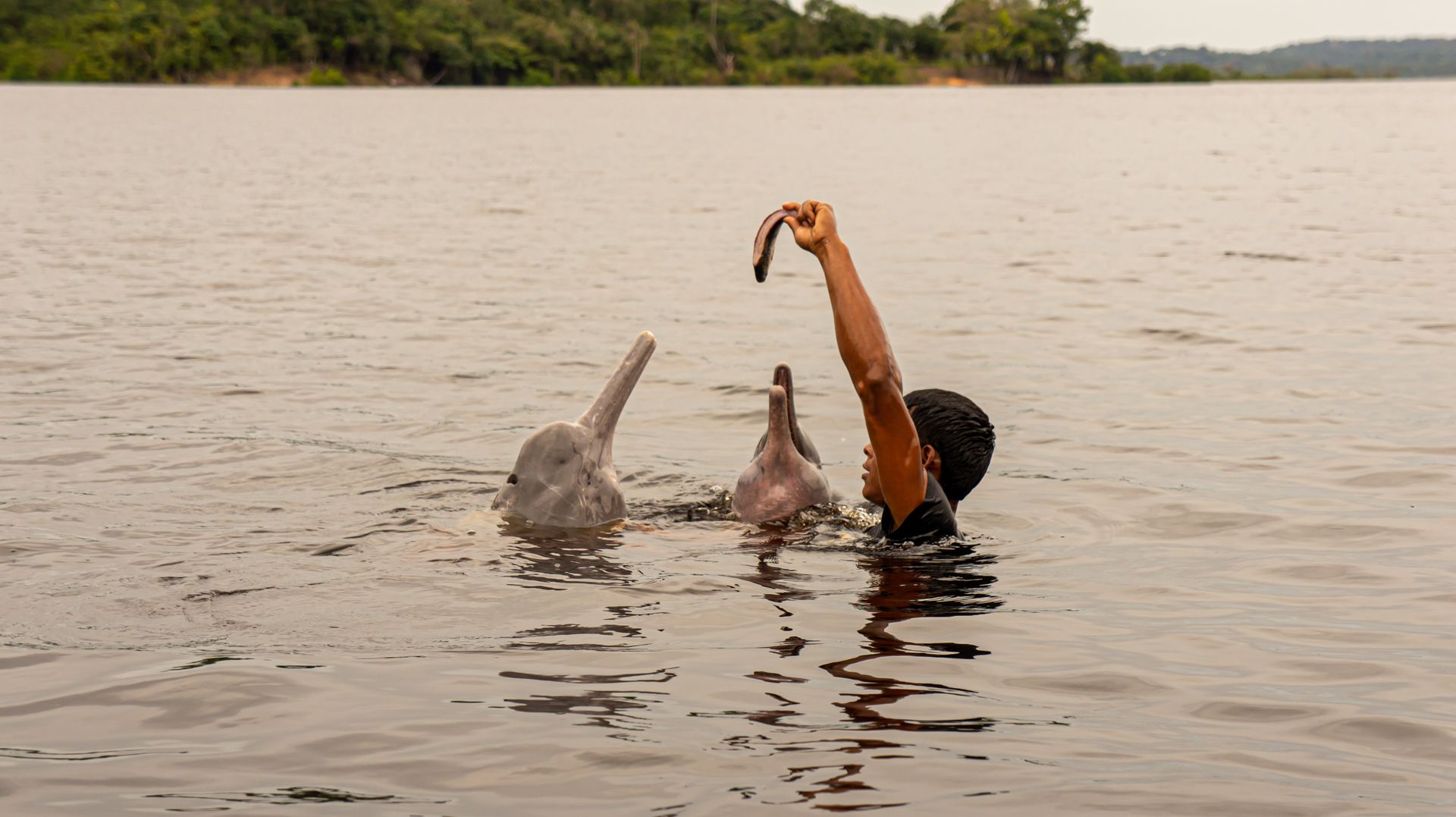
The rough-toothed dolphin is a unique and fascinating creature. It's a member of the oceanic dolphin family and can be found in warm and temperate waters around the world.
These dolphins are known for their distinctive rough-toothed jaws, which are thought to be an adaptation for eating tough, cartilaginous prey. They are also skilled hunters, using echolocation to catch fish and squid.
One of the most interesting things about rough-toothed dolphins is their social behavior. They are highly social creatures that often live in large groups, called pods, which can number in the hundreds.
You might enjoy: Spade Toothed Beaked Whales
Physical Characteristics
Rough-toothed dolphins can reach up to 8.5 feet in length and weigh about 350 pounds.
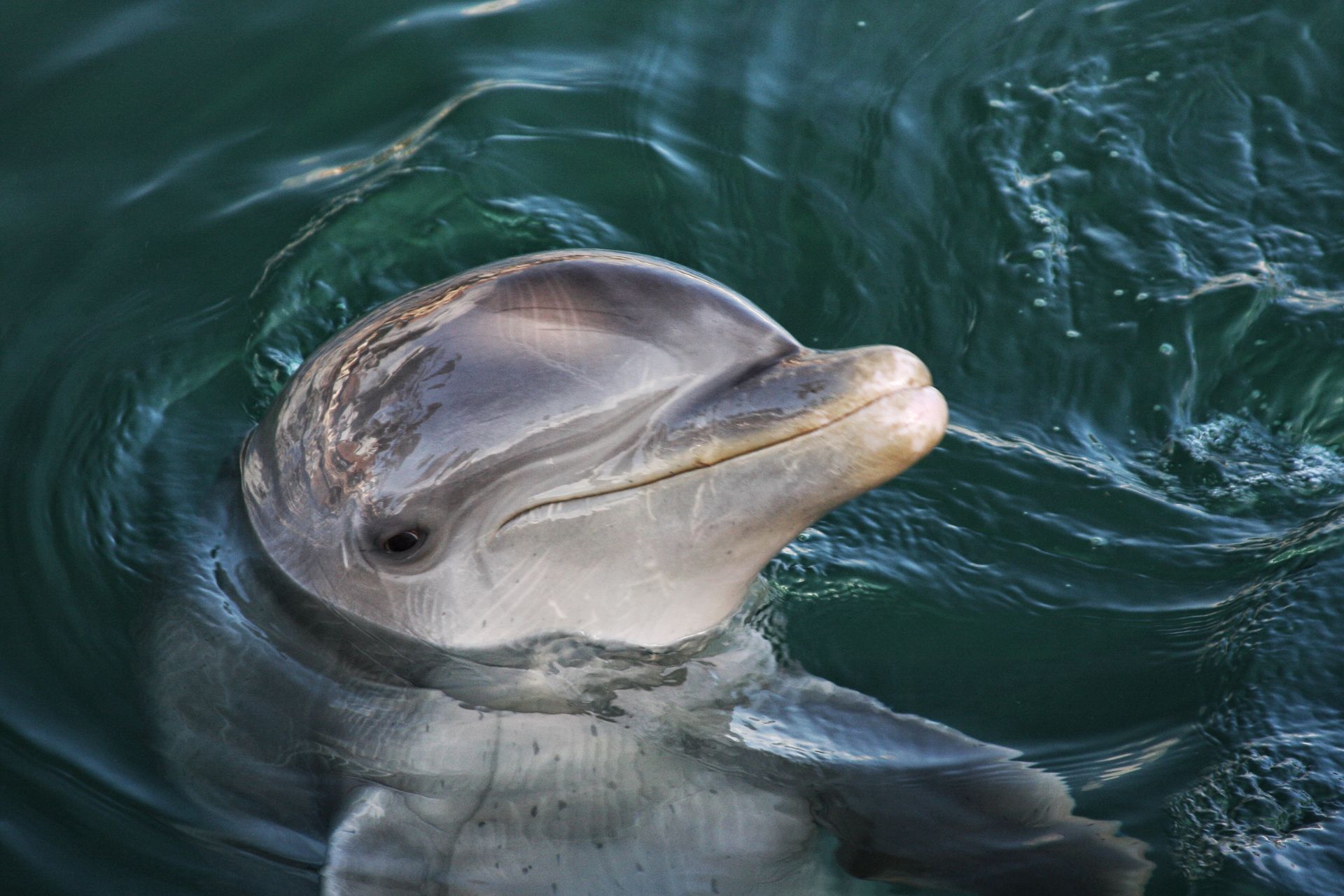
They have a small head with a long rostrum and no demarcation between their gently sloping melon and rostrum. Their dorsal fin and pectoral fins or flippers are distinctively large.
Rough-toothed dolphins have dark gray bodies with a white throat and “lips.” They also have a narrow dark cape that runs down their back between the blowhole and dorsal fin.
Their underside usually has some white or lighter spots or blotches. They can also have some pink tinge on their belly.
The flippers of rough-toothed dolphins are fairly long and large. The dorsal fin is tall and only slightly curved or hooked.
Explore further: Are Spade Toothed Whales Extinct
Behavior and Habitat
Rough-toothed dolphins live in deep oceanic waters throughout tropical and warmer temperate areas of the world. They can be found in all the world's major oceans, including the Atlantic, Pacific, and Indian Oceans.
In these deep waters, they prefer areas with lots of available prey, which is usually found offshore beyond the continental shelf. However, in some areas like Brazil and Honduras, they can be found in shallow coastal waters.
Rough-toothed dolphins are social animals and are often found in tight-knit groups of approximately 10 to 20 individuals. In Hawaii, they are found in smaller groups of on average three individuals and a median group size of seven.
For more insights, see: Dolphins Toxic
Behavior and Diet
Rough-toothed dolphins are usually found in tight-knit groups of approximately 10 to 20 individuals.
They often associate with other cetacean species, including short-finned pilot whales, bottlenose dolphins, pantropical spotted dolphins, and spinner dolphins.
Their group size can vary, with a median group size of seven in Hawaii, and they're rarely observed in larger groups of up to 100 individuals.
In Hawaii, they're often found in smaller groups of on average three individuals.
Rough-toothed dolphins have a flexible diet, but seem to particularly like eating large fish such as mahi-mahi (or dorado) that live at the surface.
They also eat houndfish, smelt, squids, and octopuses.
Animal Habitats
Rough-toothed dolphins can be found in the Atlantic, Pacific, and Indian Oceans, which cover all the world's major oceans. They prefer areas with abundant prey and are typically found offshore, beyond the continental shelf.
These dolphins thrive in deep oceanic waters, often in tropical and warmer temperate areas. The main factor determining their preferred habitat is the availability of food.
Rough-toothed dolphins can also be found in shallow coastal waters, such as in Brazil and Honduras, where there is an abundance of prey. However, this is not their typical habitat.
They are generally found in the Atlantic, Indian, and Pacific Oceans from 40° North to 35° South. This range indicates their adaptability to different oceanic environments.
In some areas, rough-toothed dolphins can be seen in small pods, usually consisting of 6-10 individuals, often in the company of other dolphin species.
Explore further: Atlantic Spotted Dolphin Lifespan
Approaching Boat off Kaua'i
As you approach a boat off Kaua'i, keep an eye out for rough-toothed dolphins, which are known to inhabit these waters.
Their long, white-coloured beak is a distinctive feature, smoothly blending into the sloping forehead.
The body of a rough-toothed dolphin is black to dark grey on the back and light grey and white on the belly, sometimes tinged with pink.
These dolphins have fairly long and large flippers, which they use to propel themselves through the water.
Be on the lookout for white, uneven splotches and white, circular scars left by cookiecutter shark bites, which are a common sight on their bodies.
Related reading: Sable and White Rough Collie
Distribution and Conservation
Rough-toothed dolphins are protected by NOAA Fisheries, which oversees marine mammal health and stranding response to ensure their well-being.
NOAA Fisheries also addresses ocean noise, a significant threat to these dolphins.
To educate the public about rough-toothed dolphins and the threats they face, NOAA Fisheries engages in public outreach and education efforts.
Here are some key actions taken by NOAA Fisheries to protect rough-toothed dolphins:
- Overseeing marine mammal health and stranding response
- Addressing ocean noise
- Educating the public about rough-toothed dolphins and the threats they face
Conservation & Management
Conservation efforts are underway to protect rough-toothed dolphins. Organizations like WDC work to stop dolphin hunts and end captivity, creating a safer environment for these animals.

NOAA Fisheries is also committed to their protection, overseeing marine mammal health and stranding response. This involves monitoring the health of rough-toothed dolphins and responding to strandings.
To address the threats they face, NOAA Fisheries is educating the public about rough-toothed dolphins and the dangers of ocean noise. By spreading awareness, we can all do our part to help these incredible creatures.
Here are some key actions being taken to protect rough-toothed dolphins:
- Stop dolphin hunts
- End captivity
- Oversee marine mammal health and stranding response
- Address ocean noise
- Educate the public
Videos in Hawai'i
Videos in Hawai'i are a rare treat, and we're lucky to have captured some footage of rough-toothed dolphins in their natural habitat.
We occasionally collect video footage of rough-toothed dolphins as part of our field work in Hawai‘i – you can view some of our videos below!
Scientific and Management Information
NOAA Fisheries oversees marine mammal health and stranding response to protect rough-toothed dolphins.
Their research projects have discovered new aspects of rough-toothed dolphin biology, behavior, and ecology, helping to better understand the challenges they face.
Scientists at NOAA Fisheries conduct various research activities on the biology, behavior, and ecology of rough-toothed dolphins, using the results to inform management decisions for this species.
Their research includes stock assessments, monitoring population abundance and distribution, and population assessments to track trends in the population.
Here are some of the specific research activities being conducted by NOAA Fisheries on rough-toothed dolphins:
- Stock assessments
- Monitoring population abundance and distribution
- Population Assessments
Your Help
You can make a real difference in the lives of rough-toothed dolphins by supporting organizations like WDC.
By stopping dolphin hunts, you can help prevent the killing of these amazing creatures.
End captivity to ensure rough-toothed dolphins are treated with the respect and care they deserve.
Creating healthy seas is crucial for the well-being of rough-toothed dolphins and their habitats.
Preventing bycatch is a vital step in protecting rough-toothed dolphins from getting caught in fishing nets and lines.
Here are some ways you can get involved:
- Support organizations like WDC
- Spread awareness about the importance of protecting rough-toothed dolphins
- Make eco-friendly choices to reduce your impact on the ocean
Scientific Classification
Scientific classification is a crucial part of understanding the natural world. It's a system used to group living things based on their characteristics and evolutionary relationships.
The most widely used classification system is the Linnaean system, which was developed by Carl Linnaeus in the 18th century. It's a hierarchical system that groups living things into seven main categories.
Kingdoms are the highest level of classification, and there are six kingdoms: Animalia, Plantae, Fungi, Protista, Chromista, and Monera.
Addressing Ocean Noise
Addressing ocean noise is a crucial step in protecting rough-toothed dolphins. NOAA Fisheries is taking steps to address this issue.
Underwater noise pollution is a significant threat to rough-toothed dolphins. It can cause temporary or permanent hearing loss, as well as disrupt their feeding, communication, and orientation behaviors.
NOAA Fisheries is investigating the effects of sound on whale behavior and hearing. They've even issued marine mammal acoustic technical guidance for assessing the effects of human-caused sound on marine mammals' hearing.
In 2016, NOAA Fisheries issued technical guidance for assessing the effects of human-caused sound on marine mammals' hearing. This guidance is a crucial tool for protecting rough-toothed dolphins and other marine mammals.

Underwater noise can cause rough-toothed dolphins to strand and die. NOAA Fisheries is working to address this issue and protect these dolphins.
Here's a summary of the key actions NOAA Fisheries is taking to address ocean noise:
- Overseeing marine mammal health and stranding response
- Addressing ocean noise
- Educating the public about rough-toothed dolphins and the threats they face
Population Monitoring
Population monitoring is a crucial aspect of understanding rough-toothed dolphin populations. Scientists observe these dolphins to record their numbers and distribution.
By comparing numbers collected over multiple years, scientists can look for trends in population abundance and distribution. This helps identify whether the population is increasing, decreasing, or remaining stable.
Population assessments are a key part of this process, allowing researchers to understand the size and health of the population. Marine Mammal Permits and Authorizations also play a role in monitoring populations.
Here are some of the ways scientists monitor population abundance and distribution:
- Population Assessments
- Marine Mammal Permits and Authorizations
Related Species
The rough-toothed dolphin is part of the Delphinidae family, which also includes the orca and the bottlenose dolphin.
These dolphins are highly social creatures, often found in large groups called pods, similar to the social behavior of the bottlenose dolphin.
The rough-toothed dolphin's diet consists mainly of fish, squid, and crustaceans, just like the bottlenose dolphin.
Their unique name comes from their distinctive teeth, which are rough and triangular in shape, a characteristic shared with the orca.
Dolphin Information
Rough-toothed dolphins are generally found in tight-knit groups of 10 to 20 with seemingly strong social structure.
They have large brains and are believed to be one of the most intelligent dolphin species.
Groups as large as 140 to 160 have been seen near Hawaii and in the Mediterranean.
Rough-toothed dolphins are highly sociable and frequently mix and travel with other oceanic dolphins.
They prefer warm and deep ocean, physically reaching up to 2.8 meters long and up to 150kg.
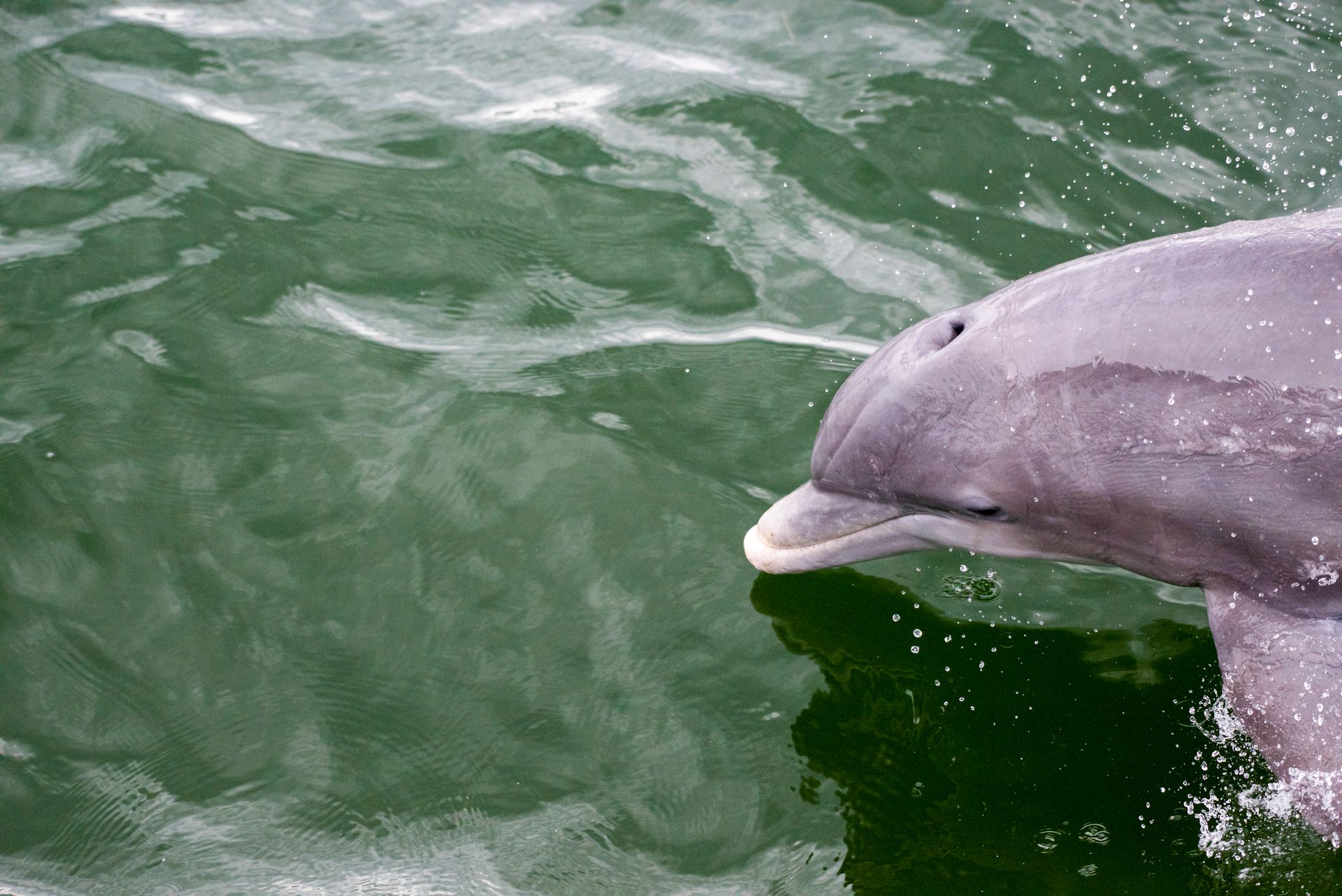
Unique to the Rough-toothed dolphin is their sloping forehead, slender beak and ridged teeth.
Older individuals often have white or pink patches along their jaws and bellies.
Rough-toothed dolphins are found in tropical and temperate seas throughout most of the world.
They are not a well-researched species, but they are often observed hunting and socialising with other cetacean species.
They typically are found offshore in seas of at least 1,000 meters deep.
Rough-toothed dolphins are able to dive underwater for at least 15 minutes at a time.
Featured Images: pexels.com