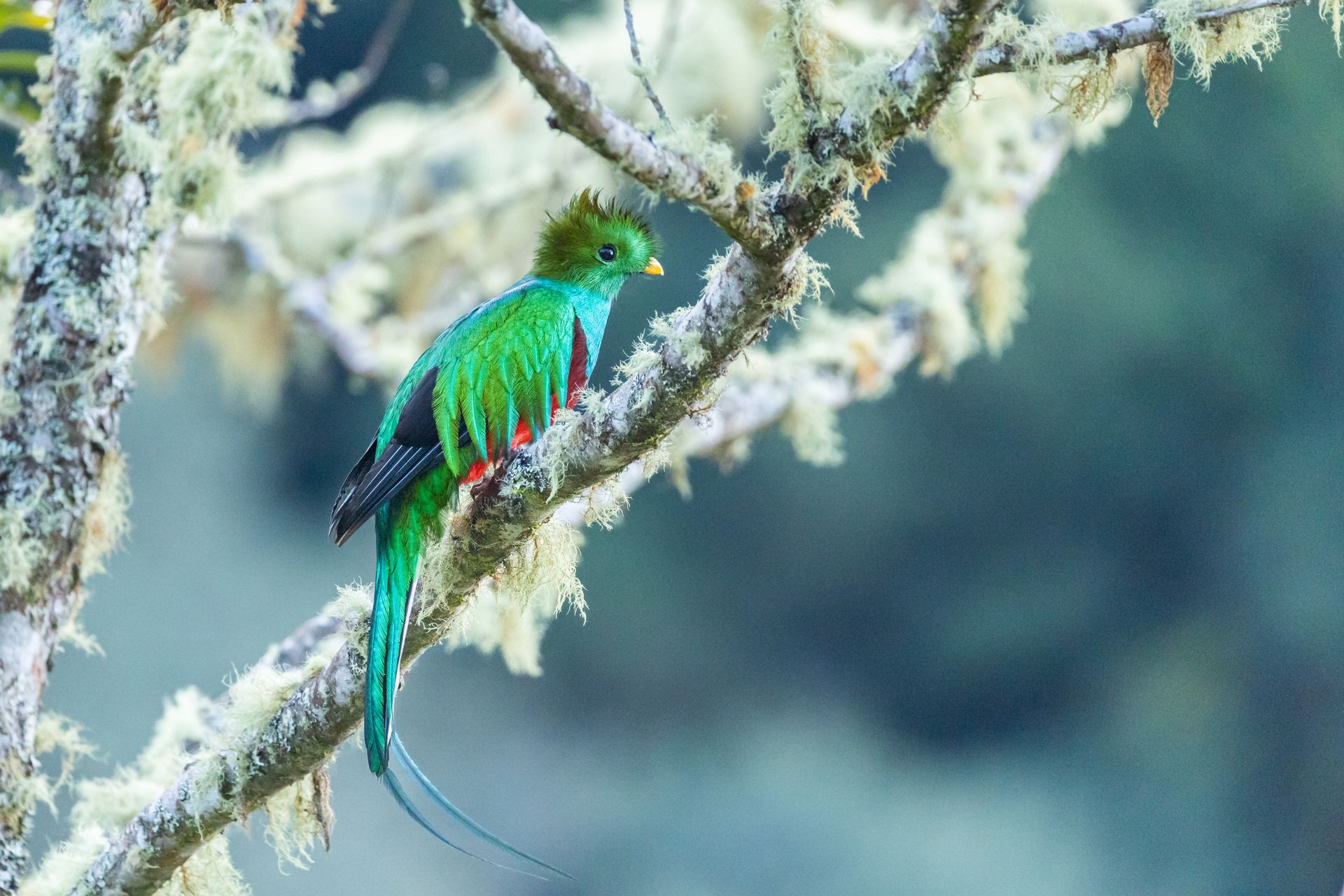
The Resplendent Quetzal is a bird of striking beauty, found in the cloud forests of Central America. It has vibrant green plumage with a long, flowing tail.
These birds are primarily found in the cloud forests of Mexico, Guatemala, Costa Rica, and Panama, where they inhabit the dense foliage of the forest canopy.
The Resplendent Quetzal is a solitary bird, only coming together with others of its species during breeding season.
Worth a look: Resplendent Quetzal Feathers
Taxonomy
The resplendent quetzal's taxonomy is a fascinating topic. The bird was first described by Mexican naturalist Pablo de La Llave in 1832.
The resplendent quetzal is one of five species of the genus Pharomachrus, commonly known as quetzals. The name "quetzal" actually comes from Nahuatl (Aztec), where it means "tall upstanding plume" or "quetzal tail feather".
The genus name Pharomachrus refers to the bird's physical characteristics, with "pharos" meaning "mantle" and "makros" meaning "long" in Ancient Greek. This is a testament to the bird's unique and striking appearance.
There are two recognized subspecies of the resplendent quetzal: P. m. mocinno and P. m. costaricensis. However, there is an ongoing debate about whether costaricensis should be recognized as a distinct species.
Here's a list of the recognized subspecies of the resplendent quetzal:
- P. m. mocinno
- P. m. costaricensis
Distribution and Habitat
The resplendent quetzal can be found in the lush vegetation of high-elevation rainforests, typically between 900-3,200 meters above sea level.
These birds inhabit the canopy and subcanopy of the rainforest, as well as ravines and cliffs, where they often live in decaying trees, stumps, and abandoned woodpecker hollows.
The resplendent quetzal's vibrant colors are expertly camouflaged by the surrounding rainforest, making them a challenging but rewarding sighting for birdwatchers.
The species can be found from southern Mexico to western Panama, with two subspecies, P. m. mocinno and P. m. costaricensis, having distinct ranges separated by the Nicaraguan depression.
During the breeding season, quetzals migrate from their lower montane rainforest habitats to the pre-montane rainforest on the Pacific slopes for three to four months, before crossing the continental divide to the Atlantic slopes.
The abundance of quetzals in their mating areas is correlated with the total number of fruiting species, although the relationship with fruiting Lauraceae species is less significant.
On a similar theme: Dangerous Animals in Brazil Rainforest
Behavior and Breeding
The resplendent quetzal is a shy bird that tends to display quiet behavior to avoid predators, but it becomes rather vocal during mating season.
Resplendent quetzals are monogamous territorial breeders, with males taking on a significant role in incubating eggs and caring for their young.
Their breeding season varies depending on the location, but it generally takes place from March to June, with both males and females involved in all aspects of breeding.
In the cloud forests of Central America, resplendent quetzals are common and can be seen feeding on fruits, especially little avocados from the laurel family, which they play a crucial role in dispersing.
Both parents take turns incubating eggs, with the male generally incubating during the day and the female at night, and they both care for the young after they fledge at three weeks of age.
Expand your knowledge: Florida Wild Turkey Season
Behavior
Resplendent quetzals are generally shy and quiet, displaying this behavior to elude predators.
Their known predators include the ornate hawk-eagle, golden eagle, and other hawks and owls as adults, along with emerald toucanets, brown jays, long-tailed weasels, squirrels, and kinkajous as nestlings or eggs.
Resplendent quetzals are rather vocal during the mating season, and their behavior is designated to exhibit and attract mates.
They play an important ecological role in the cloud forests, helping disseminate the seeds of at least 32 tree species.
To spot quetzals in their natural habitat, it's best to visit early in the morning, just after sunrise, when the forest is cooler and the light is softer.
Breeding
Resplendent quetzals create their nests over 200 feet up in the air, and they have a specific courtship ritual in the air with distinct calls.
The quetzal's vocal calls are a key part of their behavior, with six specific calls recorded, including the two-note whistle, gee-gee, and coouee whistle, which is a mating call.
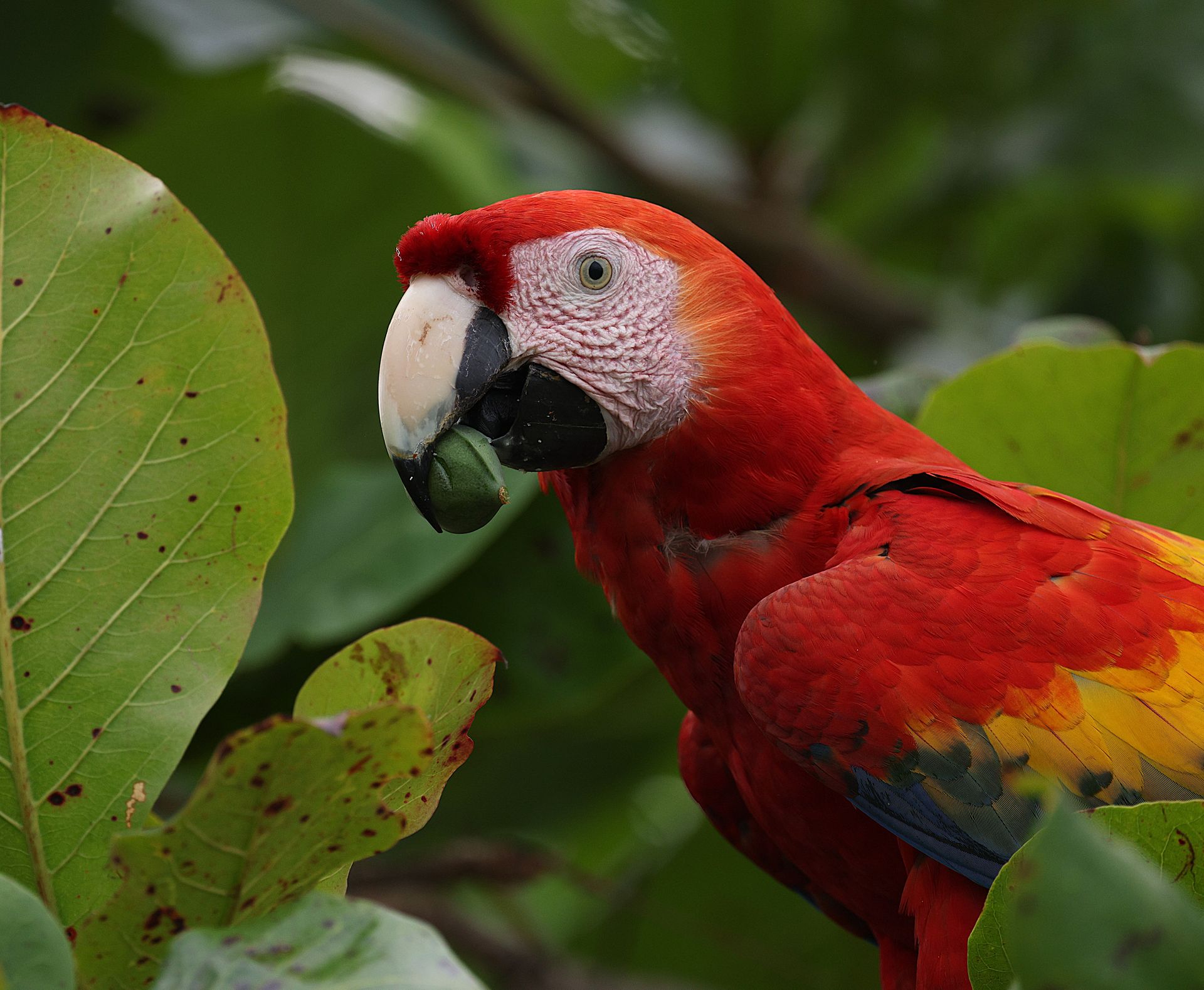
Resplendent quetzals are monogamous territorial breeders, with a territory size of 6-10 ha in Guatemala, and they breed seasonally, with different breeding seasons in different countries, from March to April in Mexico, May to June in El Salvador, and March to May in Guatemala.
The female lays one to three pale blue eggs in a nest placed in a hole carved in a rotten tree, and the quetzal tends to lay two clutches per year.
Both parents take turns incubating the eggs, with the male generally incubating during the day and the female at night.
The incubation period lasts about 17 to 19 days, and when the eggs hatch, both parents take care of the young, feeding them fruits and insects.
Nestlings are often neglected by females near the end of the rearing period, leaving it up to the male to continue caring for the offspring until they are ready to survive on their own.
The male gives more food, especially insects, to the young, and young quetzals begin flying after a month, but their distinctive long tail feathers take three years to develop in males.
Discover more: Three Dog Night Origin
Conservation Status
The resplendent quetzal's population trend varies between subpopulations, but it's generally decreasing, although some populations may be increasing or stable.
Its estimated population is between 20,000 and 49,999 individuals, which is why it's classified as near threatened on the IUCN Red List.
Deforestation, forest fragmentation, and agricultural clearing are the main threats to the quetzal's habitat, making it hard for the species to survive.
The quetzal is also hunted for food and trapped for illegal trading, which adds to its decline.
Cloud forests, the quetzal's habitat, are one of the most threatened ecosystems in the world, but the species can be found in several protected areas.
Breeding the quetzal in captivity was thought to be impossible, but scientists have discovered that the bird's susceptibility to iron can be managed with tannic acid and a special diet.
Some zoos, like the Miguel Álvarez del Toro Zoo in Tuxtla Gutiérrez, Chiapas, have successfully kept and bred the quetzal in captivity since 2004.
On a similar theme: Eastern Gray Squirrel Population Distibution Pattern
In Culture and Significance
The resplendent quetzal is a bird of great cultural significance, particularly in Guatemala, where it's the national bird and appears on the country's coat of arms.
In pre-Columbian Mesoamerican civilizations, the quetzal was associated with Quetzalcoatl, the feathered-serpent god of life, light, knowledge, and the winds. Its scintillating green tail feathers were venerated by the Aztec and Maya.
The Maya also regarded the quetzal as representative of freedom, due to the difficulty of keeping them in captivity, and with wealth, as its feathers were used as a medium of exchange. In ancient Mayan culture, quetzal feathers were considered so precious that they were used as a medium of exchange.
One Mayan legend has it that a resplendent quetzal accompanied the hero, Tecún Umán, prince of the Quiché (K'iche') Maya, during his battle against Spanish conquistador Pedro de Alvarado. Tecún Umán's battle against Alvarado is still remembered today.
The quetzal's cultural significance extends beyond Guatemala, as it's also revered in Aztec and Mayan cultures. In these cultures, the quetzal was forbidden to be killed, and instead, its tail feathers were removed and it was set free.
If this caught your attention, see: Xoloitzcuintli Aztec Art
Here are some key facts about the cultural significance of the resplendent quetzal:
- Associated with Quetzalcoatl, the feathered-serpent god of life, light, knowledge, and the winds.
- Representative of freedom and wealth in Mayan culture.
- Used as a medium of exchange in ancient Mayan culture.
- Forbidden to be killed in Aztec and Mayan cultures.
- Pictured on the coat of arms of Guatemala.
Quetzal Bird Facts
The Resplendent Quetzal is a bird like no other, and here are some fascinating facts about it.
It's the only bird on earth with the word "resplendent" in its common name. This is a pretty unique distinction, don't you think?
Young males take up to three years to grow their long tail feathers to the full length. This is a remarkable process that requires patience and dedication.
The Aztec and Mayan cultures considered Quetzal tail feathers as symbols of wealth and even used them as currency. This highlights the bird's importance in these ancient cultures.
Resplendent Quetzals make altitudinal migrations outside of the breeding season, where they presumably seek out food at lower elevations. This is a clever strategy to ensure their survival.
In several Mesoamerican languages, the word "quetzal" means sacred, erected, or precious. This speaks to the bird's revered status in these cultures.
On a similar theme: What Is Maleficent's Bird's Name?
Costa Rica and Habitat
Costa Rica is home to one of the largest populations of resplendent quetzals in Central America, thanks to strong forest protection efforts. This makes it a great place to spot one in the wild, especially during the right season.
The quetzal's favorite habitat is the misty cloud forest at high elevations, where the dense and humid vegetation creates the perfect environment for them to thrive. They can be found in areas with lush vegetation, specifically in trees that make up the canopy and subcanopy of the rainforest.
The quetzal prefers to live in decaying trees, stumps, and abandoned woodpecker hollows, which are often hidden from view by the dense foliage of the rainforest. This makes them difficult to spot, but the reward is well worth the effort.
In Costa Rica, you can find resplendent quetzals in areas where their favorite fruit trees grow, such as in the lower montane rainforest and the pre-montane rainforest on the Pacific slopes. They migrate to these areas from their breeding areas in the lower montane rainforest for three to four months, from July to October.
The quetzal's abundance in its mating areas is correlated with the total number of fruiting species, which is why Costa Rica's cloud forests provide an ideal habitat for them. With the right conditions and a little luck, you might just spot one of these stunning birds in the wild.
For more insights, see: Costa Rica Dangerous Wildlife
Spotting and Planning
Spotting a resplendent quetzal in the wild can be a thrilling experience, but it requires some planning and insider knowledge. You don't necessarily need a guide to spot a quetzal, but having one can make a huge difference, especially if it's your first time birdwatching in Costa Rica.
Certified local guides know the forest intimately and are trained to recognize bird calls, movement in the canopy, and behavior patterns that most visitors would miss. They can also help you spot and identify other incredible species along the trail, like toucans, hummingbirds, motmots, frogs, and even sloths or monkeys.
The best time to spot a quetzal depends on the season. While they live in Costa Rica year-round, your chances of spotting one increase during certain seasons. The resplendent quetzal tends to stay hidden, especially when not breeding, so knowing the right time to visit makes a big difference.
If you're planning to visit Mistico Park, it's essential to book an early morning tour. This is when birds are most active, and the forest is at its quietest. You'll also want to bring binoculars or a camera with a zoom lens, as quetzals often perch high in the canopy.
Explore further: Manzanillo Wildlife Refuge Costa Rica
Here are some tips to improve your chances of seeing a resplendent quetzal:
- Bring binoculars or a camera with a zoom lens: Quetzals often perch high in the canopy, so good optics can make all the difference.
- Dress in layers and neutral colors: Early mornings can be cool, and neutral tones help you blend in with your surroundings.
- Book an early morning tour: This is when birds are most active, and the forest is at its quietest.
- Stay quiet and move slowly: Quetzals are shy and easily spooked, so patience and stillness often lead to the best sightings.
- Go with a certified guide: A qualified tour guide knows where to look and what to listen for and can spot movement in the trees that’s easy to miss.
Spotting a quetzal can be a magical moment, but it's essential to remember that they are considered near threatened due to habitat loss across their range. Costa Rica is one of the few places where their population is still relatively stable, thanks to strong forest protection efforts.
Scientific and General Information
The resplendent quetzal is a bird of striking beauty, found in the cloud forests of Central America.
Its vibrant plumage is a sight to behold, with shades of green, blue, and red that seem almost otherworldly.
The resplendent quetzal's diet consists mainly of fruits, insects, and small frogs.
Its long, slender tail is a hallmark of the species, measuring up to 2 feet in length.
This remarkable bird is a symbol of freedom and spirituality in Mesoamerican cultures.
Frequently Asked Questions
How rare is the resplendent quetzal?
The resplendent quetzal is considered near threatened, with a population of 20,000-49,999 individuals, indicating it's a relatively rare species. Its conservation status is a concern, but more information is available on its specific population trends and habitats.
Featured Images: pexels.com